Morocco Water Desalination Equipment Market Size, Share & Growth Rate
The Morocco Water Desalination Equipment Market was estimated at USD 959 Million in 2025 and is projected to reach USD 1377 Million by 2032, growing at a CAGR of 5.3% from 2026 to 2032. This upward trajectory is primarily fueled by the pressing water scarcity issues facing the nation, exacerbated by climate change and population growth. Additionally, the Moroccan government's commitment to enhancing water infrastructure and increasing investments in sustainable desalination technologies further bolsters the market's potential.
Morocco Water Desalination Equipment Market Year-wise Growth Rate and Key Drivers
This graph highlights how the Morocco Water Desalination Equipment Market has steadily grown over the years, supported by major growth factors.
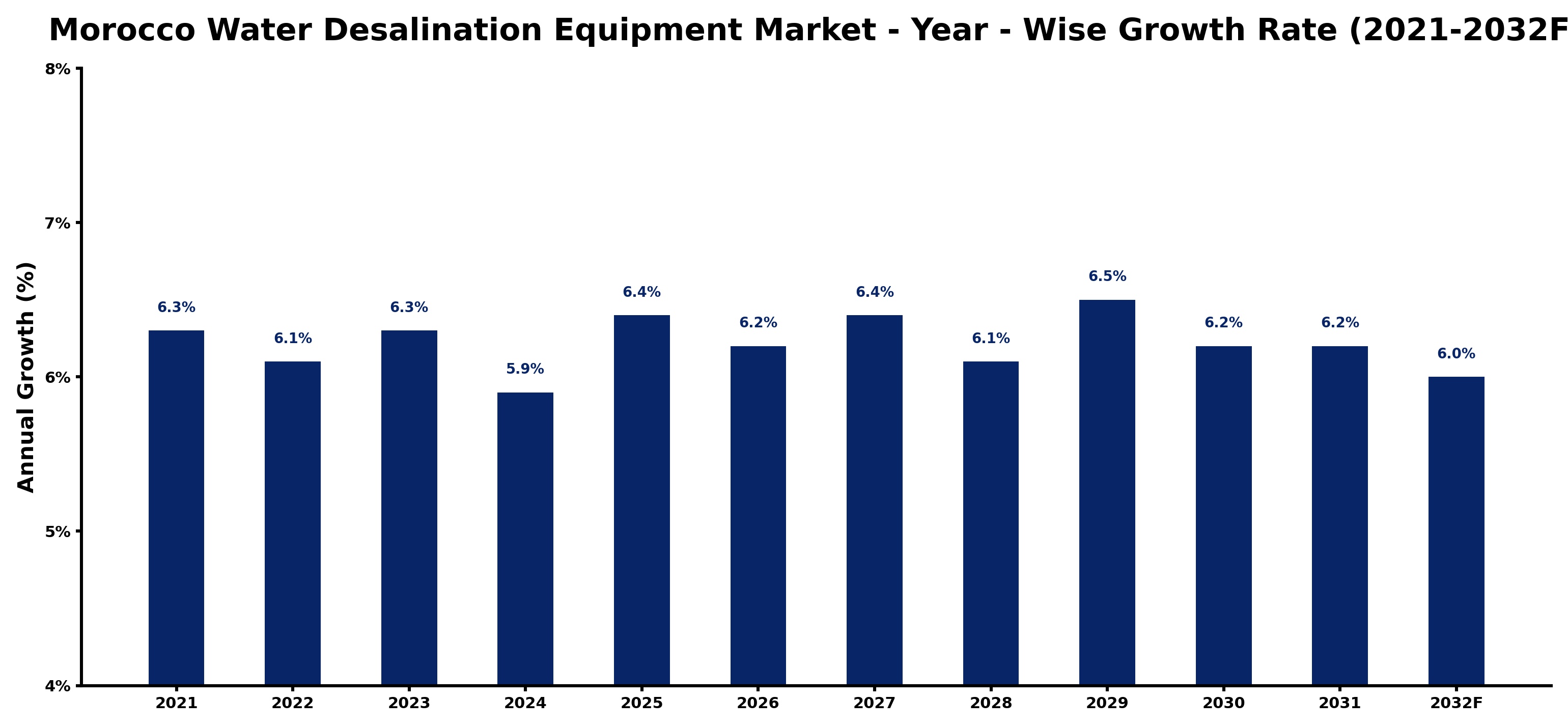
The table below presents the year‑wise growth rates along with the key drivers influencing the market
| Year | Growth Rate | Major Drivers |
| 2021 | 6.3% | Expansion of commercial construction activities |
| 2022 | 6.1% | Increasing adoption of advanced technologies |
| 2023 | 6.3% | Rising electricity demand across industries |
| 2024 | 5.9% | Rising electricity demand across industries |
| 2025 | 6.4% | Increasing adoption of advanced technologies |
| 2026 | 6.2% | Growing renewable energy integration projects |
| 2027 | 6.4% | Increasing smart city development projects |
| 2028 | 6.1% | Growing renewable energy integration projects |
| 2029 | 6.5% | Expansion of manufacturing activities |
| 2030 | 6.2% | Government infrastructure modernization initiatives |
| 2031 | 6.2% | Expansion of manufacturing activities |
| 2032 | 6.0% | Growing urbanization and commercial development |
Note - Market size estimations and growth projections presented in this report are based on 6Wresearch's advanced forecasting approach, validated with industry datasets as of June 2026.
Morocco Water Desalination Equipment Market Synopsis
The urgency to find reliable sources of potable water is driving an intensified focus on desalination technologies in Morocco. With a significant portion of the population reliant on coastal resources, the need for efficient and effective desalination systems is more critical than ever.
Current trends indicate a shift towards energy-efficient and sustainable desalination methods, reflecting growing environmental concerns. As Morocco aims to bolster its water management strategies, collaboration among private, public, and international entities has become paramount in advancing this sector.
Morocco Water Desalination Equipment Market Key Takeaways
- The Moroccan government actively supports the development of desalination technologies through favorable policies and investments.
- Energy-efficient desalination methods are emerging as preferred solutions amidst rising operational costs.
- Public-private partnerships are fostering innovation and growth in the market.
- Decentralized desalination systems are gaining traction to serve remote regions effectively.
- Technological advancements continue to enhance the performance and sustainability of desalination equipment.
Evaluation of Restraints in Morocco Water Desalination Equipment Market
Despite the positive outlook, several factors may inhibit the growth of the Morocco Water Desalination Equipment Market. Chief among these is the high energy consumption associated with desalination processes, which poses both economic and environmental challenges. The considerable electricity required not only escalates operational costs but also raises concerns regarding sustainability and carbon footprint. Additionally, securing consistent and reliable water sources for desalination remains a pressing concern, as do the substantial initial capital expenditures and ongoing maintenance costs that deter potential investments in the sector.
Morocco Water Desalination Equipment Market Trends
The market is witnessing a notable pivot towards sustainable and energy-efficient desalination technologies, particularly through advanced reverse osmosis systems. Moreover, there is a growing focus on decentralized solutions, which cater to remote and underserved areas. Innovative partnerships among government entities, private firms, and international organizations are fueling technological advancements and increasing investment in this vital sector, indicating robust growth potential.
Morocco Water Desalination Equipment Market Opportunities
Investment opportunities in the Morocco Water Desalination Equipment Market are particularly promising. The government's active initiatives to combat water scarcity create fertile ground for innovative desalination solutions tailored to local needs. Companies offering cutting-edge technologies are positioned to capitalize on the increasing demand for fresh water, especially in urban areas experiencing rapid population growth. Collaborations with local authorities and other stakeholders can further enhance market entry strategies and operational efficiencies.
Government Initiatives in the Morocco Water Desalination Equipment Market
The Moroccan government has enacted a variety of policies to facilitate the growth of the water desalination equipment market. These measures include subsidies and financial incentives aimed at attracting investments into desalination projects. Additionally, there is a concerted effort to promote research and development in water technologies. Regulatory frameworks are being established to ensure that desalination operations are sustainable and efficient, reinforcing the government's commitment to addressing water scarcity and enhancing overall water security.
Future Insights of the Morocco Water Desalination Equipment Market
Looking ahead to 2026-2032, the Morocco Water Desalination Equipment Market is set for a robust expansion. The escalating challenges posed by water scarcity, coupled with the government's proactive investment in infrastructure, signals a bright future for this sector. Innovations in desalination technology are expected to contribute significantly to enhanced efficiencies and reduced costs, paving the way for broader adoption of these essential systems across the country.
Morocco Water Desalination Equipment Market Latest Developments (May 2025 - June 2026)
Recent developments in the Morocco Water Desalination Equipment Market indicate a trend towards increasing collaboration between public and private sectors. Efforts are being made to enhance the capacity of existing desalination facilities while exploring new technologies that focus on energy efficiency. Additionally, there are ongoing discussions surrounding potential investments aimed at expanding the country's desalination infrastructure to meet the rising demand for fresh water.
Morocco Water Desalination Equipment Market - Key Attractiveness of the Report
- 10 Years of Market Numbers
- Historical Data Starting from 2022 to 2025
- Base Year: 2025
- Forecast Data until 2032
- Key Performance Indicators Impacting the Market
- Major Upcoming Developments and Projects
Key Highlights of the Report:
- Morocco Water Desalination Equipment Market Outlook
- Market Size of Morocco Water Desalination Equipment Market, 2025
- Forecast of Morocco Water Desalination Equipment Market, 2032
- Historical Data and Forecast of Morocco Water Desalination Equipment Revenues & Volume for the Period 2022-2032F
- Morocco Water Desalination Equipment Market Trend Evolution
- Morocco Water Desalination Equipment Market Drivers and Challenges
- Morocco Water Desalination Equipment Price Trends
- Morocco Water Desalination Equipment Porter's Five Forces
- Morocco Water Desalination Equipment Industry Life Cycle
- Historical Data and Forecast of Morocco Water Desalination Equipment Market Revenues & Volume By Technology for the Period 2022-2032F
- Historical Data and Forecast of Morocco Water Desalination Equipment Market Revenues & Volume By Reverse Osmosis for the Period 2022-2032F
- Historical Data and Forecast of Morocco Water Desalination Equipment Market Revenues & Volume By Multi-Stage Flash (MSF) Distillation for the Period 2022-2032F
- Historical Data and Forecast of Morocco Water Desalination Equipment Market Revenues & Volume By Multi-Effect Distillation (MED) for the Period 2022-2032F
- Historical Data and Forecast of Morocco Water Desalination Equipment Market Revenues & Volume By Others for the Period 2022-2032F
- Historical Data and Forecast of Morocco Water Desalination Equipment Market Revenues & Volume By Source for the Period 2022-2032F
- Historical Data and Forecast of Morocco Water Desalination Equipment Market Revenues & Volume By Seawater for the Period 2022-2032F
- Historical Data and Forecast of Morocco Water Desalination Equipment Market Revenues & Volume By Brackish water for the Period 2022-2032F
- Historical Data and Forecast of Morocco Water Desalination Equipment Market Revenues & Volume By River water for the Period 2022-2032F
- Historical Data and Forecast of Morocco Water Desalination Equipment Market Revenues & Volume By Others for the Period 2022-2032F
- Historical Data and Forecast of Morocco Water Desalination Equipment Market Revenues & Volume By Application for the Period 2022-2032F
- Historical Data and Forecast of Morocco Water Desalination Equipment Market Revenues & Volume By Municipal for the Period 2022-2032F
- Historical Data and Forecast of Morocco Water Desalination Equipment Market Revenues & Volume By Industrial for the Period 2022-2032F
- Historical Data and Forecast of Morocco Water Desalination Equipment Market Revenues & Volume By Others for the Period 2022-2032F
- Morocco Water Desalination Equipment Import Export Trade Statistics
- Market Opportunity Assessment By Technology
- Market Opportunity Assessment By Source
- Market Opportunity Assessment By Application
- Morocco Water Desalination Equipment Top Companies Market Share
- Morocco Water Desalination Equipment Competitive Benchmarking By Technical and Operational Parameters
- Morocco Water Desalination Equipment Company Profiles
- Morocco Water Desalination Equipment Key Strategic Recommendations






































