Morocco Wheat Starch Market Size, Share & Growth Rate
The Morocco Wheat Starch Market was estimated at USD 155 Million in 2025 and is projected to reach USD 218 Million by 2032, growing at a CAGR of 5.0% from 2026 to 2032. This trajectory is primarily fueled by the robust demand for wheat starch across the food and beverage industry, particularly in the production of staple goods like bread and pastries. Furthermore, the surge in consumer preference for gluten-free products and the expanding pharmaceutical and cosmetic sectors are enhancing the market's growth prospects.
Morocco Wheat Starch Market Year-wise Growth Rate and Key Drivers
This graph highlights how the Morocco Wheat Starch Market has steadily grown over the years, supported by major growth factors.
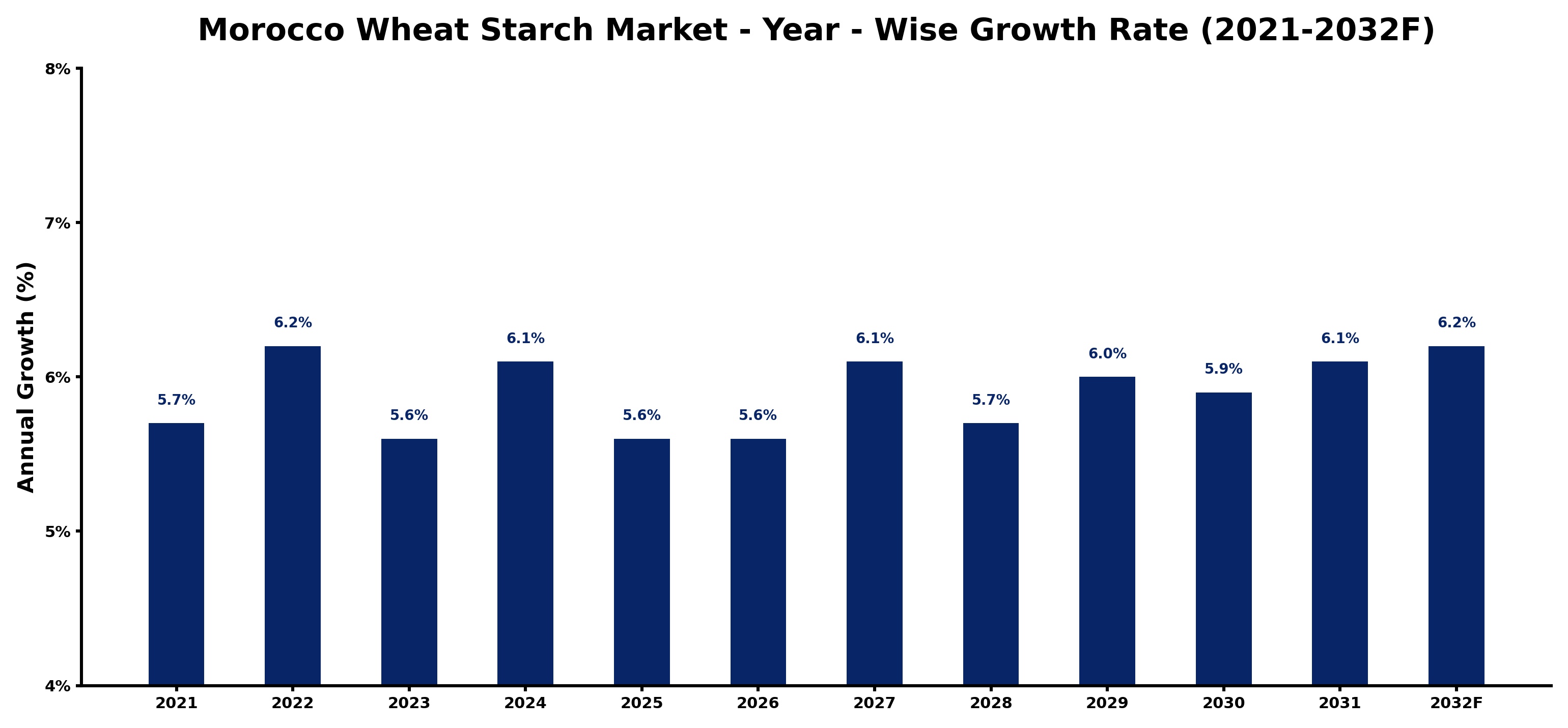
The table below presents the year‑wise growth rates along with the key drivers influencing the market
| Year | Growth Rate | Major Drivers |
| 2021 | 5.7% | Rising demand for gluten alternatives |
| 2022 | 6.2% | Increased health awareness among consumers |
| 2023 | 5.6% | Food processing innovations enhanced quality |
| 2024 | 6.1% | Growing bakery sector expanded usage |
| 2025 | 5.6% | Rising popularity of plant-based diets |
| 2026 | 5.6% | Increased exports to neighboring countries |
| 2027 | 6.1% | Consumer preference for organic products |
| 2028 | 5.7% | Expansion of foodservice sector continued |
| 2029 | 6.0% | Technological advancements improved production |
| 2030 | 5.9% | Sustainability trends boosted market growth |
| 2031 | 6.1% | Diverse applications in food industry |
| 2032 | 6.2% | Emerging markets increased consumption rates |
Note - Market size estimations and growth projections presented in this report are based on 6Wresearch’s advanced forecasting approach, validated with industry datasets as of June 2026.
Morocco Wheat Starch Market Synopsis
In Morocco, the wheat starch market is significantly influenced by its essential role in the food sector, where it acts as a vital ingredient for producing various baked goods. The trend towards convenient, ready-to-eat meals is further elevating the demand for wheat starch as a thickening and stabilizing agent.
On the supply side, both local and international manufacturers are increasingly investing in innovation to meet the evolving consumer preferences for clean label and organic products. The government's push for domestic production is expected to enhance self-sufficiency, thereby positively impacting the market dynamics.
Morocco Wheat Starch Market Key Takeaways
- The market is characterized by steady growth, driven by rising consumer demands in food, pharmaceuticals, and cosmetics.
- Wheat starch is gaining popularity due to its functional properties as a thickening agent in various applications.
- Government policies are aimed at protecting domestic production while supporting quality improvements.
- Investment opportunities exist in production facilities and distribution channels as demand for gluten-free products rises.
- Technological advancements are crucial to overcoming production limitations and enhancing product quality.
Evaluation of Restraints in Morocco Wheat Starch Market
Despite the positive growth outlook, the Morocco Wheat Starch Market faces challenges such as heavy reliance on imported wheat starch, which makes it susceptible to price fluctuations and supply chain vulnerabilities. Limited domestic production capacity further complicates the landscape, hindering the ability to meet rising local demand. Moreover, insufficient technological development and regulatory barriers around food safety and import standards can stifle potential market growth. Addressing these issues through strategic investments and improved infrastructure will be crucial for enhancing market stability.
Morocco Wheat Starch Market Trends
Current trends in the Morocco Wheat Starch Market reflect a growing consumer shift towards gluten-free and natural food products. The increasing awareness of health benefits associated with wheat starch is pushing manufacturers to incorporate it into various food applications, including bakery and processed foods. Additionally, the rise of clean label products indicates a significant consumer preference for transparency and health-conscious choices, prompting suppliers to innovate and diversify their offerings.
Morocco Wheat Starch Market Opportunities
The market presents numerous investment opportunities, particularly in the context of the food processing sector's expansion. As demand for gluten-free and natural ingredients rises, investors can tap into the development of domestic production capabilities for wheat starch. Government initiatives aimed at bolstering the agriculture and food sectors provide a supportive environment for prospective investors, creating pathways for innovative production methods and value-added products that can meet consumer needs.
Government Initiatives in the Morocco Wheat Starch Market
The Moroccan government plays an essential role in shaping the wheat starch market through supportive policies. Import tariffs are strategically imposed to foster domestic production, while subsidies are available to boost the wheat sector's efficiency. Initiatives promoting sustainable agriculture practices and investments in research and development further enhance the quality and competitiveness of local wheat starch production, helping to safeguard consumer interests and stimulate market growth.
Future Insights of the Morocco Wheat Starch Market
Looking ahead to 2026-2032, the Morocco Wheat Starch Market is set to experience notable advancements driven by a continued rise in health-conscious consumer behavior and a burgeoning food processing industry. The government's commitment to improving agricultural practices and promoting sustainability is expected to further enhance wheat production, thus positively affecting the wheat starch market. However, stakeholders must remain vigilant regarding fluctuating wheat prices and the competitive landscape of alternative starch sources to fully leverage growth opportunities.
Morocco Wheat Starch Market Latest Developments (May 2025 - June 2026)
Recent developments in the Morocco Wheat Starch Market indicate a strong push towards product innovation, with manufacturers focusing on the creation of gluten-free and organic wheat starch options to cater to changing consumer preferences. Additionally, strategic partnerships are being formed to enhance distribution networks, thereby improving market accessibility. The emphasis on quality control and meeting international food safety standards is also becoming increasingly prevalent as domestic producers seek to expand their market reach.
Morocco Wheat Starch Market - Key Attractiveness of the Report
- 10 Years of Market Numbers
- Historical Data Starting from 2022 to 2025
- Base Year: 2025
- Forecast Data until 2032
- Key Performance Indicators Impacting the Market
- Major Upcoming Developments and Projects
Key Highlights of the Report:
- Morocco Wheat Starch Market Outlook
- Market Size of Morocco Wheat Starch Market, 2025
- Forecast of Morocco Wheat Starch Market, 2032
- Historical Data and Forecast of Morocco Wheat Starch Revenues & Volume for the Period 2022-2032F
- Morocco Wheat Starch Market Trend Evolution
- Morocco Wheat Starch Market Drivers and Challenges
- Morocco Wheat Starch Price Trends
- Morocco Wheat Starch Porter's Five Forces
- Morocco Wheat Starch Industry Life Cycle
- Historical Data and Forecast of Morocco Wheat Starch Market Revenues & Volume By Type for the Period 2022-2032F
- Historical Data and Forecast of Morocco Wheat Starch Market Revenues & Volume By Native Wheat Starch for the Period 2022-2032F
- Historical Data and Forecast of Morocco Wheat Starch Market Revenues & Volume By Modified Wheat Starch for the Period 2022-2032F
- Historical Data and Forecast of Morocco Wheat Starch Market Revenues & Volume By Grade for the Period 2022-2032F
- Historical Data and Forecast of Morocco Wheat Starch Market Revenues & Volume By Food Grade for the Period 2022-2032F
- Historical Data and Forecast of Morocco Wheat Starch Market Revenues & Volume By Industrial Grade for the Period 2022-2032F
- Historical Data and Forecast of Morocco Wheat Starch Market Revenues & Volume By End-Users Industry for the Period 2022-2032F
- Historical Data and Forecast of Morocco Wheat Starch Market Revenues & Volume By Food and Beverages for the Period 2022-2032F
- Historical Data and Forecast of Morocco Wheat Starch Market Revenues & Volume By Cosmetics for the Period 2022-2032F
- Historical Data and Forecast of Morocco Wheat Starch Market Revenues & Volume By Others for the Period 2022-2032F
- Morocco Wheat Starch Import Export Trade Statistics
- Market Opportunity Assessment By Type
- Market Opportunity Assessment By Grade
- Market Opportunity Assessment By End-Users Industry
- Morocco Wheat Starch Top Companies Market Share
- Morocco Wheat Starch Competitive Benchmarking By Technical and Operational Parameters
- Morocco Wheat Starch Company Profiles
- Morocco Wheat Starch Key Strategic Recommendations






































