Morocco Winding Wire Market Size, Share & Growth Rate
The Morocco Winding Wire Market was estimated at USD 201 Million in 2025 and is projected to reach USD 281 Million by 2032, growing at a CAGR of 4.9% from 2026 to 2032. This growth trajectory is fueled by the robust expansion of the industrial and construction sectors in Morocco, which increasingly rely on high-quality winding wires for a variety of applications. The rising demand for energy-efficient solutions and the burgeoning focus on renewable energy projects further amplify the market's appeal, positioning it as a critical component of the nation's electrification efforts.
Morocco Winding Wire Market Growth Rate Analysis (2021-2032)
The Morocco Winding Wire market has shown stable growth over the past few years, with yearly increases of 5.7% in 2021, rising to 6.1% in 2022, and stabilizing around 5.9% in 2023. This growth can be attributed to rising consumer demand driven by infrastructure projects and the energy transition initiatives, which are creating a need for reliable electrical components. While projections show a slight decline to 5.5% in 2025, subsequent years are expected to regain momentum, with growth rates of 5.6% and 5.8% in 2026 and 2031, respectively. Strategic investments in manufacturing technology and improved supply chain efficiencies have further reinforced this positive trend.
Morocco Winding Wire Market Year-wise Growth Rate and Key Drivers
This graph highlights how the Morocco Winding Wire Market has steadily grown over the past five years, supported by major growth factors.
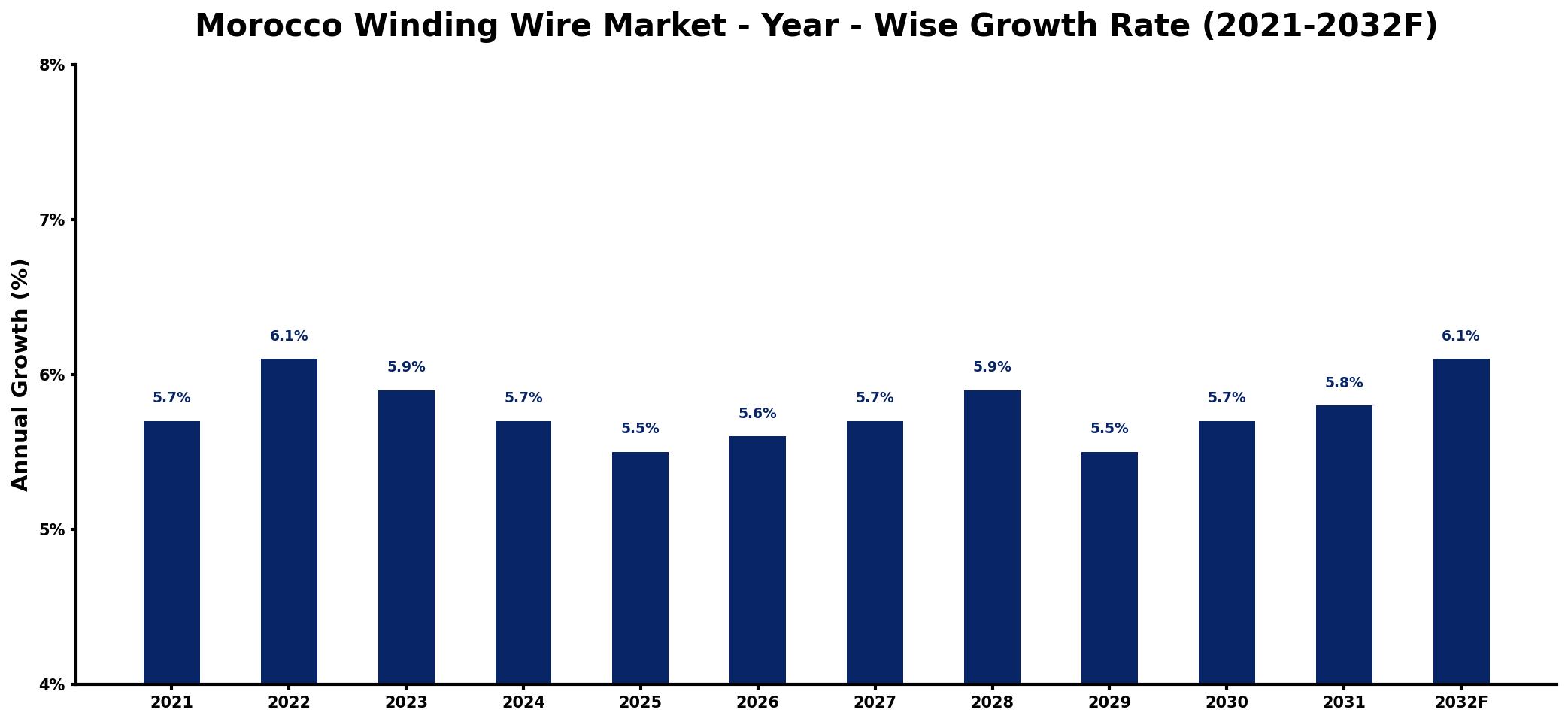
The table below presents the year‑wise growth rates along with the key drivers influencing the market
| Year | Growth Rate | Major Drivers |
| 2021 | 5.7% | Rising demand from construction sector |
| 2022 | 6.1% | Increased investment in renewable energy |
| 2023 | 5.9% | Growth in automotive manufacturing sector |
| 2024 | 5.7% | Expansion of telecommunications infrastructure |
| 2025 | 5.5% | Surge in electric vehicle production |
| 2026 | 5.6% | Growing need for energy efficiency |
| 2027 | 5.7% | Increased focus on industrial automation |
| 2028 | 5.9% | Demand from electronics manufacturing industry |
| 2029 | 5.5% | expanding healthcare application demand |
| 2030 | 5.7% | Rising investments in infrastructure projects |
| 2031 | 5.8% | growing automotive sector requirements |
| 2032 | 6.1% | enhanced product quality standards |
Note: Market size estimations and growth projections presented in this report are based on 6Wresearch's proprietary forecasting methodology, utilizing the latest available industry data, government publications, and primary research inputs.
Morocco Winding Wire Market Synopsis
The Morocco winding wire market is currently witnessing a significant transformation driven by both industrial growth and technological advancements. As key sectors like automotive and electronics expand, the need for superior winding wire solutions is becoming increasingly pronounced.
Moreover, the shift towards copper winding wires is notable, as their conductivity and efficiency surpass that of aluminum alternatives. This trend is indicative of a broader movement within Moroccan industries toward embracing materials that meet modern performance standards while adhering to environmental regulations.
Morocco Winding Wire Market Key Takeaways
- The market is experiencing consistent growth attributed to the expanding industrial and construction sectors.
- Demand for copper winding wires is on the rise, outpacing aluminum due to superior performance.
- Technological innovations are being implemented, including the development of superconducting wires for specialized applications.
- Customization in product offerings is increasing as manufacturers adapt to diverse industry needs.
- Eco-friendly initiatives are becoming essential as companies strive to align with global sustainability standards.
Evaluation of Restraints in Morocco Winding Wire Market
The Morocco winding wire market faces significant constraints primarily stemming from competitive pressures and economic fluctuations. The influx of low-cost imported products poses a challenge for local manufacturers, who must also navigate the volatile prices of essential raw materials like copper and aluminum. Furthermore, the industry grapples with the need for improved technology and automation to enhance productivity, as well as a shortage of skilled labor, which could hinder innovation and operational efficiency. These factors compel companies to adopt strategic measures that focus on quality control and cost management to remain competitive.
Morocco Winding Wire Market Trends
Several noteworthy trends are shaping the Morocco winding wire market landscape. A notable surge in the demand for copper winding wires is being driven by various sectors, including automotive and construction, which require high-performance materials for their applications. Manufacturers are increasingly innovating to create winding wires that meet stringent quality and efficiency standards.
In parallel, there is a distinct shift towards sustainable practices as eco-friendly materials gain traction, influenced by global environmental directives. The ongoing technological developments aimed at superconducting winding wires for niche applications highlight a commitment to advancing product capabilities, ensuring that Moroccan manufacturers remain at the forefront of market innovation.
Morocco Winding Wire Market Opportunities
The Morocco winding wire market is ripe with investment opportunities, particularly due to ongoing infrastructure developments and the escalation of renewable energy projects. As the demand for high-quality electrical components grows, investors can benefit by supporting local manufacturers focused on these segments. Additionally, the potential for technological advancements presents an avenue for companies to introduce innovative products, thereby securing a competitive edge in a dynamic marketplace.
Government Initiatives in the Morocco Winding Wire Market
The Moroccan government is actively promoting the domestic production of winding wires to bolster the local manufacturing sector and reduce import dependence. Policies aimed at encouraging investment in the industry, such as trade tariffs and import restrictions, are being implemented to protect local players. Furthermore, the government is fostering an environment conducive to research and development, encouraging innovation to enhance the quality and competitiveness of Moroccan winding wire products.
Future Insights of the Morocco Winding Wire Market
Looking ahead to 2026-2032, the Morocco winding wire market is set to maintain its upward trajectory, driven by continued industrialization and a burgeoning electrical sector. The increasing demand for energy-efficient and sustainable products will further bolster market growth. Additionally, ongoing investments in infrastructure and renewable energy initiatives are expected to unlock new opportunities for winding wire manufacturers, despite potential challenges related to material price volatility and market competition.
Morocco Winding Wire Market Latest Developments (2025 - 2026)
In the most recent developments within the Morocco winding wire market, there is an observable trend towards increased collaboration among manufacturers focusing on innovation and quality enhancement. New product lines are being introduced to meet the specific needs of various industries, reflecting a greater emphasis on customization. Furthermore, industry players are exploring advanced technologies to improve production efficiencies, which is seen as a crucial step towards maintaining competitiveness in a rapidly evolving market landscape.
Morocco Winding Wire Market - Key Attractiveness of the Report
- 10 Years of Market Numbers
- Historical Data Starting from 2022 to 2025
- Base Year: 2025
- Forecast Data until 2032
- Key Performance Indicators Impacting the Market
- Major Upcoming Developments and Projects
Key Highlights of the Report:
- Morocco Winding Wire Market Outlook
- Market Size of Morocco Winding Wire Market, 2025
- Forecast of Morocco Winding Wire Market, 2032
- Historical Data and Forecast of Morocco Winding Wire Revenues & Volume for the Period 2022-2032F
- Morocco Winding Wire Market Trend Evolution
- Morocco Winding Wire Market Drivers and Challenges
- Morocco Winding Wire Price Trends
- Morocco Winding Wire Porter's Five Forces
- Morocco Winding Wire Industry Life Cycle
- Historical Data and Forecast of Morocco Winding Wire Market Revenues & Volume By Product for the Period 2022-2032F
- Historical Data and Forecast of Morocco Winding Wire Market Revenues & Volume By Copper Winding Wire for the Period 2022-2032F
- Historical Data and Forecast of Morocco Winding Wire Market Revenues & Volume By Aluminum Winding Wire for the Period 2022-2032F
- Morocco Winding Wire Import Export Trade Statistics
- Market Opportunity Assessment By Product
- Morocco Winding Wire Top Companies Market Share
- Morocco Winding Wire Competitive Benchmarking By Technical and Operational Parameters
- Morocco Winding Wire Company Profiles
- Morocco Winding Wire Key Strategic Recommendations






































