Morocco Wood Charcoal Market Size, Share & Growth Rate
The Morocco Wood Charcoal Market was estimated at USD 413 Million in 2025 and is projected to reach USD 561 Million by 2032, growing at a CAGR of 4.5% from 2026 to 2032. This growth trajectory is primarily driven by the increasing demand for natural and sustainable fuel sources for both residential cooking and industrial applications. Furthermore, the popularity of traditional cooking methods, combined with advancements in production technologies, is propelling this market forward.
Morocco Wood Charcoal Market Growth Rate Analysis (2021-2032)
The Morocco wood charcoal market is experiencing a notable decline, with growth rates dropping from 6.9% in 2021 to a projected 3.6% by 2032. Initially, the market benefitted from robust demand, but increasing urbanization and a shift towards alternative energy sources are contributing to this downturn. Infrastructure challenges and policy shifts aimed at promoting cleaner energy are creating pressure on traditional charcoal consumption. Moreover, consumer preferences are gradually changing, leaning towards more sustainable options. As we move further into the decade, market participants will need to adapt to these technological trends and evolving consumer demands to mitigate the declining momentum and explore new opportunities.
Morocco Wood Charcoal Market Year-wise Growth Rate and Key Drivers
This graph highlights how the Morocco Wood Charcoal Market has steadily grown over the past five years, supported by major growth factors.
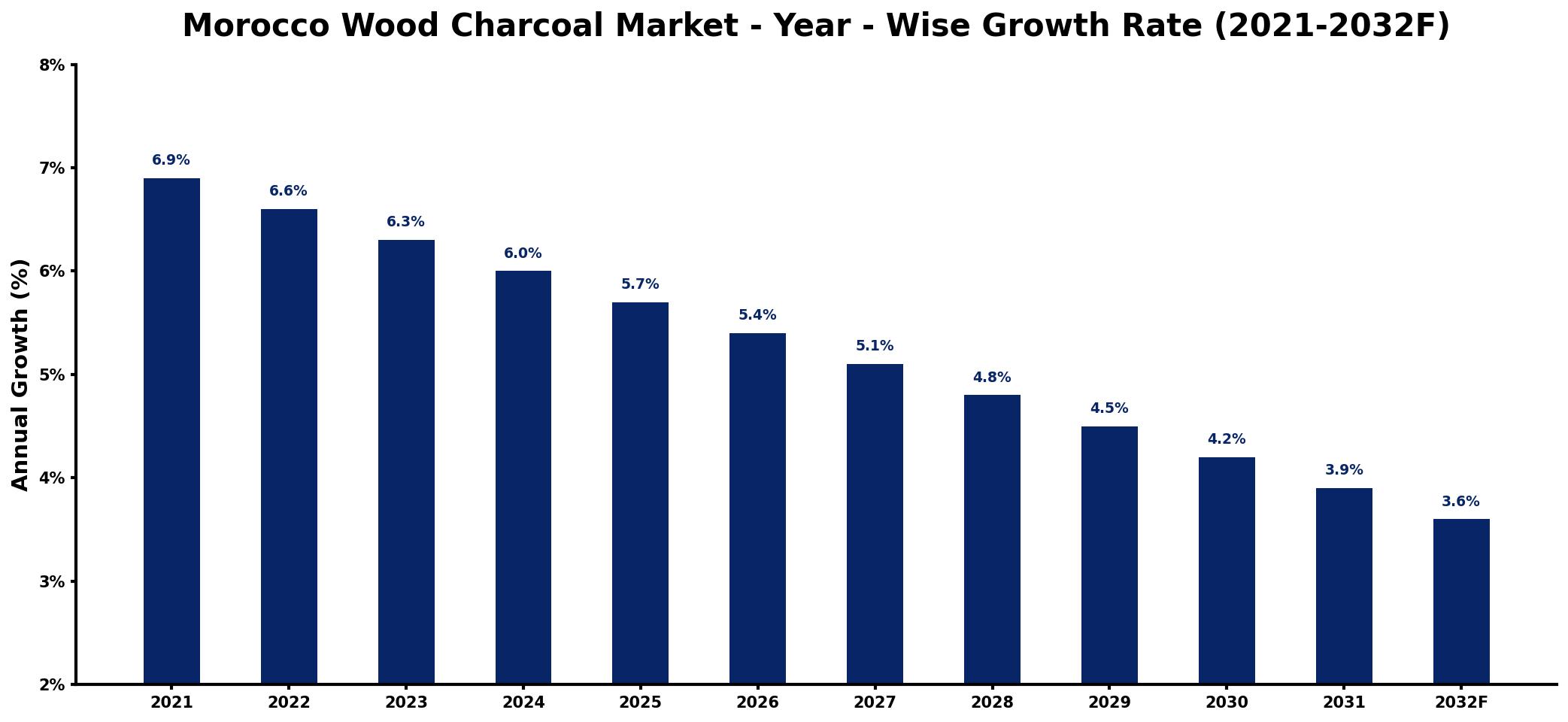
The table below presents the year‑wise growth rates along with the key drivers influencing the market
| Year | Growth Rate | Major Drivers |
| 2021 | 6.9% | Rising demand for sustainable energy |
| 2022 | 6.6% | Increased exports to neighboring countries |
| 2023 | 6.3% | Growing popularity of outdoor grilling |
| 2024 | 6.0% | Expansion of local production facilities |
| 2025 | 5.7% | Surge in eco-friendly household products |
| 2026 | 5.4% | Higher investments in renewable resources |
| 2027 | 5.1% | Increased awareness of environmental benefits |
| 2028 | 4.8% | growing automotive sector requirements |
| 2029 | 4.5% | Growing culinary trends in cooking |
| 2030 | 4.2% | rising end-use demand growth |
| 2031 | 3.9% | Emergence of new market players |
| 2032 | 3.6% | Strengthening of regional trade agreements |
Note: Market size estimations and growth projections presented in this report are based on 6Wresearch's proprietary forecasting methodology, utilizing the latest available industry data, government publications, and primary research inputs.
Morocco Wood Charcoal Market Synopsis
A significant force currently shaping the Morocco Wood Charcoal Market is the rising awareness of the environmental benefits associated with wood charcoal. As consumers increasingly seek out eco-friendly alternatives for cooking and heating, the market is experiencing a surge in demand. This trend is further bolstered by the integration of sustainable sourcing practices, which align with consumer preferences.
In Morocco, the traditional uses of wood charcoal remain paramount, particularly in households where it serves as a primary cooking fuel. The market is also witnessing growth from various industrial applications. Additionally, government policies aimed at promoting sustainable forest management practices are expected to play a crucial role in supporting the long-term viability of this market.
Morocco Wood Charcoal Market Key Takeaways
- The market is experiencing robust growth due to the increasing demand for sustainable fuel sources.
- Traditional cooking methods significantly contribute to the market's resilience and expansion.
- Technological advancements in charcoal production are enhancing product quality.
- Government initiatives are encouraging sustainable practices within the industry.
- Consumer preference for eco-friendly products is reshaping market dynamics.
Evaluation of Restraints in Morocco Wood Charcoal Market
Despite the positive growth outlook, the Morocco Wood Charcoal Market faces several challenges. Deforestation remains a pressing concern, prompting the need for sustainable sourcing practices to prevent ecological degradation. Additionally, maintaining consistent charcoal quality and meeting evolving consumer preferences for eco-friendly products can be challenging for producers. These factors underscore the importance of regulatory compliance and the implementation of sustainable practices within the market.
Morocco Wood Charcoal Market Trends
Emerging trends in the Morocco Wood Charcoal Market are largely characterized by a growing shift towards sustainability. There is an increasing inclination towards using wood charcoal as a cleaner alternative to fossil fuels in various applications. Additionally, innovations in production methods are enhancing efficiency and reducing waste, aligning with global sustainability initiatives. The rise of environmentally conscious consumer behavior is prompting manufacturers to prioritize eco-friendly practices, further influencing market dynamics.
Morocco Wood Charcoal Market Opportunities
The Morocco Wood Charcoal Market presents significant growth opportunities, particularly in the realm of product innovation and sustainable sourcing. As consumer demand for eco-friendly alternatives continues to rise, producers can leverage this trend by developing high-quality, sustainably sourced charcoal products. Moreover, expanding the distribution of wood charcoal in commercial sectors, including restaurants and hospitality, offers avenues for market expansion.
Government Initiatives in the Morocco Wood Charcoal Market
Government initiatives are playing a pivotal role in shaping the future of the Morocco Wood Charcoal Market. Efforts are being made to promote sustainable forest management practices, alongside the establishment of quality standards for charcoal production. By fostering collaboration with industry stakeholders, the government is supporting market access while ensuring that environmental conservation measures are adhered to. This regulatory framework is crucial for balancing market demands with the preservation of natural resources.
Future Insights of the Morocco Wood Charcoal Market
Looking ahead to the period from 2026 to 2032, the Morocco Wood Charcoal Market is expected to continue its upward trajectory. The ongoing shift towards sustainable fuel sources, coupled with technological advancements in charcoal production, will likely drive market growth. Additionally, as consumers increasingly prioritize eco-friendly products, the market is expected to adapt and innovate to meet these evolving demands, ensuring a competitive landscape.
Morocco Wood Charcoal Market Latest Developments (2025 - 2026)
Recent developments in the Morocco Wood Charcoal Market indicate a strong focus on sustainability and quality assurance. There has been an increase in collaborations between producers and regulatory bodies to enhance the quality of charcoal products. Furthermore, innovation in production techniques is being explored to meet both local and international standards, addressing the growing consumer demand for environmentally responsible products.
Morocco Wood Charcoal Market - Key Attractiveness of the Report
- 10 Years of Market Numbers
- Historical Data Starting from 2022 to 2025
- Base Year: 2025
- Forecast Data until 2032
- Key Performance Indicators Impacting the Market
- Major Upcoming Developments and Projects
Key Highlights of the Report:
- Morocco Wood Charcoal Market Outlook
- Market Size of Morocco Wood Charcoal Market, 2025
- Forecast of Morocco Wood Charcoal Market, 2032
- Historical Data and Forecast of Morocco Wood Charcoal Revenues & Volume for the Period 2022-2032F
- Morocco Wood Charcoal Market Trend Evolution
- Morocco Wood Charcoal Market Drivers and Challenges
- Morocco Wood Charcoal Price Trends
- Morocco Wood Charcoal Porter's Five Forces
- Morocco Wood Charcoal Industry Life Cycle
- Historical Data and Forecast of Morocco Wood Charcoal Market Revenues & Volume By Product for the Period 2022-2032F
- Historical Data and Forecast of Morocco Wood Charcoal Market Revenues & Volume By Charcoal Lumps for the Period 2022-2032F
- Historical Data and Forecast of Morocco Wood Charcoal Market Revenues & Volume By Charcoal Briquettes for the Period 2022-2032F
- Historical Data and Forecast of Morocco Wood Charcoal Market Revenues & Volume By Charcoal Powder for the Period 2022-2032F
- Historical Data and Forecast of Morocco Wood Charcoal Market Revenues & Volume By Wood for the Period 2022-2032F
- Historical Data and Forecast of Morocco Wood Charcoal Market Revenues & Volume By Softwood for the Period 2022-2032F
- Historical Data and Forecast of Morocco Wood Charcoal Market Revenues & Volume By Hardwood for the Period 2022-2032F
- Historical Data and Forecast of Morocco Wood Charcoal Market Revenues & Volume By Application for the Period 2022-2032F
- Historical Data and Forecast of Morocco Wood Charcoal Market Revenues & Volume By Fuel Feedstock for the Period 2022-2032F
- Historical Data and Forecast of Morocco Wood Charcoal Market Revenues & Volume By Reducing Agent for the Period 2022-2032F
- Historical Data and Forecast of Morocco Wood Charcoal Market Revenues & Volume By Filtration Agent & Gas Masking for the Period 2022-2032F
- Historical Data and Forecast of Morocco Wood Charcoal Market Revenues & Volume By Decolorizing Agent for the Period 2022-2032F
- Historical Data and Forecast of Morocco Wood Charcoal Market Revenues & Volume By Gastric Medicine for the Period 2022-2032F
- Historical Data and Forecast of Morocco Wood Charcoal Market Revenues & Volume By Sketches & Paints for the Period 2022-2032F
- Historical Data and Forecast of Morocco Wood Charcoal Market Revenues & Volume By Soil Conditioning for the Period 2022-2032F
- Historical Data and Forecast of Morocco Wood Charcoal Market Revenues & Volume By Others for the Period 2022-2032F
- Historical Data and Forecast of Morocco Wood Charcoal Market Revenues & Volume By End Use for the Period 2022-2032F
- Historical Data and Forecast of Morocco Wood Charcoal Market Revenues & Volume By Residential for the Period 2022-2032F
- Historical Data and Forecast of Morocco Wood Charcoal Market Revenues & Volume By Cooking Fuel for the Period 2022-2032F
- Historical Data and Forecast of Morocco Wood Charcoal Market Revenues & Volume By Gardening for the Period 2022-2032F
- Historical Data and Forecast of Morocco Wood Charcoal Market Revenues & Volume By Commercial Paints & Sketches for the Period 2022-2032F
- Historical Data and Forecast of Morocco Wood Charcoal Market Revenues & Volume By Water Treatment for the Period 2022-2032F
- Historical Data and Forecast of Morocco Wood Charcoal Market Revenues & Volume By Industrial for the Period 2022-2032F
- Morocco Wood Charcoal Import Export Trade Statistics
- Market Opportunity Assessment By Product
- Market Opportunity Assessment By Wood
- Market Opportunity Assessment By Application
- Market Opportunity Assessment By End Use
- Morocco Wood Charcoal Top Companies Market Share
- Morocco Wood Charcoal Competitive Benchmarking By Technical and Operational Parameters
- Morocco Wood Charcoal Company Profiles
- Morocco Wood Charcoal Key Strategic Recommendations






































