Morocco Wood Wool Insulation Market Size, Share & Growth Rate
The Morocco Wood Wool Insulation Market was estimated at USD 1037 Million in 2025 and is projected to reach USD 1496 Million by 2032, growing at a CAGR of 5.4% from 2026 to 2032. This growth trajectory is underpinned by a significant shift towards sustainable construction materials, with wood wool insulation being recognized for its excellent thermal and acoustic properties. Furthermore, an increasing number of green building projects and advancements in eco-friendly insulation technology are fueling the market expansion.
Morocco Wood Wool Insulation Market Year-wise Growth Rate and Key Drivers
This graph highlights how the Morocco Wood Wool Insulation Market has steadily grown over the years, supported by major growth factors.
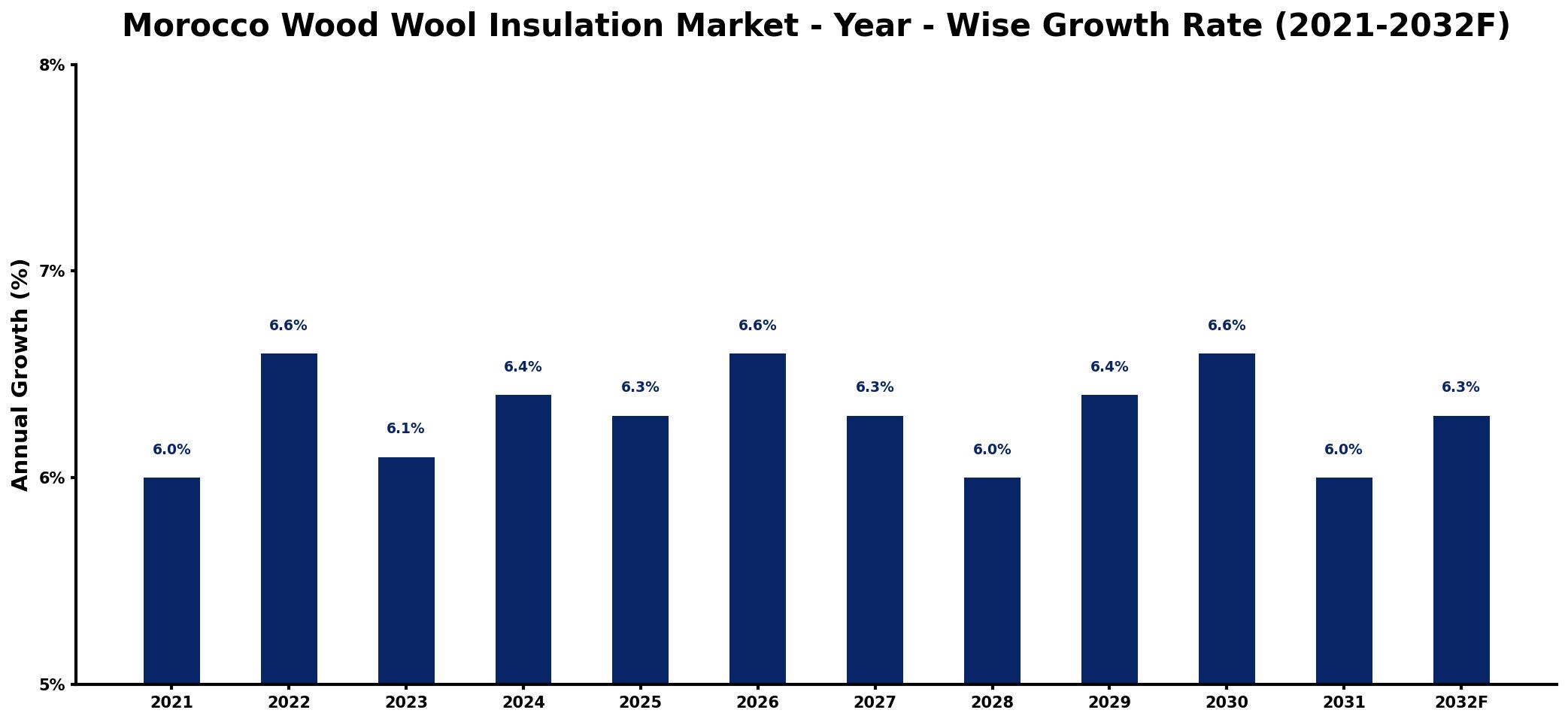
The table below presents the year‑wise growth rates along with the key drivers influencing the market
| Year | Growth Rate | Major Drivers |
| 2021 | 6.0% | Increased construction sector investments |
| 2022 | 6.6% | Rising consumer environmental awareness |
| 2023 | 6.1% | Growing demand for sustainable materials |
| 2024 | 6.4% | Expansion of renewable energy initiatives |
| 2025 | 6.3% | Increased government green building policies |
| 2026 | 6.6% | Surge in eco-friendly housing projects |
| 2027 | 6.3% | Growing popularity of passive design |
| 2028 | 6.0% | Emergence of energy efficiency standards |
| 2029 | 6.4% | Rising residential renovation activities |
| 2030 | 6.6% | stronger distribution network expansion |
| 2031 | 6.0% | growing regional consumption patterns |
| 2032 | 6.3% | Growing awareness of health benefits |
Note: Market size estimations and growth projections presented in this report are based on 6Wresearch's proprietary forecasting methodology, utilizing the latest available industry data, government publications, and primary research inputs.
Morocco Wood Wool Insulation Market Synopsis
The demand for wood wool insulation in Morocco is particularly evident as construction practices increasingly prioritize energy efficiency and sustainability. This insulation material not only meets the growing regulatory compliance demands but also resonates well with environmentally conscious builders and homeowners alike.
Moreover, the unique blend of thermal insulation and sound absorption capabilities offered by wood wool makes it a versatile choice for various building applications. As the construction sector evolves, the appeal of this material as a recyclable and eco-friendly solution continues to gain traction in the Moroccan market.
Morocco Wood Wool Insulation Market Key Takeaways
- The market is experiencing a robust growth trajectory driven by sustainability trends.
- Wood wool insulation is increasingly favored for its thermal and acoustic properties.
- Technological advancements are enhancing the performance of insulation materials.
- The market faces challenges regarding consumer education and pricing competitiveness.
- Government policies are aligning to support eco-friendly building practices.
Evaluation of Restraints in Morocco Wood Wool Insulation Market
Despite the positive growth indicators, the Morocco Wood Wool Insulation Market grapples with a few significant restraints. One major barrier is the general lack of consumer awareness regarding the benefits of wood wool insulation, which can inhibit market penetration. Additionally, pricing remains a concern as the material must compete with more established insulation types. Furthermore, achieving optimal performance while meeting sustainability standards presents ongoing challenges for manufacturers aiming to maintain product integrity without sacrificing environmental considerations.
Morocco Wood Wool Insulation Market Trends
A prominent trend in the Morocco Wood Wool Insulation Market is the increasing integration of smart technologies in construction. This development allows for more efficient energy use and performance monitoring, thus enhancing the appeal of wood wool insulation. Another emerging trend is the emphasis on circular economy practices, leading to greater innovation in recycling and repurposing insulation materials, further entrenching wood wool's position as a green solution.
Morocco Wood Wool Insulation Market Opportunities
Opportunities for growth within the Morocco Wood Wool Insulation Market are abundant. As government incentives continue to promote sustainable construction, increased investment in green building materials is expected. Furthermore, the shift towards urbanization presents a fertile ground for innovative insulation solutions, particularly in residential and commercial projects seeking to enhance energy efficiency. Collaborative ventures between private and public sectors can also pave the way for advancements in product offerings.
Government Initiatives in the Morocco Wood Wool Insulation Market
The Moroccan government is actively promoting the adoption of sustainable building practices through various initiatives and policies. These include incentives for energy-efficient construction materials, support for green certifications, and investment in public awareness campaigns that highlight the benefits of eco-friendly insulation options like wood wool. Such initiatives are critical in aligning the construction industry with national sustainability goals and fostering a culture of environmentally responsible building.
Future Insights of the Morocco Wood Wool Insulation Market
Looking ahead to 2026-2032, the Morocco Wood Wool Insulation Market is set to evolve significantly. Continued emphasis on energy efficiency and green building standards will likely drive innovation in material applications and performance enhancements. The market will also see increased collaboration between manufacturers and construction firms to refine product offerings and optimize insulation capabilities. As consumer awareness grows and sustainability becomes a focal point, the demand for wood wool insulation will likely escalate, positioning the market for long-term success.
Morocco Wood Wool Insulation Market Latest Developments (2025 - 2026)
In recent months, the Morocco Wood Wool Insulation Market has witnessed several pivotal developments. Manufacturers are increasingly focused on improving product performance through technological advancements, particularly in enhancing insulation efficiency. Additionally, there's a notable trend in partnerships between construction firms and insulation suppliers aimed at promoting eco-friendly practices. Public awareness campaigns are gaining traction, aimed at educating consumers on the benefits of using wood wool insulation in their building projects.
Morocco Wood Wool Insulation Market - Key Attractiveness of the Report
- 10 Years of Market Numbers
- Historical Data Starting from 2022 to 2025
- Base Year: 2025
- Forecast Data until 2032
- Key Performance Indicators Impacting the Market
- Major Upcoming Developments and Projects
Key Highlights of the Report:
- Morocco Wood Wool Insulation Market Outlook
- Market Size of Morocco Wood Wool Insulation Market, 2025
- Forecast of Morocco Wood Wool Insulation Market, 2032
- Historical Data and Forecast of Morocco Wood Wool Insulation Revenues & Volume for the Period 2022-2032F
- Morocco Wood Wool Insulation Market Trend Evolution
- Morocco Wood Wool Insulation Market Drivers and Challenges
- Morocco Wood Wool Insulation Price Trends
- Morocco Wood Wool Insulation Porter's Five Forces
- Morocco Wood Wool Insulation Industry Life Cycle
- Historical Data and Forecast of Morocco Wood Wool Insulation Market Revenues & Volume By Product Type for the Period 2022-2032F
- Historical Data and Forecast of Morocco Wood Wool Insulation Market Revenues & Volume By Stable for the Period 2022-2032F
- Historical Data and Forecast of Morocco Wood Wool Insulation Market Revenues & Volume By Flexible for the Period 2022-2032F
- Historical Data and Forecast of Morocco Wood Wool Insulation Market Revenues & Volume By Application for the Period 2022-2032F
- Historical Data and Forecast of Morocco Wood Wool Insulation Market Revenues & Volume By Thermal Insulation for the Period 2022-2032F
- Historical Data and Forecast of Morocco Wood Wool Insulation Market Revenues & Volume By Acoustic Insulation for the Period 2022-2032F
- Historical Data and Forecast of Morocco Wood Wool Insulation Market Revenues & Volume By Electrical Insulation for the Period 2022-2032F
- Morocco Wood Wool Insulation Import Export Trade Statistics
- Market Opportunity Assessment By Product Type
- Market Opportunity Assessment By Application
- Morocco Wood Wool Insulation Top Companies Market Share
- Morocco Wood Wool Insulation Competitive Benchmarking By Technical and Operational Parameters
- Morocco Wood Wool Insulation Company Profiles
- Morocco Wood Wool Insulation Key Strategic Recommendations






































