Morocco Wooden Toys Market Size, Share & Growth Rate
The Morocco Wooden Toys Market was estimated at USD 242 Million in 2025 and is projected to reach USD 337 Million by 2032, growing at a CAGR of 4.8% from 2026 to 2032. This growth is primarily fueled by increasing parental awareness regarding the safety and educational benefits of wooden toys, leading to a robust demand in households and educational institutions. Furthermore, the drive towards sustainable and eco-friendly consumer products is reinforcing the market's upward trajectory.
Morocco Wooden Toys Market Year-wise Growth Rate and Key Drivers
This graph highlights how the Morocco Wooden Toys Market has steadily grown over the years, supported by major growth factors.
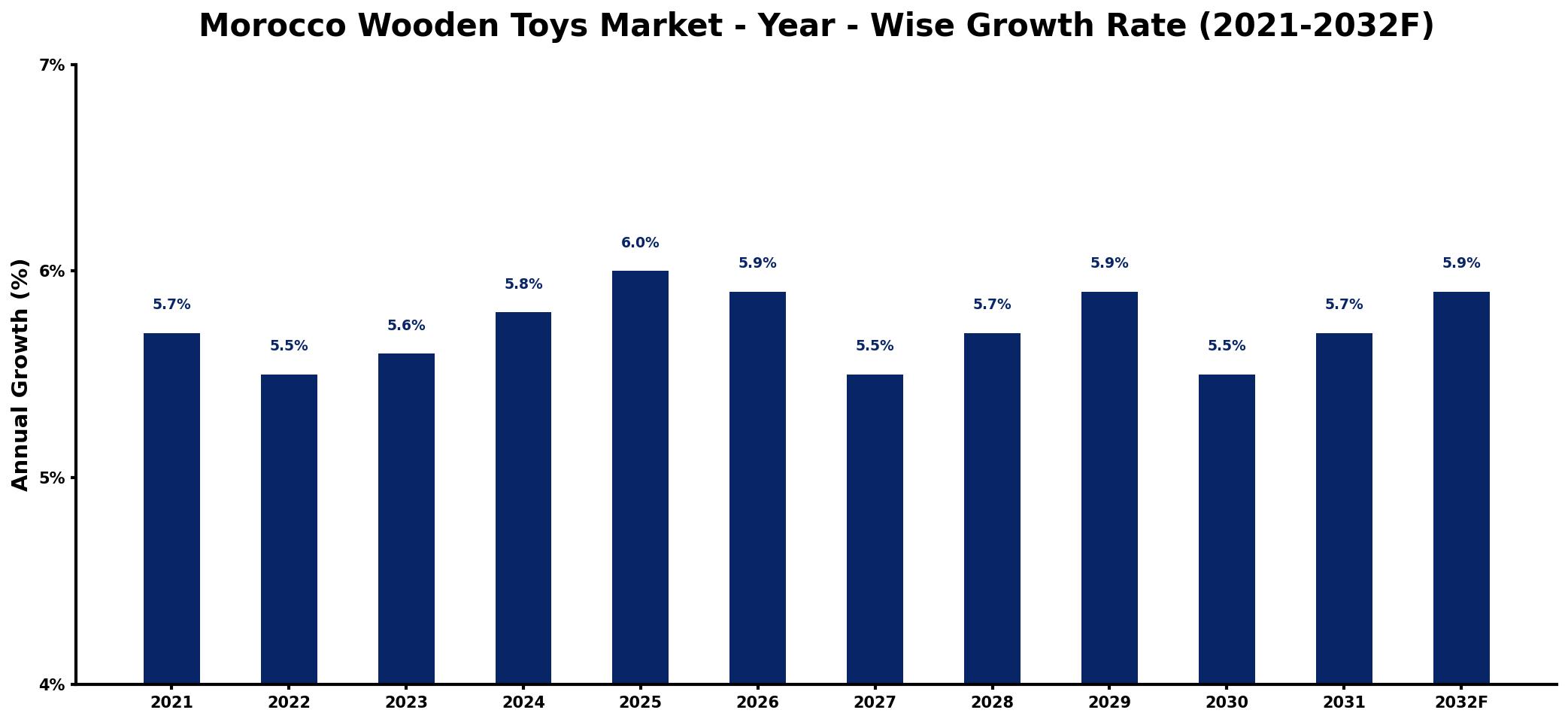
The table below presents the year‑wise growth rates along with the key drivers influencing the market
| Year | Growth Rate | Major Drivers |
| 2021 | 5.7% | Rising consumer interest in sustainability |
| 2022 | 5.5% | Increased investment in eco-friendly materials |
| 2023 | 5.6% | Growing popularity of artisanal craftsmanship |
| 2024 | 5.8% | Expansion of online retail platforms |
| 2025 | 6.0% | increased production capacity utilization |
| 2026 | 5.9% | Strengthening of local manufacturing capabilities |
| 2027 | 5.5% | Enhanced marketing strategies targeting parents |
| 2028 | 5.7% | Collaboration with educational institutions |
| 2029 | 5.9% | Diversification of product offerings available |
| 2030 | 5.5% | Focus on cultural heritage preservation |
| 2031 | 5.7% | Improvement in distribution networks efficiency |
| 2032 | 5.9% | Emergence of new market segments |
Note: Market size estimations and growth projections presented in this report are based on 6Wresearch's proprietary forecasting methodology, utilizing the latest available industry data, government publications, and primary research inputs.
Morocco Wooden Toys Market Synopsis
In recent years, the Moroccan wooden toys market has witnessed a notable surge in popularity, with an increasing number of parents and educators opting for natural materials over plastic counterparts. Looking ahead, the market is poised for sustained growth as consumer preferences continue to shift towards safe, durable, and environmentally friendly options.
Despite its upward momentum, the market is navigating a complex landscape marked by regulatory requirements and concerns about sourcing sustainable materials. However, these challenges are being met with innovative solutions and heightened compliance efforts, suggesting a positive outlook for the sector.
Morocco Wooden Toys Market Key Takeaways
- The market is anticipated to grow significantly, driven by rising safety and educational awareness among consumers.
- Innovation in manufacturing processes supports the production of high-quality, compliant toys.
- There is a clear shift towards sustainable practices in sourcing and production.
- Awareness campaigns by government bodies bolster consumer knowledge about wooden toys.
- Increased collaboration among local manufacturers enhances the competitive landscape.
Evaluation of Restraints in Morocco Wooden Toys Market
While the Moroccan wooden toys market is expanding, several restraints pose challenges. Primarily, ensuring compliance with safety regulations is critical, as any lapses could significantly hinder market growth. Additionally, there are ongoing concerns regarding environmental practices in wood sourcing and manufacturing, which could affect consumer trust. The need for continuous innovation to meet educational demand and safety standards further complicates the landscape, necessitating investment and strategic alignment within the industry.
Morocco Wooden Toys Market Trends
Current trends indicate a strong movement towards eco-friendly materials in toy production. Manufacturers are increasingly adopting non-toxic finishes and sustainable sourcing practices to align with consumer expectations. Moreover, advancements in technology enable the creation of more complex, educational toys that stimulate cognitive development in children. This innovation is not only appealing to consumers but also helps to differentiate brands in a competitive marketplace.
Morocco Wooden Toys Market Opportunities
There exists significant opportunity for growth within the Morocco wooden toys market, particularly in the realm of eco-friendly product lines. As consumer awareness of environmental impacts continues to rise, companies that prioritize sustainability can capture a larger share of the market. Furthermore, expanding distribution channels, such as online retail, can facilitate broader access to wooden toys, enhancing market penetration.
Government Initiatives in the Morocco Wooden Toys Market
The Moroccan government is actively promoting policies aimed at ensuring the safety and quality of toys within the market. Initiatives that support local production and compliance with international safety standards are being implemented to enhance consumer trust. Moreover, educational campaigns are being launched to raise awareness about the benefits of wooden toys, thus fostering a favorable environment for market growth.
Future Insights of the Morocco Wooden Toys Market
Looking ahead to 2026-2032, the Morocco wooden toys market is expected to experience robust growth driven by continuous innovation and an evolving consumer landscape. As parents increasingly prioritize safety and educational value, wooden toys will likely gain even more popularity. This period will also see greater investment in sustainable practices, positioning the market as a leader in eco-friendly toys, thereby attracting new players and boosting competitiveness.
Morocco Wooden Toys Market Latest Developments (2025 - 2026)
The industry is currently experiencing shifts towards more diversified product offerings, with manufacturers experimenting with different designs and functionalities to capture consumer interest. Sustainability initiatives are gaining traction, prompting companies to forge partnerships aimed at responsible sourcing. Additionally, consumer education regarding the advantages of wooden toys continues to grow, supported by various promotional campaigns and community outreach programs.
Morocco Wooden Toys Market - Key Attractiveness of the Report
- 10 Years of Market Numbers
- Historical Data Starting from 2022 to 2025
- Base Year: 2025
- Forecast Data until 2032
- Key Performance Indicators Impacting the Market
- Major Upcoming Developments and Projects
Key Highlights of the Report:
- Morocco Wooden Toys Market Outlook
- Market Size of Morocco Wooden Toys Market, 2025
- Forecast of Morocco Wooden Toys Market, 2032
- Historical Data and Forecast of Morocco Wooden Toys Revenues & Volume for the Period 2022-2032F
- Morocco Wooden Toys Market Trend Evolution
- Morocco Wooden Toys Market Drivers and Challenges
- Morocco Wooden Toys Price Trends
- Morocco Wooden Toys Porter's Five Forces
- Morocco Wooden Toys Industry Life Cycle
- Historical Data and Forecast of Morocco Wooden Toys Market Revenues & Volume By Product Type for the Period 2022-2032F
- Historical Data and Forecast of Morocco Wooden Toys Market Revenues & Volume By Educational Toys for the Period 2022-2032F
- Historical Data and Forecast of Morocco Wooden Toys Market Revenues & Volume By Construction Toys for the Period 2022-2032F
- Historical Data and Forecast of Morocco Wooden Toys Market Revenues & Volume By Musical Toys for the Period 2022-2032F
- Historical Data and Forecast of Morocco Wooden Toys Market Revenues & Volume By Game Toys for the Period 2022-2032F
- Historical Data and Forecast of Morocco Wooden Toys Market Revenues & Volume By Dolls & Miniatures for the Period 2022-2032F
- Historical Data and Forecast of Morocco Wooden Toys Market Revenues & Volume By Automotive Toys for the Period 2022-2032F
- Historical Data and Forecast of Morocco Wooden Toys Market Revenues & Volume By Pretend Play Toys for the Period 2022-2032F
- Historical Data and Forecast of Morocco Wooden Toys Market Revenues & Volume By Wood Type for the Period 2022-2032F
- Historical Data and Forecast of Morocco Wooden Toys Market Revenues & Volume By Softwood for the Period 2022-2032F
- Historical Data and Forecast of Morocco Wooden Toys Market Revenues & Volume By Hardwood for the Period 2022-2032F
- Historical Data and Forecast of Morocco Wooden Toys Market Revenues & Volume By Age Group for the Period 2022-2032F
- Historical Data and Forecast of Morocco Wooden Toys Market Revenues & Volume By Below 1 Year for the Period 2022-2032F
- Historical Data and Forecast of Morocco Wooden Toys Market Revenues & Volume By Age 1-3 for the Period 2022-2032F
- Historical Data and Forecast of Morocco Wooden Toys Market Revenues & Volume By Age 3-5 for the Period 2022-2032F
- Historical Data and Forecast of Morocco Wooden Toys Market Revenues & Volume By Age 5-12 for the Period 2022-2032F
- Historical Data and Forecast of Morocco Wooden Toys Market Revenues & Volume By Age 12+ for the Period 2022-2032F
- Historical Data and Forecast of Morocco Wooden Toys Market Revenues & Volume By Distribution Channel for the Period 2022-2032F
- Historical Data and Forecast of Morocco Wooden Toys Market Revenues & Volume By Online for the Period 2022-2032F
- Historical Data and Forecast of Morocco Wooden Toys Market Revenues & Volume By Offline for the Period 2022-2032F
- Morocco Wooden Toys Import Export Trade Statistics
- Market Opportunity Assessment By Product Type
- Market Opportunity Assessment By Wood Type
- Market Opportunity Assessment By Age Group
- Market Opportunity Assessment By Distribution Channel
- Morocco Wooden Toys Top Companies Market Share
- Morocco Wooden Toys Competitive Benchmarking By Technical and Operational Parameters
- Morocco Wooden Toys Company Profiles
- Morocco Wooden Toys Key Strategic Recommendations






































