Mozambique Decaffeinated Coffee Market Growth Rate Analysis (2021-2031)
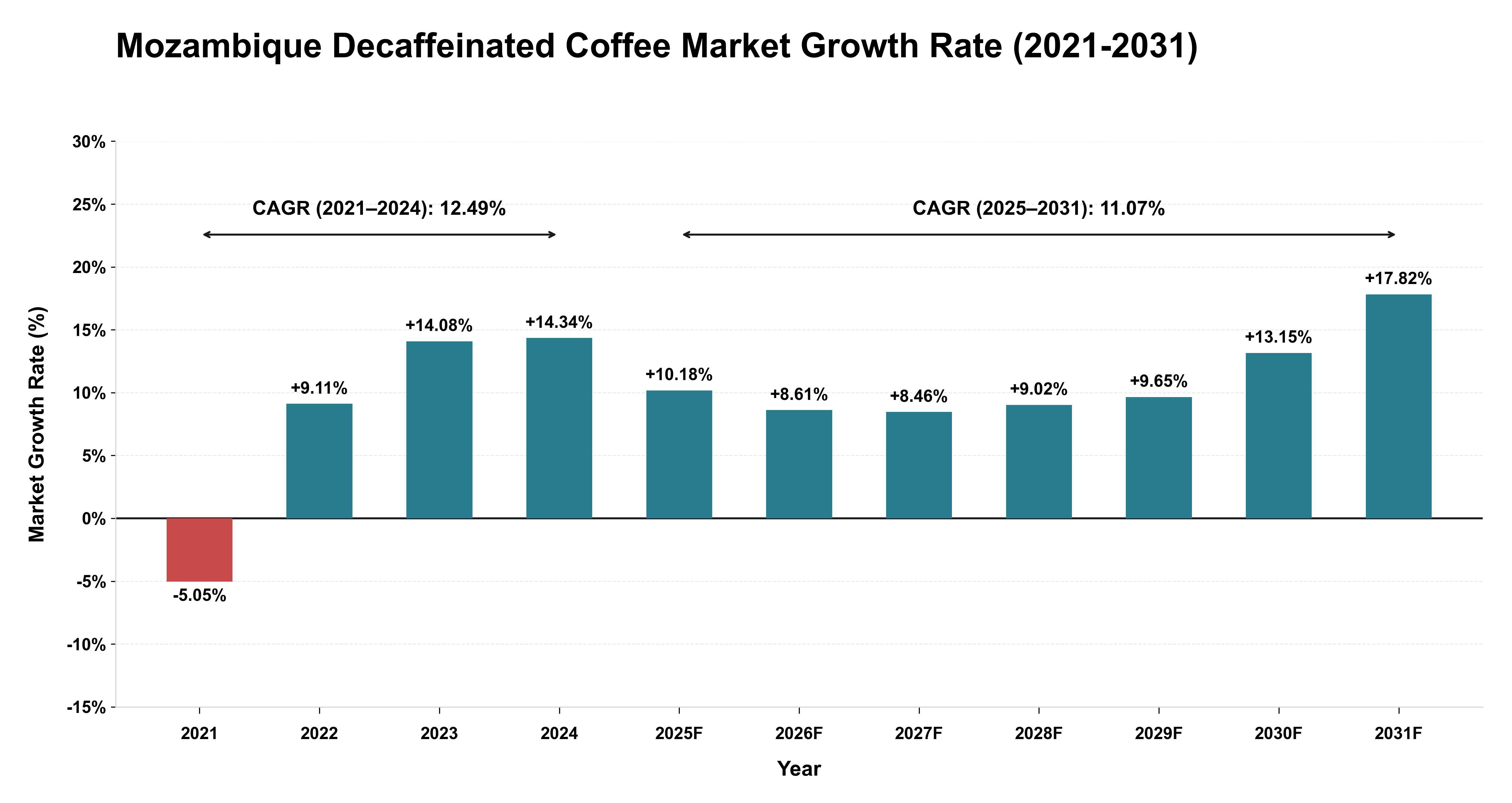
The Mozambique Decaffeinated Coffee market experienced a turbulent period from 2021 to 2024, marked by a structural consolidation with a negative growth rate of -5.05% in 2021, followed by a significant rebound in 2022 at 9.11%, and robust expansions of 14.08% and 14.34% in 2023 and 2024, respectively. Moving forward, the market stabilized its expansion from 2025 to 2031, with growth rates gradually slowing down but remaining positive. The forecasted CAGR of 11.07% indicates a trend of stabilizing growth following the volatile historical base effect post-2021. The market is poised for continued steady growth, with growth rates ranging from 8.46% to as high as 17.82% in the forecast period, reflecting a maturing market with sustained demand for decaffeinated coffee in Mozambique.
Key Highlights of the Report:
- Mozambique Decaffeinated Coffee Market Outlook
- Market Size of Mozambique Decaffeinated Coffee Market, 2024
- Forecast of Mozambique Decaffeinated Coffee Market, 2031
- Historical Data and Forecast of Mozambique Decaffeinated Coffee Revenues & Volume for the Period 2021-2031
- Mozambique Decaffeinated Coffee Market Trend Evolution
- Mozambique Decaffeinated Coffee Market Drivers and Challenges
- Mozambique Decaffeinated Coffee Price Trends
- Mozambique Decaffeinated Coffee Porter`s Five Forces
- Mozambique Decaffeinated Coffee Industry Life Cycle
- Historical Data and Forecast of Mozambique Decaffeinated Coffee Market Revenues & Volume By Product for the Period 2021-2031
- Historical Data and Forecast of Mozambique Decaffeinated Coffee Market Revenues & Volume By Roasted for the Period 2021-2031
- Historical Data and Forecast of Mozambique Decaffeinated Coffee Market Revenues & Volume By Raw for the Period 2021-2031
- Historical Data and Forecast of Mozambique Decaffeinated Coffee Market Revenues & Volume By Speciesfor the Period 2021-2031
- Historical Data and Forecast of Mozambique Decaffeinated Coffee Market Revenues & Volume By Arabica for the Period 2021-2031
- Historical Data and Forecast of Mozambique Decaffeinated Coffee Market Revenues & Volume By Robusta for the Period 2021-2031
- Historical Data and Forecast of Mozambique Decaffeinated Coffee Market Revenues & Volume By Distribution Channel for the Period 2021-2031
- Historical Data and Forecast of Mozambique Decaffeinated Coffee Market Revenues & Volume By Online for the Period 2021-2031
- Historical Data and Forecast of Mozambique Decaffeinated Coffee Market Revenues & Volume By Offline for the Period 2021-2031
- Mozambique Decaffeinated Coffee Import Export Trade Statistics
- Market Opportunity Assessment By Product
- Market Opportunity Assessment By Species
- Market Opportunity Assessment By Distribution Channel
- Mozambique Decaffeinated Coffee Top Companies Market Share
- Mozambique Decaffeinated Coffee Competitive Benchmarking By Technical and Operational Parameters
- Mozambique Decaffeinated Coffee Company Profiles
- Mozambique Decaffeinated Coffee Key Strategic Recommendations






































