Myanmar Adipic Acid Market Size Growth Rate
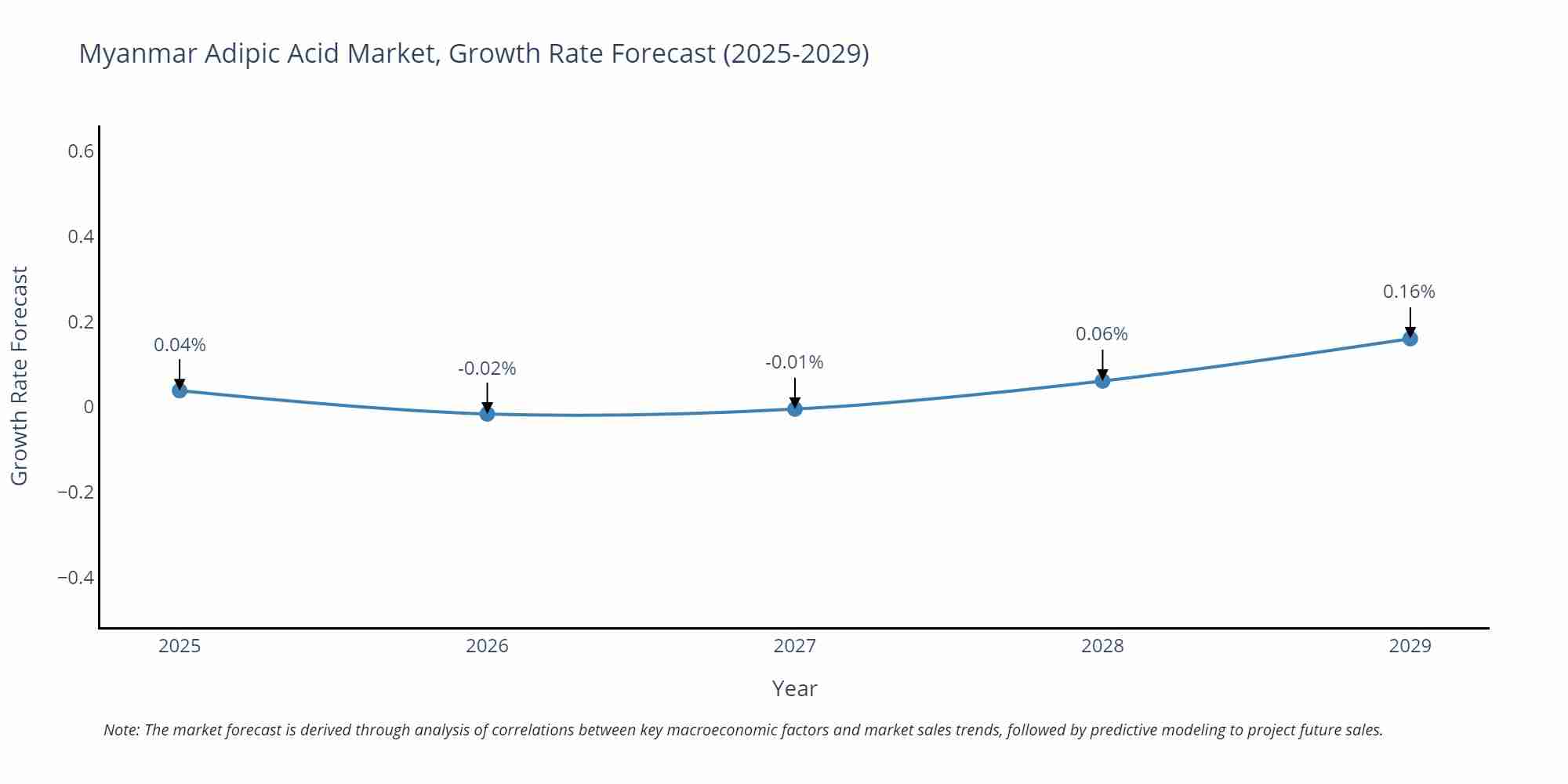
The Myanmar Adipic Acid Market is projected to witness mixed growth rate patterns during 2025 to 2029. The growth rate starts at 0.04% in 2025 and reaches 0.16% by 2029.
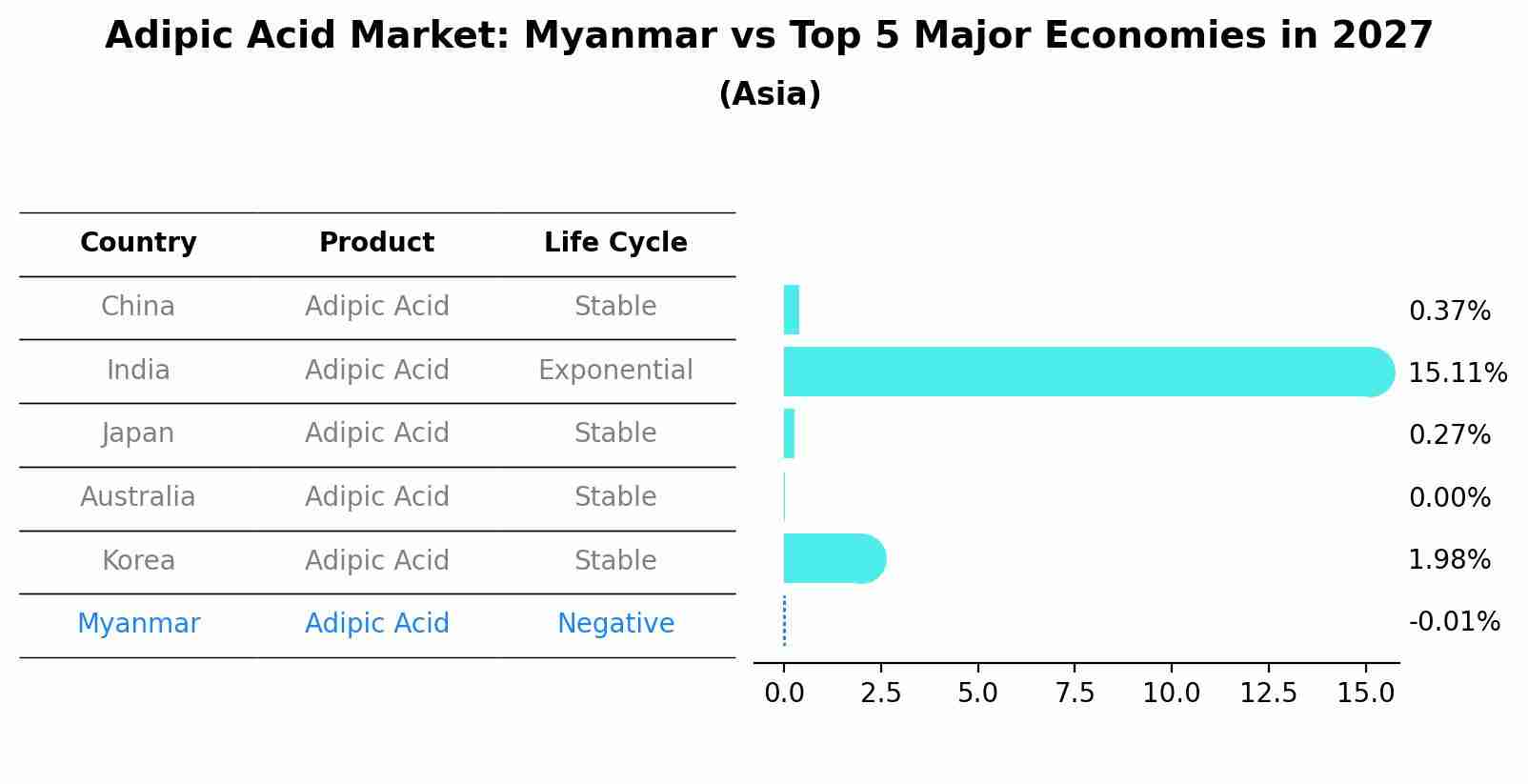
Adipic Acid Market: Myanmar vs Top 5 Major Economies in 2027 (Asia)
By 2027, Myanmar's Adipic Acid market is forecasted to achieve a negative growth rate of -0.01%, with China leading the Asia region, followed by India, Japan, Australia and South Korea.
Myanmar Adipic Acid Market Overview
The Myanmar Adipic Acid market is witnessing steady growth driven by increasing demand from various end-use industries such as automotive, textiles, and packaging. Adipic acid is primarily used in the production of nylon 6,6, which finds applications in the manufacturing of automotive components, textiles, and packaging materials. The market is also benefiting from the growing automotive sector in Myanmar and the increasing focus on sustainable packaging solutions. Key players in the Myanmar Adipic Acid market include multinational companies as well as local manufacturers. However, challenges such as fluctuating raw material prices and environmental regulations may impact market growth. Overall, the market is expected to continue its growth trajectory in the coming years, supported by the country`s expanding industrial base and rising consumer demand.
Myanmar Adipic Acid Market Trends
The Myanmar Adipic Acid market is experiencing steady growth driven by increasing demand from various end-use industries such as automotive, textiles, and packaging. The rising disposable income and changing lifestyles of consumers in Myanmar are driving the demand for products that utilize adipic acid, such as synthetic fibers and automotive components. Additionally, the government`s initiatives to promote industrial growth and foreign investments are further fueling the market expansion. However, challenges such as fluctuating raw material prices and environmental concerns regarding the production process are also influencing the market dynamics. Overall, the Myanmar Adipic Acid market is poised for growth in the coming years, with opportunities for market players to innovate and expand their product offerings to meet the evolving consumer needs and regulatory requirements.
Myanmar Adipic Acid Market Challenges
One of the key challenges faced in the Myanmar Adipic Acid market is the limited domestic production capacity. Myanmar relies heavily on imports to meet its demand for adipic acid, which can lead to supply chain disruptions and price volatility. Additionally, the lack of advanced manufacturing technologies and infrastructure in the country further hinders the growth of the adipic acid market. Political instability and regulatory uncertainties also pose significant risks to market players, impacting investment decisions and overall market development. Addressing these challenges will require strategic investments in domestic production capabilities, technology upgrades, and regulatory reforms to create a more stable and conducive business environment for the adipic acid market in Myanmar.
Myanmar Adipic Acid Market Investment Opportunities
The Myanmar Adipic Acid market presents promising investment opportunities due to the country`s growing textile, automotive, and construction industries, which are the primary consumers of this chemical compound. With the increasing demand for nylon fibers, polyurethane resins, and other applications in these sectors, there is a steady need for Adipic Acid as a raw material. Investors can consider opportunities in setting up manufacturing facilities for Adipic Acid production or establishing distribution networks to meet the growing demand. Additionally, partnerships with local businesses or government support for industrial development initiatives can further enhance investment prospects in the Myanmar Adipic Acid market. Conducting thorough market research and understanding regulatory frameworks will be crucial for successful investments in this sector.
Myanmar Adipic Acid Market Government Policy
The Myanmar government has implemented various policies to regulate and promote the adipic acid market in the country. These policies include setting quality standards for adipic acid production, promoting research and development initiatives to enhance domestic production capabilities, and providing incentives for investment in the adipic acid industry. Additionally, the government has imposed import tariffs and restrictions to protect domestic producers and ensure a level playing field in the market. Overall, the government`s policies aim to support the growth of the adipic acid market in Myanmar, enhance competitiveness, and ensure sustainable development in the industry.
Myanmar Adipic Acid Market Future Outlook
The Myanmar Adipic Acid market is expected to witness steady growth in the coming years due to increasing demand from various end-use industries such as automotive, textiles, and packaging. Factors driving this growth include the country`s growing economy, rising disposable income levels, and expanding industrial infrastructure. Additionally, the government`s efforts to attract foreign investment and improve trade relations are likely to further boost the market. However, challenges such as fluctuating raw material prices and regulatory issues may impact market growth. Overall, with the increasing adoption of adipic acid in various applications and the ongoing industrial development in Myanmar, the market is poised for expansion in the foreseeable future.
Key Highlights of the Report:
- Myanmar Adipic Acid Market Outlook
- Market Size of Myanmar Adipic Acid Market, 2024
- Forecast of Myanmar Adipic Acid Market, 2031
- Historical Data and Forecast of Myanmar Adipic Acid Revenues & Volume for the Period 2021 - 2031
- Myanmar Adipic Acid Market Trend Evolution
- Myanmar Adipic Acid Market Drivers and Challenges
- Myanmar Adipic Acid Price Trends
- Myanmar Adipic Acid Porter's Five Forces
- Myanmar Adipic Acid Industry Life Cycle
- Historical Data and Forecast of Myanmar Adipic Acid Market Revenues & Volume By Applications for the Period 2021 - 2031
- Historical Data and Forecast of Myanmar Adipic Acid Market Revenues & Volume By Nylon 66 for the Period 2021 - 2031
- Historical Data and Forecast of Myanmar Adipic Acid Market Revenues & Volume By Plasticizers for the Period 2021 - 2031
- Historical Data and Forecast of Myanmar Adipic Acid Market Revenues & Volume By Polyurethanes for the Period 2021 - 2031
- Historical Data and Forecast of Myanmar Adipic Acid Market Revenues & Volume By Automotive for the Period 2021 - 2031
- Historical Data and Forecast of Myanmar Adipic Acid Market Revenues & Volume By Polyester Staple Fiber for the Period 2021 - 2031
- Myanmar Adipic Acid Import Export Trade Statistics
- Market Opportunity Assessment By Applications
- Myanmar Adipic Acid Top Companies Market Share
- Myanmar Adipic Acid Competitive Benchmarking By Technical and Operational Parameters
- Myanmar Adipic Acid Company Profiles
- Myanmar Adipic Acid Key Strategic Recommendations






































