Myanmar AI in Education Market Size & Growth Rate (2026-2032)
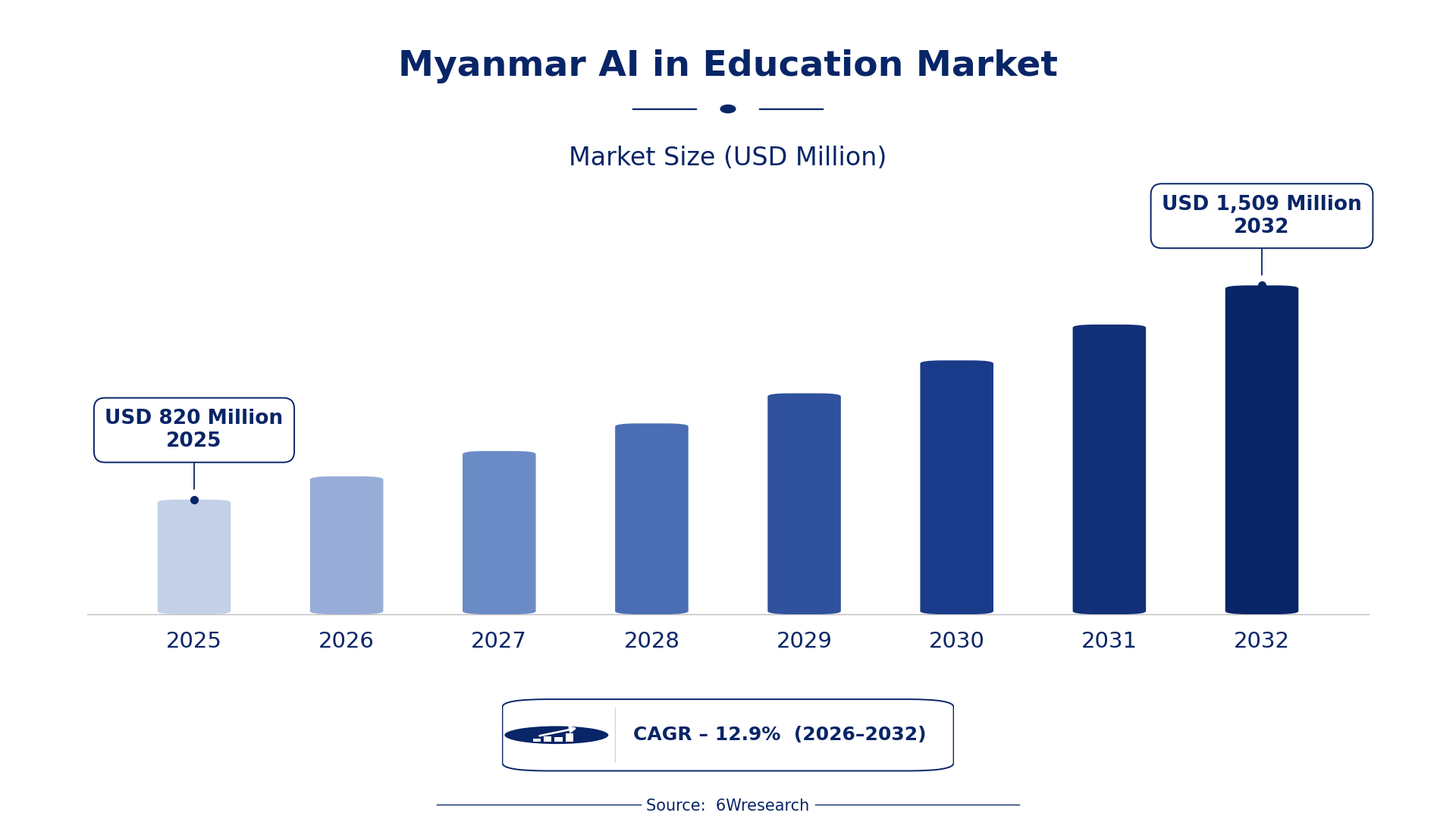
The Myanmar AI in Education Market was estimated at USD 820 Million in 2025 and is projected to reach USD 1509 Million by 2032, growing at a CAGR of 12.9% from 2026 to 2032.
Myanmar AI in Education Market Synopsis
The current surge in investment in educational technology is the driving force reshaping the Myanmar AI in Education Market. This influx is largely fueled by the government's commitment to modernizing the education sector and enhancing digital literacy across the country.
As educational institutions increasingly adopt AI solutions, we see a notable shift towards personalized learning experiences. These innovations are not only enhancing teaching methods but are also improving student outcomes, making education more accessible and tailored to individual needs.
Myanmar AI in Education Market Year-wise Growth Rate and Key Drivers
This graph illustrates the annual growth rates of the Myanmar AI in Education Market from 2021 to 2032, highlighting a steady upward trajectory and projected expansion over the forecast period.
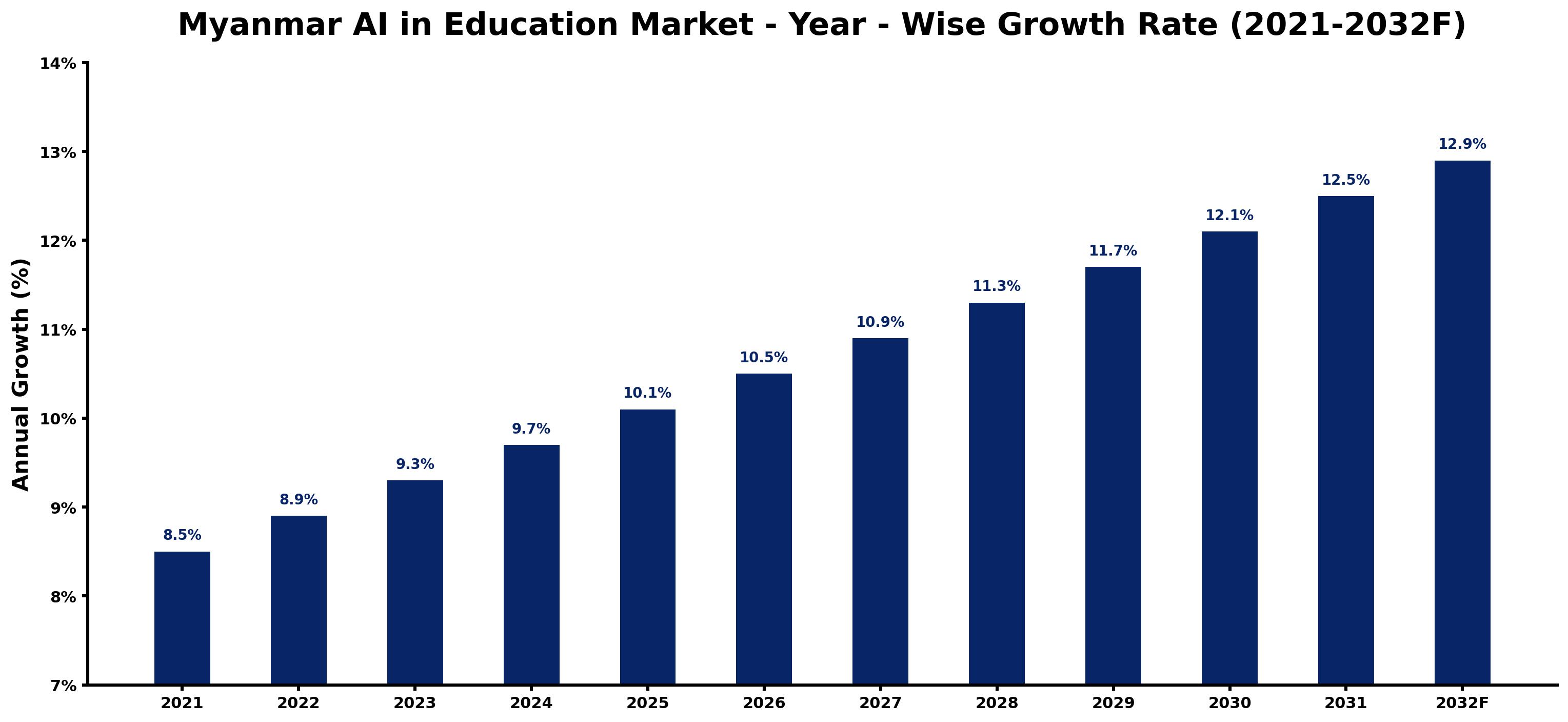
The table below presents the year‑wise growth rates along with the key drivers influencing the market
| Year | Growth Rate | Major Drivers |
| 2021 | 8.5% | Government support for digital learning initiatives |
| 2022 | 8.9% | Increasing smartphone penetration among students |
| 2023 | 9.3% | UNESCO programs promoting AI in local education |
| 2024 | 9.7% | Rising awareness of AI's benefits in teaching |
| 2025 | 10.1% | Increased investment in edtech startups by investors |
| 2026 | 10.5% | Growth of local AI training workshops for educators |
| 2027 | 10.9% | Demand for remote learning tools post-pandemic |
| 2028 | 11.3% | Collaborations between universities for AI curriculum |
| 2029 | 11.7% | Emergence of AI-driven student assessment frameworks |
| 2030 | 12.1% | Local success stories of AI-enhanced learning outcomes |
| 2031 | 12.5% | Government incentives for digital content creation |
| 2032 | 12.9% | Integration of AI in teacher training programs |
Note: Market size estimations and growth projections presented in this report are based on 6Wresearch's proprietary forecasting methodology, utilizing the latest available industry data, government publications, and primary research inputs.
Myanmar AI in Education Market Key Takeaways
Below are some of the specific key takeaways from the market, including:
- The government's focus on integrating technology into education is spurring market growth.
- AI-driven tools for personalized learning are gaining traction in schools and universities.
- Challenges such as limited internet connectivity in rural areas hinder widespread adoption.
- Investment opportunities exist in developing AI educational software and training programs.
- The emphasis on digital literacy is shaping future educational policies and initiatives.
Evaluation of Restraints in Myanmar AI in Education Market
Several real restraints impede the growth of the Myanmar AI in Education Market. Limited access to reliable internet and technology in remote regions stands out as a significant barrier. Additionally, inadequate funding for the implementation of AI solutions in educational institutions restricts progress. The lack of skilled professionals to develop and maintain these systems further exacerbates the issue. Concerns about data privacy and security also loom large, creating hesitancy among stakeholders to fully embrace AI technologies. Overcoming these challenges requires a concerted effort from government and private sectors to enhance infrastructure and training.
Myanmar AI in Education Market Trends
The demand for personalized learning experiences is driving the adoption of AI-powered platforms across Myanmar. Educational institutions are increasingly utilizing AI to analyze student performance, enabling tailored recommendations that enhance learning outcomes. The development of interactive and engaging AI-driven educational content is on the rise, aimed at improving student engagement.
on top of that, there's a growing focus on leveraging AI technologies for language learning and skills development to align with workforce needs. As educational demands evolve, so does the importance of integrating advanced AI solutions into the curriculum.
Myanmar AI in Education Market Opportunities
The Myanmar AI in Education Market presents a fertile ground for investment and growth. With the increasing need for innovative educational tools, opportunities abound for creating AI-powered platforms that cater to personalized learning. Investors can capitalize on the demand for virtual tutoring services, adaptive learning systems, and smart content generation tools. Collaborating with educational institutions to implement AI solutions or investing in the necessary infrastructure to support these technologies can yield substantial returns.
Government Initiatives in the Myanmar AI in Education Market
The Myanmar government is actively promoting the use of AI in education as part of its broader strategy to enhance learning outcomes and improve access to quality education. Recent initiatives indicate a commitment to integrating technology into the education system, although challenges such as infrastructure and resource limitations remain significant hurdles.
- A national digital infrastructure upgrade programme, launched in 2022, aims to improve connectivity in rural schools.
- Currently ongoing is a project to develop AI training modules for educators, enhancing their ability to integrate technology into classrooms.
- A planned initiative for 2026 includes the rollout of AI-driven assessment tools to streamline student evaluations across the country.
- The Ministry of Education has introduced policies encouraging public-private partnerships to foster technology adoption in schools.
- Recent workshops in early 2023 have focused on digital literacy training for teachers, laying the groundwork for future AI adoption.
Future Insights of the Myanmar AI in Education Market
Looking ahead to 2026-2032, the Myanmar AI in Education Market is set for transformative growth. The ongoing emphasis on personalized learning will likely lead to increased demand for AI solutions that enhance educational experiences. As the government continues to invest in technology and digital infrastructure, the integration of AI into the education system is expected to deepen. This evolving environment presents a wealth of opportunities for stakeholders to innovate and respond to the changing needs of educators and students alike.
Myanmar AI in Education Market Latest Developments
Recent developments in the Myanmar AI in Education Market highlight a dynamic shift towards technology adoption in educational settings. Over the past year, stakeholders have been actively pursuing partnerships and launching initiatives that aim to integrate AI solutions into the classroom.
- A new AI-based tutoring program was launched in mid-2023, designed to provide personalized learning experiences for students.
- Ongoing efforts include a pilot project that began in Q1 2023, testing AI-driven interactive learning platforms in select universities.
- In early 2023, a collaboration was established between tech companies and educational institutions to develop AI-based resources for teachers.
- Upcoming in late 2024 is a nationwide initiative to implement AI assessment tools across primary and secondary schools, aimed at modernizing evaluation methods.
Myanmar AI in Education Market - Key Attractiveness of the Report
- 10 Years of Market Numbers
- Historical Data Starting from 2022 to 2025
- Base Year: 2025
- Forecast Data until 2032
- Key Performance Indicators Impacting the Market
- Major Upcoming Developments and Projects
Key Highlights of the Report:
- Myanmar AI in Education Market Outlook
- Market Size of Myanmar AI in Education Market, 2025
- Forecast of Myanmar AI in Education Market, 2032
- Historical Data and Forecast of Myanmar AI in Education Revenues & Volume for the Period 2022-2032F
- Myanmar AI in Education Market Trend Evolution
- Myanmar AI in Education Market Drivers and Challenges
- Myanmar AI in Education Price Trends
- Myanmar AI in Education Porter's Five Forces
- Myanmar AI in Education Industry Life Cycle
- Historical Data and Forecast of Myanmar AI in Education Market Revenues & Volume By Technology for the Period 2022-2032F
- Historical Data and Forecast of Myanmar AI in Education Market Revenues & Volume By Deep Learning and Machine Learning for the Period 2022-2032F
- Historical Data and Forecast of Myanmar AI in Education Market Revenues & Volume By Natural Language Processing (NLP) for the Period 2022-2032F
- Historical Data and Forecast of Myanmar AI in Education Market Revenues & Volume By Component for the Period 2022-2032F
- Historical Data and Forecast of Myanmar AI in Education Market Revenues & Volume By Solutions for the Period 2022-2032F
- Historical Data and Forecast of Myanmar AI in Education Market Revenues & Volume By Services for the Period 2022-2032F
- Historical Data and Forecast of Myanmar AI in Education Market Revenues & Volume By Application for the Period 2022-2032F
- Historical Data and Forecast of Myanmar AI in Education Market Revenues & Volume By Virtual Facilitators and Learning Environments for the Period 2022-2032F
- Historical Data and Forecast of Myanmar AI in Education Market Revenues & Volume By Intelligent Tutoring Systems (ITS) for the Period 2022-2032F
- Historical Data and Forecast of Myanmar AI in Education Market Revenues & Volume By Content Delivery Systems for the Period 2022-2032F
- Historical Data and Forecast of Myanmar AI in Education Market Revenues & Volume By Fraud and Risk Management for the Period 2022-2032F
- Historical Data and Forecast of Myanmar AI in Education Market Revenues & Volume By Student-initiated learning for the Period 2022-2032F
- Historical Data and Forecast of Myanmar AI in Education Market Revenues & Volume By Others for the Period 2022-2032F
- Historical Data and Forecast of Myanmar AI in Education Market Revenues & Volume By Deployment for the Period 2022-2032F
- Historical Data and Forecast of Myanmar AI in Education Market Revenues & Volume By Cloud for the Period 2022-2032F
- Historical Data and Forecast of Myanmar AI in Education Market Revenues & Volume By On-premises for the Period 2022-2032F
- Historical Data and Forecast of Myanmar AI in Education Market Revenues & Volume By End for the Period 2022-2032F
- Historical Data and Forecast of Myanmar AI in Education Market Revenues & Volume By Educational Institutes for the Period 2022-2032F
- Historical Data and Forecast of Myanmar AI in Education Market Revenues & Volume By Educational Publishers for the Period 2022-2032F
- Historical Data and Forecast of Myanmar AI in Education Market Revenues & Volume By Others for the Period 2022-2032F
- Myanmar AI in Education Import Export Trade Statistics
- Market Opportunity Assessment By Technology
- Market Opportunity Assessment By Component
- Market Opportunity Assessment By Application
- Market Opportunity Assessment By Deployment
- Market Opportunity Assessment By End
- Myanmar AI in Education Top Companies Market Share
- Myanmar AI in Education Competitive Benchmarking By Technical and Operational Parameters
- Myanmar AI in Education Company Profiles
- Myanmar AI in Education Key Strategic Recommendations






































