Myanmar Amoxicillin Market Size, Share & Growth Rate
The Myanmar Amoxicillin Market was estimated at USD 707 Million in 2025 and is projected to reach USD 1033 Million by 2032, growing at a CAGR of 5.6% from 2026 to 2032. This upward trajectory is fueled by the increasing prevalence of bacterial infections and heightened healthcare awareness among the population. With both domestic and international players enhancing their distribution channels and formulation options, the market is well-positioned for growth.
Myanmar Amoxicillin Market Year-wise Growth Rate and Key Drivers
This graph highlights how the Myanmar Amoxicillin Market has steadily grown over the years, supported by major growth factors.
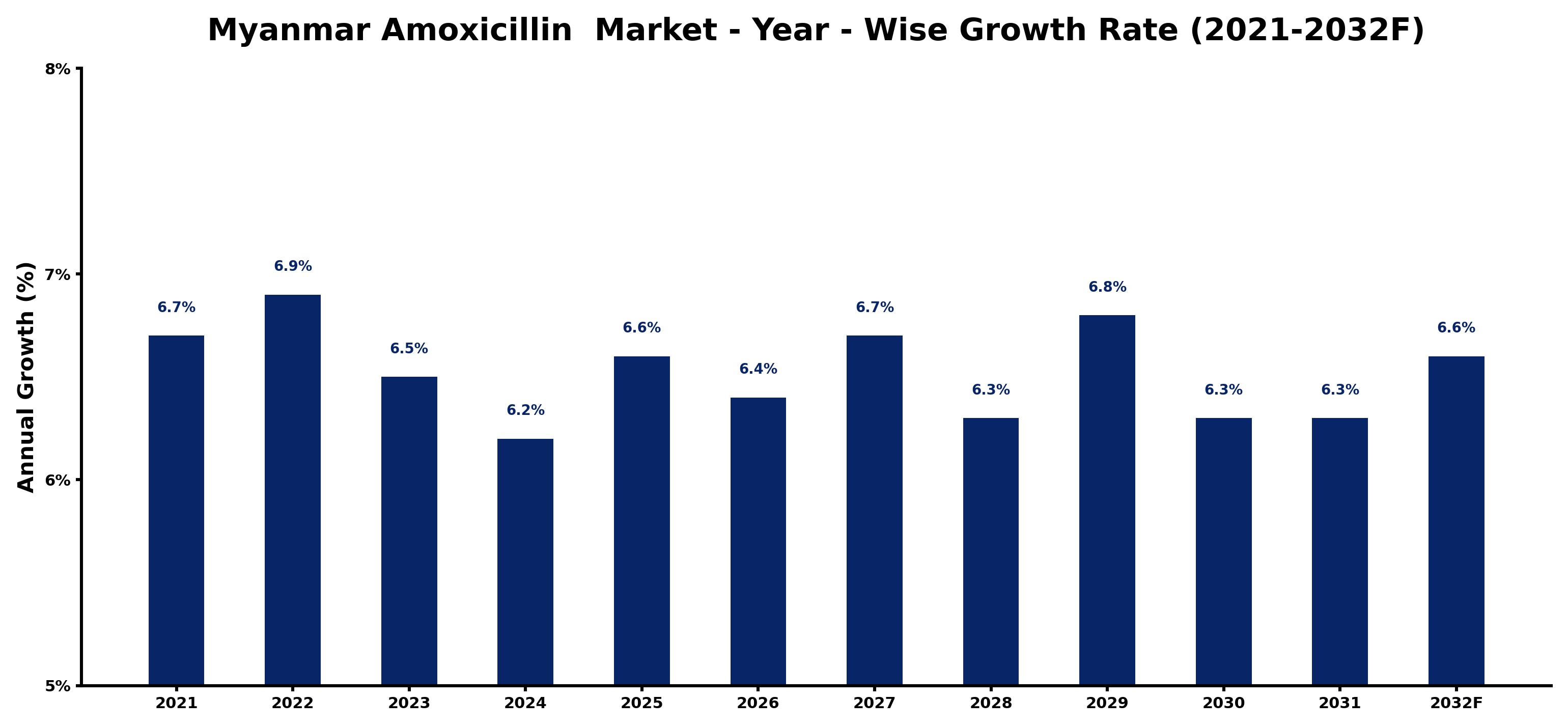
The table below presents the year‑wise growth rates along with the key drivers influencing the market
| Year | Growth Rate | Major Drivers |
| 2021 | 6.7% | Export driven pharmaceutical investments boosted local amoxicillin production capacity |
| 2022 | 6.9% | Pharmaceutical production facility upgrades drive Amoxicillin output efficiency |
| 2023 | 6.5% | Improved antibiotic production capacity drives local amoxicillin supply efficiency |
| 2024 | 6.2% | New manufacturing plants boost local amoxicillin production capacity |
| 2025 | 6.6% | Local pharmaceutical plants attract foreign investment for production scale up |
| 2026 | 6.4% | Pharmaceutical manufacturing upgrades boosted local amoxicillin production capabilities |
| 2027 | 6.7% | Local pharmaceutical manufacturing investments boosted amoxicillin production capabilities |
| 2028 | 6.3% | Export driven demand boosted local amoxicillin manufacturing capacity utilization |
| 2029 | 6.8% | Pharmaceutical tech upgrades improved amoxicillin production efficiency in Myanmar |
| 2030 | 6.3% | Pharmaceutical manufacturers expand production to meet rising Amoxicillin demand |
| 2031 | 6.3% | Pharmaceutical manufacturing upgrades drive increased amoxicillin production capacity |
| 2032 | 6.6% | Pharmaceutical facility upgrades boosted local amoxicillin production capacity |
Note - Market size estimations and growth projections presented in this report are based on 6Wresearch's advanced forecasting approach, validated with industry datasets as of June 2026.
Myanmar Amoxicillin Market Synopsis
The demand for Amoxicillin in Myanmar has surged, particularly in rural areas, where access to effective antibiotics is crucial. This has led to a notable increase in generic formulations, making treatment more affordable and widely available.
Moreover, ongoing government initiatives aimed at improving healthcare infrastructure are playing a significant role in supporting market expansion. As healthcare facilities become more accessible, the need for essential medicines like Amoxicillin is expected to rise correspondingly.
Myanmar Amoxicillin Market Key Takeaways
- The market is experiencing robust growth, driven by increasing healthcare access and awareness.
- Generic Amoxicillin products are gaining traction due to their cost-effectiveness.
- Partnerships between local and international manufacturers are on the rise, enhancing distribution.
- Regulatory policies aim to ensure quality and safety while combating counterfeit drugs.
- Investment in manufacturing and innovative formulations presents lucrative opportunities.
Evaluation of Restraints in Myanmar Amoxicillin Market
Despite the growth potential, the Myanmar Amoxicillin market faces several significant challenges. The regulatory landscape remains complex, often leading to delays in product approvals and registrations, which can hinder timely market entry. Additionally, the prevalence of counterfeit drugs poses serious risks to public health and undermines the competitiveness of legitimate offerings. Distribution inefficiencies, particularly in remote areas, further complicate access to genuine Amoxicillin products, limiting market growth and healthcare outcomes.
Myanmar Amoxicillin Market Trends
A prominent trend is the increasing shift towards generic Amoxicillin formulations, as they provide a more affordable alternative to branded options. Additionally, there is an emphasis on expanding access to essential medications in rural areas, where healthcare disparities are most pronounced. Collaborative efforts between local manufacturers and international pharmaceutical companies are enhancing the supply chain and ensuring that quality products reach underserved populations. This trend is expected to persist, fostering a more robust healthcare framework.
Myanmar Amoxicillin Market Opportunities
The market presents several key investment opportunities, particularly in establishing manufacturing facilities tailored to local needs. Given the rising population and increased demand for antibiotics, companies can benefit from localized production. Additionally, investment in research and development for innovative Amoxicillin formulations or delivery methods could create competitive advantages. Engaging with local distributors can also facilitate market penetration and enhance the accessibility of Amoxicillin across Myanmar.
Government Initiatives in the Myanmar Amoxicillin Market
The Myanmar government has implemented various policies aimed at regulating the production and distribution of pharmaceuticals, including Amoxicillin. Oversight by the Ministry of Health and Sports ensures that manufacturers comply with Good Manufacturing Practices (GMP) to maintain quality and safety standards. Initiatives also focus on licensing requirements for imports and exports to mitigate the influx of counterfeit products. Price controls are occasionally instituted to make essential medicines like Amoxicillin more affordable, reflecting the government's commitment to public health.
Future Insights of the Myanmar Amoxicillin Market
Looking ahead to 2026-2032, the Myanmar Amoxicillin market is poised for consistent growth. Factors such as continuous improvement in healthcare infrastructure and increasing awareness of the importance of antibiotics are expected to bolster demand. However, stakeholders must navigate ongoing challenges related to counterfeit medications and complex regulatory environments. If effectively addressed, these factors could lead to a more sustainable and competitive market landscape.
Myanmar Amoxicillin Market Latest Developments (May 2025 - June 2026)
Recent developments in the Myanmar Amoxicillin market have seen an uptick in collaborations among local and international pharmaceutical entities, aimed at strengthening supply chains. Efforts to combat counterfeit drugs have intensified, leading to initiatives that enhance regulatory compliance. Additionally, community health programs have been launched to raise awareness about the importance of completing antibiotic courses, thereby promoting responsible usage and further stimulating demand for genuine Amoxicillin products.
Myanmar Amoxicillin Market - Key Attractiveness of the Report
- 10 Years of Market Numbers
- Historical Data Starting from 2022 to 2025
- Base Year: 2025
- Forecast Data until 2032
- Key Performance Indicators Impacting the Market
- Major Upcoming Developments and Projects
Key Highlights of the Report:
- Myanmar Amoxicillin Market Outlook
- Market Size of Myanmar Amoxicillin Market, 2025
- Forecast of Myanmar Amoxicillin Market, 2032
- Historical Data and Forecast of Myanmar Amoxicillin Revenues & Volume for the Period 2022-2032F
- Myanmar Amoxicillin Market Trend Evolution
- Myanmar Amoxicillin Market Drivers and Challenges
- Myanmar Amoxicillin Price Trends
- Myanmar Amoxicillin Porter's Five Forces
- Myanmar Amoxicillin Industry Life Cycle
- Historical Data and Forecast of Myanmar Amoxicillin Market Revenues & Volume By Infection Type for the Period 2022-2032F
- Historical Data and Forecast of Myanmar Amoxicillin Market Revenues & Volume By Skin Infections for the Period 2022-2032F
- Historical Data and Forecast of Myanmar Amoxicillin Market Revenues & Volume By ENT (Ear, Nose & Throat) Infections for the Period 2022-2032F
- Historical Data and Forecast of Myanmar Amoxicillin Market Revenues & Volume By Stomach Infections for the Period 2022-2032F
- Historical Data and Forecast of Myanmar Amoxicillin Market Revenues & Volume By Lungs Infections for the Period 2022-2032F
- Historical Data and Forecast of Myanmar Amoxicillin Market Revenues & Volume By Urinary tract infections (UTI) for the Period 2022-2032F
- Historical Data and Forecast of Myanmar Amoxicillin Market Revenues & Volume By Pneumonia for the Period 2022-2032F
- Historical Data and Forecast of Myanmar Amoxicillin Market Revenues & Volume By Bronchitis for the Period 2022-2032F
- Historical Data and Forecast of Myanmar Skin Infections Amoxicillin Market Revenues & Volume By Gonorrhea for the Period 2022-2032F
- Historical Data and Forecast of Myanmar Amoxicillin Market Revenues & Volume By Route of Administration for the Period 2022-2032F
- Historical Data and Forecast of Myanmar Amoxicillin Market Revenues & Volume By Oral for the Period 2022-2032F
- Historical Data and Forecast of Myanmar Amoxicillin Market Revenues & Volume By Intravenous for the Period 2022-2032F
- Historical Data and Forecast of Myanmar Amoxicillin Market Revenues & Volume By Form for the Period 2022-2032F
- Historical Data and Forecast of Myanmar Amoxicillin Market Revenues & Volume By Tablets for the Period 2022-2032F
- Historical Data and Forecast of Myanmar Amoxicillin Market Revenues & Volume By Capsule for the Period 2022-2032F
- Historical Data and Forecast of Myanmar Amoxicillin Market Revenues & Volume By Suspensions for the Period 2022-2032F
- Historical Data and Forecast of Myanmar Amoxicillin Market Revenues & Volume By Syrup for the Period 2022-2032F
- Historical Data and Forecast of Myanmar Amoxicillin Market Revenues & Volume By Powder for the Period 2022-2032F
- Historical Data and Forecast of Myanmar Amoxicillin Market Revenues & Volume By Distribution Channel for the Period 2022-2032F
- Historical Data and Forecast of Myanmar Amoxicillin Market Revenues & Volume By Hospitals Pharmacies for the Period 2022-2032F
- Historical Data and Forecast of Myanmar Amoxicillin Market Revenues & Volume By Retail Pharmacies for the Period 2022-2032F
- Historical Data and Forecast of Myanmar Amoxicillin Market Revenues & Volume By Online Pharmacies for the Period 2022-2032F
- Historical Data and Forecast of Myanmar Amoxicillin Market Revenues & Volume By Others for the Period 2022-2032F
- Myanmar Amoxicillin Import Export Trade Statistics
- Market Opportunity Assessment By Infection Type
- Market Opportunity Assessment By Route of Administration
- Market Opportunity Assessment By Form
- Market Opportunity Assessment By Distribution Channel
- Myanmar Amoxicillin Top Companies Market Share
- Myanmar Amoxicillin Competitive Benchmarking By Technical and Operational Parameters
- Myanmar Amoxicillin Company Profiles
- Myanmar Amoxicillin Key Strategic Recommendations






































