Myanmar Apiculture Market Size, Share & Growth Rate
The Myanmar Apiculture Market was estimated at USD 760 Million in 2025 and is projected to reach USD 1078 Million by 2032, growing at a CAGR of 5.1% from 2026 to 2032. This growth trajectory is primarily driven by rising domestic and international demand for honey and other bee products, propelled by increasing health consciousness and a shift towards natural and organic options. Additionally, supportive government policies and favorable environmental conditions are fostering an environment ripe for expansion.
Myanmar Apiculture Market Year-wise Growth Rate and Key Drivers
This graph highlights how the Myanmar Apiculture Market has steadily grown over the years, supported by major growth factors.
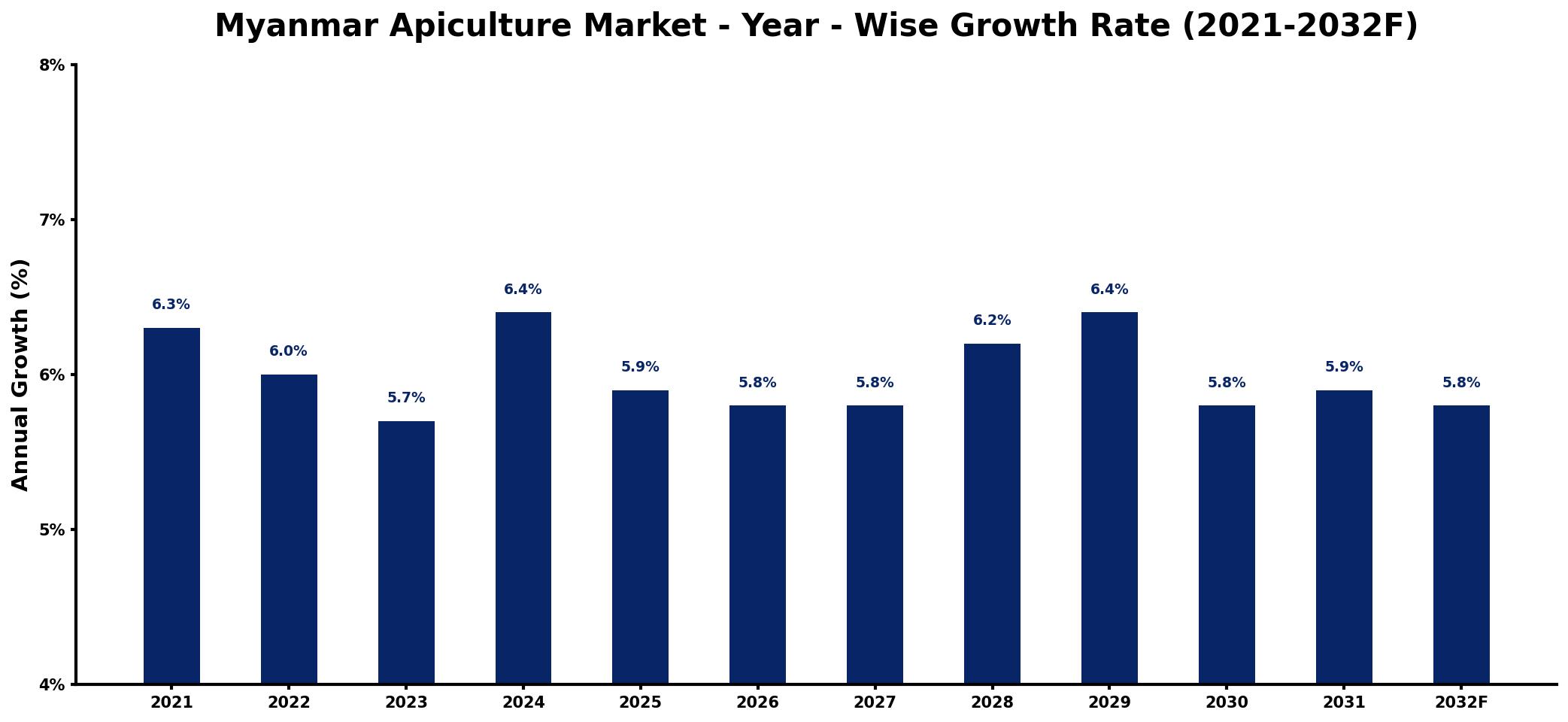
The table below presents the year‑wise growth rates along with the key drivers influencing the market
| Year | Growth Rate | Major Drivers |
| 2021 | 6.3% | Rising consumer health awareness |
| 2022 | 6.0% | Increase in organic farming practices |
| 2023 | 5.7% | Growth in local honey exports |
| 2024 | 6.4% | Expansion of beekeeping education programs |
| 2025 | 5.9% | Investments in sustainable agriculture |
| 2026 | 5.8% | Surge in natural food trends |
| 2027 | 5.8% | Development of pollinator-friendly policies |
| 2028 | 6.2% | Boost in agricultural biodiversity initiatives |
| 2029 | 6.4% | Growing demand for eco-friendly products |
| 2030 | 5.8% | Strengthening of local farmer cooperatives |
| 2031 | 5.9% | Emergence of new market players |
| 2032 | 5.8% | improved raw material availability |
Note: Market size estimations and growth projections presented in this report are based on 6Wresearch's proprietary forecasting methodology, utilizing the latest available industry data, government publications, and primary research inputs.
Myanmar Apiculture Market Synopsis
The Myanmar Apiculture Market is currently experiencing a robust phase of growth, underpinned by a strong increase in local and international demand for honey. However, this traditional sector is on the cusp of a modernization wave, seeking to enhance productivity and quality through improved beekeeping practices.
While small-scale beekeepers have historically dominated the market, there is a significant transition towards the adoption of contemporary techniques and equipment. This shift, combined with the governments initiatives to improve training and infrastructure, positions the market favorably for future expansion.
Myanmar Apiculture Market Key Takeaways
- Increasing global awareness of the health benefits of honey is driving consumer demand.
- Small-scale beekeeping remains prevalent, but modernization efforts are gaining traction.
- Government support for training and infrastructure is critical for market expansion.
- The rising trend towards organic honey presents new opportunities for differentiation.
- Investment in technology and practices is essential to overcome existing productivity barriers.
Evaluation of Restraints in Myanmar Apiculture Market
Despite its growth potential, the Myanmar Apiculture Market faces several significant challenges. A primary constraint is the limited access to advanced beekeeping technology, which hampers productivity levels and the quality of honey produced. Furthermore, beekeepers often struggle with inadequate financial resources, which restricts their ability to invest in modern equipment and practices. Additionally, logistical hurdles stemming from poor infrastructure can hinder the distribution of honey products to urban markets, and pest and disease management remains a persistent threat to beekeeping sustainability. Overcoming these obstacles will be vital to realizing the market's full potential.
Myanmar Apiculture Market Trends
A noteworthy trend in the Myanmar Apiculture Market is the growing interest in organic and sustainably sourced honey, reflecting a broader global demand for natural products. Beekeepers are increasingly adopting modern techniques, such as improved hive management and better pest control, to enhance production efficiency. Additionally, awareness of the ecological role of bees in pollination has spurred interest in beekeeping as a sustainable agricultural practice, attracting new entrants into the market. These trends underscore a pivotal shift toward quality and sustainability in apiculture.
Myanmar Apiculture Market Opportunities
The Myanmar Apiculture Market is ripe with opportunities for investment and growth. The increasing global demand for honey and bee products signifies a potential for Myanmar to establish itself as a key player in the international market. Investors are encouraged to focus on modernizing beekeeping techniques, as well as on the production of organic honey, which could command premium prices. Collaborations with local beekeepers to enhance their skills and establish effective marketing channels can create pathways for enhanced market penetration and product differentiation.
Government Initiatives in the Myanmar Apiculture Market
The government of Myanmar has implemented several initiatives aimed at bolstering the apiculture sector. These include training programs for local beekeepers to improve their skills and knowledge of sustainable practices. Furthermore, the government is focused on increasing access to modern equipment and establishing regulatory frameworks that enhance the quality and safety of honey products. The promotion of organic beekeeping methods is another key aspect of governmental support, designed to position Myanmar's honey competitively in the global marketplace.
Future Insights of the Myanmar Apiculture Market
Looking ahead to 2026-2032, the future of the Myanmar Apiculture Market appears encouraging, driven by a consistent rise in demand for honey and a broader acceptance of organic products. The combination of favorable climatic conditions and governmental support enhances the market's growth potential. However, attention to emerging challenges, such as international competition and the need for technological upgrades, will be crucial for sustaining this upward trajectory. With strategic investments and continuous innovation, the market is poised for steady advancement.
Myanmar Apiculture Market Latest Developments (2025 - 2026)
Recent developments in the Myanmar Apiculture Market indicate a strong push towards modernization, with many beekeepers beginning to adopt innovative beekeeping technologies. There has been a notable rise in community-based training programs that aim to enhance beekeeping practices and promote organic honey production. Additionally, infrastructure projects aimed at improving transportation networks are underway, which could significantly enhance the market reach for honey producers. This wave of change reflects the evolving landscape of Myanmar's apiculture sector.
Myanmar Apiculture Market - Key Attractiveness of the Report
- 10 Years of Market Numbers
- Historical Data Starting from 2022 to 2025
- Base Year: 2025
- Forecast Data until 2032
- Key Performance Indicators Impacting the Market
- Major Upcoming Developments and Projects
Key Highlights of the Report:
- Myanmar Apiculture Market Outlook
- Market Size of Myanmar Apiculture Market, 2025
- Forecast of Myanmar Apiculture Market, 2032
- Historical Data and Forecast of Myanmar Apiculture Revenues & Volume for the Period 2022-2032F
- Myanmar Apiculture Market Trend Evolution
- Myanmar Apiculture Market Drivers and Challenges
- Myanmar Apiculture Price Trends
- Myanmar Apiculture Porter's Five Forces
- Myanmar Apiculture Industry Life Cycle
- Historical Data and Forecast of Myanmar Apiculture Market Revenues & Volume By Product Type for the Period 2022-2032F
- Historical Data and Forecast of Myanmar Apiculture Market Revenues & Volume By Honey for the Period 2022-2032F
- Historical Data and Forecast of Myanmar Apiculture Market Revenues & Volume By Beeswax for the Period 2022-2032F
- Historical Data and Forecast of Myanmar Apiculture Market Revenues & Volume By Live-bees for the Period 2022-2032F
- Historical Data and Forecast of Myanmar Apiculture Market Revenues & Volume By Others for the Period 2022-2032F
- Historical Data and Forecast of Myanmar Apiculture Market Revenues & Volume By Application for the Period 2022-2032F
- Historical Data and Forecast of Myanmar Apiculture Market Revenues & Volume By Medical for the Period 2022-2032F
- Historical Data and Forecast of Myanmar Apiculture Market Revenues & Volume By Food Beverages for the Period 2022-2032F
- Historical Data and Forecast of Myanmar Apiculture Market Revenues & Volume By Cosmetics for the Period 2022-2032F
- Historical Data and Forecast of Myanmar Apiculture Market Revenues & Volume By Others for the Period 2022-2032F
- Myanmar Apiculture Import Export Trade Statistics
- Market Opportunity Assessment By Product Type
- Market Opportunity Assessment By Application
- Myanmar Apiculture Top Companies Market Share
- Myanmar Apiculture Competitive Benchmarking By Technical and Operational Parameters
- Myanmar Apiculture Company Profiles
- Myanmar Apiculture Key Strategic Recommendations






































