Myanmar Apparel Accessories Market Size, Share & Growth Rate
The Myanmar Apparel Accessories Market was estimated at USD 293 Million in 2025 and is projected to reach USD 404 Million by 2032, growing at a CAGR of 4.7% from 2026 to 2032. This growth trajectory is being fueled by increasing disposable income and the rising fashion consciousness among the countrys young population. With a shift towards sustainable and ethically sourced products, consumers are increasingly demanding a broader variety of apparel accessories, creating ample opportunities for market expansion.
Myanmar Apparel Accessories Market Year-wise Growth Rate and Key Drivers
This graph highlights how the Myanmar Apparel Accessories Market has steadily grown over the years, supported by major growth factors.
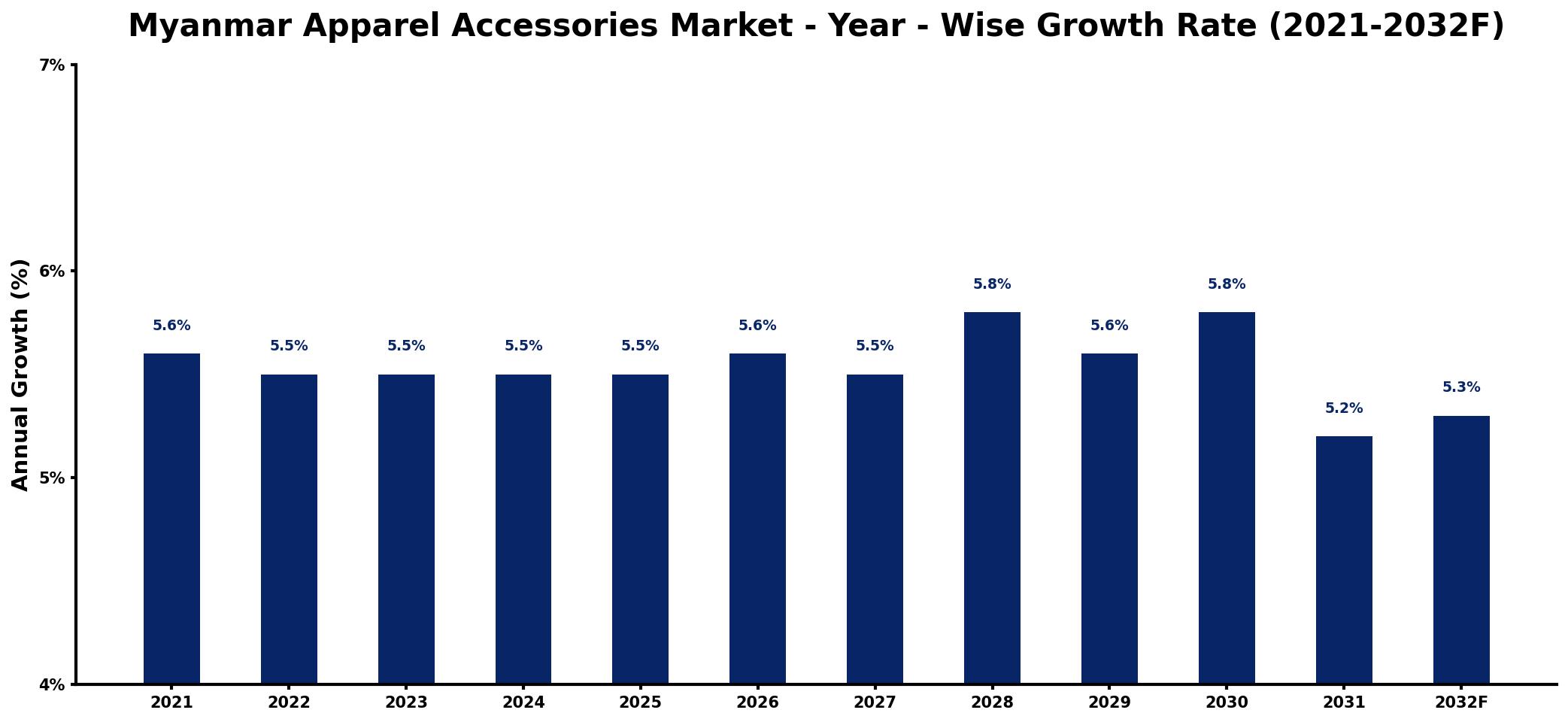
The table below presents the year‑wise growth rates along with the key drivers influencing the market
| Year | Growth Rate | Major Drivers |
| 2021 | 5.6% | Rising disposable income levels |
| 2022 | 5.5% | Increased consumer fashion consciousness |
| 2023 | 5.5% | Growth in e-commerce platforms |
| 2024 | 5.5% | Expansion of retail distribution channels |
| 2025 | 5.5% | Higher investment in manufacturing |
| 2026 | 5.6% | Emergence of sustainable practices |
| 2027 | 5.5% | Boost in local craftsmanship initiatives |
| 2028 | 5.8% | Popularity of online shopping trends |
| 2029 | 5.6% | Enhanced marketing strategies adopted |
| 2030 | 5.8% | increased production capacity utilization |
| 2031 | 5.2% | Shift towards personalized offerings |
| 2032 | 5.3% | Increase in export opportunities |
Note: Market size estimations and growth projections presented in this report are based on 6Wresearch's proprietary forecasting methodology, utilizing the latest available industry data, government publications, and primary research inputs.
Myanmar Apparel Accessories Market Synopsis
The strongest force shaping the Myanmar Apparel Accessories Market currently is the growing preference for sustainable products. As consumers become more aware of environmental and social issues, there is a notable shift towards locally made and ethically sourced accessories, reflecting a broader global trend. This shift is encouraging local artisans and traditional craftsmanship, enhancing the market's uniqueness and appeal.
Additionally, the popularity of e-commerce platforms is transforming how consumers access apparel accessories. With the convenience of online shopping, buyers are exposed to a wider range of products, including versatile and multifunctional items that cater to both style and practicality. This increased accessibility is vital for driving market growth and introducing new brands to a tech-savvy consumer base.
Myanmar Apparel Accessories Market Key Takeaways
- The market is shifting towards sustainable and ethically sourced accessories.
- Growing online shopping trends are expanding consumer access to diverse products.
- Local craftsmanship and unique designs are becoming increasingly popular.
- Investment opportunities exist for both local and international brands.
- The government's supportive policies are expected to encourage further market growth.
Evaluation of Restraints in Myanmar Apparel Accessories Market
Despite the promising growth, several restraints hinder the Myanmar Apparel Accessories Market. Limited access to advanced technology and modern production equipment leads to inefficiencies, affecting the overall product quality. Inconsistent quality standards pose challenges for manufacturers striving to compete globally. Furthermore, inadequate infrastructure, particularly in transportation and logistics, complicates timely deliveries and increases operational costs. Political instability and an unpredictable regulatory environment further inhibit investment and business expansion, necessitating strategic solutions for sustained growth.
Myanmar Apparel Accessories Market Trends
Several trends are currently shaping the Myanmar Apparel Accessories Market. A notable movement towards minimalism and neutral color palettes has emerged, catering to the aesthetic preferences of the modern consumer. Additionally, the demand for multifunctional accessories is on the rise, as consumers seek practicality without compromising style. The emphasis on sustainability is also influencing design choices, with brands increasingly opting for eco-friendly materials and production processes. As global fashion trends intermingle with local culture, traditional craftsmanship is experiencing a resurgence, adding a unique dimension to the market landscape.
Myanmar Apparel Accessories Market Opportunities
Investment opportunities in the Myanmar Apparel Accessories Market are abundant, particularly due to the countrys burgeoning garment industry. The young and fashion-conscious demographic is driving demand for stylish and affordable accessories, presenting a lucrative prospect for investors. Collaborations with local manufacturers to produce high-quality items can enhance brand visibility in both domestic and international markets. E-commerce platforms present a significant channel for reaching a broader audience, allowing brands to leverage online marketing strategies and innovative designs to meet evolving consumer preferences effectively.
Government Initiatives in the Myanmar Apparel Accessories Market
The Myanmar government is actively pursuing policies to bolster growth in the apparel accessories market. Trade liberalization measures have been implemented to attract foreign investment and support local manufacturing capabilities. Additionally, initiatives aimed at enhancing supply chain infrastructure are underway, coupled with incentives like tax breaks and subsidies for companies in the apparel sector. However, ongoing concerns about labor rights and environmental practices are prompting the government to refine regulations, ensuring responsible operations across the industry.
Future Insights of the Myanmar Apparel Accessories Market
Looking ahead to 2026-2032, the Myanmar Apparel Accessories Market is poised for substantial growth. Factors such as rising disposable incomes and an expanding middle class are set to drive demand for fashionable accessories. The governments commitment to supporting the textile and apparel industry will likely attract further investments, positioning the market for enhanced competitiveness. As consumer preferences evolve towards quality and sustainability, both local and international brands are well-placed to take advantage of the emerging opportunities, contributing to a vibrant and dynamic market landscape.
Myanmar Apparel Accessories Market Latest Developments (2025 - 2026)
Recent developments in the Myanmar Apparel Accessories Market indicate a strengthening focus on sustainability and ethical production practices. A growing number of brands are introducing collections that emphasize eco-friendly materials and transparent sourcing processes. Additionally, the rise of local artisan collaborations is gaining traction, contributing to a rich blend of traditional techniques and contemporary designs. E-commerce continues to evolve, with more platforms emerging to facilitate access to diverse product ranges, enhancing consumer choice across the market.
Myanmar Apparel Accessories Market - Key Attractiveness of the Report
- 10 Years of Market Numbers
- Historical Data Starting from 2022 to 2025
- Base Year: 2025
- Forecast Data until 2032
- Key Performance Indicators Impacting the Market
- Major Upcoming Developments and Projects
Key Highlights of the Report:
- Myanmar Apparel Accessories Market Outlook
- Market Size of Myanmar Apparel Accessories Market, 2025
- Forecast of Myanmar Apparel Accessories Market, 2032
- Historical Data and Forecast of Myanmar Apparel Accessories Revenues & Volume for the Period 2022-2032F
- Myanmar Apparel Accessories Market Trend Evolution
- Myanmar Apparel Accessories Market Drivers and Challenges
- Myanmar Apparel Accessories Price Trends
- Myanmar Apparel Accessories Porter's Five Forces
- Myanmar Apparel Accessories Industry Life Cycle
- Historical Data and Forecast of Myanmar Apparel Accessories Market Revenues & Volume By Product for the Period 2022-2032F
- Historical Data and Forecast of Myanmar Apparel Accessories Market Revenues & Volume By Belts for the Period 2022-2032F
- Historical Data and Forecast of Myanmar Apparel Accessories Market Revenues & Volume By Handbags for the Period 2022-2032F
- Historical Data and Forecast of Myanmar Apparel Accessories Market Revenues & Volume By Scarves for the Period 2022-2032F
- Historical Data and Forecast of Myanmar Apparel Accessories Market Revenues & Volume By Eye wear for the Period 2022-2032F
- Historical Data and Forecast of Myanmar Apparel Accessories Market Revenues & Volume By Jewelry for the Period 2022-2032F
- Historical Data and Forecast of Myanmar Apparel Accessories Market Revenues & Volume By Neckties for the Period 2022-2032F
- Historical Data and Forecast of Myanmar Apparel Accessories Market Revenues & Volume By Gloves for the Period 2022-2032F
- Historical Data and Forecast of Myanmar Belts Apparel Accessories Market Revenues & Volume By Others for the Period 2022-2032F
- Historical Data and Forecast of Myanmar Apparel Accessories Market Revenues & Volume By Demographic for the Period 2022-2032F
- Historical Data and Forecast of Myanmar Apparel Accessories Market Revenues & Volume By Men for the Period 2022-2032F
- Historical Data and Forecast of Myanmar Apparel Accessories Market Revenues & Volume By Women for the Period 2022-2032F
- Historical Data and Forecast of Myanmar Apparel Accessories Market Revenues & Volume By Children for the Period 2022-2032F
- Historical Data and Forecast of Myanmar Apparel Accessories Market Revenues & Volume By Price for the Period 2022-2032F
- Historical Data and Forecast of Myanmar Apparel Accessories Market Revenues & Volume By Economical Apparel Accessories for the Period 2022-2032F
- Historical Data and Forecast of Myanmar Apparel Accessories Market Revenues & Volume By Mid-range Apparel Accessories for the Period 2022-2032F
- Historical Data and Forecast of Myanmar Apparel Accessories Market Revenues & Volume By Premium Apparel Accessories for the Period 2022-2032F
- Historical Data and Forecast of Myanmar Apparel Accessories Market Revenues & Volume By Super-premium Apparel Accessories for the Period 2022-2032F
- Historical Data and Forecast of Myanmar Apparel Accessories Market Revenues & Volume By Sales Channel for the Period 2022-2032F
- Historical Data and Forecast of Myanmar Apparel Accessories Market Revenues & Volume By Apparel Accessories Sold through Modern Trade for the Period 2022-2032F
- Historical Data and Forecast of Myanmar Apparel Accessories Market Revenues & Volume By Apparel Accessories Sold at Franchise Outlets for the Period 2022-2032F
- Historical Data and Forecast of Myanmar Apparel Accessories Market Revenues & Volume By Apparel Accessories Sold at Specialty Stores for the Period 2022-2032F
- Historical Data and Forecast of Myanmar Apparel Accessories Market Revenues & Volume By Others for the Period 2022-2032F
- Myanmar Apparel Accessories Import Export Trade Statistics
- Market Opportunity Assessment By Product
- Market Opportunity Assessment By Demographic
- Market Opportunity Assessment By Price
- Market Opportunity Assessment By Sales Channel
- Myanmar Apparel Accessories Top Companies Market Share
- Myanmar Apparel Accessories Competitive Benchmarking By Technical and Operational Parameters
- Myanmar Apparel Accessories Company Profiles
- Myanmar Apparel Accessories Key Strategic Recommendations






































