Myanmar Artificial Intelligence in Accounting Market Size & Growth Rate (2026-2032)
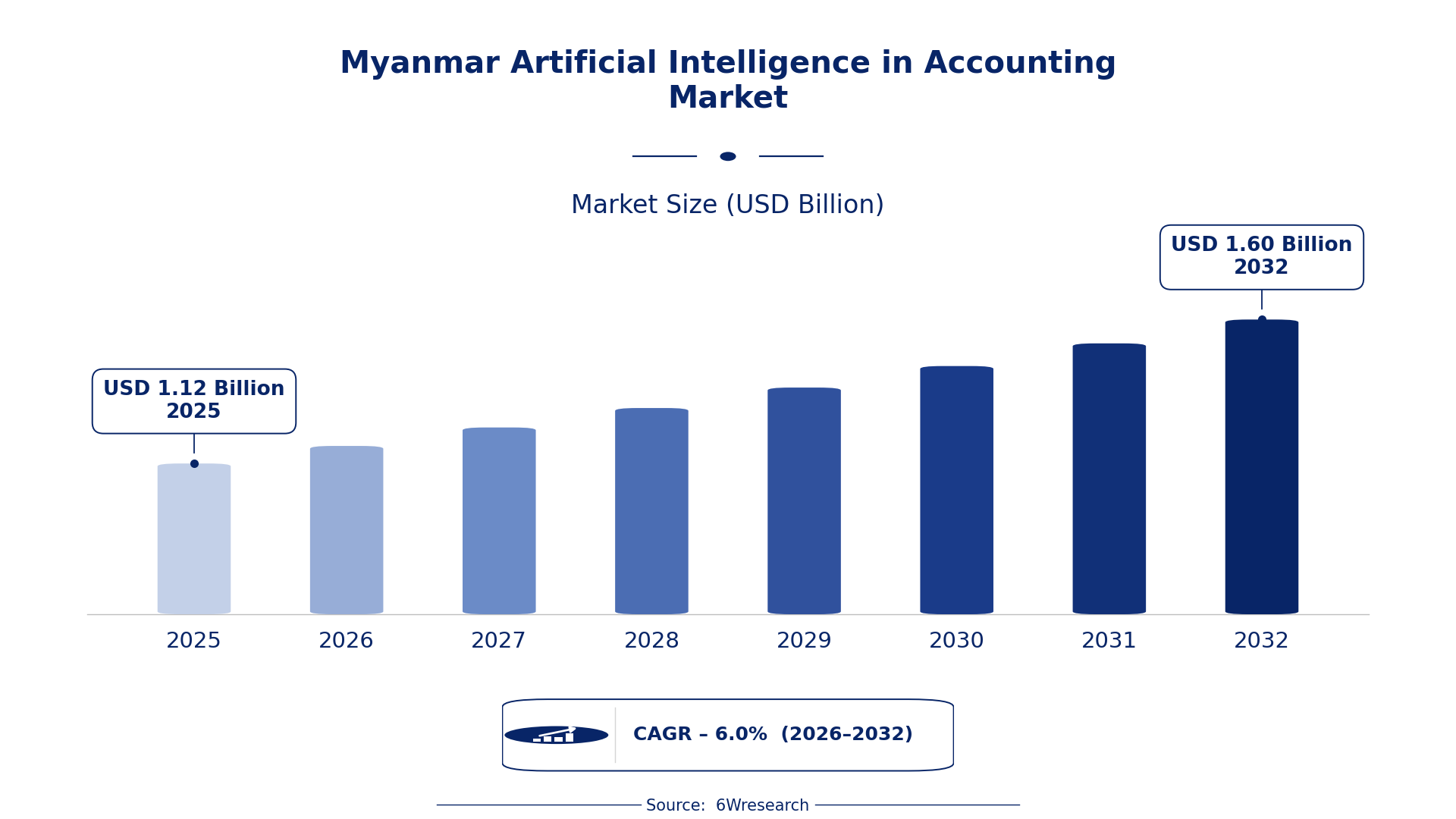
The Myanmar Artificial Intelligence in Accounting Market was estimated at USD 1117 Million in 2025 and is projected to reach USD 1597 Million by 2032, growing at a CAGR of 6.0% from 2026 to 2032.
Myanmar Artificial Intelligence in Accounting Market Synopsis
The demand for Artificial Intelligence in accounting is on the rise in Myanmar, driven by the pressing need for efficiency and accuracy in financial reporting. Businesses are increasingly integrating AI technologies into their accounting processes, focusing on automating routine tasks such as data entry and invoice processing.
As organizations look for ways to enhance their financial operations, AI solutions are becoming essential tools for gaining real-time insights and improving decision-making capabilities. The market is at a critical juncture, with opportunities for innovation and growth as companies adapt to these transformative technologies.
Myanmar Artificial Intelligence in Accounting Market Year-wise Growth Rate and Key Drivers
This graph illustrates the annual growth rates of the Myanmar Artificial Intelligence in Accounting Market from 2021 to 2032, highlighting a steady upward trajectory and projected expansion over the forecast period.
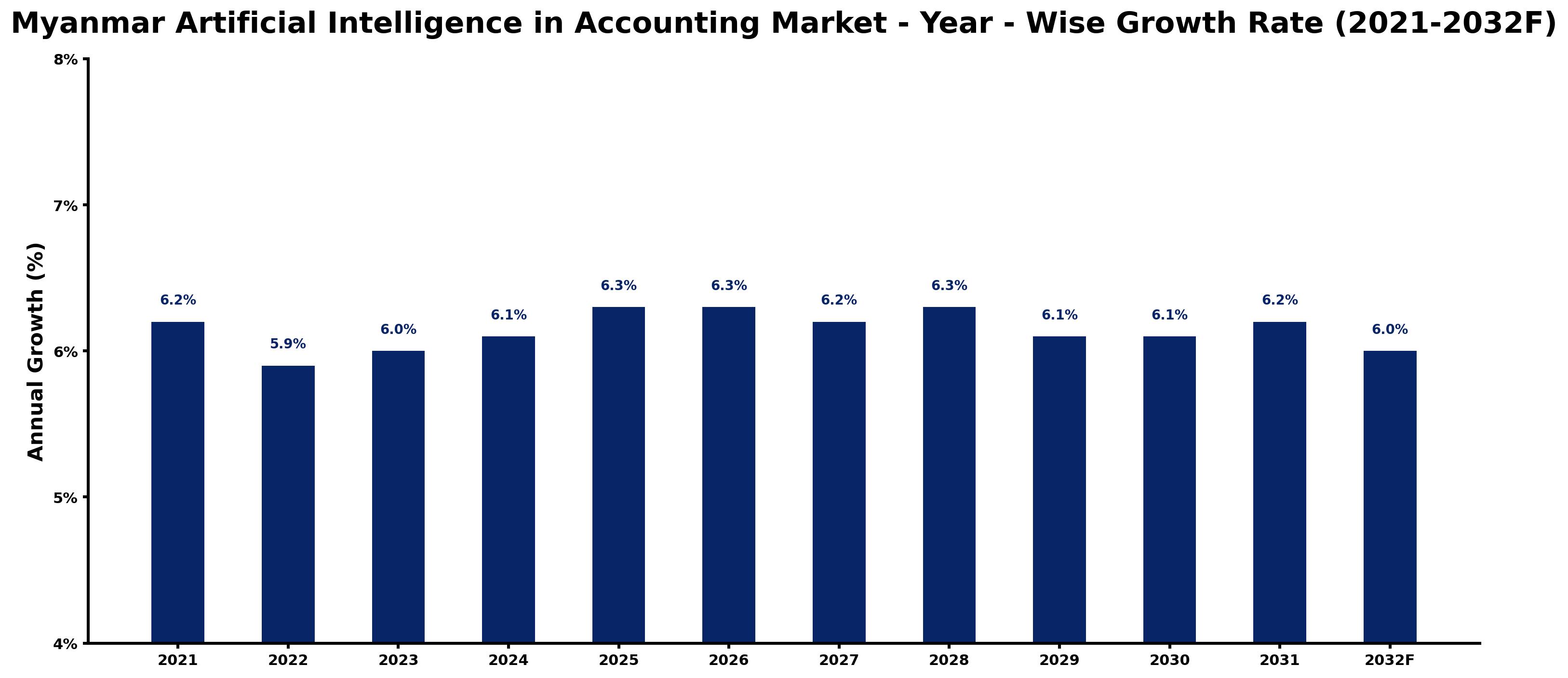
The table below presents the year‑wise growth rates along with the key drivers influencing the market
| Year | Growth Rate | Major Drivers |
| 2021 | 6.2% | Increased adoption of cloud-based accounting solutions. |
| 2022 | 5.9% | Regulatory push for digital transformation in financial reporting. |
| 2023 | 6.0% | Growing interest in automated tax compliance solutions. |
| 2024 | 6.1% | Introduction of local AI startups in financial services. |
| 2025 | 6.3% | Support from government for technology-driven financial literacy. |
| 2026 | 6.3% | Corporate investments in AI for operational efficiency. |
| 2027 | 6.2% | Emerging fintech partnerships with global AI providers. |
| 2028 | 6.3% | Local demand for enhanced fraud detection mechanisms. |
| 2029 | 6.1% | Increased user familiarity with AI-powered accounting tools. |
| 2030 | 6.1% | Strengthened data privacy regulations prompting AI innovations. |
| 2031 | 6.2% | Rising number of SMEs implementing AI solutions. |
| 2032 | 6.0% | Government incentives promoting AI integration in businesses. |
Note: Market size estimations and growth projections presented in this report are based on 6Wresearch's proprietary forecasting methodology, utilizing the latest available industry data, government publications, and primary research inputs.
Myanmar Artificial Intelligence in Accounting Market Key Takeaways
Below are some of the specific key takeaways from the market, including:
- AI technologies are streamlining accounting processes, significantly reducing manual errors.
- Predictive analytics and fraud detection are becoming integral components of financial management.
- Education on AI technology remains crucial for wider adoption within the accounting sector.
- Investment in AI solutions is increasingly seen as essential for competitive advantage among businesses.
- Government initiatives are gradually aligning with the needs of the digital transformation in accounting.
Evaluation of Restraints in Myanmar Artificial Intelligence in Accounting Market
Despite the promising growth of AI in the accounting sector, several constraints hinder its rapid adoption. A significant barrier is the limited understanding of AI technologies among accounting professionals, which affects decision-making and implementation. The shortage of a skilled workforce proficient in both AI and accounting further complicates matters. Additionally, concerns surrounding data privacy and security are prevalent, as businesses navigate regulatory frameworks that are still evolving. The high upfront costs associated with AI integration often deter companies from making the transition from traditional practices, leading to a reluctance to innovate.
Myanmar Artificial Intelligence in Accounting Market Trends
The focus on automating routine accounting tasks continues to drive the demand for AI solutions in Myanmar. Companies are increasingly prioritizing tools that enhance data accuracy and facilitate faster decision-making processes. The rise of machine learning and natural language processing capabilities in accounting software is enabling businesses to analyze extensive financial data sets more effectively, providing insights that were previously difficult to obtain. As awareness of these benefits grows, the trend toward AI adoption is expected to strengthen.
Myanmar Artificial Intelligence in Accounting Market Opportunities
The market presents numerous investment opportunities, particularly as organizations seek to automate and streamline their accounting processes. Developing partnerships with local firms to integrate AI technology into their operations can yield substantial returns. There is also a growing demand for tailored AI solutions designed specifically for the unique challenges faced by businesses in Myanmar. As companies strive for operational efficiency, investing in AI-powered accounting tools will likely become a priority.
Government Initiatives in the Myanmar Artificial Intelligence in Accounting Market
Government policy is gradually evolving to support the integration of AI technologies into various sectors, including accounting. While specific regulations for AI in accounting are still in development, the government's focus on digital transformation presents a favorable environment for growth. As Myanmar continues to modernize its economy, the establishment of clear guidelines for ethical AI use and data protection will be crucial for fostering innovation in the accounting sector.
- A national digital infrastructure upgrade programme launched in early 2024 aims to enhance connectivity for businesses, including those in the accounting sector.
- Current initiatives focus on promoting AI literacy among accounting professionals through training workshops and educational resources.
- Plans for a regulatory framework are underway, targeting the ethical use of AI and data security, expected to be introduced by late 2025.
- The government is currently exploring partnerships with technology providers to facilitate AI integration in public-sector accounting practices.
Future Insights of the Myanmar Artificial Intelligence in Accounting Market
Looking ahead to 2026-2032, the Myanmar Artificial Intelligence in Accounting Market is set for substantial growth. As businesses increasingly embrace digital technologies, the demand for AI-driven solutions will continue to rise. The ability of AI tools to streamline accounting processes and enhance operational efficiency will make them indispensable for companies aiming to stay competitive. Coupled with advancements in AI technology and heightened investment, the market is positioned for significant innovation and development.
Myanmar Artificial Intelligence in Accounting Market Latest Developments
In the past year, the Myanmar Artificial Intelligence in Accounting Market has seen dynamic activity as businesses and technology providers ramp up efforts to integrate AI solutions. The push for digital transformation has led to a surge in demand for innovative accounting technologies that enhance efficiency and accuracy.
- A leading software provider launched a new AI-driven accounting platform in early 2025, focusing on automating data entry and invoice processing.
- An ongoing initiative aims to collaborate with local universities to develop specialized AI training programs for accounting students, enhancing workforce readiness.
- A major technology vendor is currently rolling out a machine learning feature in its accounting software, expected to be completed by mid-2026.
- A partnership between financial institutions and tech startups is set to begin in late 2025, aimed at exploring AI applications in fraud detection.
Myanmar Artificial Intelligence in Accounting Market - Key Attractiveness of the Report
- 10 Years of Market Numbers
- Historical Data Starting from 2022 to 2025
- Base Year: 2025
- Forecast Data until 2032
- Key Performance Indicators Impacting the Market
- Major Upcoming Developments and Projects
Key Highlights of the Report:
- Myanmar Artificial Intelligence in Accounting Market Outlook
- Market Size of Myanmar Artificial Intelligence in Accounting Market, 2025
- Forecast of Myanmar Artificial Intelligence in Accounting Market, 2032
- Historical Data and Forecast of Myanmar Artificial Intelligence in Accounting Revenues & Volume for the Period 2022-2032F
- Myanmar Artificial Intelligence in Accounting Market Trend Evolution
- Myanmar Artificial Intelligence in Accounting Market Drivers and Challenges
- Myanmar Artificial Intelligence in Accounting Price Trends
- Myanmar Artificial Intelligence in Accounting Porter's Five Forces
- Myanmar Artificial Intelligence in Accounting Industry Life Cycle
- Historical Data and Forecast of Myanmar Artificial Intelligence in Accounting Market Revenues & Volume By Application for the Period 2022-2032F
- Historical Data and Forecast of Myanmar Artificial Intelligence in Accounting Market Revenues & Volume By Automated Bookkeeping for the Period 2022-2032F
- Historical Data and Forecast of Myanmar Artificial Intelligence in Accounting Market Revenues & Volume By Invoice Classification and Approvals for the Period 2022-2032F
- Historical Data and Forecast of Myanmar Artificial Intelligence in Accounting Market Revenues & Volume By Fraud and Risk Management for the Period 2022-2032F
- Historical Data and Forecast of Myanmar Artificial Intelligence in Accounting Market Revenues & Volume By Reporting for the Period 2022-2032F
- Historical Data and Forecast of Myanmar Artificial Intelligence in Accounting Market Revenues & Volume By Others for the Period 2022-2032F
- Historical Data and Forecast of Myanmar Artificial Intelligence in Accounting Market Revenues & Volume By Component for the Period 2022-2032F
- Historical Data and Forecast of Myanmar Artificial Intelligence in Accounting Market Revenues & Volume By Solutions for the Period 2022-2032F
- Historical Data and Forecast of Myanmar Artificial Intelligence in Accounting Market Revenues & Volume By Services for the Period 2022-2032F
- Historical Data and Forecast of Myanmar Artificial Intelligence in Accounting Market Revenues & Volume By Technology for the Period 2022-2032F
- Historical Data and Forecast of Myanmar Artificial Intelligence in Accounting Market Revenues & Volume By Machine Learning (ML) and Deep Learning for the Period 2022-2032F
- Historical Data and Forecast of Myanmar Artificial Intelligence in Accounting Market Revenues & Volume By NLP for the Period 2022-2032F
- Historical Data and Forecast of Myanmar Artificial Intelligence in Accounting Market Revenues & Volume By Deployment Mode for the Period 2022-2032F
- Historical Data and Forecast of Myanmar Artificial Intelligence in Accounting Market Revenues & Volume By On-premises for the Period 2022-2032F
- Historical Data and Forecast of Myanmar Artificial Intelligence in Accounting Market Revenues & Volume By Cloud for the Period 2022-2032F
- Historical Data and Forecast of Myanmar Artificial Intelligence in Accounting Market Revenues & Volume By Enterprise Size for the Period 2022-2032F
- Historical Data and Forecast of Myanmar Artificial Intelligence in Accounting Market Revenues & Volume By Large Enterprises for the Period 2022-2032F
- Historical Data and Forecast of Myanmar Artificial Intelligence in Accounting Market Revenues & Volume By Small and Medium-Sized Enterprises (SMEs) for the Period 2022-2032F
- Myanmar Artificial Intelligence in Accounting Import Export Trade Statistics
- Market Opportunity Assessment By Application
- Market Opportunity Assessment By Component
- Market Opportunity Assessment By Technology
- Market Opportunity Assessment By Deployment Mode
- Market Opportunity Assessment By Enterprise Size
- Myanmar Artificial Intelligence in Accounting Top Companies Market Share
- Myanmar Artificial Intelligence in Accounting Competitive Benchmarking By Technical and Operational Parameters
- Myanmar Artificial Intelligence in Accounting Company Profiles
- Myanmar Artificial Intelligence in Accounting Key Strategic Recommendations






































