Myanmar Auto Parts And Accessories Market Size, Share & Growth Rate
The Myanmar Auto Parts And Accessories Market was estimated at USD 194 Million in 2025 and is projected to reach USD 274 Million by 2032, growing at a CAGR of 5.1% from 2026 to 2032. This growth trajectory is being fueled by an increasing number of vehicles on the roads and a corresponding demand for quality auto parts and accessories. Moreover, as the automotive industry matures, consumers are seeking not just functionality but also customization, driving further opportunities for suppliers and manufacturers.
Myanmar Auto Parts And Accessories Market Year-wise Growth Rate and Key Drivers
This graph highlights how the Myanmar Auto Parts And Accessories Market has steadily grown over the years, supported by major growth factors.
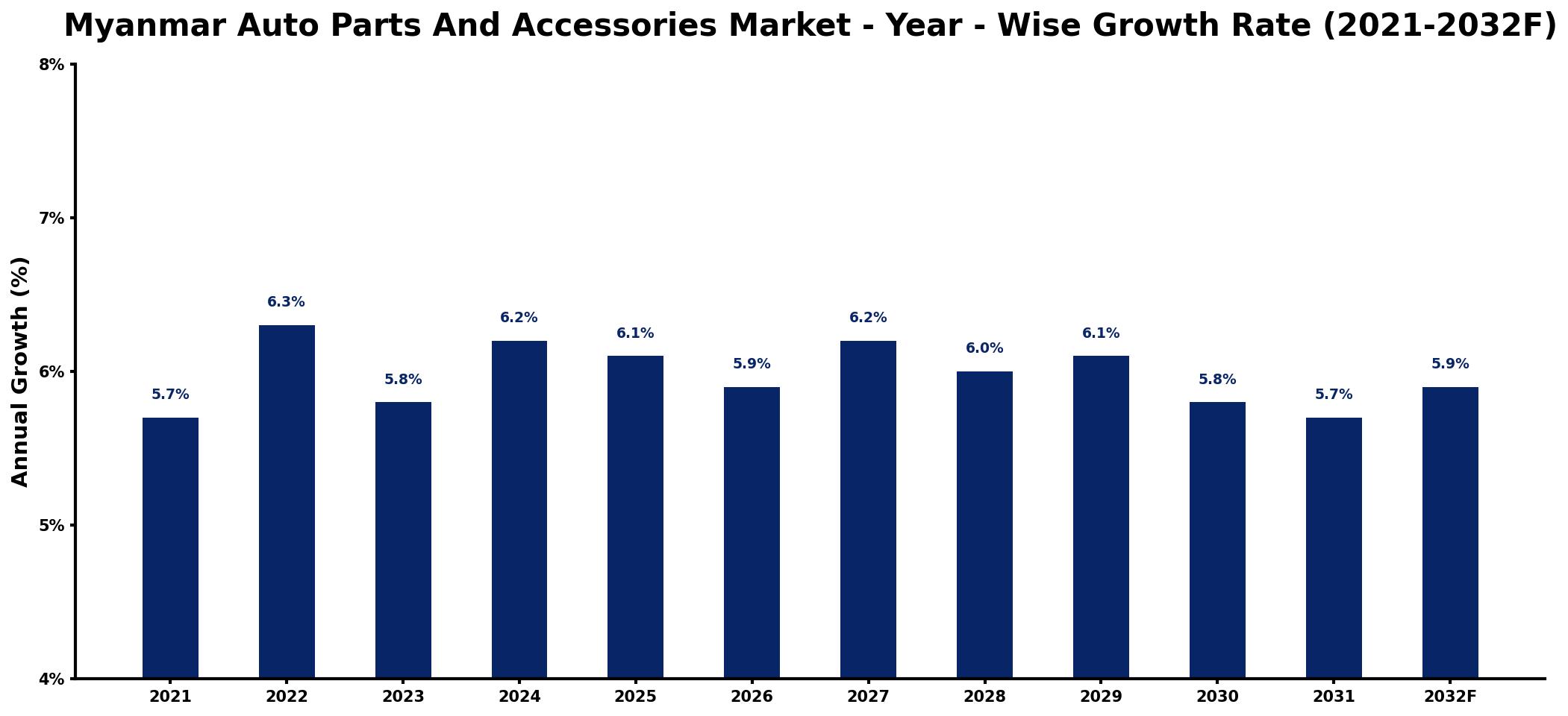
The table below presents the year‑wise growth rates along with the key drivers influencing the market
| Year | Growth Rate | Major Drivers |
| 2021 | 5.7% | Rising consumer vehicle ownership rates |
| 2022 | 6.3% | Increased infrastructure development projects |
| 2023 | 5.8% | Growing demand for eco-friendly options |
| 2024 | 6.2% | Expansion of local manufacturing capabilities |
| 2025 | 6.1% | growing commercial sector adoption |
| 2026 | 5.9% | Investment in logistics and distribution |
| 2027 | 6.2% | rising procurement volume requirements |
| 2028 | 6.0% | Growth of vehicle leasing services |
| 2029 | 6.1% | Rising popularity of electric vehicles |
| 2030 | 5.8% | Enhanced government support initiatives |
| 2031 | 5.7% | expanding manufacturing base activity |
| 2032 | 5.9% | Boost in regional trade partnerships |
Note: Market size estimations and growth projections presented in this report are based on 6Wresearch's proprietary forecasting methodology, utilizing the latest available industry data, government publications, and primary research inputs.
Myanmar Auto Parts And Accessories Market Synopsis
In recent years, Myanmar has witnessed a surge in vehicle ownership, resulting in a burgeoning demand for auto parts and accessories. This expanding automotive sector is characterized by a notable reliance on imported components, particularly from Japan, China, and Thailand, which dominate the market landscape.
The market is increasingly comprised of a diverse array of products, including essential engine components, sophisticated electronics, and performance-enhancing accessories. As the automotive infrastructure improves, both domestic and international suppliers are presented with unique growth opportunities, enhancing the overall market dynamics.
Myanmar Auto Parts And Accessories Market Key Takeaways
- The market is heavily influenced by rising vehicle ownership rates and growing disposable incomes.
- There is a marked shift towards the demand for EV components as consumers seek greener alternatives.
- Online retail platforms are becoming increasingly popular among consumers for purchasing auto parts.
- The market faces challenges related to counterfeit products and inadequate distribution networks.
- Investment opportunities abound, particularly in manufacturing and distribution sectors.
Evaluation of Restraints in Myanmar Auto Parts And Accessories Market
The growth of the Myanmar Auto Parts and Accessories Market is hindered by several significant constraints. Counterfeit products pose safety risks and damage consumer confidence, leading to reluctance in purchasing certain parts. Furthermore, the existing distribution infrastructure is often inadequate, creating logistical challenges that increase operational costs and delay delivery times. This situation is compounded by a limited availability of genuine parts, pushing consumers towards low-quality substitutes. Without industry-wide standardization, compatibility issues persist, ultimately affecting vehicle performance and longevity.
Myanmar Auto Parts And Accessories Market Trends
Several notable trends are shaping the future of the Myanmar Auto Parts and Accessories Market. One of the most prominent trends is the increasing interest in electric vehicle (EV) components, aligning with global shifts towards sustainable transportation. Additionally, consumers are demanding advanced safety features such as collision avoidance systems, reflecting a growing consciousness about road safety.
Moreover, the trend of personalization is becoming increasingly evident as consumers seek specialty parts that allow them to tailor their vehicles. This demand is further supported by the rise of online platforms, providing wider access to a diverse range of products and enhancing consumer convenience.
Myanmar Auto Parts And Accessories Market Opportunities
Investment opportunities in the Myanmar auto parts and accessories market are abundant, particularly due to the unmet demand in manufacturing and distribution networks. As local production capabilities improve, there exists potential for partnerships with local manufacturers to establish a solid foothold in the market. Additionally, as vehicle ownership continues to rise, suppliers can explore opportunities in the aftermarket sector, which is poised for significant growth. The anticipated government initiatives aimed at enhancing infrastructure could further enrich the investment landscape.
Government Initiatives in the Myanmar Auto Parts And Accessories Market
The Myanmar government is actively promoting the auto parts and accessories market through various policies and regulations. Import regulations are being implemented to ensure that automotive components meet safety and quality standards, while tariffs on imported goods encourage local manufacturing. Additionally, incentives such as tax breaks and subsidies are being offered to attract foreign investment, thereby fostering growth in the automotive sector.
Future Insights of the Myanmar Auto Parts And Accessories Market
Looking ahead to 2026-2032, the Myanmar Auto Parts and Accessories Market is expected to continue its upward trajectory. The convergence of rising disposable incomes, increasing vehicle ownership, and heightened consumer awareness regarding quality aftermarket products will propel growth. Furthermore, as the government ramps up efforts to improve infrastructure and promote industrial development, these initiatives are set to create a more conducive environment for both local and international players.
Myanmar Auto Parts And Accessories Market Latest Developments (2025 - 2026)
Recent developments in the Myanmar auto parts and accessories market reveal a growing focus on digital retailing, with several online platforms emerging to cater to the increasing demand for convenience and variety. Simultaneously, partnerships between local manufacturers and international suppliers have begun to materialize, aimed at enhancing the quality and availability of genuine parts. The market is also witnessing a gradual shift towards eco-friendly practices, as stakeholders prioritize sustainability in production and distribution methodologies.
Myanmar Auto Parts And Accessories Market - Key Attractiveness of the Report
- 10 Years of Market Numbers
- Historical Data Starting from 2022 to 2025
- Base Year: 2025
- Forecast Data until 2032
- Key Performance Indicators Impacting the Market
- Major Upcoming Developments and Projects
Key Highlights of the Report:
- Myanmar Auto Parts And Accessories Market Outlook
- Market Size of Myanmar Auto Parts And Accessories Market, 2025
- Forecast of Myanmar Auto Parts And Accessories Market, 2032
- Historical Data and Forecast of Myanmar Auto Parts And Accessories Revenues & Volume for the Period 2022-2032F
- Myanmar Auto Parts And Accessories Market Trend Evolution
- Myanmar Auto Parts And Accessories Market Drivers and Challenges
- Myanmar Auto Parts And Accessories Price Trends
- Myanmar Auto Parts And Accessories Porter's Five Forces
- Myanmar Auto Parts And Accessories Industry Life Cycle
- Historical Data and Forecast of Myanmar Auto Parts And Accessories Market Revenues & Volume By Product for the Period 2022-2032F
- Historical Data and Forecast of Myanmar Auto Parts And Accessories Market Revenues & Volume By Driveline & Powertrain for the Period 2022-2032F
- Historical Data and Forecast of Myanmar Auto Parts And Accessories Market Revenues & Volume By Interiors & Exteriors for the Period 2022-2032F
- Historical Data and Forecast of Myanmar Auto Parts And Accessories Market Revenues & Volume By Electronics for the Period 2022-2032F
- Historical Data and Forecast of Myanmar Auto Parts And Accessories Market Revenues & Volume By Bodies & Chassis for the Period 2022-2032F
- Historical Data and Forecast of Myanmar Auto Parts And Accessories Market Revenues & Volume By Wheel & Tires for the Period 2022-2032F
- Historical Data and Forecast of Myanmar Auto Parts And Accessories Market Revenues & Volume By Others for the Period 2022-2032F
- Historical Data and Forecast of Myanmar Auto Parts And Accessories Market Revenues & Volume By Application for the Period 2022-2032F
- Historical Data and Forecast of Myanmar Auto Parts And Accessories Market Revenues & Volume By OEMs for the Period 2022-2032F
- Historical Data and Forecast of Myanmar Auto Parts And Accessories Market Revenues & Volume By Aftermarket for the Period 2022-2032F
- Myanmar Auto Parts And Accessories Import Export Trade Statistics
- Market Opportunity Assessment By Product
- Market Opportunity Assessment By Application
- Myanmar Auto Parts And Accessories Top Companies Market Share
- Myanmar Auto Parts And Accessories Competitive Benchmarking By Technical and Operational Parameters
- Myanmar Auto Parts And Accessories Company Profiles
- Myanmar Auto Parts And Accessories Key Strategic Recommendations






































