Myanmar Automobile Components Market Summary
The myanmar automobile components market was estimated at USD 336 Million in 2025 and is projected to reach USD 444 Million by 2032, growing at a CAGR of 4.6% from 2026 to 2032.
Myanmar Automobile Components Market Year-wise Growth Rate and Key Drivers
This graph highlights how the Myanmar Automobile Components Market has steadily grown over the past five years, supported by major growth factors.
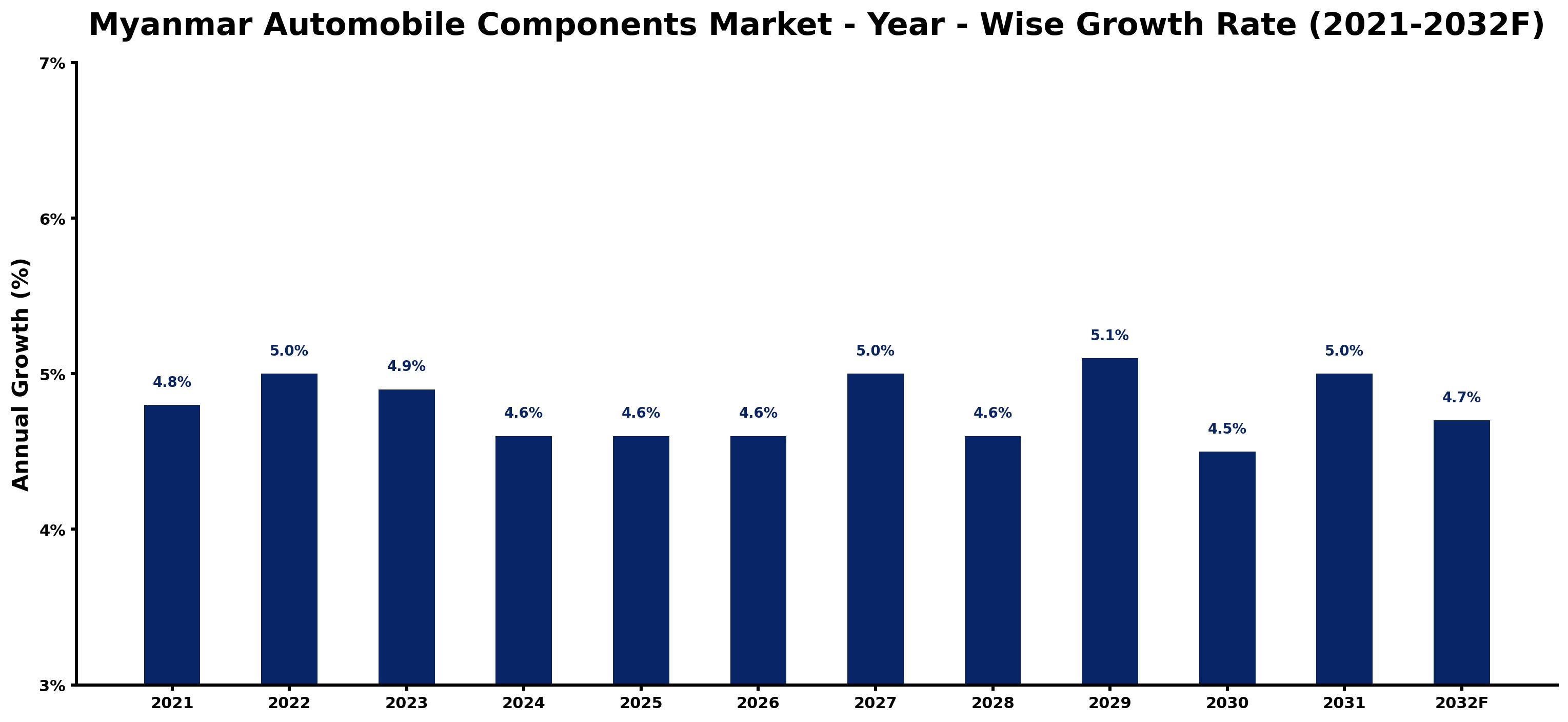
The table below presents the year wise growth rates along with the key drivers influencing the market
| Year | Growth Rate | Major Drivers |
| 2021 | 4.8% | Market recovery post-COVID-19 highlighted demand for domestic automobile production components. |
| 2022 | 5.0% | Supply chain diversification efforts spurred interest in local component manufacturing solutions. |
| 2023 | 4.9% | Increased foreign investment in automotive sector began reshaping local component capabilities. |
| 2024 | 4.6% | Local automotive regulations encouraged manufacturers to source components domestically and sustainably. |
| 2025 | 4.6% | Technological partnerships emerged between Myanmar firms and international auto component suppliers. |
| 2026 | 4.6% | Consumer preferences shifted towards electric vehicles, impacting component types and suppliers. |
| 2027 | 5.0% | Emerging middle class increased automobile ownership, driving demand for more components. |
| 2028 | 4.6% | Infrastructure improvements boosted logistics, enhancing component distribution across the nation. |
| 2029 | 5.1% | Regional trade agreements facilitated easier access to advanced automotive technologies. |
| 2030 | 4.5% | Innovative startups in Myanmar began developing unique components tailored for local markets. |
| 2031 | 5.0% | Sustainability trends prompted manufacturers to focus on eco-friendly component production methods. |
| 2032 | 4.7% | Collaboration with global firms solidified Myanmar's position in the Southeast Asian automotive market. |
Note - Market size estimations and growth projections presented in this report are based on 6Wresearch's advanced forecasting approach, validated with industry datasets as of June 2026.
Myanmar Automobile Components Market Synopsis
The Myanmar Automobile Components Market is projected to reach 4.6% and witness significant growth during the forecast period (2026-2032). The market, valued at approximately $912.5 million in 2020, is expected to experience a substantial uptick, primarily driven by increasing vehicle production and a growing appetite for automobiles within the country. As consumer preferences shift toward private vehicle ownership due to rising disposable incomes, the passenger car segment is poised to account for a significant share of the revenue generated from automotive components sales in Myanmar.
Myanmar Automobile Components Market Growth Drivers
The growth of the Myanmar Automobile Components Market is influenced by several critical factors that shape its trajectory. These include:
- Increased vehicle production capacities driven by local and foreign investments are amplifying the demand for automobile components.
- Rising disposable incomes among the Myanmar population are leading to a higher demand for personal vehicles over public transportation alternatives.
- Government initiatives aimed at enhancing infrastructure, including roads and transportation networks, are contributing to a conducive environment for automobile growth.
- Changing consumer preferences and lifestyles are prompting a shift toward private vehicle ownership, further fueling the market's expansion.
- Technological advancements in automotive manufacturing are introducing innovative components that enhance vehicle performance and safety, attracting more consumers.
Myanmar Automobile Components Market Trends and Opportunities
The Myanmar Automobile Components Market is expected to evolve with distinct trends that present lucrative opportunities for stakeholders. Key trends influencing the market include:
- The increasing emphasis on fuel efficiency and reduced emissions is steering investments toward advanced engine technologies, enhancing the demand for automotive components.
- Expansion in electric vehicle (EV) infrastructure within Myanmar is likely to create new opportunities for manufacturers of EV components, paving the way for a sustainable automotive future.
- The rise of online platforms for vehicle sales and automotive parts distribution is reshaping the retail landscape, offering new channels for market penetration.
- Enhanced collaboration between local manufacturers and international players is fostering knowledge transfer, important for improving local manufacturing competencies.
- Growing urbanisation trends are promoting increased vehicle ownership, thereby amplifying the demand for automobile components in urban settings.
Myanmar Automobile Components Market Challenges and Restraints
Despite promising growth prospects, the Myanmar Automobile Components Market faces several challenges and restraints that stakeholders must navigate:
- The underdeveloped state of Myanmar's transportation infrastructure may hinder the effective distribution of automobile components.
- Market volatility and political instability may affect foreign investment flows and investor confidence in the automotive sector.
- Limited access to advanced manufacturing technologies can impede the production capabilities of local automotive component manufacturers.
- Regulatory challenges, including compliance with international automotive standards, may pose obstacles for local players seeking to expand.
- Economic fluctuations, stemming from both domestic and international factors, could impact consumer purchasing power, ultimately affecting vehicle sales.
Myanmar Automobile Components Market Government Investment and Initiatives
The Myanmar government is actively involved in promoting the growth of the automotive sector through various investments and initiatives. These efforts are aimed at fostering an environment conducive to the development of the automobile components market. Key initiatives include:
- Implementation of policies that incentivize foreign direct investment in the automotive sector to stimulate growth and enhance production capabilities.
- Investment in infrastructure development projects intended to improve road networks, which are essential for the efficient transportation of goods, including automobile components.
- Introduction of regulations that promote the adoption of environmentally friendly technologies in vehicle manufacturing, aligning with global sustainability goals.
- Support for research and development initiatives focusing on automotive technology advancements, encouraging innovation within the local industry.
- Formation of partnerships with international organizations to provide training and capacity-building programs for the local automotive workforce.
Myanmar Automobile Components Market Latest Developments (May 2025 - June 2026)
Recent developments in the Myanmar Automobile Components Market from May 2025 to June 2026 reflect the dynamic nature of the industry. Key highlights include:
- Shortly within this period, there has been an observable increase in automotive manufacturing activities, attributed to rising consumer demand for personal vehicles.
- Efforts to enhance local manufacturing capabilities have been bolstered by new training programs aimed at upskilling the workforce in advanced automotive technologies.
- Local manufacturers are increasingly focusing on quality improvements to meet international standards, thereby expanding their competitiveness in the regional market.
- Government-backed initiatives aimed at reducing emissions have spurred investments in cleaner automotive technologies and components.
- Collaborations between local companies and foreign firms are witnessing growth, providing further access to global best practices and advanced automotive solutions.
Myanmar Automobile Components Market - Key Attractiveness of the Report
- 10 Years of Market Numbers
- Historical Data Starting from 2022 to 2025
- Base Year: 2025
- Forecast Data until 2032
- Key Performance Indicators Impacting the Market
- Major Upcoming Developments and Projects
Key Highlights of the Report:
- Myanmar Automobile Components Market Outlook
- Market Size of Myanmar Automobile Components Market, 2025
- Forecast of Myanmar Automobile Components Market, 2032F
- Historical Data and Forecast of Myanmar Automobile Components Revenues & Volume for the Period 2022-2032F
- Myanmar Automobile Components Market Trend Evolution
- Myanmar Automobile Components Market Drivers and Challenges
- Myanmar Automobile Components Price Trends
- Myanmar Automobile Components Porter's Five Forces
- Myanmar Automobile Components Industry Life Cycle
- Historical Data and Forecast of Myanmar Automobile Components Market Revenues & Volume By Product Type for the Period 2022-2032F
- Historical Data and Forecast of Myanmar Automobile Components Market Revenues & Volume By Flywheel for the Period 2022-2032F
- Historical Data and Forecast of Myanmar Automobile Components Market Revenues & Volume By Pressure Plate for the Period 2022-2032F
- Historical Data and Forecast of Myanmar Automobile Components Market Revenues & Volume By Clutch for the Period 2022-2032F
- Historical Data and Forecast of Myanmar Automobile Components Market Revenues & Volume By Other for the Period 2022-2032F
- Historical Data and Forecast of Myanmar Automobile Components Market Revenues & Volume By Applications for the Period 2022-2032F
- Historical Data and Forecast of Myanmar Automobile Components Market Revenues & Volume By Passenger Cars (PC) for the Period 2022-2032F
- Historical Data and Forecast of Myanmar Automobile Components Market Revenues & Volume By Light Commercial Vehicles (LCV) for the Period 2022-2032F
- Historical Data and Forecast of Myanmar Automobile Components Market Revenues & Volume By Heavy Commercial Vehicles (HCV) for the Period 2022-2032F
- Myanmar Automobile Components Import Export Trade Statistics
- Market Opportunity Assessment By Product Type
- Market Opportunity Assessment By Applications
- Myanmar Automobile Components Top Companies Market Share
- Myanmar Automobile Components Competitive Benchmarking By Technical and Operational Parameters
- Myanmar Automobile Components Company Profiles
- Myanmar Automobile Components Key Strategic Recommendations






































