Myanmar Automotive Seat Belts Market Size, Share & Growth Rate
The Myanmar Automotive Seat Belts Market was estimated at USD 216 Million in 2025 and is projected to reach USD 286 Million by 2032, growing at a CAGR of 4.1% from 2026 to 2032. This growth trajectory is primarily fueled by an increasing awareness of road safety and the government's stringent regulations mandating seat belt use. As vehicle ownership rises in the country, so too does the focus on advanced safety technologies that enhance passenger protection.
Myanmar Automotive Seat Belts Market Year-wise Growth Rate and Key Drivers
This graph highlights how the Myanmar Automotive Seat Belts Market has steadily grown over the years, supported by major growth factors.
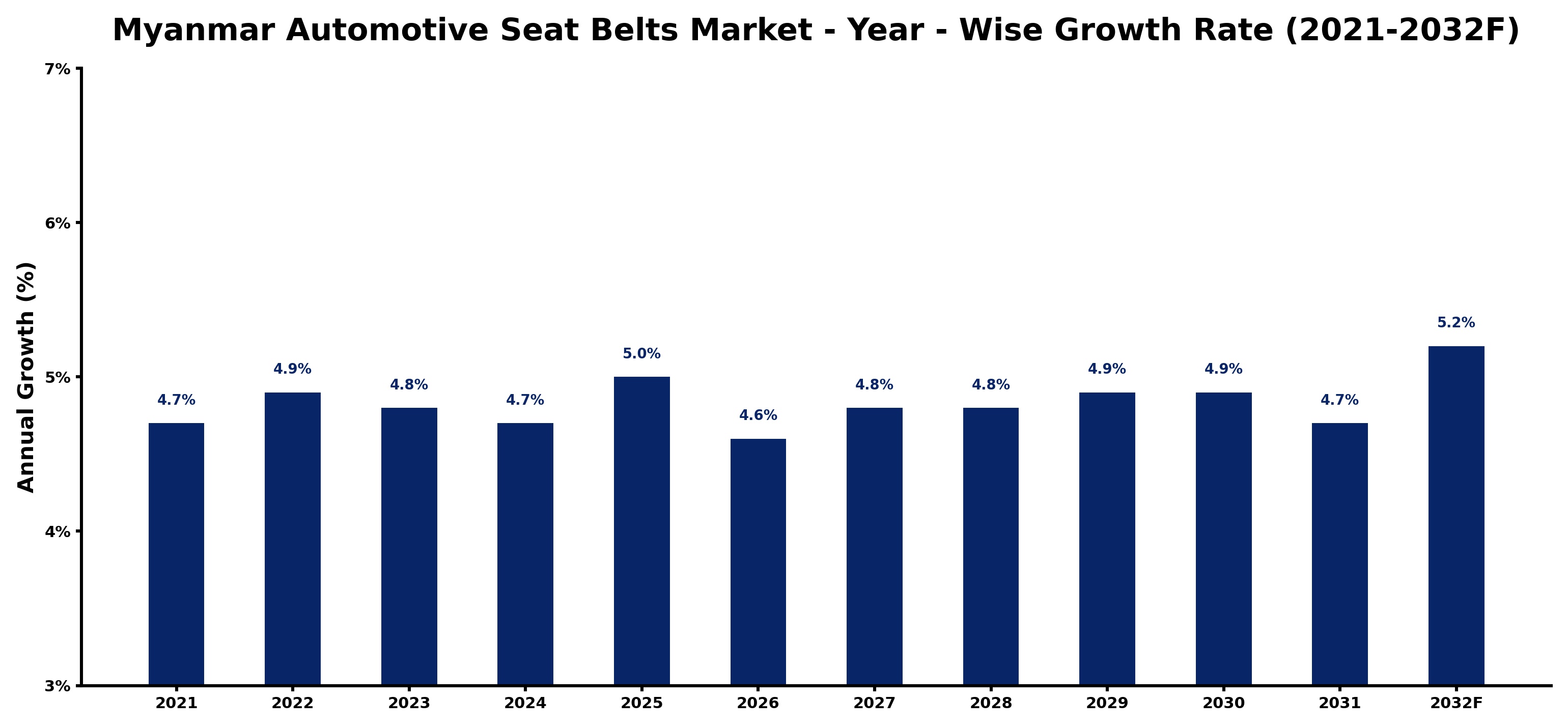
The table below presents the year‑wise growth rates along with the key drivers influencing the market
| Year | Growth Rate | Major Drivers |
| 2021 | 4.7% | Increased vehicle production demand |
| 2022 | 4.9% | Rising safety regulations enforced |
| 2023 | 4.8% | Consumer awareness of safety |
| 2024 | 4.7% | Automotive industry recovery accelerated |
| 2025 | 5.0% | Technological advancements in safety |
| 2026 | 4.6% | Government initiatives promoted safety |
| 2027 | 4.8% | Export opportunities expanded significantly |
| 2028 | 4.8% | Growing automotive aftermarket services |
| 2029 | 4.9% | Enhanced manufacturing capabilities developed |
| 2030 | 4.9% | Rising disposable income trends |
| 2031 | 4.7% | Partnerships with automotive manufacturers |
| 2032 | 5.2% | Sustainability initiatives gained momentum |
Note - Market size estimations and growth projections presented in this report are based on 6Wresearch’s advanced forecasting approach, validated with industry datasets as of June 2026.
Myanmar Automotive Seat Belts Market Synopsis
A noteworthy trend within the Myanmar automotive seat belts market is the rising consumer demand for seat belts that incorporate advanced safety features, such as pretensioners and load limiters. This demand is a direct reflection of heightened awareness surrounding road safety and the critical role seat belts play in preventing injuries during accidents.
The market is characterized by the presence of international manufacturers who provide a diverse range of seat belt options to cater to various vehicle types and safety standards. Collaborative efforts between automotive makers and seat belt suppliers have further enhanced the market's potential, aiming to deliver cutting-edge solutions that address consumer safety concerns.
Myanmar Automotive Seat Belts Market Key Takeaways
- The market is witnessing a shift towards advanced seat belt technologies that provide enhanced safety and comfort.
- Government regulations mandating seat belt use are expected to drive market growth significantly.
- Rising vehicle ownership rates indicate a growing consumer base for automotive safety products.
- Counterfeit products and limited awareness in rural areas pose challenges to market expansion.
- Strategic partnerships between manufacturers and automotive companies are fueling innovation and product development.
Evaluation of Restraints in Myanmar Automotive Seat Belts Market
While the Myanmar Automotive Seat Belts Market shows promising growth, several restraints hinder its full potential. A significant barrier is the limited awareness of seat belt importance among the general population, particularly in rural regions, where cultural norms may undervalue road safety. Additionally, the lack of stringent enforcement of existing regulations can diminish compliance, further impacting the adoption rates of seat belt usage. The presence of counterfeit products complicates matters, as they threaten consumer safety and trust in legitimate brands. Addressing these issues will be crucial for fostering a robust market environment.
Myanmar Automotive Seat Belts Market Trends
The demand for advanced safety features in automotive seat belts continues to rise in Myanmar, spurred by consumer awareness and regulatory requirements. Innovations such as adjustable and ergonomic designs are gaining traction, as they align with consumer preferences for both safety and comfort. There is also a noticeable trend toward using high-quality materials and advanced manufacturing techniques, which ensure durability and reliability, essential factors for any safety equipment.
Myanmar Automotive Seat Belts Market Opportunities
Significant investment opportunities exist within the Myanmar Automotive Seat Belts Market. The increasing number of vehicles on the road correlates with a heightened demand for high-quality seat belts. Investors can capitalize on this growth by introducing innovative seat belt technologies and expanding manufacturing capabilities. Additionally, partnerships with local automotive manufacturers offer a viable pathway to strengthen market presence and enhance product offerings, particularly as regulatory standards continue to tighten.
Government Initiatives in the Myanmar Automotive Seat Belts Market
The Myanmar government has implemented regulations mandating the use of seat belts in all vehicles, aimed at improving road safety. The Motor Vehicles Law stipulates that all vehicle occupants must wear seat belts, and penalties are imposed for non-compliance. This regulatory framework is part of broader initiatives to enhance road safety and decrease accident-related fatalities. Continuous efforts to enforce these regulations will be pivotal in driving market growth and fostering a culture of safety among the population.
Future Insights of the Myanmar Automotive Seat Belts Market
Looking ahead to 2026-2032, the Myanmar Automotive Seat Belts Market is set for robust expansion. The combination of increasing awareness around road safety, stricter government mandates, and rising disposable incomes is expected to elevate vehicle ownership rates and safety equipment adoption. As technological advancements continue to evolve, we anticipate a burgeoning demand for innovative seat belt systems that not only comply with safety regulations but also cater to consumers' desires for comfort and style.
Myanmar Automotive Seat Belts Market Latest Developments (May 2025 - June 2026)
In recent months, the Myanmar automotive seat belts market has seen an uptick in manufacturers exploring innovative seat belt designs that align with international safety standards. The industry is witnessing increased collaboration between automotive manufacturers and safety equipment suppliers to enhance vehicle safety features. Additionally, government-led campaigns aimed at raising public awareness regarding the importance of seat belt use have gained momentum, supporting broader efforts to improve road safety across the country.
Myanmar Automotive Seat Belts Market - Key Attractiveness of the Report
- 10 Years of Market Numbers
- Historical Data Starting from 2022 to 2025
- Base Year: 2025
- Forecast Data until 2032
- Key Performance Indicators Impacting the Market
- Major Upcoming Developments and Projects
Key Highlights of the Report:
- Myanmar Automotive Seat Belts Market Outlook
- Market Size of Myanmar Automotive Seat Belts Market, 2025
- Forecast of Myanmar Automotive Seat Belts Market, 2032
- Historical Data and Forecast of Myanmar Automotive Seat Belts Revenues & Volume for the Period 2022-2032F
- Myanmar Automotive Seat Belts Market Trend Evolution
- Myanmar Automotive Seat Belts Market Drivers and Challenges
- Myanmar Automotive Seat Belts Price Trends
- Myanmar Automotive Seat Belts Porter's Five Forces
- Myanmar Automotive Seat Belts Industry Life Cycle
- Historical Data and Forecast of Myanmar Automotive Seat Belts Market Revenues & Volume By Type for the Period 2022-2032F
- Historical Data and Forecast of Myanmar Automotive Seat Belts Market Revenues & Volume By 2-point Seatbelt for the Period 2022-2032F
- Historical Data and Forecast of Myanmar Automotive Seat Belts Market Revenues & Volume By 3-point Seatbelt for the Period 2022-2032F
- Historical Data and Forecast of Myanmar Automotive Seat Belts Market Revenues & Volume By Vehicle for the Period 2022-2032F
- Historical Data and Forecast of Myanmar Automotive Seat Belts Market Revenues & Volume By Passenger Cars for the Period 2022-2032F
- Historical Data and Forecast of Myanmar Automotive Seat Belts Market Revenues & Volume By Light Commercial Vehicles for the Period 2022-2032F
- Historical Data and Forecast of Myanmar Automotive Seat Belts Market Revenues & Volume By Heavy Commercial Vehicles for the Period 2022-2032F
- Historical Data and Forecast of Myanmar Automotive Seat Belts Market Revenues & Volume By Component for the Period 2022-2032F
- Historical Data and Forecast of Myanmar Automotive Seat Belts Market Revenues & Volume By Webbing strap for the Period 2022-2032F
- Historical Data and Forecast of Myanmar Automotive Seat Belts Market Revenues & Volume By Retractor for the Period 2022-2032F
- Historical Data and Forecast of Myanmar Automotive Seat Belts Market Revenues & Volume By Buckle for the Period 2022-2032F
- Historical Data and Forecast of Myanmar Automotive Seat Belts Market Revenues & Volume By Tongue for the Period 2022-2032F
- Historical Data and Forecast of Myanmar Automotive Seat Belts Market Revenues & Volume By Pillar Loop for the Period 2022-2032F
- Historical Data and Forecast of Myanmar Automotive Seat Belts Market Revenues & Volume By Distribution Channels for the Period 2022-2032F
- Historical Data and Forecast of Myanmar Automotive Seat Belts Market Revenues & Volume By OEM for the Period 2022-2032F
- Historical Data and Forecast of Myanmar Automotive Seat Belts Market Revenues & Volume By Aftermarket for the Period 2022-2032F
- Myanmar Automotive Seat Belts Import Export Trade Statistics
- Market Opportunity Assessment By Type
- Market Opportunity Assessment By Vehicle
- Market Opportunity Assessment By Component
- Market Opportunity Assessment By Distribution Channels
- Myanmar Automotive Seat Belts Top Companies Market Share
- Myanmar Automotive Seat Belts Competitive Benchmarking By Technical and Operational Parameters
- Myanmar Automotive Seat Belts Company Profiles
- Myanmar Automotive Seat Belts Key Strategic Recommendations






































