Myanmar Ballast Water Treatment Market Size, Share & Growth Rate
The Myanmar Ballast Water Treatment Market was estimated at USD 321 Million in 2025 and is projected to reach USD 439 Million by 2032, growing at a CAGR of 4.6% from 2026 to 2032. This robust growth trajectory is being fueled by the increased maritime activities in the region and the tightening of environmental regulations from global maritime authorities. The urgency to implement effective ballast water treatment solutions is further compounded by the burgeoning port infrastructure and the rising volume of shipping traffic in Myanmar, ensuring a greater demand for compliance-driven technologies.
Myanmar Ballast Water Treatment Market Year-wise Growth Rate and Key Drivers
This graph highlights how the Myanmar Ballast Water Treatment Market has steadily grown over the years, supported by major growth factors.
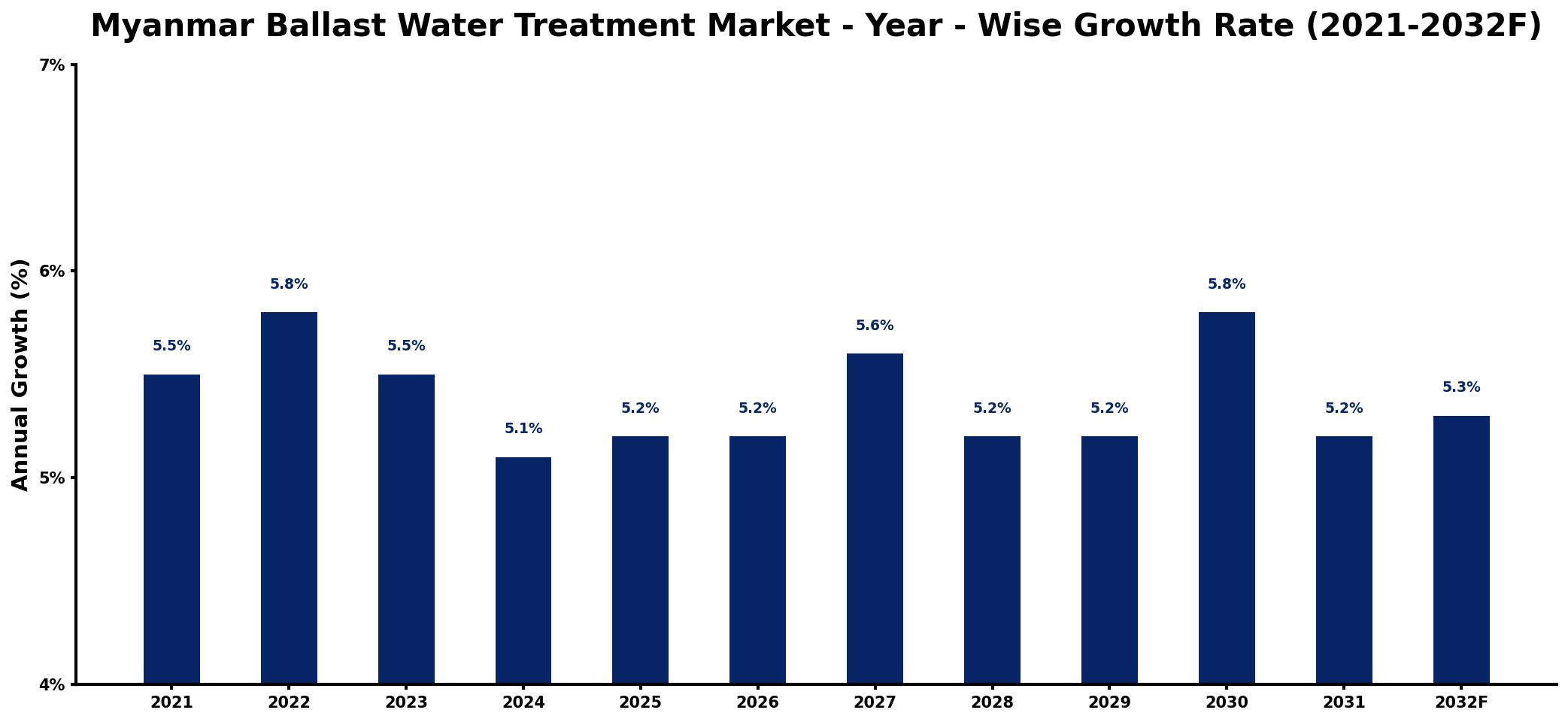
The table below presents the year‑wise growth rates along with the key drivers influencing the market
| Year | Growth Rate | Major Drivers |
| 2021 | 5.5% | Increased maritime environmental regulations |
| 2022 | 5.8% | Growing shipping industry investments |
| 2023 | 5.5% | Rising awareness of sustainability |
| 2024 | 5.1% | Expansion of port infrastructure projects |
| 2025 | 5.2% | Increased international compliance standards |
| 2026 | 5.2% | Enhanced focus on eco-friendly solutions |
| 2027 | 5.6% | Growing demand for shipping services |
| 2028 | 5.2% | Investments in maritime technology advancements |
| 2029 | 5.2% | Strengthened government environmental policies |
| 2030 | 5.8% | Increased global shipping activities |
| 2031 | 5.2% | Rising public environmental consciousness |
| 2032 | 5.3% | strengthening international trade flows |
Note: Market size estimations and growth projections presented in this report are based on 6Wresearch's proprietary forecasting methodology, utilizing the latest available industry data, government publications, and primary research inputs.
Myanmar Ballast Water Treatment Market Synopsis
The principal driver shaping the Myanmar Ballast Water Treatment Market is the adherence to stringent international environmental regulations. The imperative to mitigate the spread of invasive aquatic species has prompted shipping companies to invest in advanced ballast water treatment systems to remain compliant and safeguard marine biodiversity.
In addition, the growth of Myanmar's shipping industry and port infrastructure significantly enhances market dynamics. As maritime trade expands, the requirement for innovative ballast water management solutions becomes increasingly critical, offering a clear path for the advancement of treatment technologies tailored to the local context.
Myanmar Ballast Water Treatment Market Key Takeaways
- Growing maritime activities are accelerating the demand for ballast water treatment systems.
- Compliance with international regulations is a crucial factor influencing market growth.
- Technological advancements are pivotal in the development of effective treatment solutions.
- Government policies are encouraging investments in modern ballast water management systems.
- The shipping industry's expansion in Myanmar is creating new opportunities for market players.
Evaluation of Restraints in Myanmar Ballast Water Treatment Market
Despite the growth potential, the Myanmar Ballast Water Treatment Market encounters notable restraints. The financial burden of complying with international regulations can deter shipping companies, particularly smaller operators, from investing in advanced treatment systems. Additionally, the lack of technical expertise in installation and maintenance hampers the effective deployment of these complex systems. Regulatory enforcement poses another challenge, as the industry navigates a landscape where consistent compliance is crucial yet difficult to monitor, leading to uneven adherence to standards.
Myanmar Ballast Water Treatment Market Trends
Current trends indicate a shift towards integrated treatment systems that combine filtration, UV radiation, and chemical disinfection. These hybrid technologies are gaining traction as they provide comprehensive solutions to meet regulatory compliance while minimizing operational costs. Furthermore, there is an increasing focus on sustainability and the protection of marine ecosystems, prompting shipping companies to adopt environmentally friendly practices.
Myanmar Ballast Water Treatment Market Opportunities
Investment opportunities abound in the Myanmar Ballast Water Treatment Market, particularly in the development of innovative technologies that enhance treatment efficacy and reduce costs. Partnerships between technology providers and shipping firms can yield customized solutions that address local challenges. Moreover, as awareness of marine conservation grows, companies that position themselves as leaders in sustainable practices are likely to capture market share and foster long-term growth.
Government Initiatives in the Myanmar Ballast Water Treatment Market
The Myanmar government has instituted regulations that align closely with International Maritime Organization (IMO) guidelines, reinforcing the need for approved ballast water treatment systems. These policies aim to minimize the ecological impact of ballast water discharge, while financial incentives and subsidies are provided to stimulate shipping companies investments in modern ballast water management solutions. This supportive regulatory framework is integral to fostering a responsible maritime industry in Myanmar.
Future Insights of the Myanmar Ballast Water Treatment Market
Looking ahead to the period between 2026 and 2032, the Myanmar Ballast Water Treatment Market is poised for steady expansion. The ongoing commitment to environmental sustainability will drive further adoption of treatment technologies. Additionally, as global shipping practices evolve and newer regulations emerge, the local market will need to adapt swiftly, creating an environment ripe for innovation and growth. The combination of increased shipping activity and regulatory pressures will likely shape the market dynamics significantly.
Myanmar Ballast Water Treatment Market Latest Developments (2025 - 2026)
In recent months, there has been a noticeable shift towards collaborative efforts among maritime stakeholders aimed at enhancing ballast water treatment solutions. Industry forums have emerged, focusing on the exchange of technological advancements and regulatory best practices. Moreover, initiatives to improve training and technical support for shipping companies are gaining momentum, aiming to address the expertise gap that currently exists in the market.
Myanmar Ballast Water Treatment Market - Key Attractiveness of the Report
- 10 Years of Market Numbers
- Historical Data Starting from 2022 to 2025
- Base Year: 2025
- Forecast Data until 2032
- Key Performance Indicators Impacting the Market
- Major Upcoming Developments and Projects
Key Highlights of the Report:
- Myanmar Ballast Water Treatment Market Outlook
- Market Size of Myanmar Ballast Water Treatment Market, 2025
- Forecast of Myanmar Ballast Water Treatment Market, 2032
- Historical Data and Forecast of Myanmar Ballast Water Treatment Revenues & Volume for the Period 2022-2032F
- Myanmar Ballast Water Treatment Market Trend Evolution
- Myanmar Ballast Water Treatment Market Drivers and Challenges
- Myanmar Ballast Water Treatment Price Trends
- Myanmar Ballast Water Treatment Porter's Five Forces
- Myanmar Ballast Water Treatment Industry Life Cycle
- Historical Data and Forecast of Myanmar Ballast Water Treatment Market Revenues & Volume By Technology for the Period 2022-2032F
- Historical Data and Forecast of Myanmar Ballast Water Treatment Market Revenues & Volume By Physical Disinfection for the Period 2022-2032F
- Historical Data and Forecast of Myanmar Ballast Water Treatment Market Revenues & Volume By Mechanical Method for the Period 2022-2032F
- Historical Data and Forecast of Myanmar Ballast Water Treatment Market Revenues & Volume By Chemical Method for the Period 2022-2032F
- Historical Data and Forecast of Myanmar Ballast Water Treatment Market Revenues & Volume By Service for the Period 2022-2032F
- Historical Data and Forecast of Myanmar Ballast Water Treatment Market Revenues & Volume By Installation & Calibration for the Period 2022-2032F
- Historical Data and Forecast of Myanmar Ballast Water Treatment Market Revenues & Volume By Performance Measurement for the Period 2022-2032F
- Historical Data and Forecast of Myanmar Ballast Water Treatment Market Revenues & Volume By Recommissioning for the Period 2022-2032F
- Myanmar Ballast Water Treatment Import Export Trade Statistics
- Market Opportunity Assessment By Technology
- Market Opportunity Assessment By Service
- Myanmar Ballast Water Treatment Top Companies Market Share
- Myanmar Ballast Water Treatment Competitive Benchmarking By Technical and Operational Parameters
- Myanmar Ballast Water Treatment Company Profiles
- Myanmar Ballast Water Treatment Key Strategic Recommendations






































