Myanmar Biomimetic Materials Market Size, Share & Growth Rate
The Myanmar Biomimetic Materials Market was estimated at USD 429 Million in 2025 and is projected to reach USD 597 Million by 2032, growing at a CAGR of 4.8% from 2026 to 2032. This positive growth trajectory is primarily driven by an increasing demand for sustainable and eco-friendly materials across key sectors such as healthcare, construction, and automotive. As industries begin to recognize the advantages of biomimetic materials, their unique properties like self-healing and biocompatibility position them as valuable alternatives to traditional materials, reinforcing their adoption in Myanmar.
Myanmar Biomimetic Materials Market Year-wise Growth Rate and Key Drivers
This graph highlights how the Myanmar Biomimetic Materials Market has steadily grown over the years, supported by major growth factors.
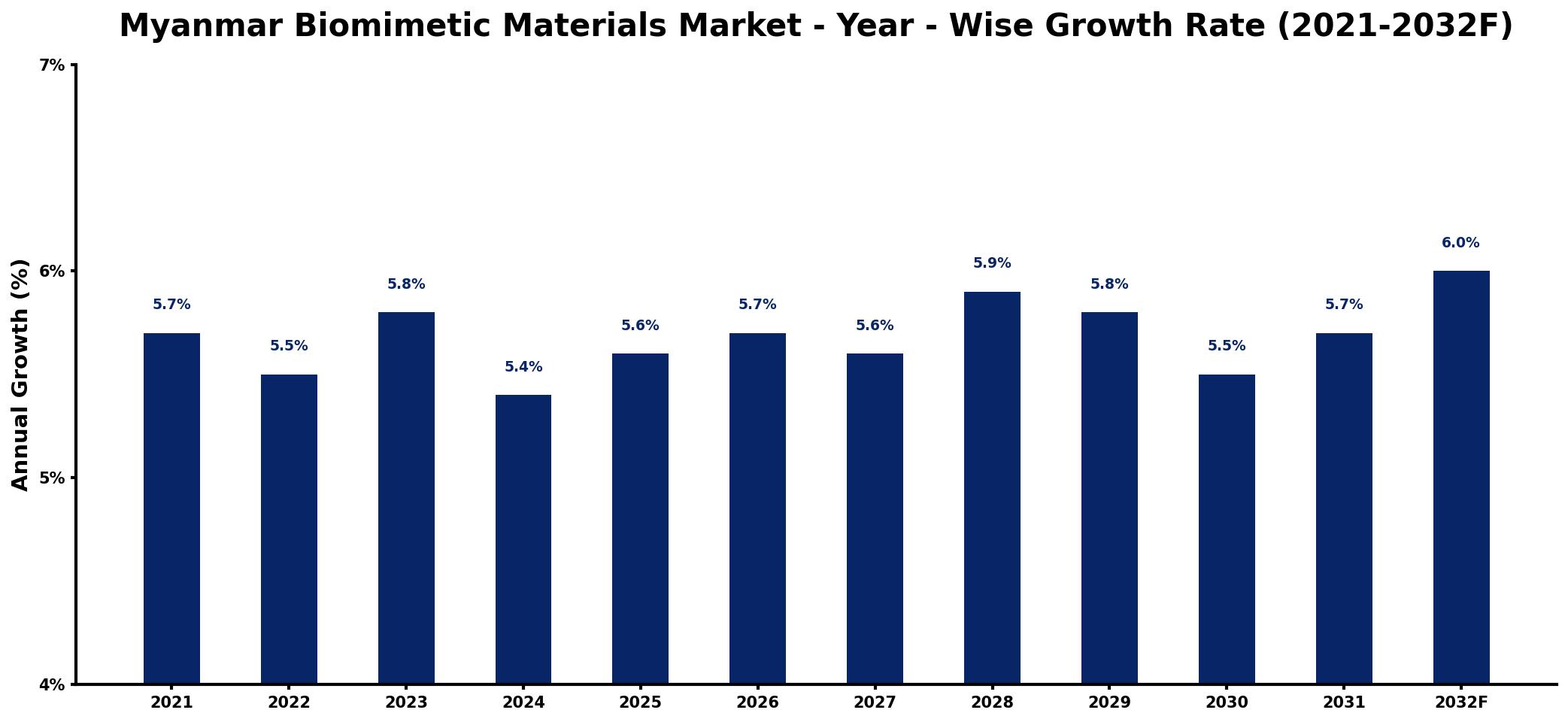
The table below presents the year‑wise growth rates along with the key drivers influencing the market
| Year | Growth Rate | Major Drivers |
| 2021 | 5.7% | Rising demand in construction sector |
| 2022 | 5.5% | Increased investment in R&D |
| 2023 | 5.8% | Growing interest in sustainability |
| 2024 | 5.4% | Expansion of eco-friendly initiatives |
| 2025 | 5.6% | Boost in renewable energy projects |
| 2026 | 5.7% | Surge in healthcare applications |
| 2027 | 5.6% | Emergence of advanced technologies |
| 2028 | 5.9% | Development of innovative startups |
| 2029 | 5.8% | Strengthening of regulatory frameworks |
| 2030 | 5.5% | Growth in educational partnerships |
| 2031 | 5.7% | Increase in government funding |
| 2032 | 6.0% | Rise in global collaborations |
Note: Market size estimations and growth projections presented in this report are based on 6Wresearch's proprietary forecasting methodology, utilizing the latest available industry data, government publications, and primary research inputs.
Myanmar Biomimetic Materials Market Synopsis
Currently, the Myanmar Biomimetic Materials Market is on the cusp of significant evolution, motivated by a shift towards sustainability in various industries. The concept of biomimetic materials—products that draw inspiration from nature—has garnered attention for its potential to address pressing environmental concerns.
Despite this potential, the market remains in its early stages, facing challenges related to awareness and infrastructure. However, ongoing government support and rising investment in research and development initiatives are paving the way for future advancements in biomimetic applications.
Myanmar Biomimetic Materials Market Key Takeaways
- The market is driven by the increasing demand for sustainable alternatives across healthcare, construction, and automotive sectors.
- Biomimetic materials are recognized for their unique attributes like strength, biodegradability, and self-healing properties.
- Investment opportunities arise from government initiatives promoting innovation and eco-friendly practices.
- Challenges such as limited local expertise and high production costs need addressing for market expansion.
- Collaborations among industry players, researchers, and government bodies are crucial to fostering growth.
Evaluation of Restraints in Myanmar Biomimetic Materials Market
The Myanmar Biomimetic Materials Market faces notable restraints that hinder its growth. One of the primary challenges is the limited awareness and understanding of biomimetic materials among potential end-users and manufacturers, which slows adoption rates. Additionally, the lack of local expertise and infrastructure dedicated to research and development creates barriers to innovation. The high costs associated with sourcing and producing these materials also deter many companies, complicating market dynamics further. Furthermore, navigating the regulatory landscape and intellectual property rights can be cumbersome for businesses seeking to introduce new biomimetic solutions.
Myanmar Biomimetic Materials Market Trends
The market is witnessing a surge in interest for innovative and sustainable materials, with biomimetic solutions at the forefront. Recent trends indicate a shift towards bio-based polymers, which are becoming increasingly popular in applications requiring lightweight yet durable materials. Additionally, the development of biomimetic coatings aimed at enhancing product longevity and performance is gaining traction, particularly in the construction sector.
Biomimetic textiles are also emerging as a promising area, offering enhanced functionality such as moisture-wicking and antimicrobial properties. These trends reflect a growing recognition of the advantages biomimetic materials provide, reinforcing their relevance in a market that increasingly prioritizes sustainability.
Myanmar Biomimetic Materials Market Opportunities
Opportunities for growth in the Myanmar Biomimetic Materials Market are particularly promising. The increasing demand for eco-friendly solutions across various sectors is a key driver for investment. This presents a unique opening for companies looking to partner with local research institutions to develop materials tailored to Myanmars specific environmental and industrial needs.
Moreover, collaborations with international firms can facilitate technology transfer, enhancing local capabilities in producing high-performance biomimetic materials. As awareness continues to spread, businesses positioned to innovate within this niche market stand to benefit significantly.
Government Initiatives in the Myanmar Biomimetic Materials Market
The Myanmar government is increasingly focused on fostering sustainable development within the country, implementing policies that promote the growth of biomimetic materials. Incentives for research and development are being offered to companies willing to invest in eco-friendly material solutions. Additionally, the government aims to encourage collaboration between local businesses and international organizations, creating an environment ripe for innovation in biomimetic materials.
Future Insights of the Myanmar Biomimetic Materials Market
Looking ahead to 2026-2032, the future of the Myanmar Biomimetic Materials Market is characterized by optimism and potential. With a global pivot towards sustainability, the demand for biomimetic solutions is expected to rise, supported by a commitment from industries to reduce their environmental impact. Myanmars rich biodiversity presents a unique opportunity to leverage locally-sourced materials in developing innovative biomimetic solutions across construction, healthcare, and agriculture.
The governments proactive stance on environmental conservation and the escalating consumer awareness of sustainable products will likely further catalyze market growth. As businesses begin to align their operations with these emerging trends, the biomimetic materials market in Myanmar stands poised for substantial expansion.
Myanmar Biomimetic Materials Market Latest Developments (2025 - 2026)
Recent developments in the Myanmar Biomimetic Materials Market indicate a growing commitment to innovation and sustainability. Industry stakeholders are actively exploring partnerships to enhance research efforts focused on developing new biomimetic materials. Notably, ongoing discussions have surfaced regarding the establishment of pilot projects aimed at demonstrating the benefits of biomimetic solutions in practical applications. Furthermore, there are indications of increased funding directed toward R&D initiatives that align with the governments sustainability goals.
Myanmar Biomimetic Materials Market - Key Attractiveness of the Report
- 10 Years of Market Numbers
- Historical Data Starting from 2022 to 2025
- Base Year: 2025
- Forecast Data until 2032
- Key Performance Indicators Impacting the Market
- Major Upcoming Developments and Projects
Key Highlights of the Report:
- Myanmar Biomimetic Materials Market Outlook
- Market Size of Myanmar Biomimetic Materials Market, 2025
- Forecast of Myanmar Biomimetic Materials Market, 2032
- Historical Data and Forecast of Myanmar Biomimetic Materials Revenues & Volume for the Period 2022-2032F
- Myanmar Biomimetic Materials Market Trend Evolution
- Myanmar Biomimetic Materials Market Drivers and Challenges
- Myanmar Biomimetic Materials Price Trends
- Myanmar Biomimetic Materials Porter's Five Forces
- Myanmar Biomimetic Materials Industry Life Cycle
- Historical Data and Forecast of Myanmar Biomimetic Materials Market Revenues & Volume By Material for the Period 2022-2032F
- Historical Data and Forecast of Myanmar Biomimetic Materials Market Revenues & Volume By Biomimetic Polymers for the Period 2022-2032F
- Historical Data and Forecast of Myanmar Biomimetic Materials Market Revenues & Volume By Biomimetic Ceramics & Glass for the Period 2022-2032F
- Historical Data and Forecast of Myanmar Biomimetic Materials Market Revenues & Volume By Biomimetic Metals & Alloys for the Period 2022-2032F
- Historical Data and Forecast of Myanmar Biomimetic Materials Market Revenues & Volume By Others for the Period 2022-2032F
- Historical Data and Forecast of Myanmar Biomimetic Materials Market Revenues & Volume By Application for the Period 2022-2032F
- Historical Data and Forecast of Myanmar Biomimetic Materials Market Revenues & Volume By Medical for the Period 2022-2032F
- Historical Data and Forecast of Myanmar Biomimetic Materials Market Revenues & Volume By Automotive for the Period 2022-2032F
- Historical Data and Forecast of Myanmar Biomimetic Materials Market Revenues & Volume By Defense for the Period 2022-2032F
- Historical Data and Forecast of Myanmar Biomimetic Materials Market Revenues & Volume By Electronics for the Period 2022-2032F
- Historical Data and Forecast of Myanmar Biomimetic Materials Market Revenues & Volume By Others for the Period 2022-2032F
- Myanmar Biomimetic Materials Import Export Trade Statistics
- Market Opportunity Assessment By Material
- Market Opportunity Assessment By Application
- Myanmar Biomimetic Materials Top Companies Market Share
- Myanmar Biomimetic Materials Competitive Benchmarking By Technical and Operational Parameters
- Myanmar Biomimetic Materials Company Profiles
- Myanmar Biomimetic Materials Key Strategic Recommendations






































