Myanmar Bleached Sulphite Pulp Market Size, Share & Growth Rate
The Myanmar Bleached Sulphite Pulp Market was estimated at USD 1036 Million in 2025 and is projected to reach USD 1489 Million by 2032, growing at a CAGR of 5.3% from 2026 to 2032. This growth trajectory is primarily driven by the rising demand for high-quality specialty papers and packaging materials, where the unique properties of bleached sulphite pulp, such as softness and brightness, provide a competitive edge. Furthermore, advancements in sulphite pulping technology and sustainable sourcing practices are fostering a favorable environment for market expansion.
Myanmar Bleached Sulphite Pulp Market Year-wise Growth Rate and Key Drivers
This graph highlights how the Myanmar Bleached Sulphite Pulp Market has steadily grown over the years, supported by major growth factors.
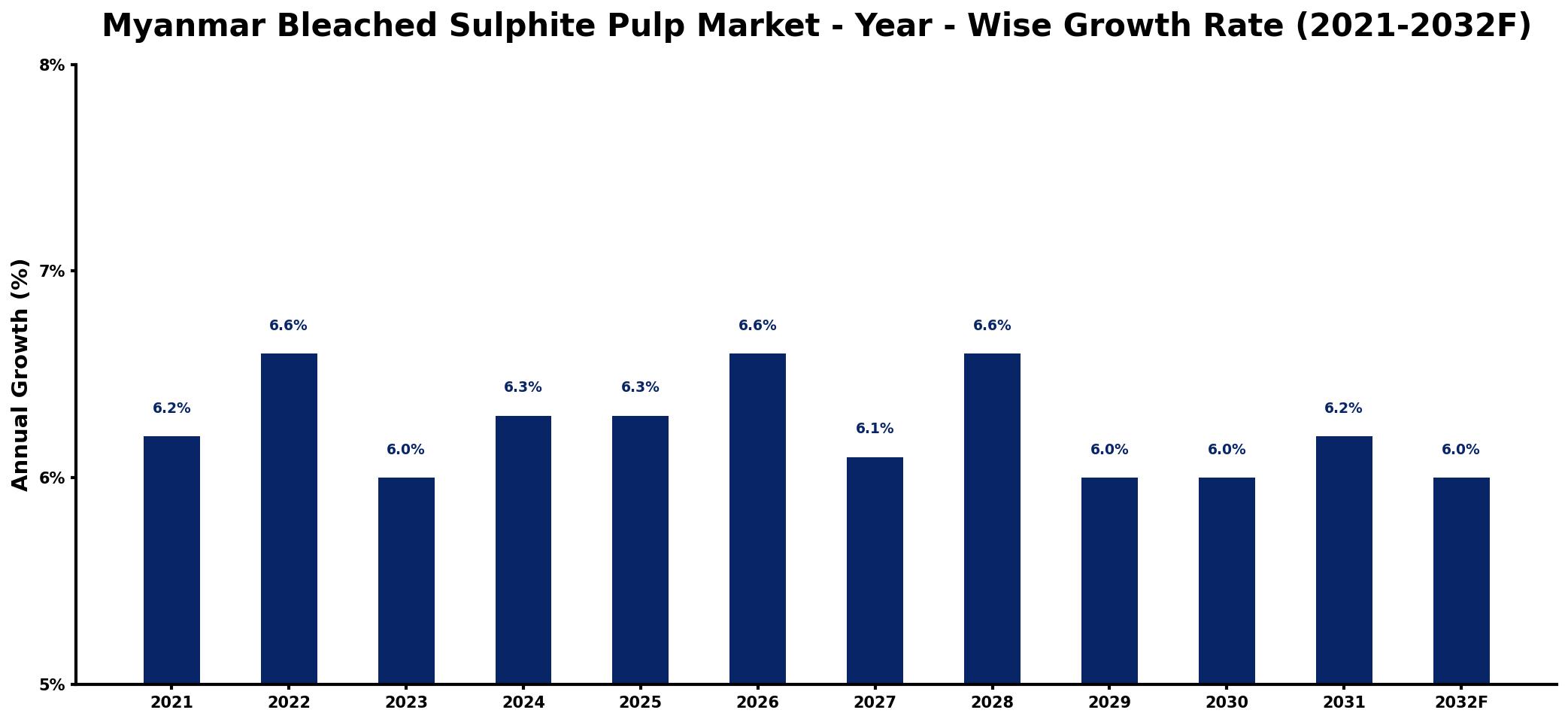
The table below presents the year‑wise growth rates along with the key drivers influencing the market
| Year | Growth Rate | Major Drivers |
| 2021 | 6.2% | Rising demand from packaging sector |
| 2022 | 6.6% | Increased investment in manufacturing facilities |
| 2023 | 6.0% | Expansion in sustainable product applications |
| 2024 | 6.3% | Growth in export opportunities globally |
| 2025 | 6.3% | Higher consumption in construction industry |
| 2026 | 6.6% | Technological advancements in production processes |
| 2027 | 6.1% | Emerging markets driving consumption growth |
| 2028 | 6.6% | Strengthened supply chain efficiencies observed |
| 2029 | 6.0% | enhanced product quality standards |
| 2030 | 6.0% | Increased collaboration with international partners |
| 2031 | 6.2% | Development of innovative product solutions |
| 2032 | 6.0% | Rising awareness of environmental sustainability |
Note: Market size estimations and growth projections presented in this report are based on 6Wresearch's proprietary forecasting methodology, utilizing the latest available industry data, government publications, and primary research inputs.
Myanmar Bleached Sulphite Pulp Market Synopsis
In Myanmar, the increasing production of specialty papers, particularly fine papers and tissue, is fueling demand for bleached sulphite pulp. The unique properties of this pulp type, combined with its environmental advantages when sourced sustainably, make it a preferred choice for manufacturers looking to meet rising consumer expectations.
Additionally, the expansion of the printing and writing paper segments reflects a broader trend towards high-quality materials, further solidifying the position of bleached sulphite pulp within the market. This growth is underscored by ongoing technological advancements that continue to improve the efficiency and sustainability of production processes.
Myanmar Bleached Sulphite Pulp Market Key Takeaways
- The market is set for robust growth, driven by increasing demand for high-quality paper products.
- Technological advancements in sulphite pulping are improving production efficiency.
- Environmental regulations are prompting a shift towards sustainable sourcing practices.
- Competitive pressures from alternative pulping methods are challenging market dynamics.
- Government initiatives aim to enhance the industry's competitiveness through targeted support.
Evaluation of Restraints in Myanmar Bleached Sulphite Pulp Market
Despite its promising outlook, the Myanmar bleached sulphite pulp market faces significant restraints, primarily due to stringent environmental regulations. The pulping process is notorious for its environmental impact, leading to increased compliance costs for producers. Additionally, the sourcing of sustainable raw materials presents a formidable challenge, as deforestation and ecological concerns limit wood availability. Outdated production facilities further hinder product quality and production efficiency, placing Myanmar producers at a competitive disadvantage against those in regions with more advanced technologies.
Myanmar Bleached Sulphite Pulp Market Trends
Current trends indicate a shift towards sustainable production methods within the Myanmar bleached sulphite pulp market. Manufacturers are increasingly adopting environmentally friendly practices to align with global sustainability goals. Moreover, there is a growing consumer preference for eco-friendly packaging solutions, which is encouraging the use of bleached sulphite pulp in diverse applications. Additionally, the integration of advanced technology in the production process is expected to enhance operational efficiencies and product quality, further driving market interest.
Myanmar Bleached Sulphite Pulp Market Opportunities
Opportunities for growth within the Myanmar bleached sulphite pulp market are abundant, particularly in the specialty paper and packaging segments. As consumer awareness around sustainability grows, businesses that can innovate and implement eco-friendly practices will find themselves well-positioned to capitalize on new market segments. Investments in modernizing production facilities and adopting advanced pulping technologies can also lead to increased operational efficiency, enabling companies to enhance their product offerings and market reach.
Government Initiatives in the Myanmar Bleached Sulphite Pulp Market
The Myanmar government is actively working to bolster the bleached sulphite pulp market through a variety of initiatives. These include tax incentives aimed at encouraging pulp producers to adopt sustainable practices and invest in infrastructure development. The Ministry of Industry is emphasizing the importance of clean production techniques to mitigate environmental impacts. Collaborative efforts with international organizations are also in place to enhance the technological capabilities and market access for domestic pulp producers, fostering a more competitive landscape.
Future Insights of the Myanmar Bleached Sulphite Pulp Market
Looking ahead to 2026-2032, the Myanmar bleached sulphite pulp market is poised for significant transformation. Driven by technological advancements and a commitment to sustainable practices, producers can anticipate improved efficiencies and product quality. As demand for high-quality specialty papers continues to rise, the market will likely adapt to meet the evolving needs of consumers. Furthermore, ongoing government support and a focus on international collaboration will play crucial roles in shaping the future trajectory of this promising market.
Myanmar Bleached Sulphite Pulp Market Latest Developments (2025 - 2026)
Recent developments in the Myanmar bleached sulphite pulp market highlight a growing focus on sustainability and innovation. Producers are increasingly prioritizing the modernization of facilities to reduce environmental impact while enhancing product quality. Additionally, strategic partnerships with international organizations are being formed to leverage advanced technologies and best practices. These shifts not only reflect the industry's response to regulatory pressures but also align with global trends towards more sustainable production processes.
Myanmar Bleached Sulphite Pulp Market - Key Attractiveness of the Report
- 10 Years of Market Numbers
- Historical Data Starting from 2022 to 2025
- Base Year: 2025
- Forecast Data until 2032
- Key Performance Indicators Impacting the Market
- Major Upcoming Developments and Projects
Key Highlights of the Report:
- Myanmar Bleached Sulphite Pulp Market Outlook
- Market Size of Myanmar Bleached Sulphite Pulp Market, 2025
- Forecast of Myanmar Bleached Sulphite Pulp Market, 2032
- Historical Data and Forecast of Myanmar Bleached Sulphite Pulp Revenues & Volume for the Period 2022-2032F
- Myanmar Bleached Sulphite Pulp Market Trend Evolution
- Myanmar Bleached Sulphite Pulp Market Drivers and Challenges
- Myanmar Bleached Sulphite Pulp Price Trends
- Myanmar Bleached Sulphite Pulp Porter's Five Forces
- Myanmar Bleached Sulphite Pulp Industry Life Cycle
- Historical Data and Forecast of Myanmar Bleached Sulphite Pulp Market Revenues & Volume By End Use for the Period 2022-2032F
- Historical Data and Forecast of Myanmar Bleached Sulphite Pulp Market Revenues & Volume By Chemical for the Period 2022-2032F
- Historical Data and Forecast of Myanmar Bleached Sulphite Pulp Market Revenues & Volume By Healthcare for the Period 2022-2032F
- Historical Data and Forecast of Myanmar Bleached Sulphite Pulp Market Revenues & Volume By Furniture for the Period 2022-2032F
- Historical Data and Forecast of Myanmar Bleached Sulphite Pulp Market Revenues & Volume By Others for the Period 2022-2032F
- Myanmar Bleached Sulphite Pulp Import Export Trade Statistics
- Market Opportunity Assessment By End Use
- Myanmar Bleached Sulphite Pulp Top Companies Market Share
- Myanmar Bleached Sulphite Pulp Competitive Benchmarking By Technical and Operational Parameters
- Myanmar Bleached Sulphite Pulp Company Profiles
- Myanmar Bleached Sulphite Pulp Key Strategic Recommendations






































