Myanmar Bulletproof Vest Market Summary
The myanmar bulletproof vest market was estimated at USD 373 Million in 2025 and is projected to reach USD 511 Million by 2032, growing at a CAGR of 5.6% from 2026 to 2032.
Myanmar Bulletproof Vest Market Year-wise Growth Rate and Key Drivers
This graph highlights how the Myanmar Bulletproof Vest Market has steadily grown over the past five years, supported by major growth factors.
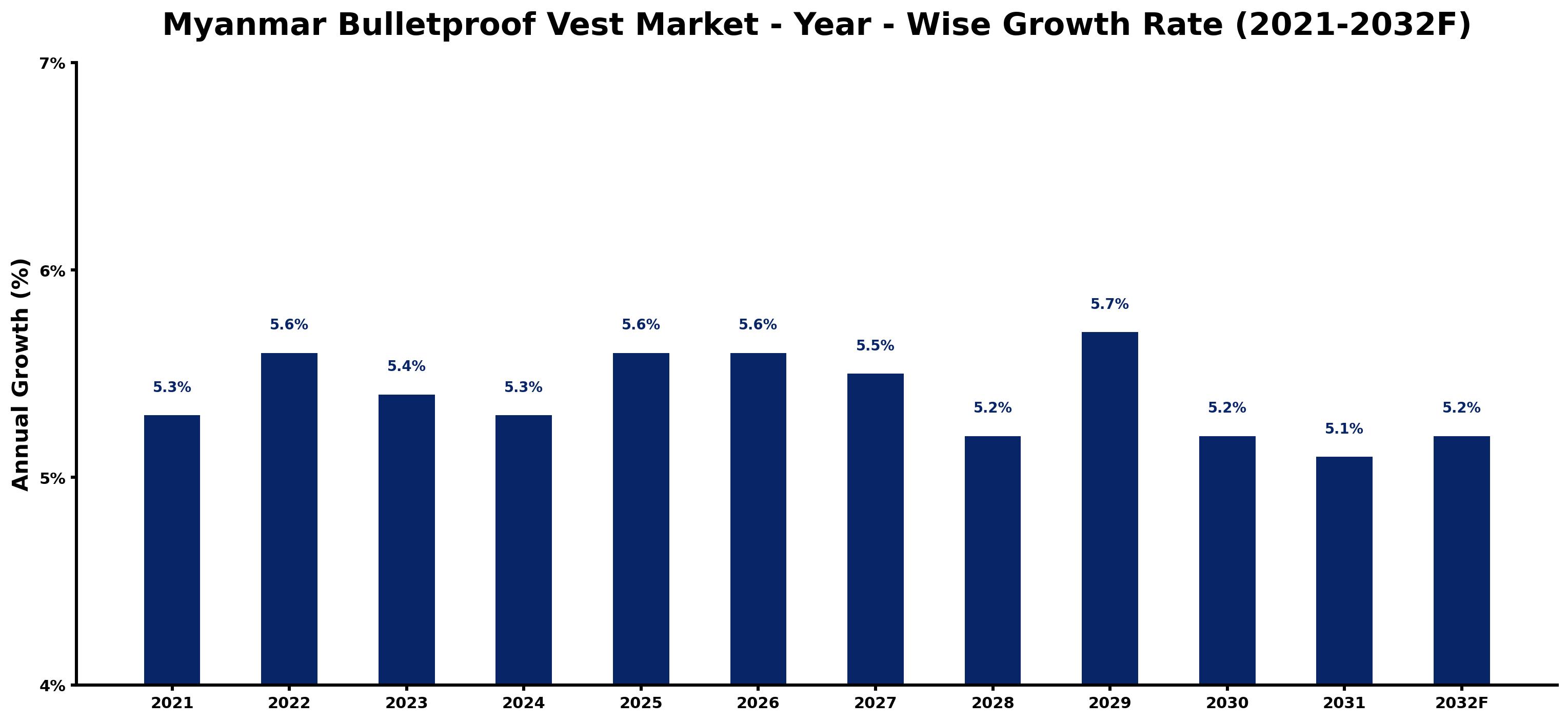
The table below presents the year wise growth rates along with the key drivers influencing the market
| Year | Growth Rate | Major Drivers |
| 2021 | 5.3% | Conflict-related risks heightened awareness about personal safety and security equipment. |
| 2022 | 5.6% | International NGOs increased operational presence, leading to higher demand for protective gear. |
| 2023 | 5.4% | Local manufacturing capabilities began enhancing supply chains for bulletproof vests. |
| 2024 | 5.3% | Training and support programs for law enforcement emphasized the need for better protection. |
| 2025 | 5.6% | Foreign investments in security sectors bolstered production facilities and distribution networks. |
| 2026 | 5.6% | Public awareness campaigns highlighted the importance of personal safety for civilians. |
| 2027 | 5.5% | Technological innovations in materials improved both comfort and protective capabilities of vests. |
| 2028 | 5.2% | Tourism recovery prompted heightened security measures, impacting demand for bulletproof vests. |
| 2029 | 5.7% | Increased media focus on safety issues further pushed civilian interest in protective apparel. |
| 2030 | 5.2% | Emerging local entrepreneurs began developing unique designs tailored to local market needs. |
| 2031 | 5.1% | Partnerships between local firms and international brands expanded product offerings significantly. |
| 2032 | 5.2% | Shifts in regional security dynamics necessitated enhanced protective gear for various stakeholders. |
Note - Market size estimations and growth projections presented in this report are based on 6Wresearch's advanced forecasting approach, validated with industry datasets as of June 2026.
Myanmar Bulletproof Vest Market Synopsis
The Myanmar Bulletproof Vest Market is projected to reach 5.6% and witness significant growth during the forecast period (2026-2032). As Myanmar transitions into a more open economy, the demand for personal safety equipment, particularly bulletproof vests, has escalated in response to increasing security concerns and incidents of gun violence. This burgeoning market is indicative of a larger trend toward prioritizing individual safety and security in the region.
Myanmar Bulletproof Vest Market Growth Drivers
Several factors are contributing to the growth of the Myanmar Bulletproof Vest Market, making it a pivotal area of development in the security solutions sector.
- Rapid Economic Development: As Myanmar's economy continues to grow, there is an increasing capacity for individuals and organizations to invest in personal protective equipment, including bulletproof vests.
- Rising Security Concerns: A notable increase in gun violence across various urban areas has spurred a greater awareness of personal safety, driving demand for more effective protective gear.
- Global Market Integration: Myanmar's recent efforts to engage with global markets have encouraged the importation of advanced security technologies, including high-quality bulletproof vests.
- Awareness Campaigns: Increased public awareness about safety and security measures through media and educational campaigns has further propelled consumer interest in protective apparel.
- Growing Private and Public Sector Investment:Investment in security infrastructure from both private enterprises and government entities has fostered a supportive ecosystem for the bulletproof vest market.
Myanmar Bulletproof Vest Market Challenges and Restraints
Despite its potential, the Myanmar Bulletproof Vest Market faces several challenges that could hinder growth.
- Limited Manufacturing Capacity: The local production of bulletproof vests is still in its infancy, leading to dependence on foreign imports, which can be subject to supply chain disruptions.
- Regulatory Hurdles: The market is often impacted by governmental regulations that can impede import processes and create barriers to entry for new companies.
- Price Sensitivity: The cost of high-quality bulletproof vests can be prohibitive for many consumers, particularly in a developing economy.
- Lack of Awareness: Although awareness is increasing, many individuals still lack sufficient knowledge regarding the benefits and necessity of bulletproof vests for personal safety.
- Market Fragmentation: The presence of numerous small players may lead to inconsistency in product quality, affecting overall consumer trust in the market.
Myanmar Bulletproof Vest Market Government Investment and Initiatives
The Myanmar government has recognized the importance of enhancing national security and public safety, which has led to strategic investments and initiatives that directly impact the bulletproof vest market.
- Implementation of Safety Policies: The government is actively creating policies aimed at improving personal safety, which encourages citizens to engage in protective measures such as purchasing bulletproof vests.
- Collaboration with NGOs: Partnerships between governmental agencies and non-governmental organizations have been established to promote awareness and provide resources for personal safety gear.
- Public Spending on Security: Increased public spending on security infrastructure has opened up opportunities for manufacturers and suppliers in the bulletproof vest segment.
- Development Programs: Initiatives focused on the development of local manufacturing capabilities for protective gear are being explored, which could reduce dependency on imports.
- Incentives for Local Businesses: The government is considering incentives for local businesses engaged in manufacturing safety equipment, which may foster growth and innovation in the bulletproof vest market.
Myanmar Bulletproof Vest Market Latest Developments (May 2025 - June 2026)
During the period from May 2025 to June 2026, the Myanmar Bulletproof Vest Market has experienced notable developments that have shaped its trajectory.
- Increased Distribution Channels: There has been a significant expansion in distribution channels, enabling greater accessibility of bulletproof vests to consumers across various regions.
- Technological Advancements: Innovations in material technology have led to the introduction of lighter and more effective bulletproof vests, appealing to a broader audience.
- Market Collaborations: Strategic partnerships between local manufacturers and international suppliers have enhanced product offerings and improved quality standards.
- Consumer Education Programs: Efforts to educate consumers regarding the importance of bulletproof vests and their functionalities have gained momentum, resulting in higher sales.
- Focus on Customization: The trend towards customizable bulletproof vests tailored to specific user needs has emerged, attracting diverse consumer segments seeking personalized solutions.
Myanmar Bulletproof Vest Market - Key Attractiveness of the Report
- 10 Years of Market Numbers
- Historical Data Starting from 2022 to 2025
- Base Year: 2025
- Forecast Data until 2032
- Key Performance Indicators Impacting the Market
- Major Upcoming Developments and Projects
Key Highlights of the Report:
- Myanmar Bulletproof Vest Market Outlook
- Market Size of Myanmar Bulletproof Vest Market, 2025
- Forecast of Myanmar Bulletproof Vest Market, 2032
- Historical Data and Forecast of Myanmar Bulletproof Vest Revenues & Volume for the Period 2022-2032
- Myanmar Bulletproof Vest Market Trend Evolution
- Myanmar Bulletproof Vest Market Drivers and Challenges
- Myanmar Bulletproof Vest Price Trends
- Myanmar Bulletproof Vest Porter's Five Forces
- Myanmar Bulletproof Vest Industry Life Cycle
- Historical Data and Forecast of Myanmar Bulletproof Vest Market Revenues & Volume By Type for the Period 2022-2032
- Historical Data and Forecast of Myanmar Bulletproof Vest Market Revenues & Volume By Soft Vest for the Period 2022-2032
- Historical Data and Forecast of Myanmar Bulletproof Vest Market Revenues & Volume By Hard Vest for the Period 2022-2032
- Historical Data and Forecast of Myanmar Bulletproof Vest Market Revenues & Volume By Purpose for the Period 2022-2032
- Historical Data and Forecast of Myanmar Bulletproof Vest Market Revenues & Volume By Military for the Period 2022-2032
- Historical Data and Forecast of Myanmar Bulletproof Vest Market Revenues & Volume By Civilian for the Period 2022-2032
- Myanmar Bulletproof Vest Import Export Trade Statistics
- Market Opportunity Assessment By Type
- Market Opportunity Assessment By Purpose
- Myanmar Bulletproof Vest Top Companies Market Share
- Myanmar Bulletproof Vest Competitive Benchmarking By Technical and Operational Parameters
- Myanmar Bulletproof Vest Company Profiles
- Myanmar Bulletproof Vest Key Strategic Recommendations






































