Myanmar Business Intelligence Market Size & Growth Rate (2026-2032)
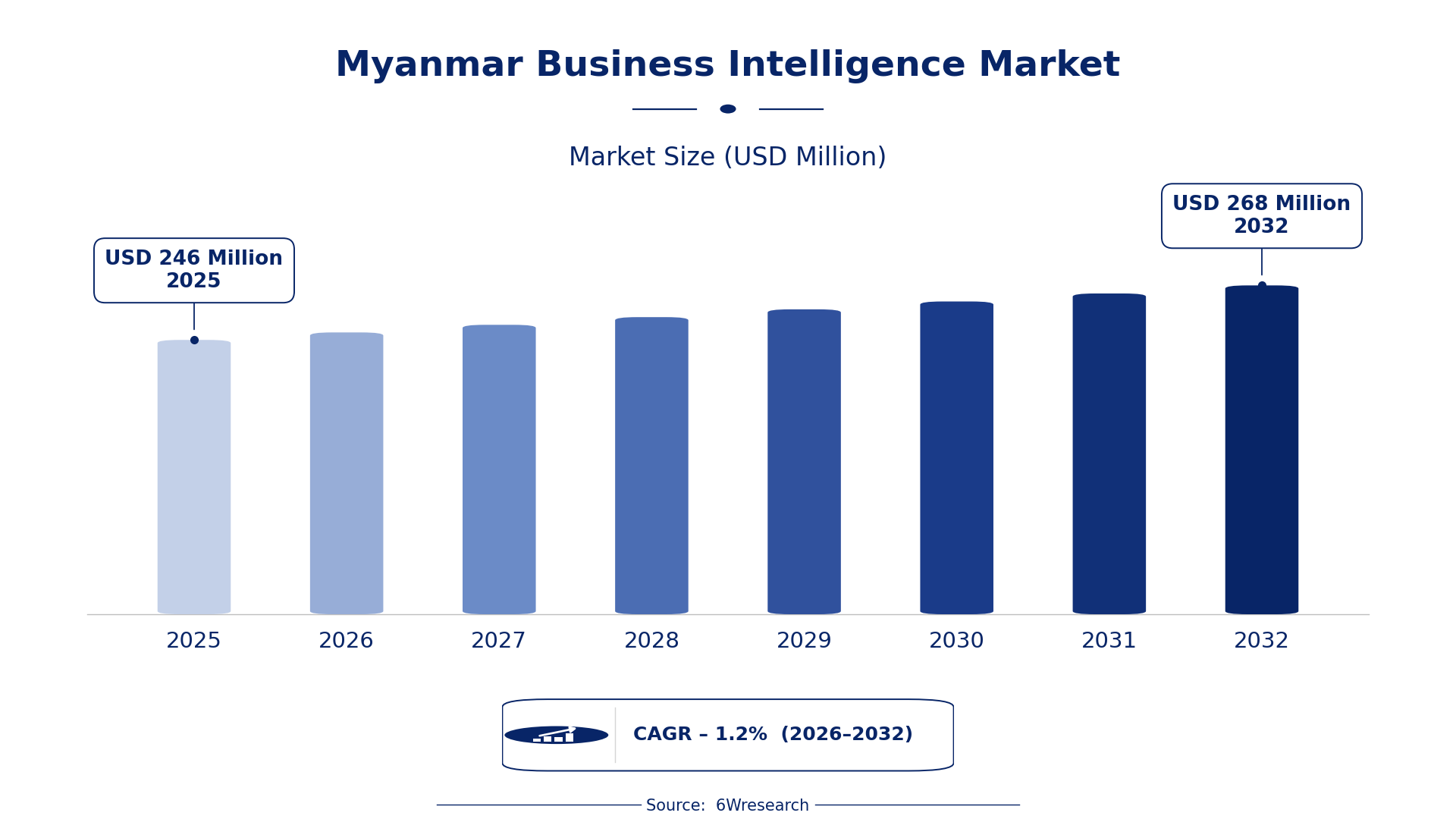
The Myanmar Business Intelligence Market was estimated at USD 246 Million in 2025 and is projected to reach USD 268 Million by 2032, growing at a CAGR of 1.2% from 2026 to 2032.
Myanmar Business Intelligence Market Synopsis
The rapid digital transformation in Myanmar is the strongest force shaping the Business Intelligence Market today. As companies increasingly recognize the power of data-driven decision-making, there’s a clear shift toward adopting advanced BI tools that can analyze complex datasets.
This growth is fueled by a burgeoning economy where businesses, especially SMEs, are striving to enhance their operational efficiencies. As organizations leverage cloud-based BI solutions for better scalability and accessibility, the demand for predictive analytics and data visualization is on the rise.
Myanmar Business Intelligence Market Year-wise Growth Rate and Key Drivers
This graph illustrates the annual growth rates of the Myanmar Business Intelligence Market from 2021 to 2032, highlighting a steady upward trajectory and projected expansion over the forecast period.
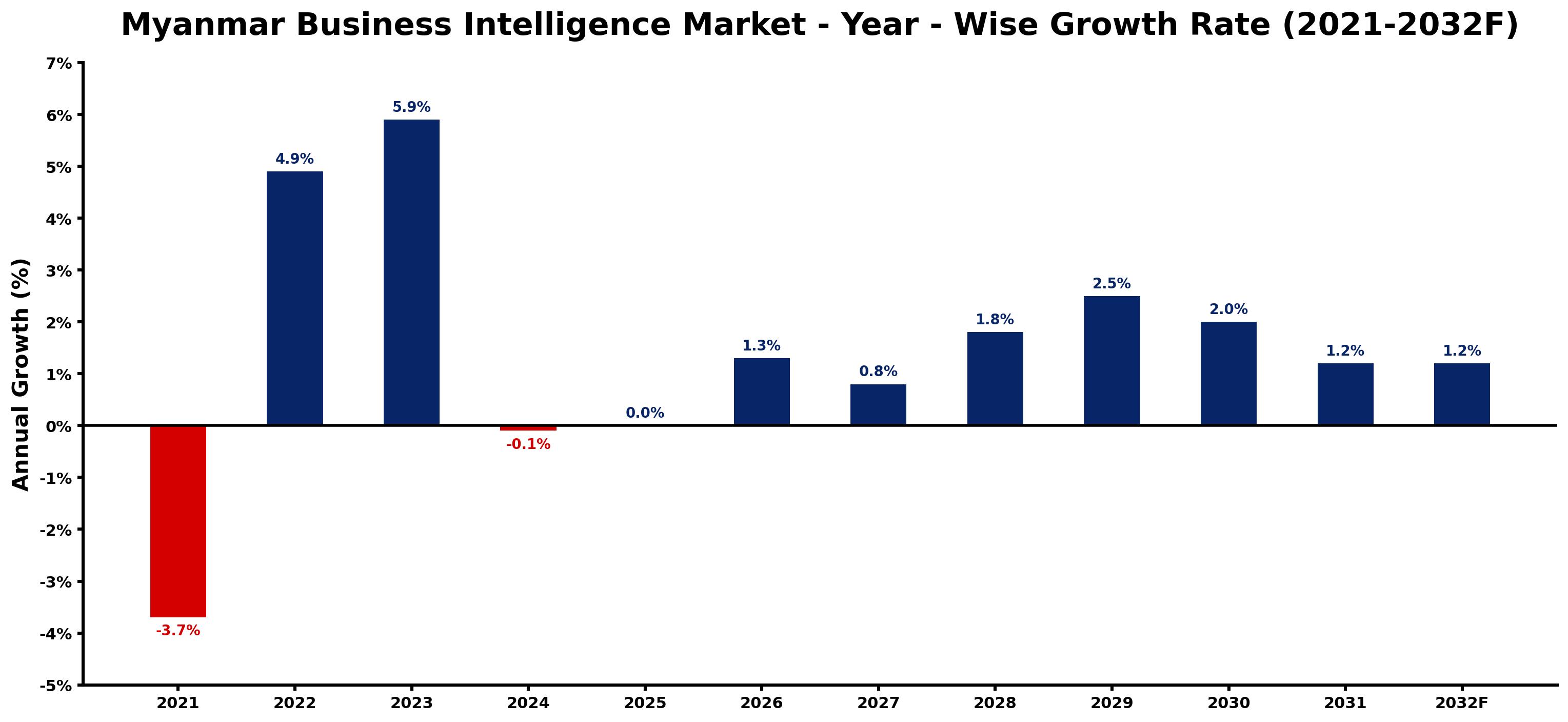
The table below presents the year‑wise growth rates along with the key drivers influencing the market
| Year | Growth Rate | Major Drivers |
| 2021 | -3.7% | COVID-19 lockdowns reduced business activity significantly |
| 2022 | 4.9% | Increase in local business analytics startups |
| 2023 | 5.9% | Adoption of Myanmar's digital economy initiatives |
| 2024 | -0.1% | Political instability hindered investment in analytics solutions |
| 2025 | 0.0% | Increasing smart city development projects |
| 2026 | 1.3% | Growth in regional e-commerce platforms usage |
| 2027 | 0.8% | Government grants for tech-driven business solutions |
| 2028 | 1.8% | Rise in demand for data-driven decision making |
| 2029 | 2.5% | Emerging interest in predictive analytics tools |
| 2030 | 2.0% | Development of local data privacy regulations |
| 2031 | 1.2% | Local SMEs investing in business intelligence solutions |
| 2032 | 1.2% | Increased training programs for data literacy |
Note: Market size estimations and growth projections presented in this report are based on 6Wresearch's proprietary forecasting methodology, utilizing the latest available industry data, government publications, and primary research inputs.
Myanmar Business Intelligence Market Key Takeaways
Below are some of the specific key takeaways from the market, including:
- Cloud-based BI solutions are increasingly preferred due to their cost-effectiveness and scalability.
- Self-service BI tools are gaining traction, allowing non-technical users to analyze data independently.
- The market is challenged by limited access to reliable data and a shortage of skilled data professionals.
- Government initiatives are aimed at enhancing transparency and efficiency in business operations.
- Investment opportunities exist in sectors like finance, telecommunications, and retail driven by data analytics.
Evaluation of Restraints in Myanmar Business Intelligence Market
The Myanmar Business Intelligence Market faces several restraints that could stifle its growth. One of the primary issues is the limited access to reliable and updated data sources. This situation is exacerbated by the country's historical political instability, which has created an environment where accurate data collection is challenging.
Additionally, there is a noticeable shortage of skilled professionals who are well-versed in data analytics and BI tools. This skill gap hampers the effective implementation of advanced analytics practices. Regulatory constraints further complicate the landscape, as unclear data privacy laws inhibit comprehensive data collection and analysis.
Myanmar Business Intelligence Market Trends
Several trends are shaping the Myanmar Business Intelligence Market. One of the most notable is the increasing adoption of advanced analytics tools by businesses seeking to improve operational efficiency. As more organizations recognize the value of data insights, the demand for sophisticated BI solutions continues to grow.
The shift towards cloud-based BI platforms is another critical trend, as these solutions offer enhanced scalability and lower costs, particularly beneficial for small and medium-sized enterprises. on top of that, the emphasis on self-service BI tools is empowering users to engage with data independently, streamlining decision-making processes.
Myanmar Business Intelligence Market Opportunities
Investment opportunities in the Myanmar Business Intelligence Market are abundant, driven by the country’s economic growth and increasing digitalization. Sectors like finance, telecommunications, and retail are particularly ripe for investment as they increasingly rely on data analytics to make informed strategic decisions.
on top of that, partnering with local entities can provide crucial insights into market dynamics and regulatory requirements, enhancing the chances of success. As businesses continue to prioritize data analytics, the demand for tailored BI solutions will only intensify.
Government Initiatives in the Myanmar Business Intelligence Market
The government of Myanmar is actively shaping the Business Intelligence Market through various policies aimed at promoting transparency and operational efficiency. Recent initiatives reflect a commitment to improving data security and fostering a more conducive environment for business operations.
- A recently completed initiative involved the establishment of the Myanmar Investment Commission (MIC) to enhance foreign investment opportunities.
- A current initiative focuses on rolling out the Data Protection Law to enhance data security and privacy regulations.
- Planned for the coming years is a national digital infrastructure upgrade programme aimed at improving data accessibility across sectors.
- Efforts are underway to implement training programs aimed at developing skilled professionals in data analytics and BI tools.
- Upcoming regulatory reforms are expected to clarify data privacy laws, making it easier for businesses to engage in data analytics.
Future Insights of the Myanmar Business Intelligence Market
Looking ahead to 2026-2032, the Myanmar Business Intelligence Market is set for notable expansion. The combination of increasing digitalization and a growing need for data-driven decision-making will propel the market forward. As more businesses invest in technology infrastructure, the demand for advanced BI solutions will escalate.
The government's emphasis on creating a favorable business environment, coupled with the rise of startups and SMEs, will drive the adoption of data analytics tools. Organizations will increasingly seek to enhance operational efficiency and improve customer experiences, paving the way for significant growth in the Business Intelligence Market.
Myanmar Business Intelligence Market Latest Developments
Over the last year, the Myanmar Business Intelligence Market has witnessed various developments that reflect a dynamic shift towards data-centric operations. Companies are actively investing in analytics solutions to adapt to the changing business environment.
- A major technology vendor launched a new cloud-based analytics platform in early 2025, designed to enhance data visualization capabilities.
- A partnership formed between local businesses and international data analytics firms is currently ongoing, focusing on improving market access for BI solutions.
- In Q3 2025, a significant training programme was initiated to upskill professionals in data analytics across various sectors.
- Plans are in place for a regulatory update set for mid-2026, aimed at clarifying compliance standards for data collection.
- A recent initiative to enhance data integration processes was completed, significantly improving operational efficiencies for SMEs.
Myanmar Business Intelligence Market - Key Attractiveness of the Report
- 10 Years of Market Numbers
- Historical Data Starting from 2022 to 2025
- Base Year: 2025
- Forecast Data until 2032
- Key Performance Indicators Impacting the Market
- Major Upcoming Developments and Projects
Key Highlights of the Report:
- Myanmar Business Intelligence Market Outlook
- Market Size of Myanmar Business Intelligence Market, 2025
- Forecast of Myanmar Business Intelligence Market, 2032
- Historical Data and Forecast of Myanmar Business Intelligence Revenues & Volume for the Period 2022-2032F
- Myanmar Business Intelligence Market Trend Evolution
- Myanmar Business Intelligence Market Drivers and Challenges
- Myanmar Business Intelligence Price Trends
- Myanmar Business Intelligence Porter's Five Forces
- Myanmar Business Intelligence Industry Life Cycle
- Historical Data and Forecast of Myanmar Business Intelligence Market Revenues & Volume By Component for the Period 2022-2032F
- Historical Data and Forecast of Myanmar Business Intelligence Market Revenues & Volume By Solutions for the Period 2022-2032F
- Historical Data and Forecast of Myanmar Business Intelligence Market Revenues & Volume By Services for the Period 2022-2032F
- Historical Data and Forecast of Myanmar Business Intelligence Market Revenues & Volume By Business Function for the Period 2022-2032F
- Historical Data and Forecast of Myanmar Business Intelligence Market Revenues & Volume By Human Resource for the Period 2022-2032F
- Historical Data and Forecast of Myanmar Business Intelligence Market Revenues & Volume By Finance for the Period 2022-2032F
- Historical Data and Forecast of Myanmar Business Intelligence Market Revenues & Volume By Operations for the Period 2022-2032F
- Historical Data and Forecast of Myanmar Business Intelligence Market Revenues & Volume By Sales and Marketing for the Period 2022-2032F
- Historical Data and Forecast of Myanmar Business Intelligence Market Revenues & Volume By Deployment Mode for the Period 2022-2032F
- Historical Data and Forecast of Myanmar Business Intelligence Market Revenues & Volume By On-premises for the Period 2022-2032F
- Historical Data and Forecast of Myanmar Business Intelligence Market Revenues & Volume By Cloud for the Period 2022-2032F
- Historical Data and Forecast of Myanmar Business Intelligence Market Revenues & Volume By Organization Size for the Period 2022-2032F
- Historical Data and Forecast of Myanmar Business Intelligence Market Revenues & Volume By SMEs for the Period 2022-2032F
- Historical Data and Forecast of Myanmar Business Intelligence Market Revenues & Volume By Large Enterprises for the Period 2022-2032F
- Historical Data and Forecast of Myanmar Business Intelligence Market Revenues & Volume By Vertical for the Period 2022-2032F
- Historical Data and Forecast of Myanmar Business Intelligence Market Revenues & Volume By Retail for the Period 2022-2032F
- Historical Data and Forecast of Myanmar Business Intelligence Market Revenues & Volume By Manufacturing for the Period 2022-2032F
- Historical Data and Forecast of Myanmar Business Intelligence Market Revenues & Volume By Government and Public Services for the Period 2022-2032F
- Historical Data and Forecast of Myanmar Business Intelligence Market Revenues & Volume By Media and Entertainment for the Period 2022-2032F
- Historical Data and Forecast of Myanmar Business Intelligence Market Revenues & Volume By Transportation and Logistics for the Period 2022-2032F
- Historical Data and Forecast of Myanmar Business Intelligence Market Revenues & Volume By BFSI for the Period 2022-2032F
- Historical Data and Forecast of Myanmar Business Intelligence Market Revenues & Volume By Telecom and IT for the Period 2022-2032F
- Historical Data and Forecast of Myanmar Business Intelligence Market Revenues & Volume By Healthcare and Life Sciences for the Period 2022-2032F
- Myanmar Business Intelligence Import Export Trade Statistics
- Market Opportunity Assessment By Component
- Market Opportunity Assessment By Business Function
- Market Opportunity Assessment By Deployment Mode
- Market Opportunity Assessment By Organization Size
- Market Opportunity Assessment By Vertical
- Myanmar Business Intelligence Top Companies Market Share
- Myanmar Business Intelligence Competitive Benchmarking By Technical and Operational Parameters
- Myanmar Business Intelligence Company Profiles
- Myanmar Business Intelligence Key Strategic Recommendations






































