Myanmar Car Air Fresheners Market Size, Share & Growth Rate
The Myanmar Car Air Fresheners Market was estimated at USD 682 Million in 2025 and is projected to reach USD 1282 Million by 2032, growing at a CAGR of 9.4% from 2026 to 2032. This impressive growth trajectory is primarily driven by increasing car ownership rates and the rising awareness among consumers regarding the importance of maintaining a pleasant in-car environment. As the urban population expands and disposable incomes rise, the demand for diverse and high-quality car air fresheners continues to surge.
Myanmar Car Air Fresheners Market Year-wise Growth Rate and Key Drivers
This graph highlights how the Myanmar Car Air Fresheners Market has steadily grown over the years, supported by major growth factors.
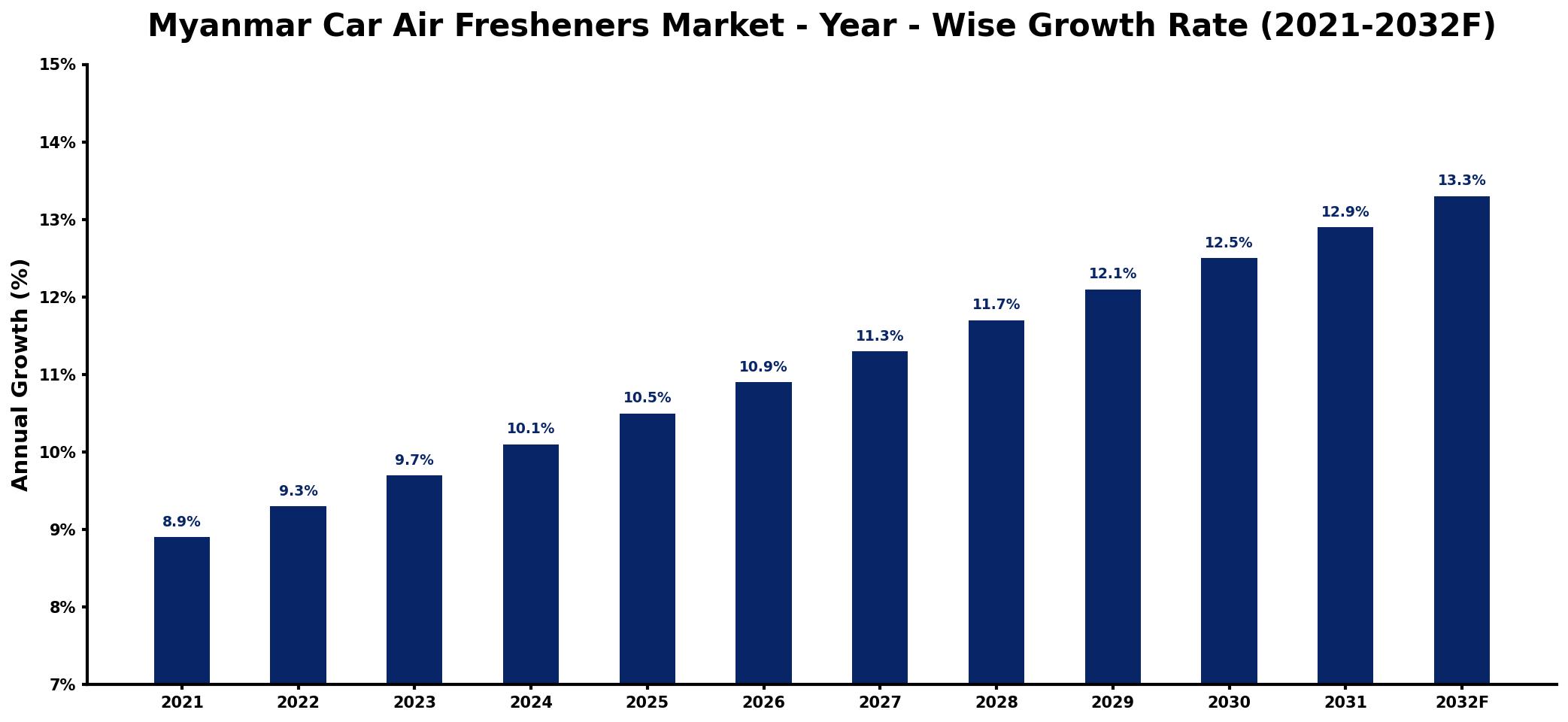
The table below presents the year‑wise growth rates along with the key drivers influencing the market
| Year | Growth Rate | Major Drivers |
| 2021 | 8.9% | Increased consumer preference for scents |
| 2022 | 9.3% | Growing disposable income among consumers |
| 2023 | 9.7% | Rising demand for automotive accessories |
| 2024 | 10.1% | Expansion of retail distribution channels |
| 2025 | 10.5% | Increased focus on personal hygiene |
| 2026 | 10.9% | Growing interest in eco-friendly products |
| 2027 | 11.3% | increased pharmaceutical industry usage |
| 2028 | 11.7% | Rising popularity of subscription services |
| 2029 | 12.1% | Increased investment in marketing strategies |
| 2030 | 12.5% | growing regional consumption patterns |
| 2031 | 12.9% | Growing trend of customization options |
| 2032 | 13.3% | Increased awareness of aromatherapy benefits |
Note: Market size estimations and growth projections presented in this report are based on 6Wresearch's proprietary forecasting methodology, utilizing the latest available industry data, government publications, and primary research inputs.
Myanmar Car Air Fresheners Market Synopsis
A significant force shaping the Myanmar Car Air Fresheners Market is the increasing consumer preference for eco-friendly and long-lasting products. As consumers become more environmentally conscious, the demand for air fresheners made from natural ingredients without harmful chemicals is on the rise, reflecting a broader trend towards sustainability.
Furthermore, innovative scent options beyond traditional fragrances are captivating consumers' interest. Manufacturers are keen to explore woody, herbal, and exotic aromas, allowing for a unique in-car atmosphere that meets various customer preferences and enhances the driving experience.
Myanmar Car Air Fresheners Market Key Takeaways
- The market is witnessing a significant shift towards eco-friendly and natural air fresheners.
- Urbanization and rising disposable incomes are key drivers of market growth.
- Innovative fragrances are emerging as a strong trend, diversifying product offerings.
- Distribution through e-commerce platforms is expanding, catering to tech-savvy consumers.
- There is a growing demand for long-lasting freshness and customizable solutions in air fresheners.
Evaluation of Restraints in Myanmar Car Air Fresheners Market
Despite its promising growth, the Myanmar Car Air Fresheners Market faces several restraints that could limit its potential. One major barrier is the limited consumer awareness regarding the benefits and varieties of air fresheners available. Additionally, the lower purchasing power among a significant portion of the population restricts market expansion. Furthermore, the competitive landscape is crowded, making it challenging for new entrants to effectively differentiate their products. Disjointed distribution channels can lead to inefficiencies in reaching consumers, while a lack of strict quality regulations may result in the presence of low-quality products, undermining consumer trust and brand loyalty.
Myanmar Car Air Fresheners Market Trends
The current trends in the Myanmar Car Air Fresheners Market are prominently leaning towards natural and eco-friendly products. Consumers increasingly demand solutions that do not compromise their health or the environment, fueling the popularity of air fresheners crafted from organic materials. Additionally, manufacturers are focusing on creating unique scent blends that reflect cultural preferences and seasonal trends, thus enhancing the user experience. Online purchasing has also gained traction, driven by convenience and the wide array of options available on e-commerce platforms.
Myanmar Car Air Fresheners Market Opportunities
The Myanmar Car Air Fresheners Market holds substantial opportunities for investment and growth. With the rise of car ownership and a burgeoning middle class, the demand for high-quality air fresheners tailored to local tastes is substantial. There is potential for introducing innovative products such as eco-friendly options and long-lasting fragrances. Strategic partnerships with local automotive retailers and effective marketing campaigns can enhance market reach. Moreover, leveraging e-commerce platforms can provide a significant advantage in accessing a broader customer base, thus maximizing sales potential.
Government Initiatives in the Myanmar Car Air Fresheners Market
Government policies affecting the Myanmar Car Air Fresheners Market are primarily focused on ensuring product safety and compliance with environmental standards. Regulations are in place to guarantee that air fresheners meet quality benchmarks and do not contain harmful chemicals that may jeopardize consumer health. Labeling requirements and adherence to international standards are also emphasized, prompting businesses to remain vigilant and informed regarding these regulations. This proactive approach fosters a more reliable marketplace, benefitting both consumers and reputable manufacturers.
Future Insights of the Myanmar Car Air Fresheners Market
Looking ahead to the period between 2026 and 2032, the Myanmar Car Air Fresheners Market is poised for continued growth. The combination of increasing car ownership, heightened disposable incomes, and a growing emphasis on personal hygiene and cleanliness will drive demand for air fresheners. Manufacturers are likely to respond with innovative offerings that cater to evolving consumer preferences, especially those leaning towards sustainability. By focusing on effective marketing strategies and expanding distribution networks, both local and international players can leverage the anticipated growth in this vibrant market segment.
Myanmar Car Air Fresheners Market Latest Developments (2025 - 2026)
Recent developments in the Myanmar Car Air Fresheners Market indicate a heightened focus on sustainability, with several brands exploring natural ingredients and eco-friendly packaging options. There has been a noticeable shift toward utilizing local scent profiles, enhancing the cultural relevance of products. Additionally, brands are increasingly leveraging digital marketing strategies to enhance brand visibility and connect with the modern consumer. E-commerce has also become a vital channel for reaching customers, allowing for a more efficient and personalized shopping experience.
Myanmar Car Air Fresheners Market - Key Attractiveness of the Report
- 10 Years of Market Numbers
- Historical Data Starting from 2022 to 2025
- Base Year: 2025
- Forecast Data until 2032
- Key Performance Indicators Impacting the Market
- Major Upcoming Developments and Projects
Key Highlights of the Report:
- Myanmar Car Air Fresheners Market Outlook
- Market Size of Myanmar Car Air Fresheners Market, 2025
- Forecast of Myanmar Car Air Fresheners Market, 2032
- Historical Data and Forecast of Myanmar Car Air Fresheners Revenues & Volume for the Period 2022-2032F
- Myanmar Car Air Fresheners Market Trend Evolution
- Myanmar Car Air Fresheners Market Drivers and Challenges
- Myanmar Car Air Fresheners Price Trends
- Myanmar Car Air Fresheners Porter's Five Forces
- Myanmar Car Air Fresheners Industry Life Cycle
- Historical Data and Forecast of Myanmar Car Air Fresheners Market Revenues & Volume By Product for the Period 2022-2032F
- Historical Data and Forecast of Myanmar Car Air Fresheners Market Revenues & Volume By Gel & Cans for the Period 2022-2032F
- Historical Data and Forecast of Myanmar Car Air Fresheners Market Revenues & Volume By Spray/Aerosol for the Period 2022-2032F
- Historical Data and Forecast of Myanmar Car Air Fresheners Market Revenues & Volume By Paper Car Air Fresheners for the Period 2022-2032F
- Historical Data and Forecast of Myanmar Car Air Fresheners Market Revenues & Volume By Vents & Clips for the Period 2022-2032F
- Historical Data and Forecast of Myanmar Car Air Fresheners Market Revenues & Volume By End-User for the Period 2022-2032F
- Historical Data and Forecast of Myanmar Car Air Fresheners Market Revenues & Volume By Sports Car for the Period 2022-2032F
- Historical Data and Forecast of Myanmar Car Air Fresheners Market Revenues & Volume By Mid-range Car for the Period 2022-2032F
- Historical Data and Forecast of Myanmar Car Air Fresheners Market Revenues & Volume By SUV for the Period 2022-2032F
- Historical Data and Forecast of Myanmar Car Air Fresheners Market Revenues & Volume By Others for the Period 2022-2032F
- Historical Data and Forecast of Myanmar Car Air Fresheners Market Revenues & Volume By Fragrance for the Period 2022-2032F
- Historical Data and Forecast of Myanmar Car Air Fresheners Market Revenues & Volume By Scented for the Period 2022-2032F
- Historical Data and Forecast of Myanmar Car Air Fresheners Market Revenues & Volume By UnScented for the Period 2022-2032F
- Myanmar Car Air Fresheners Import Export Trade Statistics
- Market Opportunity Assessment By Product
- Market Opportunity Assessment By End-User
- Market Opportunity Assessment By Fragrance
- Myanmar Car Air Fresheners Top Companies Market Share
- Myanmar Car Air Fresheners Competitive Benchmarking By Technical and Operational Parameters
- Myanmar Car Air Fresheners Company Profiles
- Myanmar Car Air Fresheners Key Strategic Recommendations






































