Myanmar Carbon Disulfide Market Size, Share & Growth Rate
The Myanmar Carbon Disulfide Market was estimated at USD 209 Million in 2025 and is projected to reach USD 291 Million by 2032, growing at a CAGR of 4.8% from 2026 to 2032. This growth trajectory is primarily driven by the robust demand from the textile and rubber industries, where carbon disulfide serves as a critical raw material. Furthermore, the chemicals applications in agricultural pest control and soil fumigation are gaining traction, reinforcing its importance in Myanmars industrial landscape.
Myanmar Carbon Disulfide Market Year-wise Growth Rate and Key Drivers
This graph highlights how the Myanmar Carbon Disulfide Market has steadily grown over the years, supported by major growth factors.
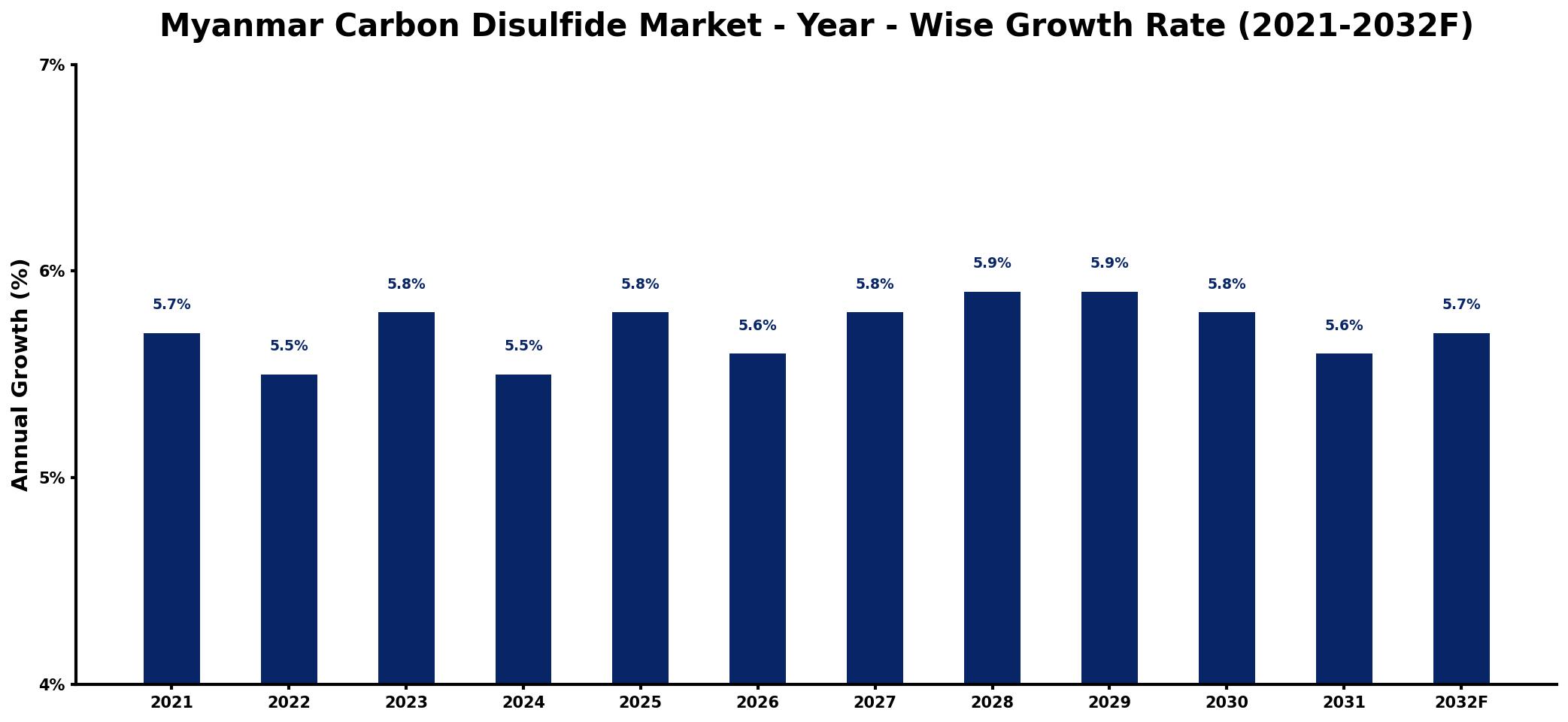
The table below presents the year‑wise growth rates along with the key drivers influencing the market
| Year | Growth Rate | Major Drivers |
| 2021 | 5.7% | Rise in industrial applications demand |
| 2022 | 5.5% | Growth in chemical manufacturing sector |
| 2023 | 5.8% | Increased agricultural sector investments |
| 2024 | 5.5% | Expansion of textile production capabilities |
| 2025 | 5.8% | Surge in oil extraction activities |
| 2026 | 5.6% | Boost in research and development |
| 2027 | 5.8% | growing downstream application demand |
| 2028 | 5.9% | Increase in market export opportunities |
| 2029 | 5.9% | Rising demand from electronics sector |
| 2030 | 5.8% | rising export shipment volumes |
| 2031 | 5.6% | strengthening international trade flows |
| 2032 | 5.7% | expanding manufacturing base activity |
Note: Market size estimations and growth projections presented in this report are based on 6Wresearch's proprietary forecasting methodology, utilizing the latest available industry data, government publications, and primary research inputs.
Myanmar Carbon Disulfide Market Synopsis
Recently, the Myanmar carbon disulfide market has experienced notable momentum, largely propelled by an increase in industrial activities. Looking ahead, the market is positioned for sustained growth, driven by ongoing industrialization and the expansion of key sectors such as textiles and rubber, both of which rely heavily on carbon disulfide as a key input.
However, while growth prospects are promising, the market also faces challenges related to regulatory compliance and environmental safety. As the sector evolves, addressing these concerns will be critical for fostering a stable and sustainable market environment.
Myanmar Carbon Disulfide Market Key Takeaways
- Robust demand from textile and rubber industries is a major market driver.
- The market is projected to grow at a CAGR of 4.8% between 2026 and 2032.
- Environmental regulations are shaping production practices and safety protocols.
- Carbon disulfide plays a vital role in agricultural applications, further diversifying its demand.
- Ongoing industrialization in Myanmar presents significant growth opportunities.
Evaluation of Restraints in Myanmar Carbon Disulfide Market
The carbon disulfide market in Myanmar is confronted with several restraints that could hinder its growth. Chief among these are the stringent environmental regulations that aim to mitigate the health risks associated with the chemical's production and use. While these measures are crucial for safeguarding public health and the environment, they can also result in increased operational costs for manufacturers. Additionally, a lack of awareness surrounding the safe handling of carbon disulfide among various industries poses challenges to effective compliance and monitoring. Addressing these issues is imperative to ensure sustainable market growth.
Myanmar Carbon Disulfide Market Trends
The current trends in the Myanmar carbon disulfide market indicate a heightened focus on sustainable practices and the implementation of advanced safety measures in production processes. As industries increasingly prioritize environmental responsibility, innovative technologies aimed at reducing emissions and enhancing the safety of carbon disulfide handling are gaining importance. Additionally, the integration of digital tools for supply chain management is becoming commonplace, improving efficiency and transparency across the market.
Myanmar Carbon Disulfide Market Opportunities
Opportunities for growth in the Myanmar carbon disulfide market are abundant, particularly as the nation continues its path toward industrialization. Investments in the textile and rubber sectors present a significant avenue for expansion, as demand for high-quality materials increases. Furthermore, the ongoing need for effective agricultural solutions, including pest control and soil treatment, underscores the potential for innovation and product development in this segment. Capitalizing on these opportunities can position companies favorably within the competitive landscape.
Government Initiatives in the Myanmar Carbon Disulfide Market
The Myanmar government has instituted several policies aimed at regulating the use of carbon disulfide to ensure safe handling and environmental protection. These initiatives include strict guidelines for production processes and disposal methods to mitigate pollution risks associated with this chemical. Public spending on environmental monitoring and enforcement programs also supports industry compliance, demonstrating a commitment to safeguarding both public health and the environment.
Future Insights of the Myanmar Carbon Disulfide Market
Looking ahead to the years 2026-2032, the Myanmar carbon disulfide market is expected to evolve in response to increasing industrial activity and regulatory developments. As demand from textile and rubber industries continues to rise, companies that adopt innovative production techniques and prioritize safety will likely gain competitive advantages. Furthermore, as regulatory frameworks become more stringent, adherence to best practices in environmental management will be essential for sustainable growth. The market appears well-positioned to adapt and thrive amidst these changes.
Myanmar Carbon Disulfide Market Latest Developments (2025 - 2026)
In recent months, the Myanmar carbon disulfide market has witnessed notable shifts, with an increased focus on enhancing safety protocols within production facilities. Various industry stakeholders are engaging in discussions surrounding best practices for the safe handling and disposal of carbon disulfide, reflecting an evolving understanding of its environmental implications. Additionally, there has been a rise in collaborative efforts between governmental bodies and private sectors aimed at establishing comprehensive guidelines that further ensure compliance with safety regulations.
Myanmar Carbon Disulfide Market - Key Attractiveness of the Report
- 10 Years of Market Numbers
- Historical Data Starting from 2022 to 2025
- Base Year: 2025
- Forecast Data until 2032
- Key Performance Indicators Impacting the Market
- Major Upcoming Developments and Projects
Key Highlights of the Report:
- Myanmar Carbon Disulfide Market Outlook
- Market Size of Myanmar Carbon Disulfide Market, 2025
- Forecast of Myanmar Carbon Disulfide Market, 2032
- Historical Data and Forecast of Myanmar Carbon Disulfide Revenues & Volume for the Period 2022-2032F
- Myanmar Carbon Disulfide Market Trend Evolution
- Myanmar Carbon Disulfide Market Drivers and Challenges
- Myanmar Carbon Disulfide Price Trends
- Myanmar Carbon Disulfide Porter's Five Forces
- Myanmar Carbon Disulfide Industry Life Cycle
- Historical Data and Forecast of Myanmar Carbon Disulfide Market Revenues & Volume By Purity for the Period 2022-2032F
- Historical Data and Forecast of Myanmar Carbon Disulfide Market Revenues & Volume By Pure for the Period 2022-2032F
- Historical Data and Forecast of Myanmar Carbon Disulfide Market Revenues & Volume By Impure for the Period 2022-2032F
- Historical Data and Forecast of Myanmar Carbon Disulfide Market Revenues & Volume By Application for the Period 2022-2032F
- Historical Data and Forecast of Myanmar Carbon Disulfide Market Revenues & Volume By Rayon for the Period 2022-2032F
- Historical Data and Forecast of Myanmar Carbon Disulfide Market Revenues & Volume By Rubber for the Period 2022-2032F
- Historical Data and Forecast of Myanmar Carbon Disulfide Market Revenues & Volume By Cleaning Carbon Nanotubes for the Period 2022-2032F
- Historical Data and Forecast of Myanmar Carbon Disulfide Market Revenues & Volume By Perfumes for the Period 2022-2032F
- Historical Data and Forecast of Myanmar Carbon Disulfide Market Revenues & Volume By Cellophane for the Period 2022-2032F
- Historical Data and Forecast of Myanmar Carbon Disulfide Market Revenues & Volume By Others for the Period 2022-2032F
- Historical Data and Forecast of Myanmar Carbon Disulfide Market Revenues & Volume By End-User for the Period 2022-2032F
- Historical Data and Forecast of Myanmar Carbon Disulfide Market Revenues & Volume By Pharmaceuticals for the Period 2022-2032F
- Historical Data and Forecast of Myanmar Carbon Disulfide Market Revenues & Volume By Agriculture for the Period 2022-2032F
- Historical Data and Forecast of Myanmar Carbon Disulfide Market Revenues & Volume By Packaging for the Period 2022-2032F
- Historical Data and Forecast of Myanmar Carbon Disulfide Market Revenues & Volume By Textile for the Period 2022-2032F
- Historical Data and Forecast of Myanmar Carbon Disulfide Market Revenues & Volume By Cosmetics for the Period 2022-2032F
- Historical Data and Forecast of Myanmar Carbon Disulfide Market Revenues & Volume By Others for the Period 2022-2032F
- Myanmar Carbon Disulfide Import Export Trade Statistics
- Market Opportunity Assessment By Purity
- Market Opportunity Assessment By Application
- Market Opportunity Assessment By End-User
- Myanmar Carbon Disulfide Top Companies Market Share
- Myanmar Carbon Disulfide Competitive Benchmarking By Technical and Operational Parameters
- Myanmar Carbon Disulfide Company Profiles
- Myanmar Carbon Disulfide Key Strategic Recommendations






































