Myanmar Case Management Market Size & Growth Rate (2026-2032)
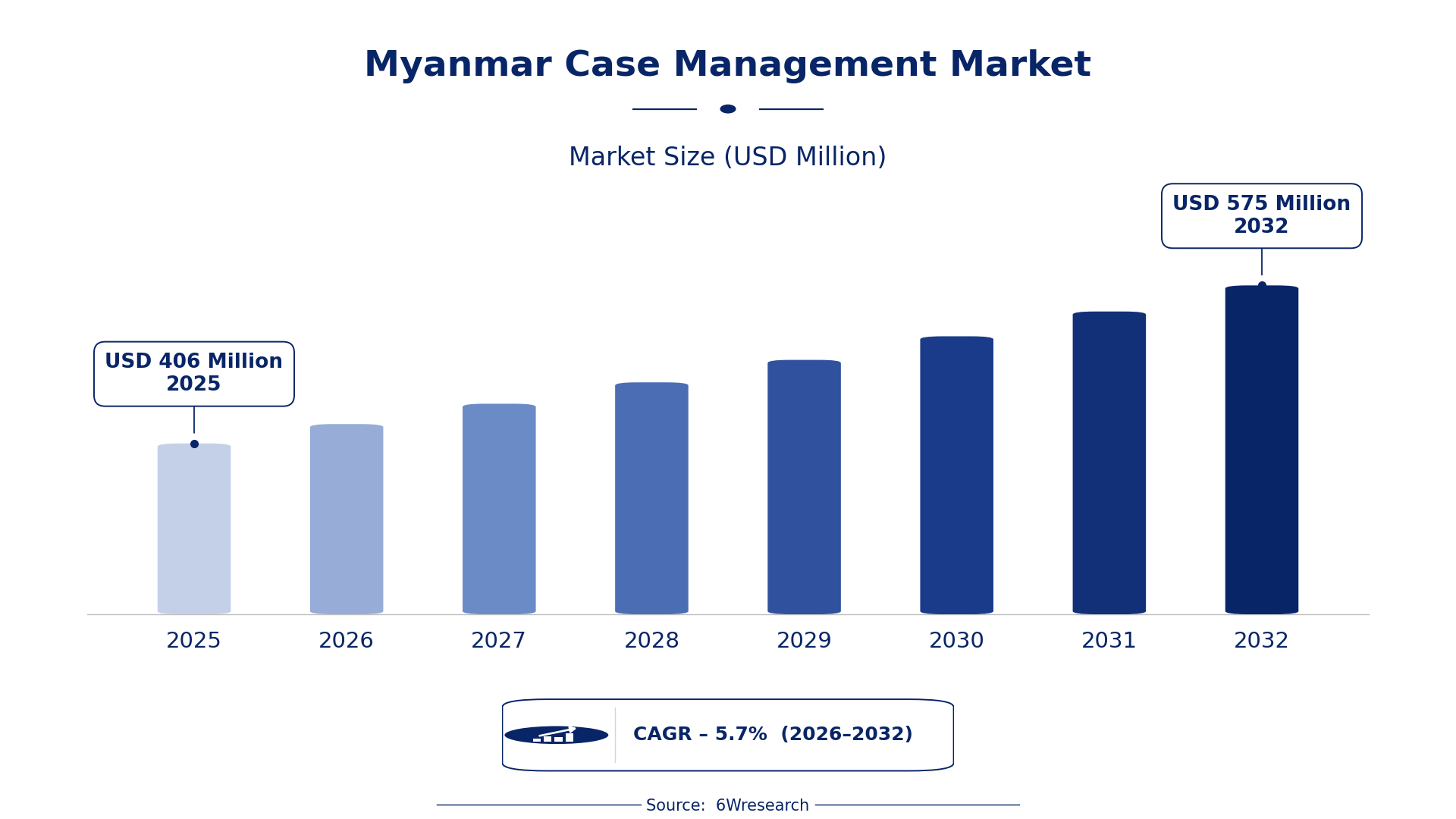
The Myanmar Case Management Market was estimated at USD 406 Million in 2025 and is projected to reach USD 575 Million by 2032, growing at a CAGR of 5.7% from 2026 to 2032.
Myanmar Case Management Market Synopsis
The driving force behind the Myanmar Case Management Market is the pressing need for efficient workflow management across various sectors, particularly healthcare and legal services. Organizations are increasingly recognizing that streamlined processes not only enhance productivity but also improve service delivery, ultimately benefiting end-users.
As digital transformation accelerates, the demand for case management software is surging. This shift is primarily motivated by the desire for better data management and compliance with regulatory standards. While growth prospects are promising, organizations must navigate challenges related to technological infrastructure and skilled workforce shortages.
Myanmar Case Management Market Year-wise Growth Rate and Key Drivers
This graph illustrates the annual growth rates of the Myanmar Case Management Market from 2021 to 2032, highlighting a steady upward trajectory and projected expansion over the forecast period.
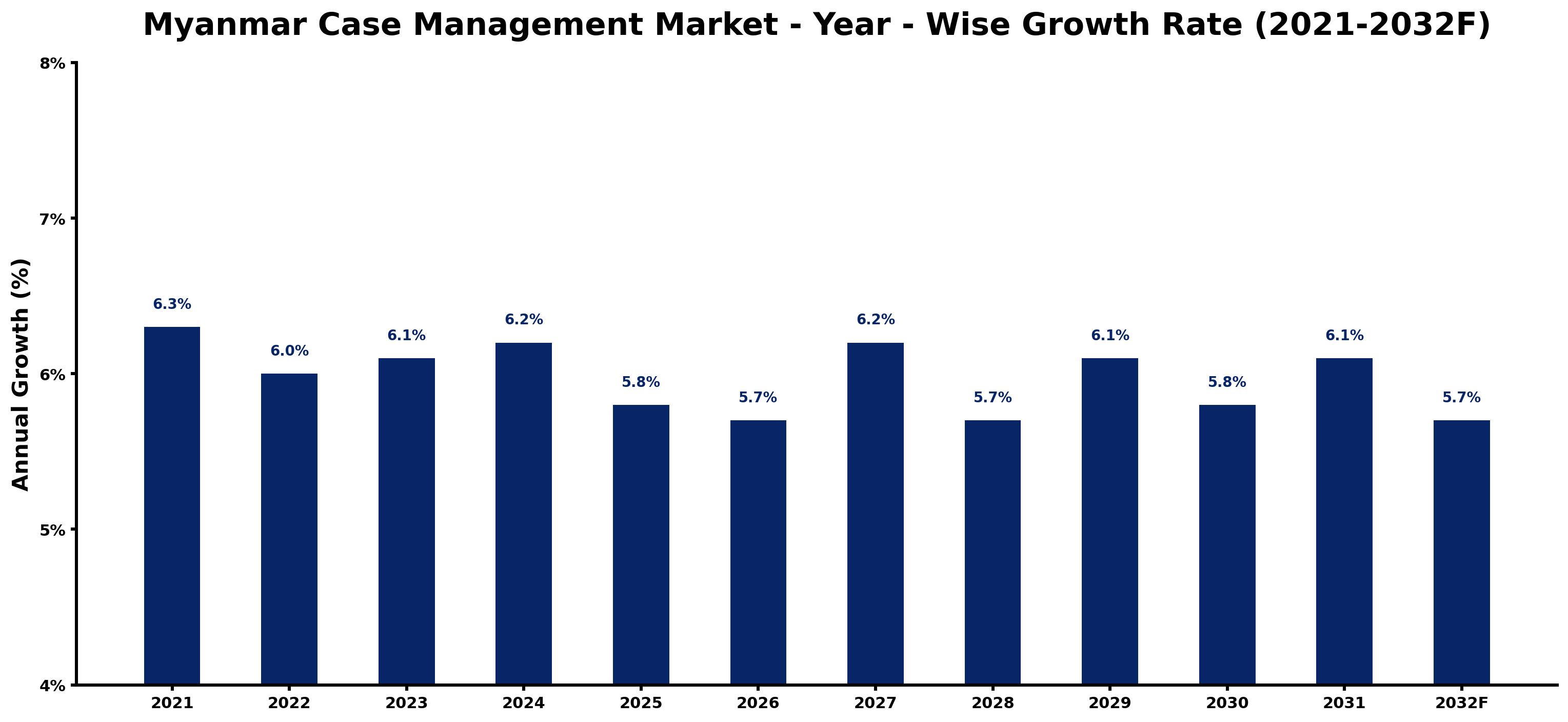
The table below presents the year‑wise growth rates along with the key drivers influencing the market
| Year | Growth Rate | Major Drivers |
| 2021 | 6.3% | Increased government focus on legal service accessibility. |
| 2022 | 6.0% | Rising urban population demanding streamlined case management. |
| 2023 | 6.1% | Adoption of mobile technology in judicial processes. |
| 2024 | 6.2% | Legal reforms enhancing efficiency in court proceedings. |
| 2025 | 5.8% | Growing NGO initiatives supporting case management training. |
| 2026 | 5.7% | Strengthening of domestic dispute resolution frameworks. |
| 2027 | 6.2% | Emphasis on transparency in legal processes by authorities. |
| 2028 | 5.7% | Government investment in digitizing court records. |
| 2029 | 6.1% | Collaborations with international legal tech firms increasing. |
| 2030 | 5.8% | Emerging startup ecosystem focusing on legal solutions. |
| 2031 | 6.1% | Increased awareness of legal rights among citizens. |
| 2032 | 5.7% | Integration of AI tools for case analysis. |
Note: Market size estimations and growth projections presented in this report are based on 6Wresearch's proprietary forecasting methodology, utilizing the latest available industry data, government publications, and primary research inputs.
Myanmar Case Management Market Key Takeaways
Below are some of the specific key takeaways from the market, including:
- Significant growth expected in healthcare and legal sectors driving market demand.
- Digital transformation initiatives are a key factor in accelerating software adoption.
- Government policies are focused on improving efficiency in public administration.
- Infrastructure development remains a critical challenge for market players.
- A lack of skilled professionals hinders the effective implementation of case management systems.
Evaluation of Restraints in Myanmar Case Management Market
Real restraints in the Myanmar Case Management Market include inadequate investment in technology infrastructure and a shortage of trained professionals. These limitations not only hinder the effective deployment of case management solutions but also impede organizations' ability to fully realize the benefits of digital transformation. Bureaucratic hurdles within the legal system further complicate the adoption of modern case management practices, creating a complex environment for stakeholders.
Myanmar Case Management Market Trends
Several trends are shaping the Myanmar Case Management Market. The increasing emphasis on data-driven decision-making is compelling organizations to adopt advanced analytics capabilities within their case management systems. on top of that, the integration of artificial intelligence and machine learning is gaining traction as companies seek to automate repetitive tasks and enhance case handling efficiency. This evolution not only streamlines processes but also improves accuracy and compliance.
Myanmar Case Management Market Opportunities
Opportunities for growth in the Myanmar Case Management Market are abundant, particularly in sectors such as healthcare and social services. As organizations strive to enhance service delivery, there is a growing demand for tailored software solutions that can address specific needs. Additionally, partnerships between technology providers and public institutions can facilitate access to modern case management tools, further propelling market growth.
Government Initiatives in the Myanmar Case Management Market
Government policy is significantly shaping the Myanmar Case Management Market through various initiatives aimed at strengthening legal and judicial systems. By focusing on efficiency and transparency, these initiatives are designed to modernize processes and improve access to justice for citizens. The government's active engagement in this area is vital for the market's future growth and stability.
- A national digital infrastructure upgrade programme was recently completed to improve case handling efficiency across public sectors.
- Current initiatives include ongoing training programs for legal professionals to adopt modern case management practices.
- Plans for a new regulatory framework to enhance billing transparency in legal services are set to be introduced in 2026.
- A public-private initiative aimed at expanding access to technology in rural areas is currently underway.
- Future policies are expected to focus on streamlining court procedures and improving case resolution timelines.
Future Insights of the Myanmar Case Management Market
Looking ahead, the Myanmar Case Management Market is likely to witness substantial growth fueled by ongoing digital transformation efforts. As organizations increasingly prioritize data management and operational efficiency, the demand for specialized case management solutions will intensify. on top of that, with government support and initiatives aimed at modernizing the judicial system, stakeholders can expect a more favorable environment for innovation and investment.
Myanmar Case Management Market Latest Developments
In the last year, the Myanmar Case Management Market has seen notable activity, driven by both public and private sector initiatives. Organizations are increasingly adopting new technologies and methodologies to enhance their case management capabilities. This momentum indicates a commitment to improving efficiency and service delivery across various sectors.
- A major technology vendor launched a new cloud-based case management platform in mid-2025, aiming to enhance accessibility for legal professionals.
- An initiative to upgrade existing case management systems in government agencies began in early 2025 and remains ongoing.
- A partnership between a leading regional operator and a local technology firm was formed to develop customized case management solutions, expected to begin implementation by late 2025.
- Upcoming workshops aimed at educating stakeholders on best practices in case management are planned for Q2 2026.
- A pilot project focused on integrating AI into case management processes is currently in development, with a rollout expected by early 2026.
Myanmar Case Management Market - Key Attractiveness of the Report
- 10 Years of Market Numbers
- Historical Data Starting from 2022 to 2025
- Base Year: 2025
- Forecast Data until 2032
- Key Performance Indicators Impacting the Market
- Major Upcoming Developments and Projects
Key Highlights of the Report:
- Myanmar Case Management Market Outlook
- Market Size of Myanmar Case Management Market, 2025
- Forecast of Myanmar Case Management Market, 2032
- Historical Data and Forecast of Myanmar Case Management Revenues & Volume for the Period 2022-2032F
- Myanmar Case Management Market Trend Evolution
- Myanmar Case Management Market Drivers and Challenges
- Myanmar Case Management Price Trends
- Myanmar Case Management Porter's Five Forces
- Myanmar Case Management Industry Life Cycle
- Historical Data and Forecast of Myanmar Case Management Market Revenues & Volume By Component for the Period 2022-2032F
- Historical Data and Forecast of Myanmar Case Management Market Revenues & Volume By Solution for the Period 2022-2032F
- Historical Data and Forecast of Myanmar Case Management Market Revenues & Volume By Services for the Period 2022-2032F
- Historical Data and Forecast of Myanmar Case Management Market Revenues & Volume By Deployment Mode for the Period 2022-2032F
- Historical Data and Forecast of Myanmar Case Management Market Revenues & Volume By Cloud for the Period 2022-2032F
- Historical Data and Forecast of Myanmar Case Management Market Revenues & Volume By On-premises for the Period 2022-2032F
- Historical Data and Forecast of Myanmar Case Management Market Revenues & Volume By Service for the Period 2022-2032F
- Historical Data and Forecast of Myanmar Case Management Market Revenues & Volume By Professional Services for the Period 2022-2032F
- Historical Data and Forecast of Myanmar Case Management Market Revenues & Volume By Managed Services for the Period 2022-2032F
- Historical Data and Forecast of Myanmar Case Management Market Revenues & Volume By Business Function for the Period 2022-2032F
- Historical Data and Forecast of Myanmar Case Management Market Revenues & Volume By Service request for the Period 2022-2032F
- Historical Data and Forecast of Myanmar Case Management Market Revenues & Volume By Fraud detection and anti-money laundering for the Period 2022-2032F
- Historical Data and Forecast of Myanmar Case Management Market Revenues & Volume By Incident management for the Period 2022-2032F
- Historical Data and Forecast of Myanmar Case Management Market Revenues & Volume By Investigation management for the Period 2022-2032F
- Historical Data and Forecast of Myanmar Case Management Market Revenues & Volume By Legal workflow management for the Period 2022-2032F
- Historical Data and Forecast of Myanmar Case Management Market Revenues & Volume By Organization Size for the Period 2022-2032F
- Historical Data and Forecast of Myanmar Case Management Market Revenues & Volume By Large enterprises for the Period 2022-2032F
- Historical Data and Forecast of Myanmar Case Management Market Revenues & Volume By Small and Medium-sized Enterprises (SMEs) for the Period 2022-2032F
- Historical Data and Forecast of Myanmar Case Management Market Revenues & Volume By Vertical for the Period 2022-2032F
- Historical Data and Forecast of Myanmar Case Management Market Revenues & Volume By Banking, Financial Services, and Insurance (BFSI) for the Period 2022-2032F
- Historical Data and Forecast of Myanmar Case Management Market Revenues & Volume By Government for the Period 2022-2032F
- Historical Data and Forecast of Myanmar Case Management Market Revenues & Volume By Healthcare for the Period 2022-2032F
- Historical Data and Forecast of Myanmar Case Management Market Revenues & Volume By IT and telecom for the Period 2022-2032F
- Historical Data and Forecast of Myanmar Case Management Market Revenues & Volume By Retail for the Period 2022-2032F
- Historical Data and Forecast of Myanmar Case Management Market Revenues & Volume By Manufacturing for the Period 2022-2032F
- Historical Data and Forecast of Myanmar Case Management Market Revenues & Volume By Others for the Period 2022-2032F
- Myanmar Case Management Import Export Trade Statistics
- Market Opportunity Assessment By Component
- Market Opportunity Assessment By Deployment Mode
- Market Opportunity Assessment By Service
- Market Opportunity Assessment By Business Function
- Market Opportunity Assessment By Organization Size
- Market Opportunity Assessment By Vertical
- Myanmar Case Management Top Companies Market Share
- Myanmar Case Management Competitive Benchmarking By Technical and Operational Parameters
- Myanmar Case Management Company Profiles
- Myanmar Case Management Key Strategic Recommendations






































