Myanmar Ceiling Tiles Market Size, Share & Growth Rate
The Myanmar Ceiling Tiles Market was estimated at USD 194 Million in 2025 and is projected to reach USD 263 Million by 2032, growing at a CAGR of 4.4% from 2026 to 2032. This growth trajectory is primarily driven by the ongoing expansion of the construction sector, with significant investments in commercial real estate and urban development projects. Enhanced awareness surrounding the benefits of acoustic and thermal insulation also boosts demand, while the increasing emphasis on sustainable building materials opens up new avenues for growth in the market.
Myanmar Ceiling Tiles Market Year-wise Growth Rate and Key Drivers
This graph highlights how the Myanmar Ceiling Tiles Market has steadily grown over the years, supported by major growth factors.
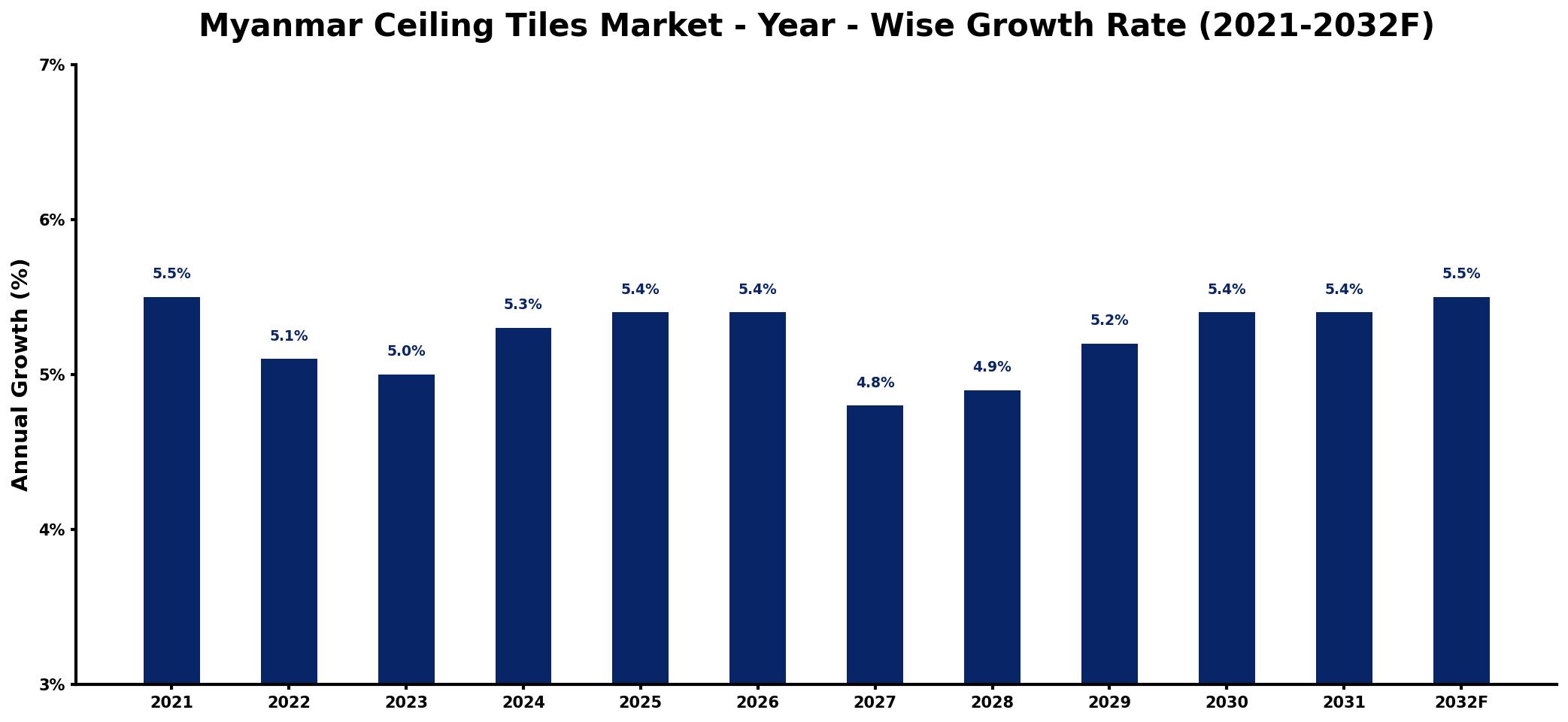
The table below presents the year‑wise growth rates along with the key drivers influencing the market
| Year | Growth Rate | Major Drivers |
| 2021 | 5.5% | Rising construction sector investments |
| 2022 | 5.1% | Increased residential building projects |
| 2023 | 5.0% | Growing urbanization and infrastructure |
| 2024 | 5.3% | Expansion of commercial real estate |
| 2025 | 5.4% | Surge in renovation activities |
| 2026 | 5.4% | Higher disposable income levels |
| 2027 | 4.8% | Shifts towards sustainable materials |
| 2028 | 4.9% | Emerging green building initiatives |
| 2029 | 5.2% | Strengthening tourism and hospitality |
| 2030 | 5.4% | Advancements in interior design trends |
| 2031 | 5.4% | Increased government infrastructure spending |
| 2032 | 5.5% | Growing awareness of aesthetics |
Note: Market size estimations and growth projections presented in this report are based on 6Wresearch's proprietary forecasting methodology, utilizing the latest available industry data, government publications, and primary research inputs.
Myanmar Ceiling Tiles Market Synopsis
Ceiling tiles in Myanmar are increasingly recognized for their versatility, not only enhancing aesthetic appeal but also providing critical acoustic solutions. The demand in both commercial and residential segments is set to grow, particularly as urbanization accelerates and new construction projects emerge across major cities.
Manufacturers are responding to the evolving market by introducing innovative, eco-friendly ceiling tile products that appeal to environmentally conscious consumers. This shift toward sustainability is becoming a key differentiator in the competitive landscape of ceiling tile offerings.
Myanmar Ceiling Tiles Market Key Takeaways
- The market is poised for steady growth, driven by increasing investments in construction and real estate.
- Eco-friendly and sustainable ceiling tile options are gaining traction among consumers.
- Demand is being reinforced by heightened awareness of fire safety and acoustic insulation.
- Government regulations are promoting the use of quality materials that adhere to safety standards.
- Educational initiatives are essential to enhance consumer understanding of ceiling tile benefits.
Evaluation of Restraints in Myanmar Ceiling Tiles Market
Despite the promising growth, the Myanmar Ceiling Tiles Market faces several restraints. A significant challenge is the lack of awareness regarding the advantages of ceiling tiles, particularly in the residential sector. Many consumers remain uninformed about how ceiling tiles can enhance acoustics, thermal insulation, and overall aesthetic value. Furthermore, skepticism regarding the quality and durability of locally manufactured ceiling tiles compared to imported products can hinder market expansion and erode consumer confidence. Addressing these issues through consumer education and quality assurance initiatives will be vital for fostering market growth.
Myanmar Ceiling Tiles Market Trends
As the market evolves, several trends are emerging that shape both demand and technology. The incorporation of advanced manufacturing techniques is allowing for the production of more innovative and customizable ceiling tile solutions. Additionally, the trend towards open-concept spaces is increasing the demand for integrated ceiling designs that not only enhance acoustics but also provide aesthetic coherence across interior environments. The move towards sustainability is not just a passing trend; it is becoming a foundational principle driving product development and consumer preference.
Myanmar Ceiling Tiles Market Opportunities
The Myanmar Ceiling Tiles Market presents genuine growth opportunities particularly in urban centers where infrastructure development is on the rise. Increased collaboration with architects and interior designers can further propel the market as these stakeholders advocate for innovative ceiling solutions. Moreover, the growing demand for green building certifications opens pathways for manufacturers to develop and market eco-friendly ceiling tiles, capitalizing on the rising consumer consciousness regarding sustainability.
Government Initiatives in the Myanmar Ceiling Tiles Market
Government initiatives play a crucial role in shaping the Myanmar Ceiling Tiles Market. Policies aimed at fostering construction and infrastructure development are critical, with a focus on safety and quality standards. Regulations pertaining to the materials used in ceiling tiles ensure compliance with safety requirements and promote the adoption of innovative products. Additionally, public spending on infrastructure projects may yield further opportunities for ceiling tile manufacturers, while incentives to adopt sustainable practices may encourage the development of green materials.
Future Insights of the Myanmar Ceiling Tiles Market
Looking ahead to the years 2026-2032, the Myanmar Ceiling Tiles Market is expected to continue its upward trajectory. Driven by urbanization and increasing awareness of building aesthetics, the market will likely witness more players entering with innovative, sustainable offerings. Additionally, as government support for construction initiatives persists, industry stakeholders will find ample opportunities to tap into this growing market. Education and marketing efforts surrounding the benefits of ceiling tiles will also help to unlock further demand.
Myanmar Ceiling Tiles Market Latest Developments (2025 - 2026)
The recent period has seen a steady shift towards the adoption of sustainable materials in the ceiling tiles market, with several manufacturers unveiling new product lines that boast eco-friendly credentials. Additionally, collaborations between local construction firms and international manufacturers have emerged, aimed at enhancing the quality and variety of ceiling tile offerings. The emphasis on safety standards remains paramount, as industry stakeholders adapt to ever-evolving regulations in the building and construction sector.
Myanmar Ceiling Tiles Market - Key Attractiveness of the Report
- 10 Years of Market Numbers
- Historical Data Starting from 2022 to 2025
- Base Year: 2025
- Forecast Data until 2032
- Key Performance Indicators Impacting the Market
- Major Upcoming Developments and Projects
Key Highlights of the Report:
- Myanmar Ceiling Tiles Market Outlook
- Market Size of Myanmar Ceiling Tiles Market, 2025
- Forecast of Myanmar Ceiling Tiles Market, 2032
- Historical Data and Forecast of Myanmar Ceiling Tiles Revenues & Volume for the Period 2022-2032F
- Myanmar Ceiling Tiles Market Trend Evolution
- Myanmar Ceiling Tiles Market Drivers and Challenges
- Myanmar Ceiling Tiles Price Trends
- Myanmar Ceiling Tiles Porter's Five Forces
- Myanmar Ceiling Tiles Industry Life Cycle
- Historical Data and Forecast of Myanmar Ceiling Tiles Market Revenues & Volume By Material Type for the Period 2022-2032F
- Historical Data and Forecast of Myanmar Ceiling Tiles Market Revenues & Volume By Mineral Wool for the Period 2022-2032F
- Historical Data and Forecast of Myanmar Ceiling Tiles Market Revenues & Volume By Metal for the Period 2022-2032F
- Historical Data and Forecast of Myanmar Ceiling Tiles Market Revenues & Volume By Gypsum for the Period 2022-2032F
- Historical Data and Forecast of Myanmar Ceiling Tiles Market Revenues & Volume By Others for the Period 2022-2032F
- Historical Data and Forecast of Myanmar Ceiling Tiles Market Revenues & Volume By Application for the Period 2022-2032F
- Historical Data and Forecast of Myanmar Ceiling Tiles Market Revenues & Volume By Residential for the Period 2022-2032F
- Historical Data and Forecast of Myanmar Ceiling Tiles Market Revenues & Volume By Non-residential for the Period 2022-2032F
- Myanmar Ceiling Tiles Import Export Trade Statistics
- Market Opportunity Assessment By Material Type
- Market Opportunity Assessment By Application
- Myanmar Ceiling Tiles Top Companies Market Share
- Myanmar Ceiling Tiles Competitive Benchmarking By Technical and Operational Parameters
- Myanmar Ceiling Tiles Company Profiles
- Myanmar Ceiling Tiles Key Strategic Recommendations






































