Myanmar Cellulose Acetate Fiber Market Size, Share & Growth Rate
The Myanmar Cellulose Acetate Fiber Market was estimated at USD 344 Million in 2025 and is projected to reach USD 467 Million by 2032, growing at a CAGR of 4.5% from 2026 to 2032. This upward trajectory is largely driven by a burgeoning demand for sustainable textile materials in Myanmar, as more consumers opt for biodegradable options over traditional synthetic fibers. Moreover, supportive governmental policies and an increase in domestic production capabilities are contributing to a robust market environment.
Myanmar Cellulose Acetate Fiber Market Year-wise Growth Rate and Key Drivers
This graph highlights how the Myanmar Cellulose Acetate Fiber Market has steadily grown over the years, supported by major growth factors.
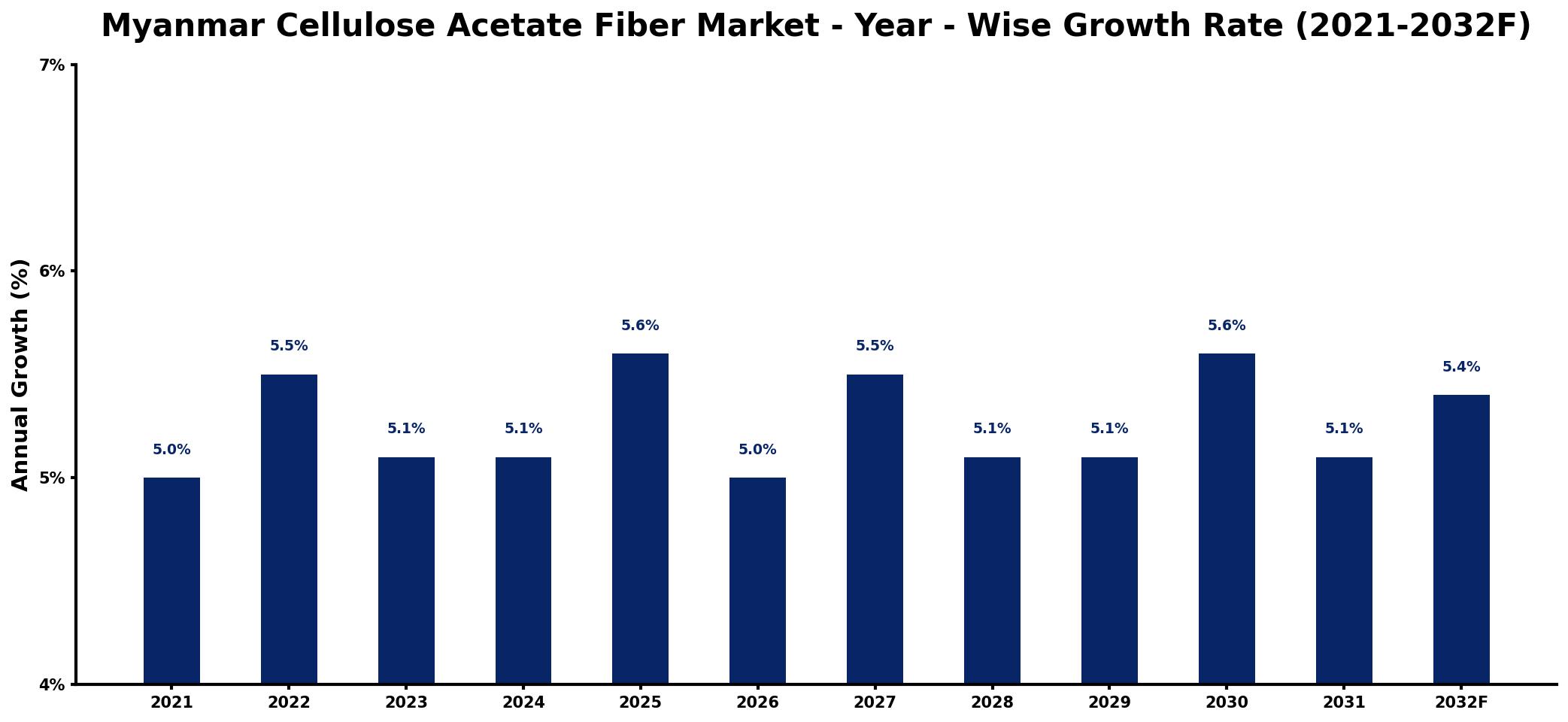
The table below presents the year‑wise growth rates along with the key drivers influencing the market
| Year | Growth Rate | Major Drivers |
| 2021 | 5.0% | Rising textile manufacturing demands |
| 2022 | 5.5% | Increased fashion industry investments |
| 2023 | 5.1% | Sustainable product preferences grow |
| 2024 | 5.1% | Expansion of eco-friendly initiatives |
| 2025 | 5.6% | Emergence of new market applications |
| 2026 | 5.0% | Growing demand for innovative materials |
| 2027 | 5.5% | Higher consumer awareness of sustainability |
| 2028 | 5.1% | enhanced product quality standards |
| 2029 | 5.1% | Technological advancements in production |
| 2030 | 5.6% | Strengthened domestic production capabilities |
| 2031 | 5.1% | Growing interest in biobased solutions |
| 2032 | 5.4% | Increased collaboration with global partners |
Note: Market size estimations and growth projections presented in this report are based on 6Wresearch's proprietary forecasting methodology, utilizing the latest available industry data, government publications, and primary research inputs.
Myanmar Cellulose Acetate Fiber Market Synopsis
The demand for cellulose acetate fiber in Myanmar is escalating due to its biodegradable nature and luxurious feel, making it a preferred choice for both manufacturers and consumers. As the textile sector expands, more companies are looking to incorporate cellulose acetate fibers into their product lines, leading to a shift in manufacturing practices across the industry.
In addition to its appeal in apparel, this fiber is gaining traction in home textiles and industrial applications, signifying its versatility. Furthermore, increased awareness regarding the environmental impacts of synthetic fibers is driving consumers toward eco-friendly alternatives, thereby solidifying the position of cellulose acetate fiber in the market.
Myanmar Cellulose Acetate Fiber Market Key Takeaways
- The market is driven by a growing preference for sustainable textile solutions.
- Cellulose acetate fiber is recognized for its softness and biodegradability.
- Government initiatives are fostering investment in the textile sector.
- Rising consumer awareness about environmental issues is boosting demand.
- Innovative manufacturing practices are enhancing fiber performance and applications.
Evaluation of Restraints in Myanmar Cellulose Acetate Fiber Market
The Myanmar Cellulose Acetate Fiber Market faces significant challenges that could impede growth. Primarily, limited technological advancements in production processes often lead to inefficiencies and increased costs, placing local manufacturers at a disadvantage compared to their global counterparts. Furthermore, reliance on imported raw materials makes the industry susceptible to international price volatility and supply disruptions. Skilled labor shortages in specialized fields, particularly in research and development, also hinder progress. Additionally, underdeveloped infrastructure can complicate distribution efforts, while regulatory uncertainties can create an unpredictable business environment.
Myanmar Cellulose Acetate Fiber Market Trends
Currently, the market is witnessing a robust trend toward the use of eco-friendly materials, with cellulose acetate fiber being at the forefront of this shift. Manufacturers are increasingly investing in innovative blends that enhance the fiber's performance, making it suitable for various applications, from fashionable clothing to durable industrial fabrics. Another notable trend is the rise of ethical fashion, with more brands committing to sustainable practices, further driving the demand for cellulose acetate fibers.
Myanmar Cellulose Acetate Fiber Market Opportunities
Investment opportunities abound in the Myanmar Cellulose Acetate Fiber Market as the need for sustainable materials continues to grow. Establishing production facilities or collaborating with local manufacturers can provide significant advantages for investors looking to tap into the rising demand. Furthermore, as global awareness of sustainable fashion heightens, Myanmar's strategic location and competitive production costs position it as an ideal hub for exporting cellulose acetate fibers. Thorough market research and strong partnerships with local businesses are critical for navigating this promising landscape.
Government Initiatives in the Myanmar Cellulose Acetate Fiber Market
The Myanmar government is actively fostering growth within the Cellulose Acetate Fiber Market through various supportive measures. Incentives for foreign direct investment are designed to attract international players, while initiatives aimed at promoting research and development in the textile sector are in place. Additionally, favorable trade agreements with key global markets aim to enhance the export potential of cellulose acetate fiber products, creating a conducive business environment for growth.
Future Insights of the Myanmar Cellulose Acetate Fiber Market
Looking ahead, the Myanmar Cellulose Acetate Fiber Market is on a promising growth trajectory, expected to flourish as eco-friendly fibers become mainstream in the textile industry. An increasing number of consumers are prioritizing sustainability, which positions cellulose acetate fibers as an attractive alternative to traditional materials. However, the market must navigate challenges such as fluctuating raw material costs and competition from other sustainable fibers. Overall, a heightened focus on innovation and sustainability will continue to drive market growth through 2032.
Myanmar Cellulose Acetate Fiber Market Latest Developments (2025 - 2026)
Recent developments in the Myanmar Cellulose Acetate Fiber Market indicate a shift towards more environmentally conscious manufacturing practices. As awareness of sustainability rises, many producers are exploring innovative techniques to enhance the eco-friendliness of their products. Additionally, local companies are beginning to collaborate more with international firms to exchange knowledge and technology, facilitating the development of advanced production processes.
Myanmar Cellulose Acetate Fiber Market - Key Attractiveness of the Report
- 10 Years of Market Numbers
- Historical Data Starting from 2022 to 2025
- Base Year: 2025
- Forecast Data until 2032
- Key Performance Indicators Impacting the Market
- Major Upcoming Developments and Projects
Key Highlights of the Report:
- Myanmar Cellulose Acetate Fiber Market Outlook
- Market Size of Myanmar Cellulose Acetate Fiber Market, 2025
- Forecast of Myanmar Cellulose Acetate Fiber Market, 2032
- Historical Data and Forecast of Myanmar Cellulose Acetate Fiber Revenues & Volume for the Period 2022-2032F
- Myanmar Cellulose Acetate Fiber Market Trend Evolution
- Myanmar Cellulose Acetate Fiber Market Drivers and Challenges
- Myanmar Cellulose Acetate Fiber Price Trends
- Myanmar Cellulose Acetate Fiber Porter's Five Forces
- Myanmar Cellulose Acetate Fiber Industry Life Cycle
- Historical Data and Forecast of Myanmar Cellulose Acetate Fiber Market Revenues & Volume By Type for the Period 2022-2032F
- Historical Data and Forecast of Myanmar Cellulose Acetate Fiber Market Revenues & Volume By Plastic for the Period 2022-2032F
- Historical Data and Forecast of Myanmar Cellulose Acetate Fiber Market Revenues & Volume By Fiber for the Period 2022-2032F
- Historical Data and Forecast of Myanmar Cellulose Acetate Fiber Market Revenues & Volume By Application for the Period 2022-2032F
- Historical Data and Forecast of Myanmar Cellulose Acetate Fiber Market Revenues & Volume By Photographic Films for the Period 2022-2032F
- Historical Data and Forecast of Myanmar Cellulose Acetate Fiber Market Revenues & Volume By Cigarette Filters for the Period 2022-2032F
- Historical Data and Forecast of Myanmar Cellulose Acetate Fiber Market Revenues & Volume By Tapes & Labels for the Period 2022-2032F
- Historical Data and Forecast of Myanmar Cellulose Acetate Fiber Market Revenues & Volume By Textiles & Apparel for the Period 2022-2032F
- Myanmar Cellulose Acetate Fiber Import Export Trade Statistics
- Market Opportunity Assessment By Type
- Market Opportunity Assessment By Application
- Myanmar Cellulose Acetate Fiber Top Companies Market Share
- Myanmar Cellulose Acetate Fiber Competitive Benchmarking By Technical and Operational Parameters
- Myanmar Cellulose Acetate Fiber Company Profiles
- Myanmar Cellulose Acetate Fiber Key Strategic Recommendations






































