Myanmar Chamotte Market Size, Share & Growth Rate
The Myanmar Chamotte Market was estimated at USD 396 Million in 2025 and is projected to reach USD 554 Million by 2032, growing at a CAGR of 4.9% from 2026 to 2032. This growth trajectory is propelled by the burgeoning construction sector and increasing infrastructure projects, which elevate the demand for high-quality chamotte materials. Additionally, the expanding ceramics industry further fuels this upward trend, reinforcing the vital role that chamotte plays in industrial applications across the region.
Myanmar Chamotte Market Year-wise Growth Rate and Key Drivers
This graph highlights how the Myanmar Chamotte Market has steadily grown over the years, supported by major growth factors.
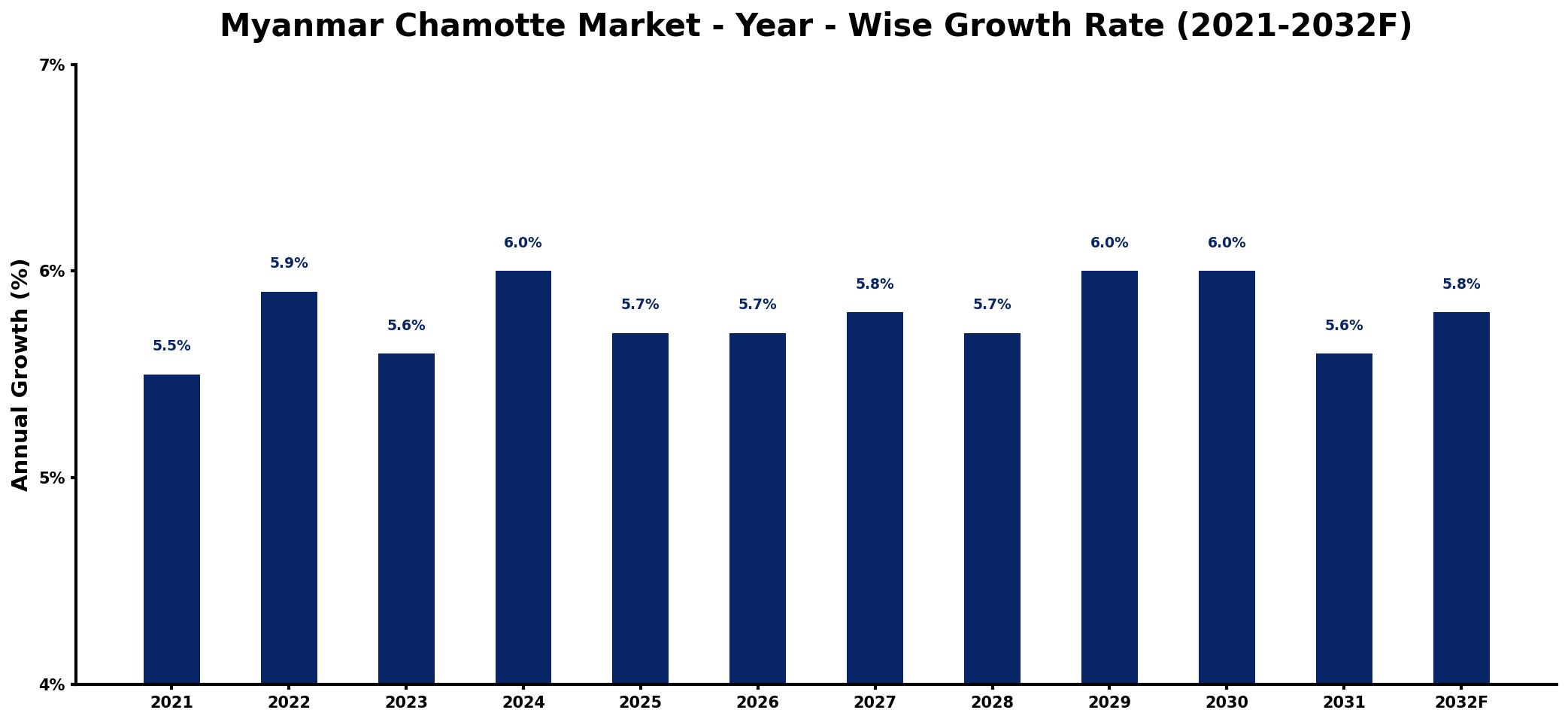
The table below presents the year‑wise growth rates along with the key drivers influencing the market
| Year | Growth Rate | Major Drivers |
| 2021 | 5.5% | Increased construction sector investments |
| 2022 | 5.9% | Rising demand from manufacturing industries |
| 2023 | 5.6% | Expansion of energy production facilities |
| 2024 | 6.0% | Growth in infrastructure development projects |
| 2025 | 5.7% | Higher utilization in ceramics production |
| 2026 | 5.7% | increased production capacity utilization |
| 2027 | 5.8% | Increased focus on sustainable practices |
| 2028 | 5.7% | Development of new industrial applications |
| 2029 | 6.0% | stronger distribution network expansion |
| 2030 | 6.0% | expanding healthcare application demand |
| 2031 | 5.6% | Investment in research and innovation |
| 2032 | 5.8% | Rising consumer demand for quality |
Note: Market size estimations and growth projections presented in this report are based on 6Wresearch's proprietary forecasting methodology, utilizing the latest available industry data, government publications, and primary research inputs.
Myanmar Chamotte Market Synopsis
The most significant force shaping the Myanmar Chamotte Market is the rapid expansion of the construction industry. As Myanmar continues to develop its infrastructure, the demand for chamotte in high-temperature applications is seeing a notable increase. This has positioned chamotte as a key raw material for various sectors, including refractories and ceramics.
Moreover, the rising manufacturing base in Myanmar is also contributing to market growth. With more companies emerging, the need for quality chamotte products is escalating, showcasing the resources importance in diverse industrial processes. This dual momentum from construction and manufacturing sectors underscores the market's potential for sustained growth.
Myanmar Chamotte Market Key Takeaways
- Growing construction activities are significantly driving demand for chamotte-based products.
- The ceramics industry's expansion is further boosting the need for high-quality chamotte.
- Investment opportunities abound as local and international players recognize the region's potential.
- Government regulations are focusing on sustainable practices and quality standards in the chamotte market.
- Challenges such as fluctuating raw material prices are influencing market dynamics.
Evaluation of Restraints in Myanmar Chamotte Market
Despite the promising growth, the Myanmar Chamotte Market faces several restraints that limit its potential. Limited availability of quality raw materials due to strict environmental regulations poses significant challenges for producers. Furthermore, inconsistencies in product quality can lead to performance variability, potentially deterring industrial clients. Additionally, the lack of advanced technological infrastructure hampers efficient production processes. These factors collectively create a complex landscape that requires strategic interventions to enhance competitiveness.
Myanmar Chamotte Market Trends
Current trends in the Myanmar Chamotte Market include a growing emphasis on sustainable practices among manufacturers, in response to environmental concerns. Companies are increasingly investing in eco-friendly extraction and production technologies, which not only align with global standards but also cater to consumer preferences for responsible sourcing. Moreover, as urbanization accelerates, there is a notable shift towards high-performance chamotte products that meet the demands of modern infrastructure projects. This trend is expected to shape product development and innovation moving forward.
Myanmar Chamotte Market Opportunities
The Myanmar Chamotte Market presents substantial investment opportunities, particularly as the demand for chamotte intensifies across various sectors. Investors can capitalize on the regions abundant natural resources and strategic location in Southeast Asia. Establishing production facilities or forming partnerships with local suppliers can provide a competitive edge. Additionally, the ongoing industrialization and infrastructure initiatives create a favorable environment for businesses looking to enter or expand in this promising market.
Government Initiatives in the Myanmar Chamotte Market
The Myanmar government is actively promoting sustainable practices within the chamotte market through various policies. These regulations are designed to ensure responsible mining and processing activities, focusing on environmental protection and resource preservation. Furthermore, the government encourages local value addition and processing of chamotte products, which is vital for boosting the domestic industry and creating job opportunities. By emphasizing quality standards and fair trade practices, these initiatives aim to enhance the competitiveness of the Myanmar Chamotte Market.
Future Insights of the Myanmar Chamotte Market
Looking ahead to the period from 2026 to 2032, the Myanmar Chamotte Market is poised for significant expansion. Continued urbanization and rising disposable incomes are expected to further stimulate demand for chamotte in construction and ceramics. However, producers will need to navigate challenges such as fluctuating raw material costs and regulatory environments. By investing in technology and sustainable practices, businesses can capitalize on this projected growth while contributing positively to the local economy and environment.
Myanmar Chamotte Market Latest Developments (2025 - 2026)
In recent months, the Myanmar Chamotte Market has witnessed a heightened focus on sustainability, with several initiatives aimed at improving mining practices and product quality. Additionally, as local manufacturers seek to enhance their competitive positioning, investments in technological upgrades and modern production facilities have become more prevalent. Industry stakeholders are also exploring collaborations to expand distribution networks and meet the rising demand for chamotte-based products, thereby reflecting a dynamic shift in market operations.
Myanmar Chamotte Market - Key Attractiveness of the Report
- 10 Years of Market Numbers
- Historical Data Starting from 2022 to 2025
- Base Year: 2025
- Forecast Data until 2032
- Key Performance Indicators Impacting the Market
- Major Upcoming Developments and Projects
Key Highlights of the Report:
- Myanmar Chamotte Market Outlook
- Market Size of Myanmar Chamotte Market, 2025
- Forecast of Myanmar Chamotte Market, 2032
- Historical Data and Forecast of Myanmar Chamotte Revenues & Volume for the Period 2022-2032F
- Myanmar Chamotte Market Trend Evolution
- Myanmar Chamotte Market Drivers and Challenges
- Myanmar Chamotte Price Trends
- Myanmar Chamotte Porter's Five Forces
- Myanmar Chamotte Industry Life Cycle
- Historical Data and Forecast of Myanmar Chamotte Market Revenues & Volume By Type for the Period 2022-2032F
- Historical Data and Forecast of Myanmar Chamotte Market Revenues & Volume By Clinker for the Period 2022-2032F
- Historical Data and Forecast of Myanmar Chamotte Market Revenues & Volume By Cement Clinker for the Period 2022-2032F
- Historical Data and Forecast of Myanmar Chamotte Market Revenues & Volume By Application for the Period 2022-2032F
- Historical Data and Forecast of Myanmar Chamotte Market Revenues & Volume By Cement for the Period 2022-2032F
- Historical Data and Forecast of Myanmar Chamotte Market Revenues & Volume By Silicate Material for the Period 2022-2032F
- Historical Data and Forecast of Myanmar Chamotte Market Revenues & Volume By Others for the Period 2022-2032F
- Myanmar Chamotte Import Export Trade Statistics
- Market Opportunity Assessment By Type
- Market Opportunity Assessment By Application
- Myanmar Chamotte Top Companies Market Share
- Myanmar Chamotte Competitive Benchmarking By Technical and Operational Parameters
- Myanmar Chamotte Company Profiles
- Myanmar Chamotte Key Strategic Recommendations






































