Myanmar Cloud Infrastructure Services Market Size & Growth Rate (2026-2032)
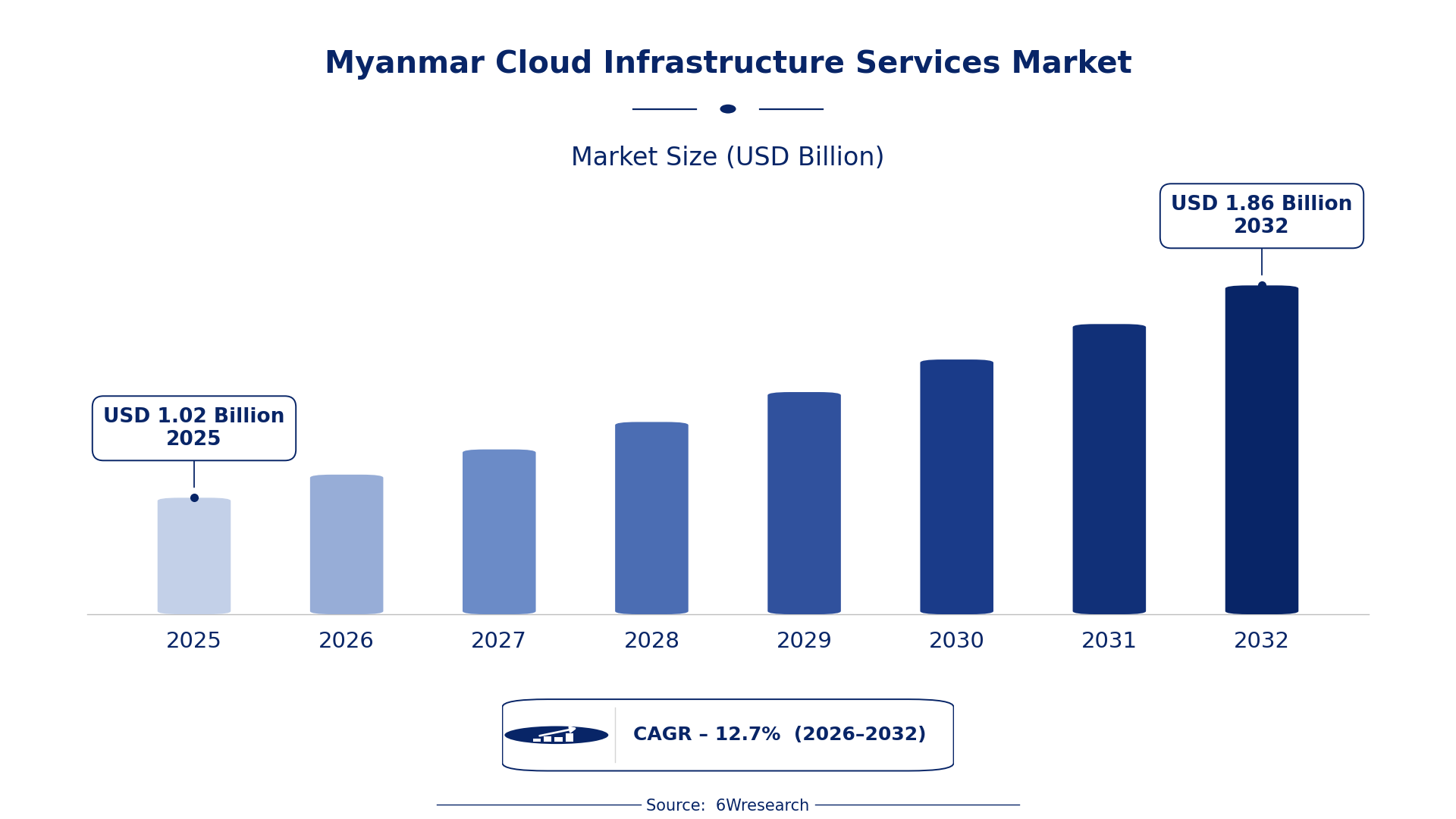
The Myanmar Cloud Infrastructure Services Market was estimated at USD 1023 Million in 2025 and is projected to reach USD 1862 Million by 2032, growing at a CAGR of 12.7% from 2026 to 2032.
Myanmar Cloud Infrastructure Services Market Synopsis
The demand for cloud infrastructure services in Myanmar is on an upward trajectory as businesses strive for scalable IT solutions. Companies are increasingly recognizing the strategic value of cloud services to enhance operational efficiency and reduce overhead costs, making a significant shift from traditional on-premise setups.
With the rise of digital transformation initiatives across various sectors, the need for reliable cloud storage and computing power is intensifying. Enterprises are eager to adopt these technologies, yet they face hurdles such as inadequate internet bandwidth and a lack of awareness about data security, which are critical to fully realizing the benefits of cloud infrastructure.
Myanmar Cloud Infrastructure Services Market Year-wise Growth Rate and Key Drivers
This graph illustrates the annual growth rates of the Myanmar Cloud Infrastructure Services Market from 2021 to 2032, highlighting a steady upward trajectory and projected expansion over the forecast period.
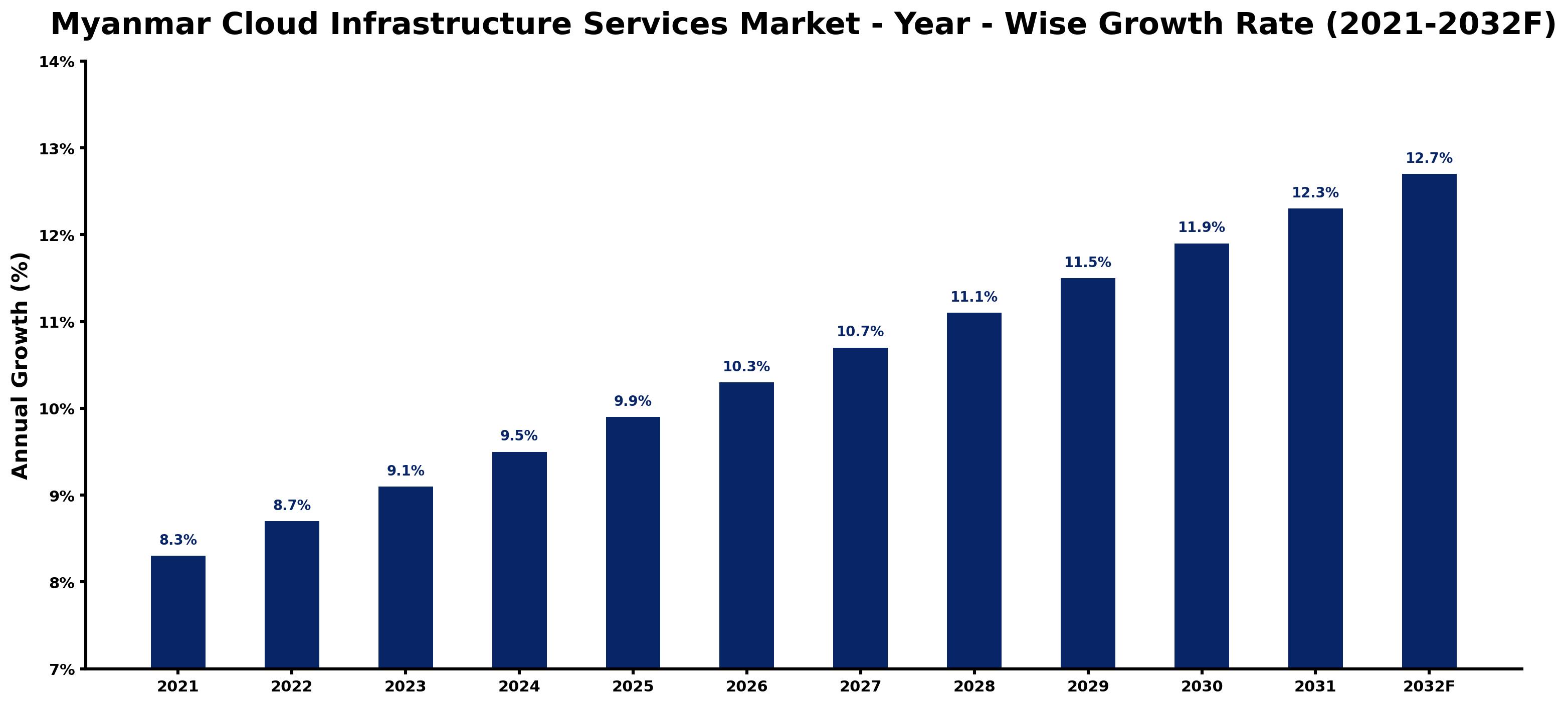
The table below presents the year‑wise growth rates along with the key drivers influencing the market
| Year | Growth Rate | Major Drivers |
| 2021 | 8.3% | Increased internet penetration due to affordable mobile plans. |
| 2022 | 8.7% | Emergence of local startups driving cloud service demand. |
| 2023 | 9.1% | Government support for e-commerce platforms enhancing infrastructure needs. |
| 2024 | 9.5% | Rising health tech solutions requiring data storage and processing. |
| 2025 | 9.9% | Growth in remote work fueling demand for cloud tools. |
| 2026 | 10.3% | Educational initiatives promoting online learning increasing cloud usage. |
| 2027 | 10.7% | Financial sector digitization accelerating cloud infrastructure adoption. |
| 2028 | 11.1% | Local regulations favoring digital financial transactions boosting cloud reliance. |
| 2029 | 11.5% | Government campaigns against piracy enhancing content protection services. |
| 2030 | 11.9% | Adoption of IoT devices in agriculture driving cloud demand. |
| 2031 | 12.3% | Collaboration with ASEAN nations increasing regional cloud investments. |
| 2032 | 12.7% | Focus on smart city developments amplifying cloud infrastructure needs. |
Note: Market size estimations and growth projections presented in this report are based on 6Wresearch's proprietary forecasting methodology, utilizing the latest available industry data, government publications, and primary research inputs.
Myanmar Cloud Infrastructure Services Market Key Takeaways
Below are some of the specific key takeaways from the market, including:
- The Myanmar Cloud Infrastructure Services Market is witnessing accelerated growth fueled by digital transformation initiatives.
- Key drivers include the demand for scalable solutions and enhanced disaster recovery capabilities.
- High costs and regulatory uncertainties are limiting the adoption of cloud services, especially among SMEs.
- The government's strategic focus on improving digital infrastructure is set to bolster market expansion.
- Investment in IT infrastructure is crucial for businesses looking to transition to cloud solutions effectively.
Evaluation of Restraints in Myanmar Cloud Infrastructure Services Market
The Myanmar Cloud Infrastructure Services Market faces notable restraints that impede its potential growth. Key challenges include insufficient internet bandwidth and high latency issues, which directly impact the reliability and performance of cloud services. Many businesses remain skeptical about cloud adoption due to concerns over data security and potential service interruptions. These issues are compounded by the high costs associated with cloud services, which deter small and medium-sized enterprises from making the transition. on top of that, the evolving regulatory environment creates additional uncertainty for organizations considering cloud solutions.
Myanmar Cloud Infrastructure Services Market Trends
Several trends are shaping the Myanmar Cloud Infrastructure Services Market. Businesses are increasingly focusing on hybrid cloud solutions, allowing them to balance between on-premise and cloud-based resources. There is a marked rise in partnerships between local enterprises and international cloud service providers, aimed at enhancing service delivery. on top of that, the emphasis on data privacy and compliance is leading organizations to prioritize security features in their cloud strategies. This shift reflects a growing understanding of the importance of protecting sensitive information while leveraging cloud technologies.
Myanmar Cloud Infrastructure Services Market Opportunities
The market is ripe with opportunities for growth and investment. As the government ramps up efforts to improve digital infrastructure, new avenues are opening for both local and foreign investors. The increasing adoption of IoT and AI technologies is pushing businesses to seek cloud solutions that can support these innovations. on top of that, as the awareness of cloud benefits grows, there is a significant opportunity to educate and assist SMEs in adopting cloud services, which could drive substantial market penetration in the coming years.
Government Initiatives in the Myanmar Cloud Infrastructure Services Market
Government policy is a critical component influencing the Myanmar Cloud Infrastructure Services Market. The authorities are actively pursuing initiatives aimed at developing a stronger digital economy. These efforts are essential for laying the groundwork for a sustainable cloud ecosystem, ensuring that infrastructure can meet the growing demand for digital services.
- A national digital infrastructure upgrade programme recently launched to enhance internet connectivity and service reliability.
- Current initiatives include public-private partnerships focused on establishing data centers across major urban areas.
- The government is formulating a regulatory framework aimed at promoting transparency in cloud service billing, expected to roll out in early 2026.
- Future plans involve investing in training programs to improve understanding of cloud technology among SMEs, set to begin in late 2025.
- Ongoing discussions with international tech firms to attract investments in cloud infrastructure development.
Future Insights of the Myanmar Cloud Infrastructure Services Market
Looking ahead to 2026-2032, the Myanmar Cloud Infrastructure Services Market is expected to evolve significantly. Continued investment in digital infrastructure by both the government and private sectors will be crucial for sustaining growth. The growing focus on data security and compliance will further shape service offerings, pushing providers to enhance their security protocols. As businesses increasingly recognize the advantages of cloud solutions, market penetration is likely to deepen, fostering a competitive environment conducive to innovation and improved service delivery.
Myanmar Cloud Infrastructure Services Market Latest Developments
Over the past year, the Myanmar Cloud Infrastructure Services Market has experienced notable advancements and activity. As businesses strive to adapt to changing digital needs, various initiatives have emerged to enhance service offerings and address challenges in the market.
- A major technology vendor launched a new cloud storage solution aimed at SMEs in early 2025, designed to offer scalable pricing models.
- Currently ongoing is an initiative that began in mid-2025, focused on establishing partnerships with local ISPs to improve internet bandwidth for cloud users.
- A leading regional operator is expanding its data center capabilities, with construction expected to be completed by late 2026.
- A planned rollout of a cloud-based disaster recovery service is set to begin in Q3 2026, catering specifically to financial institutions.
- Collaborations with educational institutions are currently underway to develop cloud computing curricula aimed at enhancing local skill sets.
Myanmar Cloud Infrastructure Services Market - Key Attractiveness of the Report
- 10 Years of Market Numbers
- Historical Data Starting from 2022 to 2025
- Base Year: 2025
- Forecast Data until 2032
- Key Performance Indicators Impacting the Market
- Major Upcoming Developments and Projects
The government’s focus on improving digital infrastructure and the growing demand for IoT and AI technologies present significant investment opportunities in cloud solutions tailored to these needs.
Key Highlights of the Report:
- Myanmar Cloud Infrastructure Services Market Outlook
- Market Size of Myanmar Cloud Infrastructure Services Market, 2025
- Forecast of Myanmar Cloud Infrastructure Services Market, 2032
- Historical Data and Forecast of Myanmar Cloud Infrastructure Services Revenues & Volume for the Period 2022-2032F
- Myanmar Cloud Infrastructure Services Market Trend Evolution
- Myanmar Cloud Infrastructure Services Market Drivers and Challenges
- Myanmar Cloud Infrastructure Services Price Trends
- Myanmar Cloud Infrastructure Services Porter's Five Forces
- Myanmar Cloud Infrastructure Services Industry Life Cycle
- Historical Data and Forecast of Myanmar Cloud Infrastructure Services Market Revenues & Volume By Service Type for the Period 2022-2032F
- Historical Data and Forecast of Myanmar Cloud Infrastructure Services Market Revenues & Volume By Compute as a Service for the Period 2022-2032F
- Historical Data and Forecast of Myanmar Cloud Infrastructure Services Market Revenues & Volume By Storage as a Service for the Period 2022-2032F
- Historical Data and Forecast of Myanmar Cloud Infrastructure Services Market Revenues & Volume By Disaster Recovery and Backup as a Service for the Period 2022-2032F
- Historical Data and Forecast of Myanmar Cloud Infrastructure Services Market Revenues & Volume By Networking as a Service for the Period 2022-2032F
- Historical Data and Forecast of Myanmar Cloud Infrastructure Services Market Revenues & Volume By Desktop as a Service for the Period 2022-2032F
- Historical Data and Forecast of Myanmar Cloud Infrastructure Services Market Revenues & Volume By Managed Hosting for the Period 2022-2032F
- Historical Data and Forecast of Myanmar Cloud Infrastructure Services Market Revenues & Volume By Deployment Type for the Period 2022-2032F
- Historical Data and Forecast of Myanmar Cloud Infrastructure Services Market Revenues & Volume By On-premises for the Period 2022-2032F
- Historical Data and Forecast of Myanmar Cloud Infrastructure Services Market Revenues & Volume By Cloud for the Period 2022-2032F
- Historical Data and Forecast of Myanmar Cloud Infrastructure Services Market Revenues & Volume By Organization Size for the Period 2022-2032F
- Historical Data and Forecast of Myanmar Cloud Infrastructure Services Market Revenues & Volume By Small and Medium-sized Enterprises (SMEs) for the Period 2022-2032F
- Historical Data and Forecast of Myanmar Cloud Infrastructure Services Market Revenues & Volume By Large Enterprises for the Period 2022-2032F
- Historical Data and Forecast of Myanmar Cloud Infrastructure Services Market Revenues & Volume By Vertical for the Period 2022-2032F
- Historical Data and Forecast of Myanmar Cloud Infrastructure Services Market Revenues & Volume By Banking, Financial Services, and Insurance (BFSI) for the Period 2022-2032F
- Historical Data and Forecast of Myanmar Cloud Infrastructure Services Market Revenues & Volume By IT and Telecommunications for the Period 2022-2032F
- Historical Data and Forecast of Myanmar Cloud Infrastructure Services Market Revenues & Volume By Government and Public Sector for the Period 2022-2032F
- Historical Data and Forecast of Myanmar Cloud Infrastructure Services Market Revenues & Volume By Retail and Consumer Goods for the Period 2022-2032F
- Historical Data and Forecast of Myanmar Cloud Infrastructure Services Market Revenues & Volume By Manufacturing for the Period 2022-2032F
- Historical Data and Forecast of Myanmar Cloud Infrastructure Services Market Revenues & Volume By Energy and Utilities for the Period 2022-2032F
- Historical Data and Forecast of Myanmar Cloud Infrastructure Services Market Revenues & Volume By Media and Entertainment for the Period 2022-2032F
- Historical Data and Forecast of Myanmar Cloud Infrastructure Services Market Revenues & Volume By Healthcare and Life Sciences for the Period 2022-2032F
- Myanmar Cloud Infrastructure Services Import Export Trade Statistics
- Market Opportunity Assessment By Service Type
- Market Opportunity Assessment By Deployment Type
- Market Opportunity Assessment By Organization Size
- Market Opportunity Assessment By Vertical
- Myanmar Cloud Infrastructure Services Top Companies Market Share
- Myanmar Cloud Infrastructure Services Competitive Benchmarking By Technical and Operational Parameters
- Myanmar Cloud Infrastructure Services Company Profiles
- Myanmar Cloud Infrastructure Services Key Strategic Recommendations






































