Myanmar Data Center Colocation Market Size & Growth Rate (2026-2032)
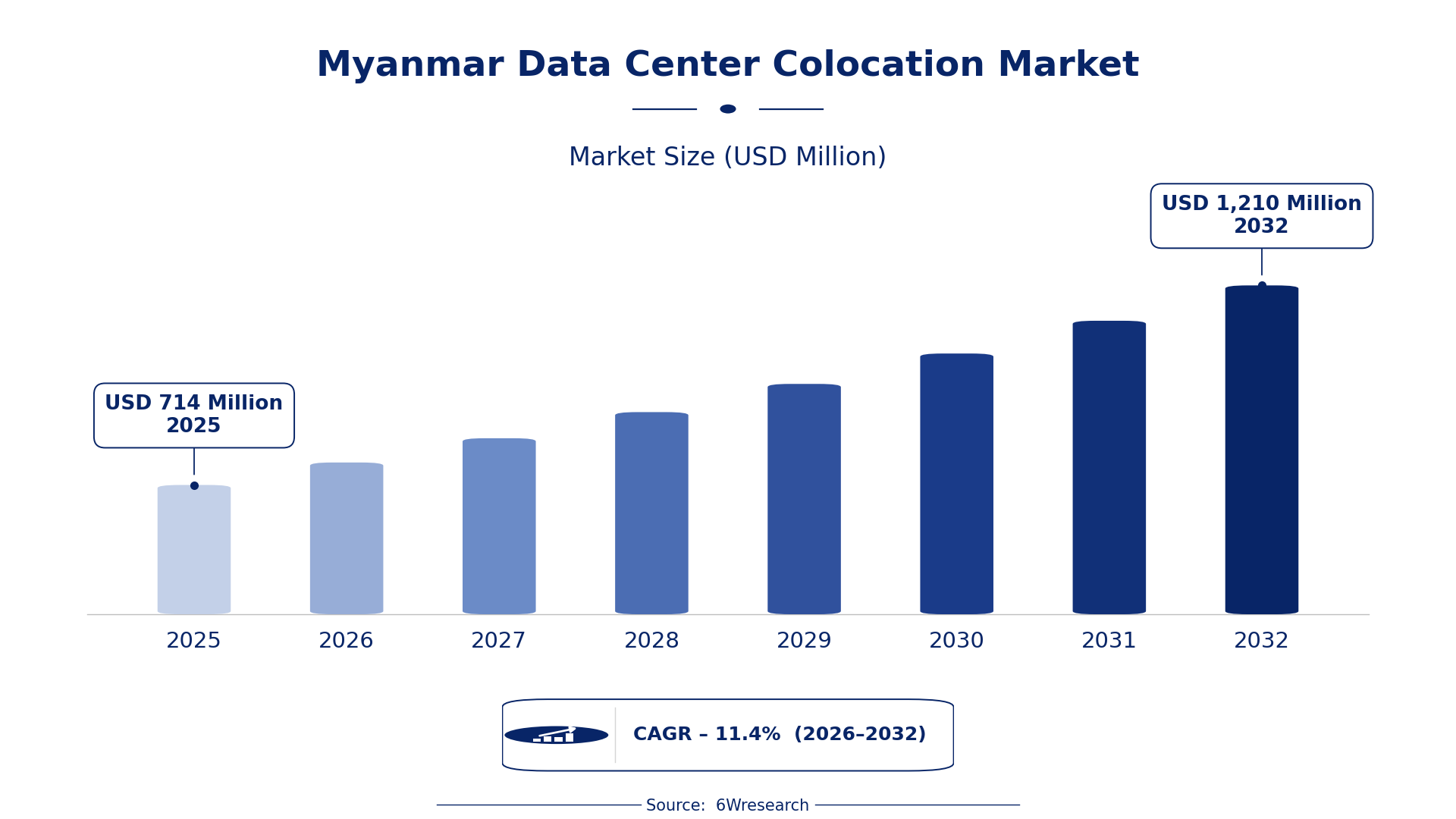
The Myanmar Data Center Colocation Market was estimated at USD 714 Million in 2025 and is projected to reach USD 1210 Million by 2032, growing at a CAGR of 11.4% from 2026 to 2032.
Myanmar Data Center Colocation Market Synopsis
The primary force shaping the Myanmar Data Center Colocation Market is the increasing demand for scalable and flexible IT solutions. As more businesses recognize the advantages of outsourcing their data center needs, colocation services are becoming a viable option for reducing operational costs and enhancing resource access.
In addition to cost efficiencies, the rise of cloud computing and digital transformation initiatives is driving substantial growth in this sector. Remote work trends have further accelerated the need for reliable data center services, making colocation an attractive choice for both local and international enterprises.
Myanmar Data Center Colocation Market Year-wise Growth Rate and Key Drivers
This graph illustrates the annual growth rates of the Myanmar Data Center Colocation Market from 2021 to 2032, highlighting a steady upward trajectory and projected expansion over the forecast period.
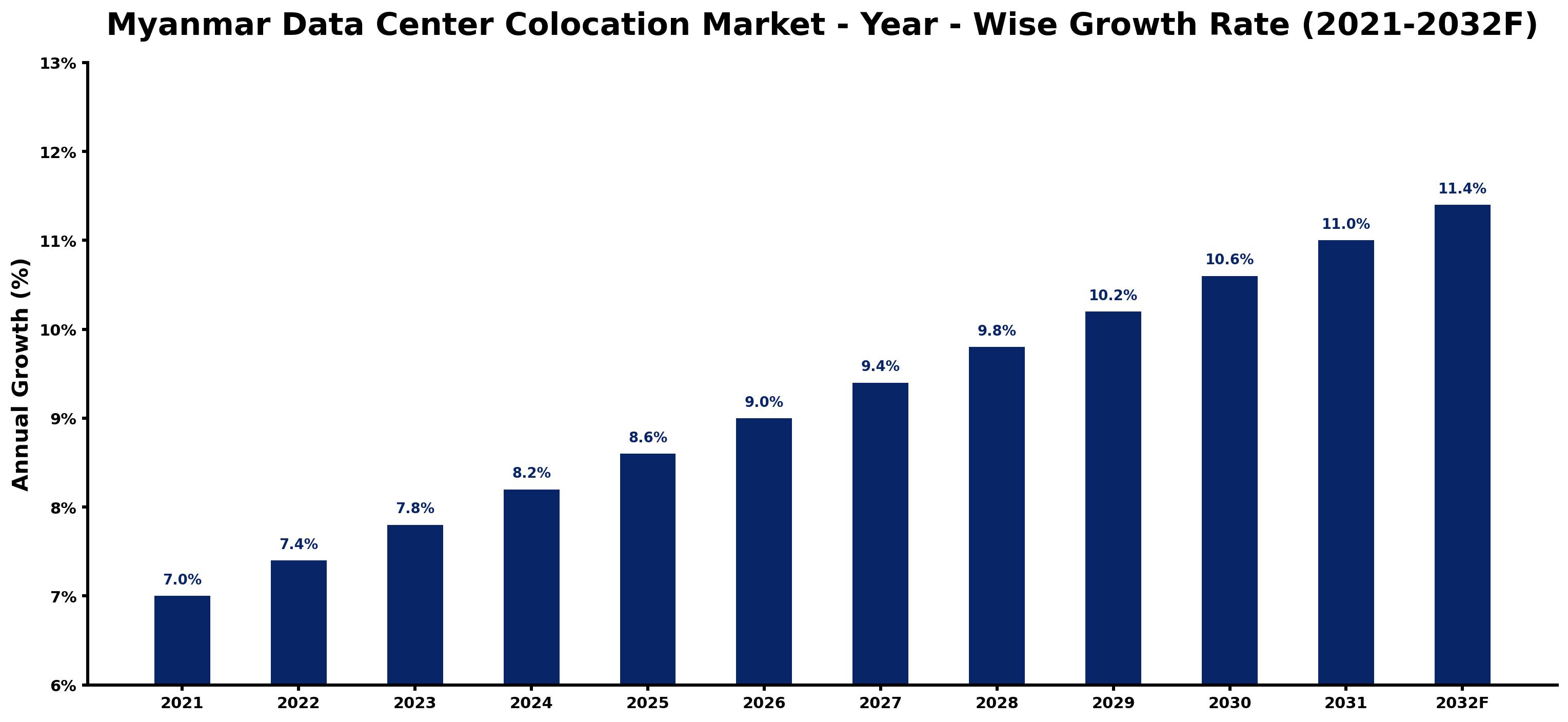
The table below presents the year‑wise growth rates along with the key drivers influencing the market
| Year | Growth Rate | Major Drivers |
| 2021 | 7.0% | Government's E-Governance initiative drives data center investments. |
| 2022 | 7.4% | Increasing mobile internet penetration fuels demand for colocation. |
| 2023 | 7.8% | Local fintech growth boosts need for data storage solutions. |
| 2024 | 8.2% | Rising adoption of cloud services enhances colocation demand. |
| 2025 | 8.6% | Smart city plans accelerate infrastructure investment in data centers. |
| 2026 | 9.0% | Regulatory framework improves for digital infrastructure development. |
| 2027 | 9.4% | Growing cybersecurity concerns increase need for secure data hosting. |
| 2028 | 9.8% | Education sector's digitalization sparks demand for colocation services. |
| 2029 | 10.2% | Telecommunications advancements lead to more data hosting requirements. |
| 2030 | 10.6% | Investment in tech startups drives colocation facility growth. |
| 2031 | 11.0% | Government incentives boost private sector data center projects. |
| 2032 | 11.4% | Increased foreign investment enhances infrastructure for data centers. |
Note: Market size estimations and growth projections presented in this report are based on 6Wresearch's proprietary forecasting methodology, utilizing the latest available industry data, government publications, and primary research inputs.
Myanmar Data Center Colocation Market Key Takeaways
Below are some of the specific key takeaways from the market, including:
- The market is forecasted to grow significantly, reaching USD 1210 Million by 2032.
- Businesses are increasingly adopting outsourcing strategies to optimize IT expenditures.
- Limited infrastructure development poses challenges for colocation providers.
- Government initiatives are aimed at enhancing the regulatory environment and attracting investment.
- The scarcity of land and resources is pushing enterprises towards colocation services.
Evaluation of Restraints in Myanmar Data Center Colocation Market
The Myanmar Data Center Colocation Market is hindered by several restraints. First and foremost is the limited availability of purpose-built facilities that meet industry standards for power, cooling, and security. This situation restricts both scalability and reliability for businesses seeking colocation services. Connectivity remains another significant barrier, as limited network bandwidth and interconnection options can impede the performance of collocated infrastructure. on top of that, the regulatory environment poses challenges, with existing licensing requirements and data sovereignty concerns complicating foreign investments. Addressing these issues requires substantial investment in infrastructure and improved engagement with policymakers to foster a more conducive business environment.
Myanmar Data Center Colocation Market Trends
Several trends are emerging that are likely to shape the Myanmar Data Center Colocation Market in the coming years. The shift towards cloud services continues to gain momentum, compelling businesses to adopt more flexible and scalable IT solutions. on top of that, the rise in digital content consumption and online applications has created an urgent need for secure data center facilities. Innovations in energy-efficient technologies are also becoming a focal point, as businesses strive to minimize their carbon footprints while maximizing performance.
Myanmar Data Center Colocation Market Opportunities
Opportunities for growth in the Myanmar Data Center Colocation Market are plentiful. As businesses increasingly seek cost-effective solutions, colocation services present a compelling alternative to building private data centers. Investments in expanding infrastructure and improving connectivity options can pave the way for new entrants and existing providers alike. Additionally, partnerships with technology vendors can enhance service offerings, creating a competitive edge in this rapidly growing sector.
Government Initiatives in the Myanmar Data Center Colocation Market
The Myanmar government is actively working to establish a supportive regulatory framework that encourages investment in the Data Center Colocation Market. Through various initiatives, policymakers aim to foster competition and enhance the overall infrastructure environment. These efforts are crucial as they address some of the existing limitations and create a more attractive landscape for colocation providers.
- A national digital infrastructure upgrade programme now in its rollout phase aims to improve connectivity across urban and rural areas.
- A regulatory framework introduced in 2025 mandates billing transparency among service providers, ensuring consumer protection.
- Current efforts focus on streamlining the permitting processes for new colocation facilities, reducing bureaucratic hurdles.
- A planned public-private initiative is expected to expand telecom infrastructure access by 2028, enhancing overall connectivity.
Future Insights of the Myanmar Data Center Colocation Market
Looking ahead to 2026-2032, the Myanmar Data Center Colocation Market is set to evolve significantly. As digital transformation accelerates across sectors, the demand for flexible and scalable IT solutions will rise correspondingly. Enterprises will continue to seek colocation services as a means of optimizing costs while ensuring reliability and security. With ongoing government support and increasing investment in infrastructure, the market has the potential to attract both local and foreign players, paving the way for sustainable growth.
Myanmar Data Center Colocation Market Latest Developments
Over the past 12-14 months, the Myanmar Data Center Colocation Market has witnessed a series of noteworthy developments. These activities reflect the growing interest from both local and international stakeholders, seeking to capitalize on the expanding opportunities within this sector.
- A major technology vendor launched a new energy-efficient cooling solution for data centers in early 2025, enhancing operational efficiency.
- A leading regional operator announced an expansion of their colocation services in Q3 2025, increasing their footprint in Yangon.
- An initiative that began in mid-2025 aims to upgrade existing data center facilities to align with international standards for security and reliability.
- A partnership was formed in late 2025 between a local provider and an international firm to enhance service offerings for cloud-based solutions.
Myanmar Data Center Colocation Market - Key Attractiveness of the Report
- 10 Years of Market Numbers
- Historical Data Starting from 2022 to 2025
- Base Year: 2025
- Forecast Data until 2032
- Key Performance Indicators Impacting the Market
- Major Upcoming Developments and Projects
Key Highlights of the Report:
- Myanmar Data Center Colocation Market Outlook
- Market Size of Myanmar Data Center Colocation Market, 2025
- Forecast of Myanmar Data Center Colocation Market, 2032
- Historical Data and Forecast of Myanmar Data Center Colocation Revenues & Volume for the Period 2022-2032F
- Myanmar Data Center Colocation Market Trend Evolution
- Myanmar Data Center Colocation Market Drivers and Challenges
- Myanmar Data Center Colocation Price Trends
- Myanmar Data Center Colocation Porter's Five Forces
- Myanmar Data Center Colocation Industry Life Cycle
- Historical Data and Forecast of Myanmar Data Center Colocation Market Revenues & Volume By Type for the Period 2022-2032F
- Historical Data and Forecast of Myanmar Data Center Colocation Market Revenues & Volume By Retail colocation for the Period 2022-2032F
- Historical Data and Forecast of Myanmar Data Center Colocation Market Revenues & Volume By Wholesale colocation for the Period 2022-2032F
- Historical Data and Forecast of Myanmar Data Center Colocation Market Revenues & Volume By End-User for the Period 2022-2032F
- Historical Data and Forecast of Myanmar Data Center Colocation Market Revenues & Volume By Small and Medium-Sized Enterprises (SMEs) for the Period 2022-2032F
- Historical Data and Forecast of Myanmar Data Center Colocation Market Revenues & Volume By Large Enterprises for the Period 2022-2032F
- Historical Data and Forecast of Myanmar Data Center Colocation Market Revenues & Volume By Industry for the Period 2022-2032F
- Historical Data and Forecast of Myanmar Data Center Colocation Market Revenues & Volume By Banking, Financial Services, and Insurance (BFSI) for the Period 2022-2032F
- Historical Data and Forecast of Myanmar Data Center Colocation Market Revenues & Volume By IT and telecom for the Period 2022-2032F
- Historical Data and Forecast of Myanmar Data Center Colocation Market Revenues & Volume By Government and defense for the Period 2022-2032F
- Historical Data and Forecast of Myanmar Data Center Colocation Market Revenues & Volume By Healthcare for the Period 2022-2032F
- Historical Data and Forecast of Myanmar Data Center Colocation Market Revenues & Volume By Research and academics for the Period 2022-2032F
- Historical Data and Forecast of Myanmar Data Center Colocation Market Revenues & Volume By Retail for the Period 2022-2032F
- Historical Data and Forecast of Myanmar Data Center Colocation Market Revenues & Volume By Energy for the Period 2022-2032F
- Historical Data and Forecast of Myanmar Data Center Colocation Market Revenues & Volume By Manufacturing for the Period 2022-2032F
- Myanmar Data Center Colocation Import Export Trade Statistics
- Market Opportunity Assessment By Type
- Market Opportunity Assessment By End-User
- Market Opportunity Assessment By Industry
- Myanmar Data Center Colocation Top Companies Market Share
- Myanmar Data Center Colocation Competitive Benchmarking By Technical and Operational Parameters
- Myanmar Data Center Colocation Company Profiles
- Myanmar Data Center Colocation Key Strategic Recommendations






































