Myanmar DevOps Market Size & Growth Rate (2026-2032)
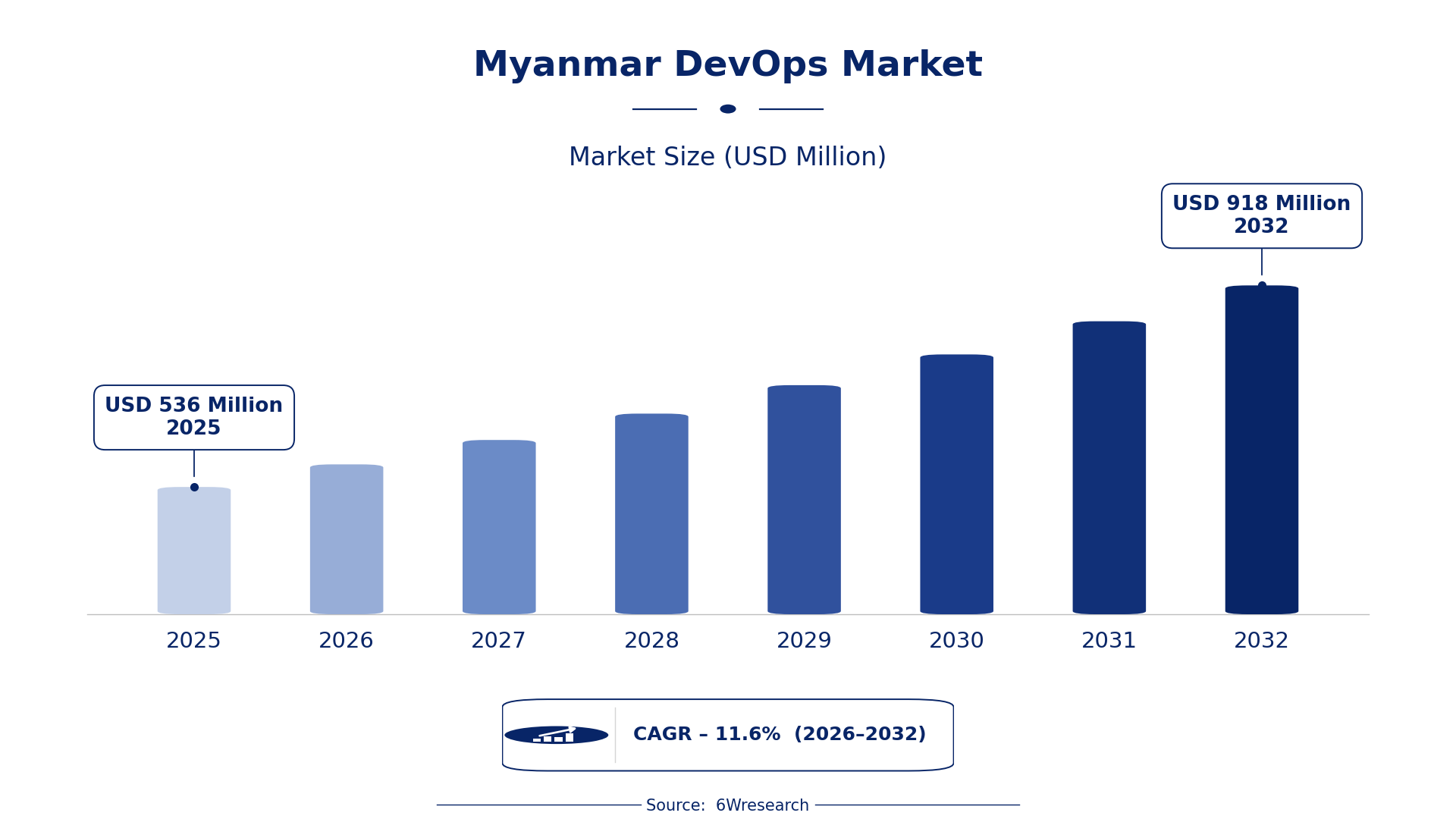
The Myanmar DevOps Market was estimated at USD 536 Million in 2025 and is projected to reach USD 918 Million by 2032, growing at a CAGR of 11.6% from 2026 to 2032.
Myanmar DevOps Market Synopsis
As organizations in Myanmar increasingly embrace digital transformation, the demand for DevOps practices is escalating. This shift is not merely a trend; businesses are recognizing that adopting a DevOps culture enhances collaboration and accelerates software delivery, critical in today’s competitive environment.
The growth of cloud technologies in Myanmar is also a driving force behind the DevOps market. Companies are actively seeking tools and services that facilitate continuous integration and deployment, automation, and monitoring, all essential for streamlining development processes and enhancing operational efficiency.
Myanmar DevOps Market Year-wise Growth Rate and Key Drivers
This graph illustrates the annual growth rates of the Myanmar DevOps Market from 2021 to 2032, highlighting a steady upward trajectory and projected expansion over the forecast period.
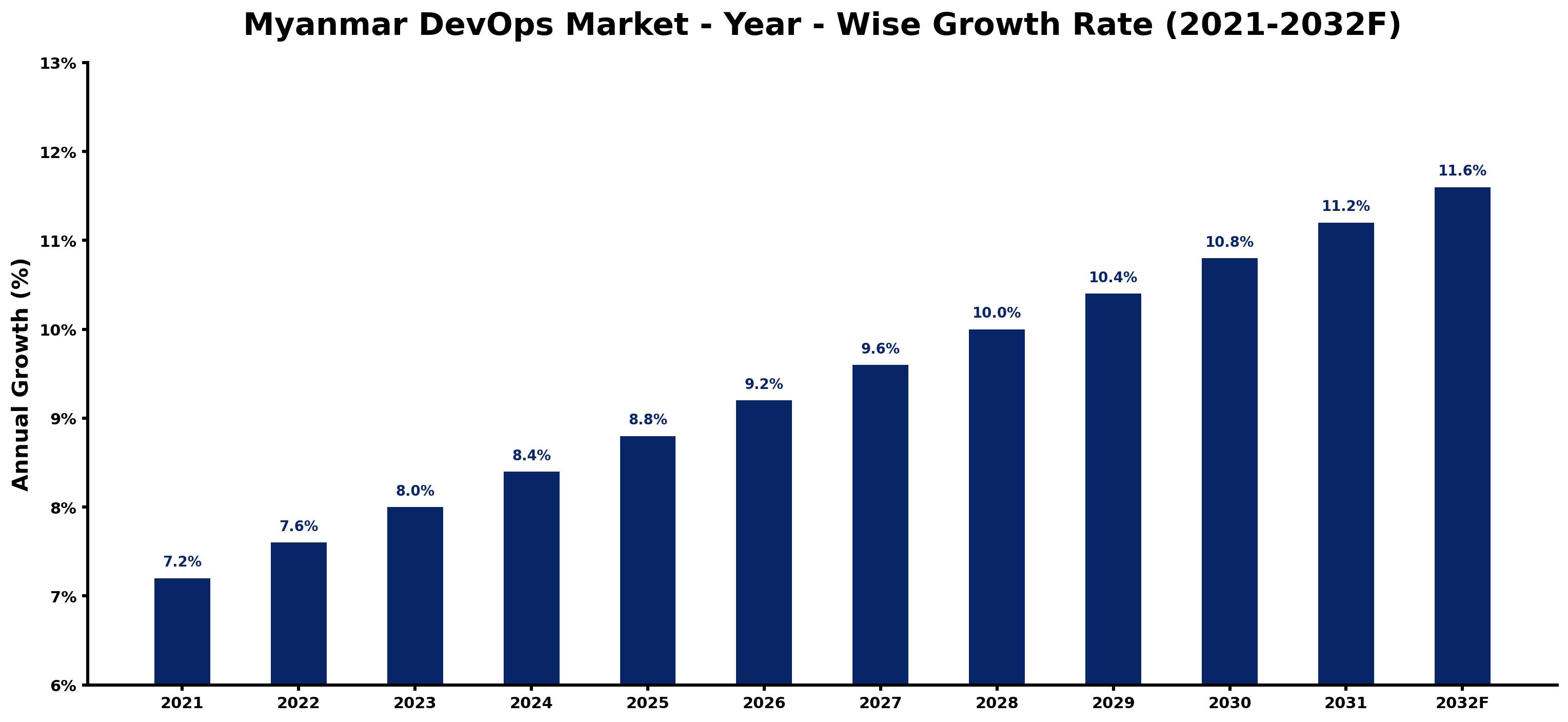
The table below presents the year‑wise growth rates along with the key drivers influencing the market
| Year | Growth Rate | Major Drivers |
| 2021 | 7.2% | Increased internet penetration enhances remote collaboration capabilities. |
| 2022 | 7.6% | Emerging tech startups driving agile software development practices. |
| 2023 | 8.0% | Local educational programs strengthening software engineering skills. |
| 2024 | 8.4% | Government grants encouraging tech adoption among SMEs. |
| 2025 | 8.8% | Integration of local businesses with global tech ecosystems. |
| 2026 | 9.2% | Growing focus on cybersecurity influencing software deployment. |
| 2027 | 9.6% | Rising developer community fostering innovation and collaboration. |
| 2028 | 10.0% | Investment in infrastructure supporting DevOps tools adoption. |
| 2029 | 10.4% | Demand for faster release cycles in local enterprises. |
| 2030 | 10.8% | Development of localized platforms catering to local needs. |
| 2031 | 11.2% | Boost in remote work culture increasing DevOps relevance. |
| 2032 | 11.6% | Supportive policies for tech entrepreneurship enhancing market growth. |
Note: Market size estimations and growth projections presented in this report are based on 6Wresearch's proprietary forecasting methodology, utilizing the latest available industry data, government publications, and primary research inputs.
Myanmar DevOps Market Key Takeaways
Below are some of the specific key takeaways from the market, including:
- Rapid adoption of cloud technologies is reshaping development and operational frameworks.
- There is a growing recognition of the need for efficient software delivery processes among businesses.
- Investment in training and skill development is crucial to overcome the skills gap in the local IT workforce.
- Government initiatives are fostering a conducive environment for technological growth and innovation.
- Automation tools and CI/CD pipelines are in high demand as businesses seek to improve productivity.
Evaluation of Restraints in Myanmar DevOps Market
The Myanmar DevOps market faces several real constraints. A prevalent lack of awareness about DevOps principles hinders widespread adoption. Many local IT professionals lack the necessary skills and expertise, creating a bottleneck in effective implementation. Political instability further complicates the environment, making it challenging for businesses to invest in long-term DevOps strategies. Traditional organizational structures, which often resist change, also impede the collaborative culture essential for DevOps success. Addressing these issues will require substantial investments in education and tailored solutions.
Myanmar DevOps Market Trends
The market is witnessing noteworthy trends that are shaping its future. The increasing focus on automation is evident as organizations aim to reduce manual errors and speed up deployment processes. on top of that, the rise of agile methodologies is encouraging teams to work more collaboratively, breaking down silos between development and operations. There's also a notable shift towards utilizing AI and machine learning within DevOps practices, enhancing predictive capabilities and operational efficiencies.
Myanmar DevOps Market Opportunities
Investment opportunities abound in the Myanmar DevOps market, particularly as businesses strive for digital advancement. Companies that offer tailored DevOps consultancy services and training programs stand to benefit significantly. Additionally, partnerships with local tech startups can open doors to innovative solutions that cater to the unique demands of the Myanmar market. As the landscape evolves, the need for effective DevOps tools will only grow, making this a fertile ground for investors.
Government Initiatives in the Myanmar DevOps Market
The Myanmar government is actively involved in promoting its IT sector, which has direct implications for the DevOps market. By enhancing digital infrastructure and fostering a supportive regulatory environment, the government is laying the groundwork for technological innovation. These initiatives are crucial as they help create a vibrant ecosystem for technology companies to thrive.
- A national digital infrastructure upgrade programme now in its rollout phase, aimed at improving connectivity across the country.
- Ongoing skill development programs designed to enhance the capabilities of local IT professionals in DevOps practices.
- A recently launched initiative focused on cybersecurity measures that support the safe implementation of DevOps tools.
- Plans for a public-private partnership expected to boost investment in IT startups by 2026.
- Regulatory frameworks introduced in 2025 to ensure transparency and efficiency in IT operations.
Future Insights of the Myanmar DevOps Market
Looking ahead, the Myanmar DevOps market is likely to experience steady growth driven by ongoing digital transformation initiatives. Companies will increasingly prioritize automation and collaborative tools as they seek to enhance their operational efficiency. With the government's support in advancing digital capabilities, the market is set for a dynamic evolution, attracting both local and foreign investments.
Myanmar DevOps Market Latest Developments
Recent activities in the Myanmar DevOps market indicate a clear trajectory towards modernization and efficiency. The past year has seen a surge in interest from companies eager to adopt DevOps methodologies to remain competitive in a digital-first world.
- A leading regional operator launched a comprehensive DevOps training program in early 2023, aiming to upskill over 500 local IT professionals.
- In Q2 2023, a major technology vendor introduced a new suite of automation tools tailored for the Myanmar market, enhancing operational efficiencies.
- An initiative that began in late 2022 is currently ongoing, focusing on establishing a collaborative platform for DevOps practitioners across the country.
- A rollout expected to begin in early 2024 will implement new cloud services to facilitate better software delivery across various sectors.
- By mid-2023, several technology startups have secured funding to develop localized DevOps solutions, reflecting growing investor confidence.
Myanmar DevOps Market - Key Attractiveness of the Report
- 10 Years of Market Numbers
- Historical Data Starting from 2022 to 2025
- Base Year: 2025
- Forecast Data until 2032
- Key Performance Indicators Impacting the Market
- Major Upcoming Developments and Projects
Key Highlights of the Report:
- Myanmar DevOps Market Outlook
- Market Size of Myanmar DevOps Market, 2025
- Forecast of Myanmar DevOps Market, 2032
- Historical Data and Forecast of Myanmar DevOps Revenues & Volume for the Period 2022-2032F
- Myanmar DevOps Market Trend Evolution
- Myanmar DevOps Market Drivers and Challenges
- Myanmar DevOps Price Trends
- Myanmar DevOps Porter's Five Forces
- Myanmar DevOps Industry Life Cycle
- Historical Data and Forecast of Myanmar DevOps Market Revenues & Volume By Type for the Period 2022-2032F
- Historical Data and Forecast of Myanmar DevOps Market Revenues & Volume By Solutions for the Period 2022-2032F
- Historical Data and Forecast of Myanmar DevOps Market Revenues & Volume By Services for the Period 2022-2032F
- Historical Data and Forecast of Myanmar DevOps Market Revenues & Volume By Vertical for the Period 2022-2032F
- Historical Data and Forecast of Myanmar DevOps Market Revenues & Volume By Telecommunications for the Period 2022-2032F
- Historical Data and Forecast of Myanmar DevOps Market Revenues & Volume By IT and ITeS for the Period 2022-2032F
- Historical Data and Forecast of Myanmar DevOps Market Revenues & Volume By Retail and Consumer Goods for the Period 2022-2032F
- Historical Data and Forecast of Myanmar DevOps Market Revenues & Volume By Media and Entertainment for the Period 2022-2032F
- Historical Data and Forecast of Myanmar DevOps Market Revenues & Volume By Government and Public Sector for the Period 2022-2032F
- Historical Data and Forecast of Myanmar DevOps Market Revenues & Volume By Manufacturing for the Period 2022-2032F
- Historical Data and Forecast of Myanmar DevOps Market Revenues & Volume By Healthcare and Life Sciences for the Period 2022-2032F
- Historical Data and Forecast of Myanmar DevOps Market Revenues & Volume By Education for the Period 2022-2032F
- Historical Data and Forecast of Myanmar DevOps Market Revenues & Volume By Deployment Model for the Period 2022-2032F
- Historical Data and Forecast of Myanmar DevOps Market Revenues & Volume By Public for the Period 2022-2032F
- Historical Data and Forecast of Myanmar DevOps Market Revenues & Volume By Private for the Period 2022-2032F
- Historical Data and Forecast of Myanmar DevOps Market Revenues & Volume By Organization Size for the Period 2022-2032F
- Historical Data and Forecast of Myanmar DevOps Market Revenues & Volume By SMEs for the Period 2022-2032F
- Historical Data and Forecast of Myanmar DevOps Market Revenues & Volume By Large enterprises for the Period 2022-2032F
- Myanmar DevOps Import Export Trade Statistics
- Market Opportunity Assessment By Type
- Market Opportunity Assessment By Vertical
- Market Opportunity Assessment By Deployment Model
- Market Opportunity Assessment By Organization Size
- Myanmar DevOps Top Companies Market Share
- Myanmar DevOps Competitive Benchmarking By Technical and Operational Parameters
- Myanmar DevOps Company Profiles
- Myanmar DevOps Key Strategic Recommendations






































