Myanmar Digital Badges Market Size, Share & Growth Rate
The Myanmar Digital Badges Market was estimated at USD 194 Million in 2025 and is projected to reach USD 253 Million by 2032, growing at a CAGR of 3.9% from 2026 to 2032. This growth trajectory is supported by the increasing emphasis on online learning and the pursuit of verifiable skills recognition within the workforce. As educational institutions and corporate training programs increasingly adopt digital credentials, the demand for portable and credible achievement representations continues to rise.
Myanmar Digital Badges Market Year-wise Growth Rate and Key Drivers
This graph highlights how the Myanmar Digital Badges Market has steadily grown over the years, supported by major growth factors.
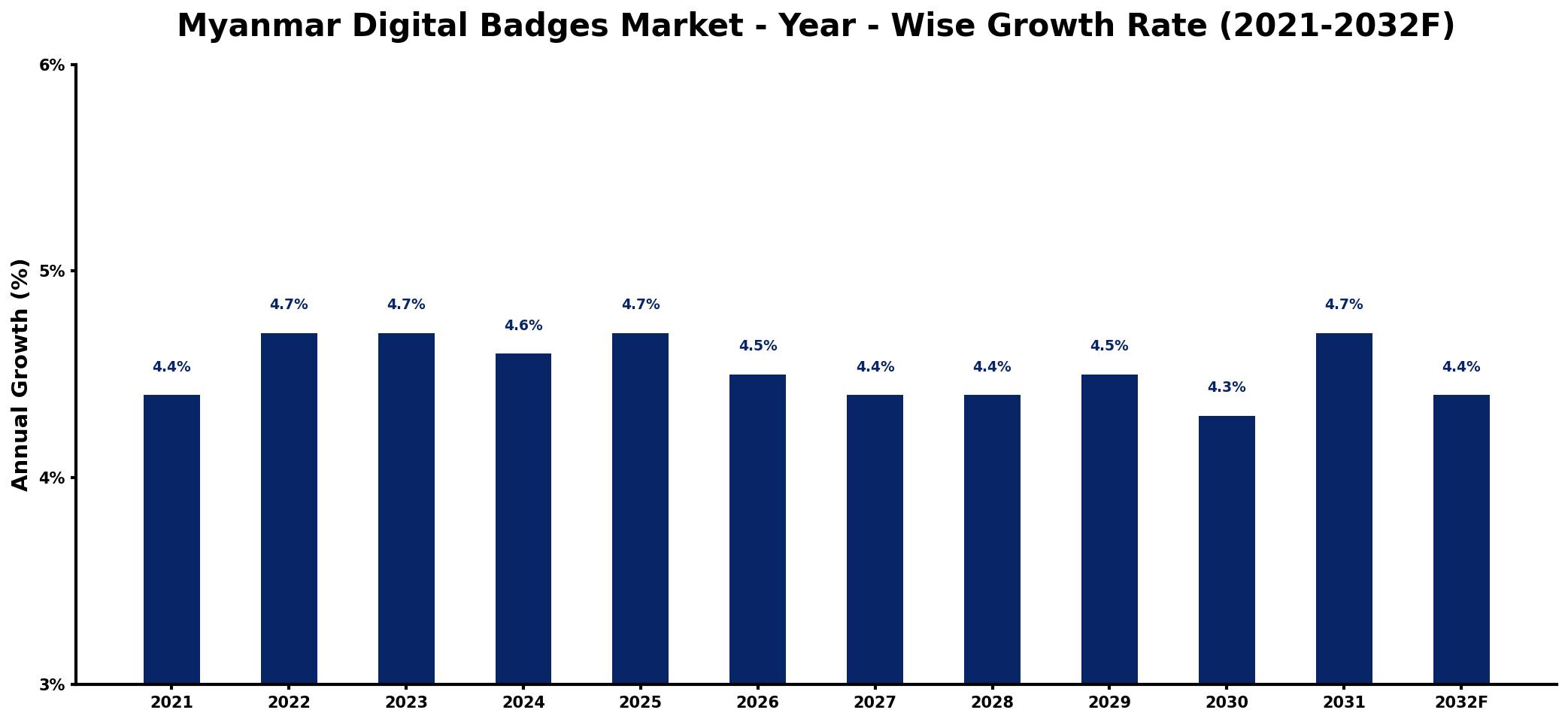
The table below presents the year‑wise growth rates along with the key drivers influencing the market
| Year | Growth Rate | Major Drivers |
| 2021 | 4.4% | Increased interest in online credentials |
| 2022 | 4.7% | Growth in remote learning platforms |
| 2023 | 4.7% | Rise in professional skill recognition |
| 2024 | 4.6% | Expansion of corporate training programs |
| 2025 | 4.7% | Demand for innovative learning solutions |
| 2026 | 4.5% | Investments in educational technology tools |
| 2027 | 4.4% | Adoption of competency based assessments |
| 2028 | 4.4% | Focus on lifelong learning initiatives |
| 2029 | 4.5% | Emergence of new certification programs |
| 2030 | 4.3% | Integration of gamification in education |
| 2031 | 4.7% | Collaboration between employers and educators |
| 2032 | 4.4% | Increase in workforce development funding |
Note: Market size estimations and growth projections presented in this report are based on 6Wresearch's proprietary forecasting methodology, utilizing the latest available industry data, government publications, and primary research inputs.
Myanmar Digital Badges Market Synopsis
In Myanmar, the trend of issuing digital badges is transforming traditional methods of skills validation. With a growing digital-savvy population, the need for flexible and recognizable credentials is becoming more critical in an evolving job market.
Educational institutions and training organizations are adopting digital badges not just as an innovative means of recognition, but as a response to the burgeoning online learning ecosystem. This shift enables learners to showcase their competencies across multiple platforms, facilitating greater mobility and employability in the workforce.
Myanmar Digital Badges Market Key Takeaways
- Significant growth anticipated as online learning and certification programs expand.
- Increased recognition of digital badges is leading to greater acceptance among employers.
- Technological advancements are enhancing the security and verification of digital credentials.
- Government initiatives are fostering an environment conducive to skills recognition.
- Growing awareness among educational institutions on the importance of microcredentials.
Evaluation of Restraints in Myanmar Digital Badges Market
While the Myanmar Digital Badges Market is poised for growth, several restraints limit its full potential. The lack of standardization in credentialing and varying levels of recognition across different sectors hinder widespread adoption. Many employers still lack awareness and understanding of the value of digital badges, which impacts their credibility. Additionally, concerns regarding the security of digital badge systems require robust measures to ensure data integrity and user trust.
Myanmar Digital Badges Market Trends
Key trends shaping the Myanmar Digital Badges Market include the integration of digital badges into broader educational frameworks and the move towards decentralized verification technologies. There is also a noticeable shift towards creating interoperable systems that allow badges to be recognized across various platforms. Moreover, the emphasis on lifelong learning has catalyzed the adoption of microcredentials as a mainstream solution for professional development.
Myanmar Digital Badges Market Opportunities
The market presents numerous growth opportunities, particularly for technology providers developing innovative credentialing solutions. Organizations looking to enhance employee skills and enable continuous learning are increasingly investing in digital badge systems. Furthermore, partnerships between educational institutions and employers can lead to tailored badge programs that address specific skills gaps in the workforce.
Government Initiatives in the Myanmar Digital Badges Market
The Myanmar government is actively promoting the use of digital badges as part of its commitment to skills development and lifelong learning. Initiatives aimed at standardizing badge accreditation processes and establishing competency frameworks are being implemented. These efforts not only seek to enhance the acceptance of digital badges across educational institutions but also encourage employers to integrate them into hiring and promotion processes.
Future Insights of the Myanmar Digital Badges Market
Looking ahead to 2026-2032, the Myanmar Digital Badges Market is expected to flourish as acceptance grows and technological barriers diminish. Increased collaboration between educational bodies and businesses will facilitate the integration of digital badges into the standard education and hiring processes. Additionally, as the workforce becomes more dynamic and skill-oriented, the demand for flexible credentialing solutions will drive further innovations and expansions within the market.
Myanmar Digital Badges Market Latest Developments (2025 - 2026)
Recent developments in the Myanmar Digital Badges Market indicate a strong push towards greater recognition of digital credentials among educational institutions and corporations. Initiatives launched to improve interoperability between different badge systems have gained traction, aiming to create a more integrated credentialing landscape. Moreover, increased collaboration between private sector technology firms and educational entities is likely to yield innovative solutions for skill validation.
Myanmar Digital Badges Market - Key Attractiveness of the Report
- 10 Years of Market Numbers
- Historical Data Starting from 2022 to 2025
- Base Year: 2025
- Forecast Data until 2032
- Key Performance Indicators Impacting the Market
- Major Upcoming Developments and Projects
Key Highlights of the Report:
- Myanmar Digital Badges Market Outlook
- Market Size of Myanmar Digital Badges Market, 2025
- Forecast of Myanmar Digital Badges Market, 2032
- Historical Data and Forecast of Myanmar Digital Badges Revenues & Volume for the Period 2022-2032F
- Myanmar Digital Badges Market Trend Evolution
- Myanmar Digital Badges Market Drivers and Challenges
- Myanmar Digital Badges Price Trends
- Myanmar Digital Badges Porter's Five Forces
- Myanmar Digital Badges Industry Life Cycle
- Historical Data and Forecast of Myanmar Digital Badges Market Revenues & Volume By Offering for the Period 2022-2032F
- Historical Data and Forecast of Myanmar Digital Badges Market Revenues & Volume By Platform for the Period 2022-2032F
- Historical Data and Forecast of Myanmar Digital Badges Market Revenues & Volume By Services for the Period 2022-2032F
- Historical Data and Forecast of Myanmar Digital Badges Market Revenues & Volume By End-User for the Period 2022-2032F
- Historical Data and Forecast of Myanmar Digital Badges Market Revenues & Volume By Academic for the Period 2022-2032F
- Historical Data and Forecast of Myanmar Digital Badges Market Revenues & Volume By Corporate for the Period 2022-2032F
- Myanmar Digital Badges Import Export Trade Statistics
- Market Opportunity Assessment By Offering
- Market Opportunity Assessment By End-User
- Myanmar Digital Badges Top Companies Market Share
- Myanmar Digital Badges Competitive Benchmarking By Technical and Operational Parameters
- Myanmar Digital Badges Company Profiles
- Myanmar Digital Badges Key Strategic Recommendations






































