Myanmar Digital Lending Market Size & Growth Rate (2026-2032)
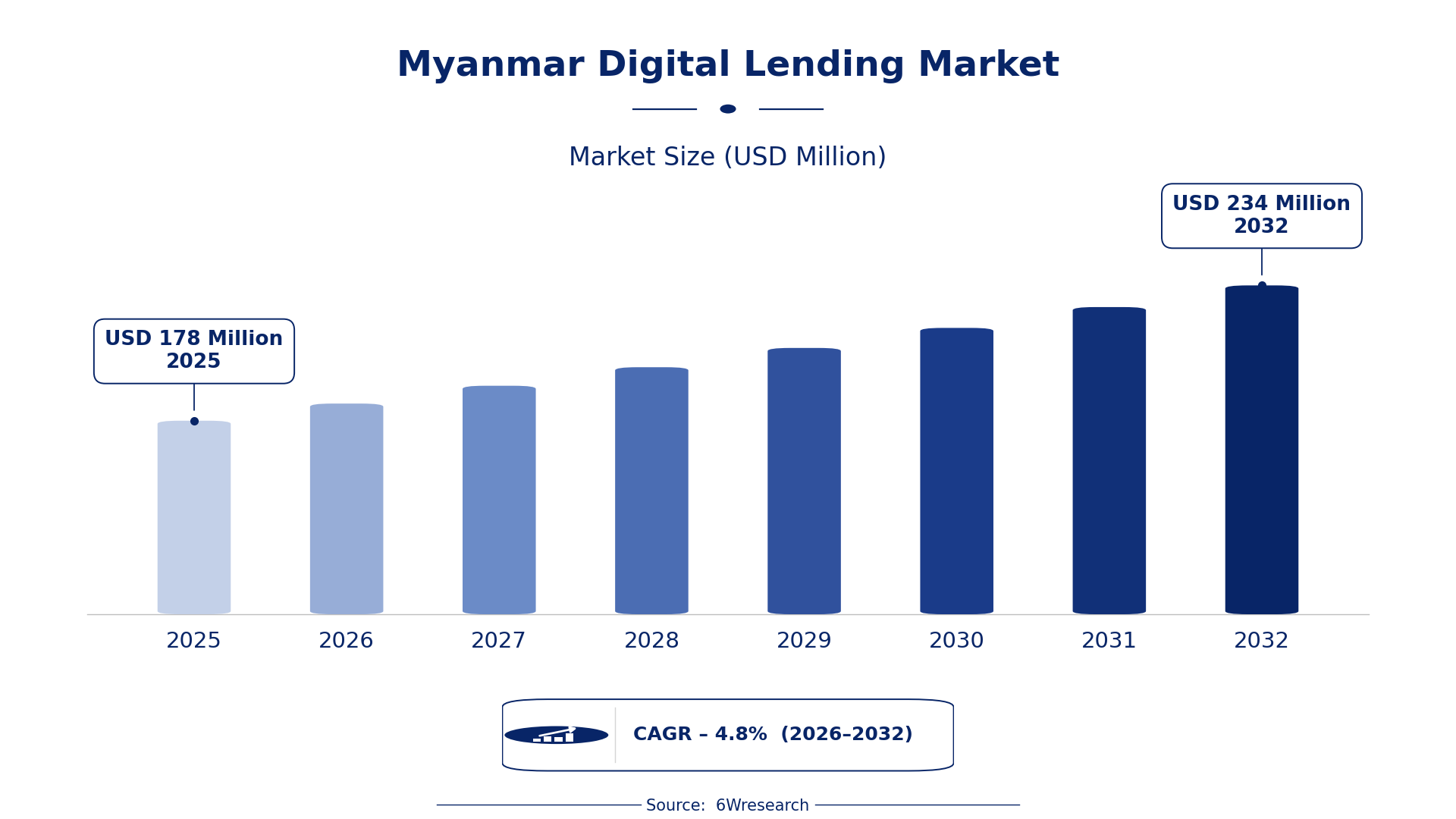
The Myanmar Digital Lending Market was estimated at USD 178 Million in 2025 and is projected to reach USD 234 Million by 2032, growing at a CAGR of 4.8% from 2026 to 2032.
Myanmar Digital Lending Market Synopsis
The rapid expansion of smartphone usage is the primary catalyst driving growth in the Myanmar Digital Lending Market. As more people gain access to mobile technology, digital lending platforms are tapping into a previously underserved population eager for financial services.
In addition to increasing smartphone penetration, the lack of traditional banking infrastructure leaves a vast segment of the population reliant on alternative lending solutions. Digital platforms are rising to the occasion, offering quick and convenient access to credit for individuals and small businesses that have long been overlooked.
Myanmar Digital Lending Market Year-wise Growth Rate and Key Drivers
This graph illustrates the annual growth rates of the Myanmar Digital Lending Market from 2021 to 2032, highlighting a steady upward trajectory and projected expansion over the forecast period.
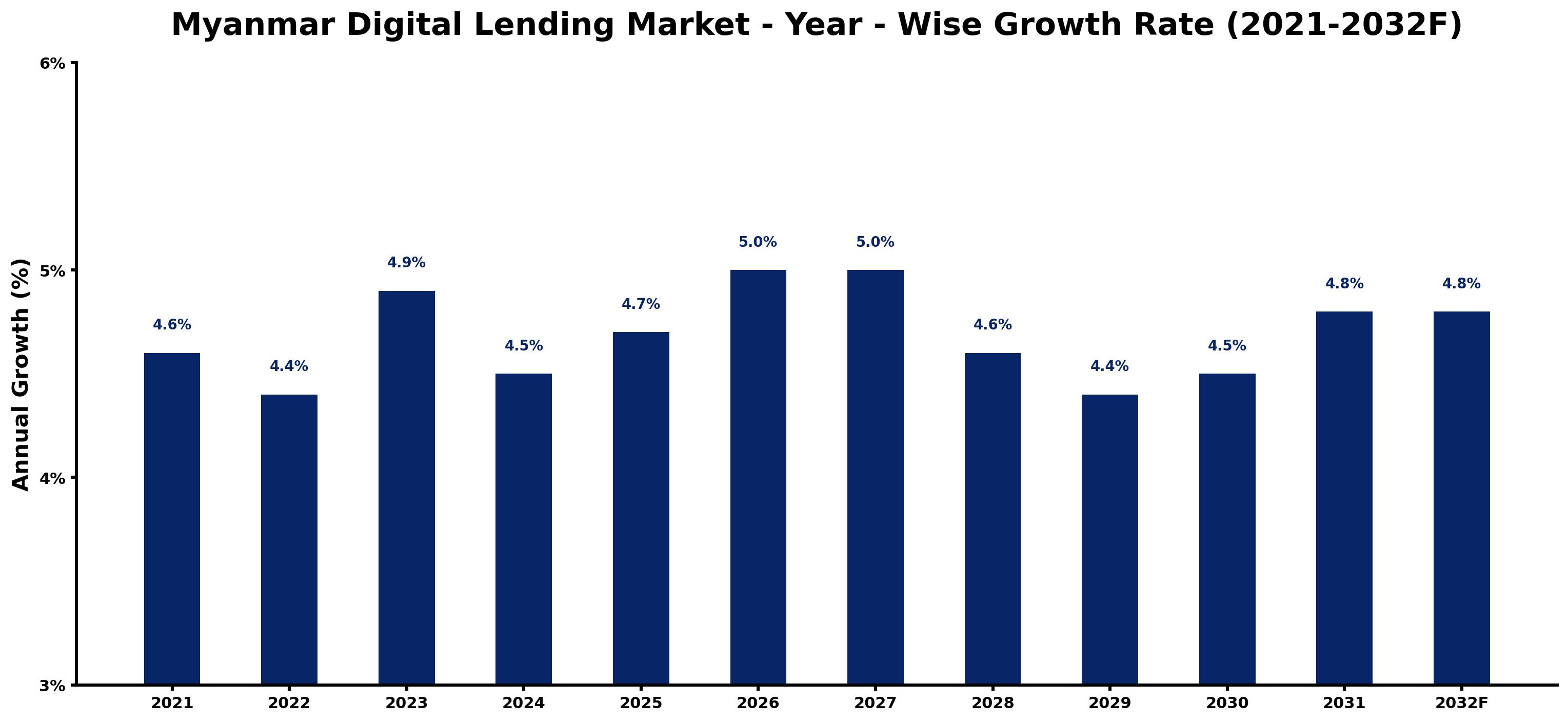
The table below presents the year‑wise growth rates along with the key drivers influencing the market
| Year | Growth Rate | Major Drivers |
| 2021 | 4.6% | Increased smartphone penetration enhancing digital access. |
| 2022 | 4.4% | Regulatory support from Central Bank for fintech innovation. |
| 2023 | 4.9% | Growing urban population driving digital loan demand. |
| 2024 | 4.5% | Emergence of local fintech startups diversifying lending options. |
| 2025 | 4.7% | Government initiatives promoting financial inclusion for youth. |
| 2026 | 5.0% | Enhanced internet connectivity facilitating online lending platforms. |
| 2027 | 5.0% | Rising consumer awareness of digital financial products. |
| 2028 | 4.6% | Increased collaboration between banks and fintech firms. |
| 2029 | 4.4% | Targeted marketing reaching underserved rural populations. |
| 2030 | 4.5% | Prominence of peer-to-peer lending platforms gaining traction. |
| 2031 | 4.8% | Legal reforms enhancing borrower protection and trust. |
| 2032 | 4.8% | Growing acceptance of alternative credit scoring methods. |
Note: Market size estimations and growth projections presented in this report are based on 6Wresearch's proprietary forecasting methodology, utilizing the latest available industry data, government publications, and primary research inputs.
Myanmar Digital Lending Market Key Takeaways
Below are some of the specific key takeaways from the market, including:
- Smartphone adoption is a critical driver of digital lending growth in Myanmar.
- The market is witnessing an influx of players due to favorable regulatory changes.
- Alternative data sources are increasingly being utilized for credit scoring.
- Challenges such as regulatory uncertainties and data security issues persist.
- Investment opportunities exist in established digital lending platforms catering to underserved segments.
Evaluation of Restraints in Myanmar Digital Lending Market
Despite its potential, the Myanmar Digital Lending Market faces several significant restraints. The regulatory framework is still in its infancy, creating uncertainty for both lenders and borrowers. As the government works to establish clearer guidelines, many players are left navigating a complex landscape with limited direction.
Additionally, the absence of a reliable credit scoring system hampers lenders' ability to assess risk accurately, leading to potential defaults. Data privacy concerns and the prevalence of informal lending practices pose further challenges, making it crucial for digital lenders to establish trust and implement effective risk management strategies.
Myanmar Digital Lending Market Trends
The move towards mobile-based lending platforms is not just a trend; it’s a fundamental shift in how financial services are delivered in Myanmar. As more consumers embrace smartphones, the demand for convenient, on-the-go lending solutions continues to rise.
Simultaneously, the use of alternative data for credit assessments is gaining traction, allowing lenders to make more informed decisions. This trend is critical for reaching the unbanked population, as traditional credit histories are often non-existent. The competitive landscape is also heating up, with new entrants constantly innovating to meet consumer needs.
Myanmar Digital Lending Market Opportunities
The potential for investment in the Myanmar Digital Lending Market is substantial. With a burgeoning population that is increasingly tech-savvy, the demand for accessible credit is set to grow. Digital lending platforms are well-positioned to capitalize on this opportunity, especially as traditional banking remains limited.
Investors should consider platforms that are leveraging technology effectively to assess risk and reach underserved demographics. The evolving regulatory landscape also presents opportunities for collaboration between fintech companies and traditional financial institutions, which could foster a more inclusive financial environment.
Government Initiatives in the Myanmar Digital Lending Market
The Myanmar government is actively shaping the digital lending market through various initiatives aimed at promoting financial inclusion while protecting consumers. Recent regulatory frameworks are designed to foster a healthier lending environment by ensuring transparency and fair practices.
- A regulatory framework established in 2018 requires digital lending platforms to obtain licenses and adhere to consumer protection measures.
- Currently ongoing is the formation of the Digital Economy Development Committee, which oversees the regulation of digital financial services.
- Plans are underway for a national awareness campaign to educate consumers about digital lending options and their rights.
- A public-private initiative focused on enhancing digital infrastructure is set to begin in early 2026 to improve access to financial services.
- Upcoming guidelines are expected to address data privacy and security, which are critical for building consumer trust.
Future Insights of the Myanmar Digital Lending Market
Looking ahead to 2026-2032, the Myanmar Digital Lending Market is expected to undergo significant transformation. Factors such as rising internet connectivity and a young, tech-savvy demographic will continue to drive demand for digital financial services.
As the regulatory environment matures, digital lending platforms will likely expand their offerings and enhance customer experience. However, addressing data privacy and risk assessment challenges will be essential for sustainable growth, paving the way for more innovative solutions in the sector.
Myanmar Digital Lending Market Latest Developments
In the past year, activity within the Myanmar Digital Lending Market has intensified as companies race to innovate and meet consumer needs. The focus has shifted toward enhancing user experience and ensuring compliance with evolving regulations.
- A major technology vendor launched a new credit scoring model in Q2 2025 that utilizes alternative data sources to improve lending accuracy.
- An ongoing collaboration between fintech companies and local banks, initiated in late 2025, aims to streamline loan processing and enhance consumer outreach.
- A public awareness initiative launched in early 2025 seeks to educate potential borrowers about digital lending options and responsible borrowing practices.
- Plans for a new mobile app designed to simplify the lending process are set to roll out in mid-2026, targeting young, tech-savvy users.
- A partnership announced in late 2025 between two leading digital platforms aims to enhance data security measures, addressing growing privacy concerns.
Myanmar Digital Lending Market - Key Attractiveness of the Report
- 10 Years of Market Numbers
- Historical Data Starting from 2022 to 2025
- Base Year: 2025
- Forecast Data until 2032
- Key Performance Indicators Impacting the Market
- Major Upcoming Developments and Projects
Key Highlights of the Report:
- Myanmar Digital Lending Market Outlook
- Market Size of Myanmar Digital Lending Market, 2025
- Forecast of Myanmar Digital Lending Market, 2032
- Historical Data and Forecast of Myanmar Digital Lending Revenues & Volume for the Period 2022-2032F
- Myanmar Digital Lending Market Trend Evolution
- Myanmar Digital Lending Market Drivers and Challenges
- Myanmar Digital Lending Price Trends
- Myanmar Digital Lending Porter's Five Forces
- Myanmar Digital Lending Industry Life Cycle
- Historical Data and Forecast of Myanmar Digital Lending Market Revenues & Volume By Offering for the Period 2022-2032F
- Historical Data and Forecast of Myanmar Digital Lending Market Revenues & Volume By Solutions for the Period 2022-2032F
- Historical Data and Forecast of Myanmar Digital Lending Market Revenues & Volume By Services for the Period 2022-2032F
- Historical Data and Forecast of Myanmar Digital Lending Market Revenues & Volume By Deployment Mode for the Period 2022-2032F
- Historical Data and Forecast of Myanmar Digital Lending Market Revenues & Volume By Cloud for the Period 2022-2032F
- Historical Data and Forecast of Myanmar Digital Lending Market Revenues & Volume By On-premises for the Period 2022-2032F
- Historical Data and Forecast of Myanmar Digital Lending Market Revenues & Volume By End User for the Period 2022-2032F
- Historical Data and Forecast of Myanmar Digital Lending Market Revenues & Volume By Banks for the Period 2022-2032F
- Historical Data and Forecast of Myanmar Digital Lending Market Revenues & Volume By Credit Unions for the Period 2022-2032F
- Historical Data and Forecast of Myanmar Digital Lending Market Revenues & Volume By NBFCs for the Period 2022-2032F
- Myanmar Digital Lending Import Export Trade Statistics
- Market Opportunity Assessment By Offering
- Market Opportunity Assessment By Deployment Mode
- Market Opportunity Assessment By End User
- Myanmar Digital Lending Top Companies Market Share
- Myanmar Digital Lending Competitive Benchmarking By Technical and Operational Parameters
- Myanmar Digital Lending Company Profiles
- Myanmar Digital Lending Key Strategic Recommendations






































