Myanmar Digital Printing Market Size, Share & Growth Rate
The Myanmar Digital Printing Market was estimated at USD 160 Million in 2025 and is projected to reach USD 211 Million by 2032, growing at a CAGR of 4.0% from 2026 to 2032. This growth trajectory is fueled by the increasing demand for high-quality, customized printing solutions across various sectors, notably in advertising and packaging. As businesses in Myanmar continue to modernize and adapt to digital technologies, the shift towards efficient and flexible printing solutions is expected to drive further market expansion.
Myanmar Digital Printing Market Year-wise Growth Rate and Key Drivers
This graph highlights how the Myanmar Digital Printing Market has steadily grown over the years, supported by major growth factors.
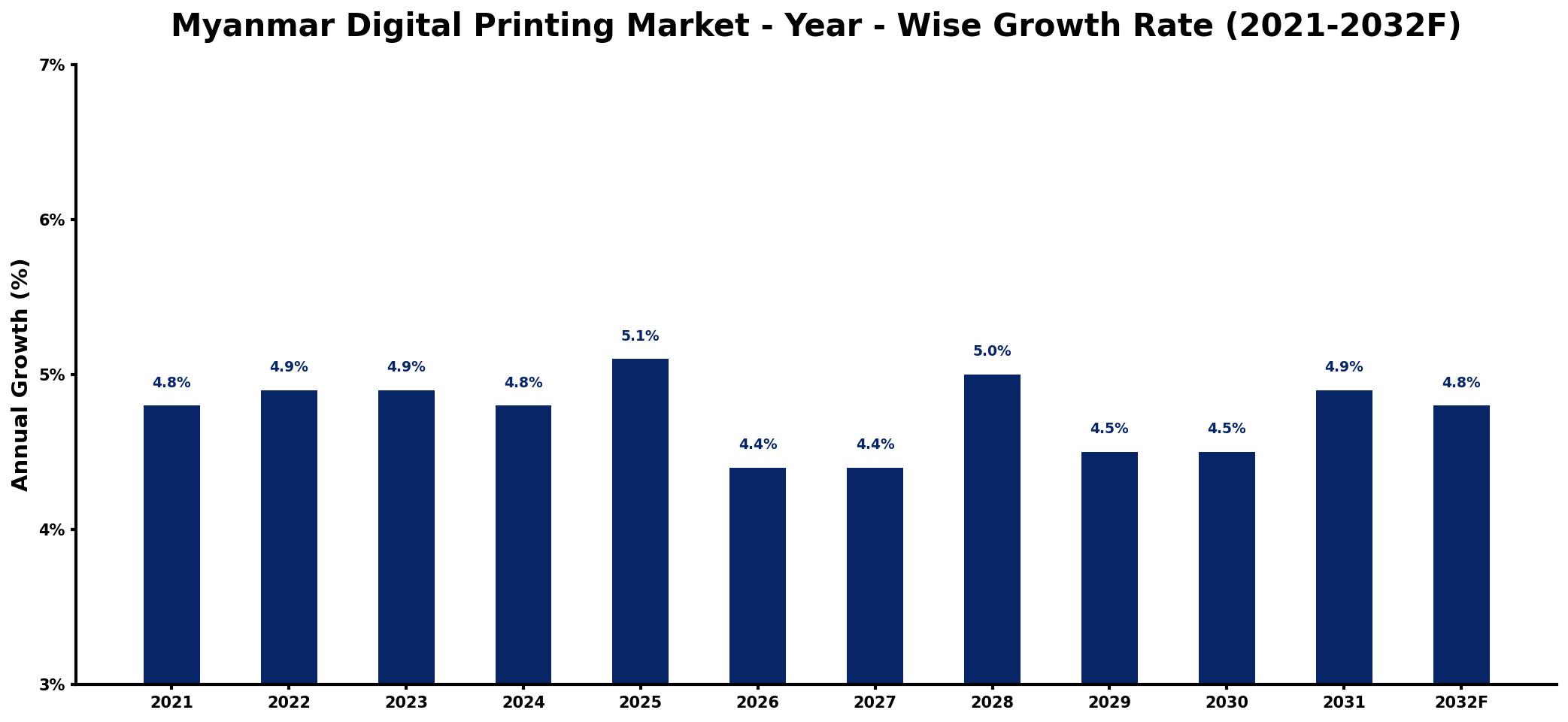
The table below presents the year‑wise growth rates along with the key drivers influencing the market
| Year | Growth Rate | Major Drivers |
| 2021 | 4.8% | Increase in advertising expenditures |
| 2022 | 4.9% | Growth in packaging requirements |
| 2023 | 4.9% | Rising e-commerce market demand |
| 2024 | 4.8% | Expansion of retail sector presence |
| 2025 | 5.1% | Surge in promotional activities |
| 2026 | 4.4% | Diversification in consumer preferences |
| 2027 | 4.4% | Increased investments in technology |
| 2028 | 5.0% | increased production capacity utilization |
| 2029 | 4.5% | rising export shipment volumes |
| 2030 | 4.5% | Rising demand for customization |
| 2031 | 4.9% | expanding industrial usage applications |
| 2032 | 4.8% | growing regional consumption patterns |
Note: Market size estimations and growth projections presented in this report are based on 6Wresearch's proprietary forecasting methodology, utilizing the latest available industry data, government publications, and primary research inputs.
Myanmar Digital Printing Market Synopsis
In recent years, the Myanmar digital printing market has gained momentum, propelled by rapid advancements in technology and rising consumer expectations for personalized products. Looking ahead, the market is set to evolve, with increasing emphasis on eco-friendly practices and innovative applications in textiles and signage.
As businesses seek to differentiate themselves and appeal to a broader audience, the adoption of state-of-the-art digital printing technologies is likely to rise. This transition is indicative of a broader trend in Myanmar's economic landscape, as sectors increasingly embrace digital solutions to enhance operational efficiency.
Myanmar Digital Printing Market Key Takeaways
- The market is expanding due to increased demand for high-quality, customized printing services.
- Technological advancements are driving the adoption of digital printing solutions across various sectors.
- There is a notable shift towards sustainable printing practices and eco-friendly materials.
- Government initiatives are supporting the growth of the digital printing sector through incentives and regulations.
- Investment in digital printing technology presents significant opportunities for both local and foreign businesses.
Evaluation of Restraints in Myanmar Digital Printing Market
Despite the promising growth potential, the Myanmar digital printing market faces several restraints that could impede its progress. Limited awareness and understanding of digital printing technologies among businesses lead to a slow adoption rate. Additionally, the market is challenged by high initial investment costs for advanced digital equipment and a shortage of skilled professionals, which restricts operational capacity. Furthermore, persistent infrastructure issues, including inconsistent electricity supply and inadequate internet connectivity, present significant hurdles that need to be addressed for sustainable growth.
Myanmar Digital Printing Market Trends
Several trends are currently shaping the Myanmar digital printing market. Firstly, the adoption of UV and eco-solvent printing technologies is increasing, particularly for wide-format applications. This shift not only enhances print quality but also aligns with growing consumer preferences for sustainability. Secondly, digital textile printing is gaining traction in the garment industry, as manufacturers look for more efficient ways to produce customized designs. Additionally, automation and workflow optimization are becoming crucial as businesses seek to enhance efficiency and reduce costs in an increasingly competitive landscape.
Myanmar Digital Printing Market Opportunities
The Myanmar digital printing market offers substantial investment opportunities driven by the nation's economic growth and evolving consumer demands. Industries such as advertising, packaging, and textiles are ripe for the introduction of advanced digital printing solutions, which can significantly improve branding and marketing efforts. As businesses increasingly prioritize quality and sustainability, those investing in cutting-edge technology and services are likely to see considerable returns. Furthermore, government policies aimed at fostering foreign investment and improving infrastructure further enhance the market's appeal for potential investors.
Government Initiatives in the Myanmar Digital Printing Market
The Myanmar government has implemented several initiatives to support the digital printing market's development. These include providing financial incentives for businesses investing in digital printing technologies and tax breaks for companies operating within the sector. Regulatory frameworks are also in place to ensure that quality standards are maintained and consumer protection is prioritized. Additionally, the government encourages research and innovation in digital printing through collaborations with educational institutions and funding programs aimed at promoting technological advancements.
Future Insights of the Myanmar Digital Printing Market
Looking forward to the period from 2026 to 2032, the Myanmar digital printing market appears set for continued growth. The increasing adoption of innovative digital printing technologies, coupled with rising demand for personalized and customized solutions, will likely drive market expansion. As industries further embrace digital transformation, the need for efficient, high-quality, and cost-effective printing services will intensify. Moreover, advancements in eco-friendly printing technologies will play a significant role in meeting the evolving expectations of both businesses and consumers.
Myanmar Digital Printing Market Latest Developments (2025 - 2026)
Recent developments in the Myanmar digital printing market indicate a shift towards enhanced technological capabilities. Businesses are increasingly adopting automated solutions to streamline operations and reduce production costs. There has also been a surge in demand for eco-friendly printing materials, as consumers become more environmentally conscious. As the government continues to support the sector through various initiatives, the market is expected to evolve rapidly, with a focus on innovation and sustainability.
Myanmar Digital Printing Market - Key Attractiveness of the Report
- 10 Years of Market Numbers
- Historical Data Starting from 2022 to 2025
- Base Year: 2025
- Forecast Data until 2032
- Key Performance Indicators Impacting the Market
- Major Upcoming Developments and Projects
Key Highlights of the Report:
- Myanmar DigitalPrinting Market Outlook
- Market Size of Myanmar DigitalPrinting Market, 2025
- Forecast of Myanmar DigitalPrinting Market, 2032
- Historical Data and Forecast of Myanmar DigitalPrinting Revenues & Volume for the Period 2022-2032F
- Myanmar DigitalPrinting Market Trend Evolution
- Myanmar DigitalPrinting Market Drivers and Challenges
- Myanmar DigitalPrinting Price Trends
- Myanmar DigitalPrinting Porter's Five Forces
- Myanmar DigitalPrinting Industry Life Cycle
- Historical Data and Forecast of Myanmar DigitalPrinting Market Revenues & Volume By Printing Process for the Period 2022-2032F
- Historical Data and Forecast of Myanmar DigitalPrinting Market Revenues & Volume By Electrophotography for the Period 2022-2032F
- Historical Data and Forecast of Myanmar DigitalPrinting Market Revenues & Volume By Inkjet for the Period 2022-2032F
- Historical Data and Forecast of Myanmar DigitalPrinting Market Revenues & Volume By Application for the Period 2022-2032F
- Historical Data and Forecast of Myanmar DigitalPrinting Market Revenues & Volume By Books for the Period 2022-2032F
- Historical Data and Forecast of Myanmar DigitalPrinting Market Revenues & Volume By Commercial Printing for the Period 2022-2032F
- Historical Data and Forecast of Myanmar DigitalPrinting Market Revenues & Volume By Packaging for the Period 2022-2032F
- Historical Data and Forecast of Myanmar DigitalPrinting Market Revenues & Volume By Labels for the Period 2022-2032F
- Historical Data and Forecast of Myanmar DigitalPrinting Market Revenues & Volume By Corrugated Packaging for the Period 2022-2032F
- Historical Data and Forecast of Myanmar DigitalPrinting Market Revenues & Volume By Cartons for the Period 2022-2032F
- Historical Data and Forecast of Myanmar DigitalPrinting Market Revenues & Volume By Flexible Packaging for the Period 2022-2032F
- Historical Data and Forecast of Myanmar DigitalPrinting Market Revenues & Volume By Rigid Plastic Packaging for the Period 2022-2032F
- Historical Data and Forecast of Myanmar DigitalPrinting Market Revenues & Volume By Metal Packaging for the Period 2022-2032F
- Myanmar DigitalPrinting Import Export Trade Statistics
- Market Opportunity Assessment By Printing Process
- Market Opportunity Assessment By Application
- Market Opportunity Assessment By Packaging
- Myanmar DigitalPrinting Top Companies Market Share
- Myanmar DigitalPrinting Competitive Benchmarking By Technical and Operational Parameters
- Myanmar DigitalPrinting Company Profiles
- Myanmar DigitalPrinting Key Strategic Recommendations






































