Myanmar Dimension Stone Market Size, Share & Growth Rate
The Myanmar Dimension Stone Market was estimated at USD 1490 Million in 2025 and is projected to reach USD 2157 Million by 2032, growing at a CAGR of 5.4% from 2026 to 2032. This positive trajectory is largely fueled by heightened infrastructure initiatives, as Myanmar undergoes a significant urban transformation. As demand for premium construction materials rises, particularly for exquisite marble and durable granite, local producers are ramping up efforts to enhance quality and design offerings, further propelling market growth.
Myanmar Dimension Stone Market Year-wise Growth Rate and Key Drivers
This graph highlights how the Myanmar Dimension Stone Market has steadily grown over the years, supported by major growth factors.
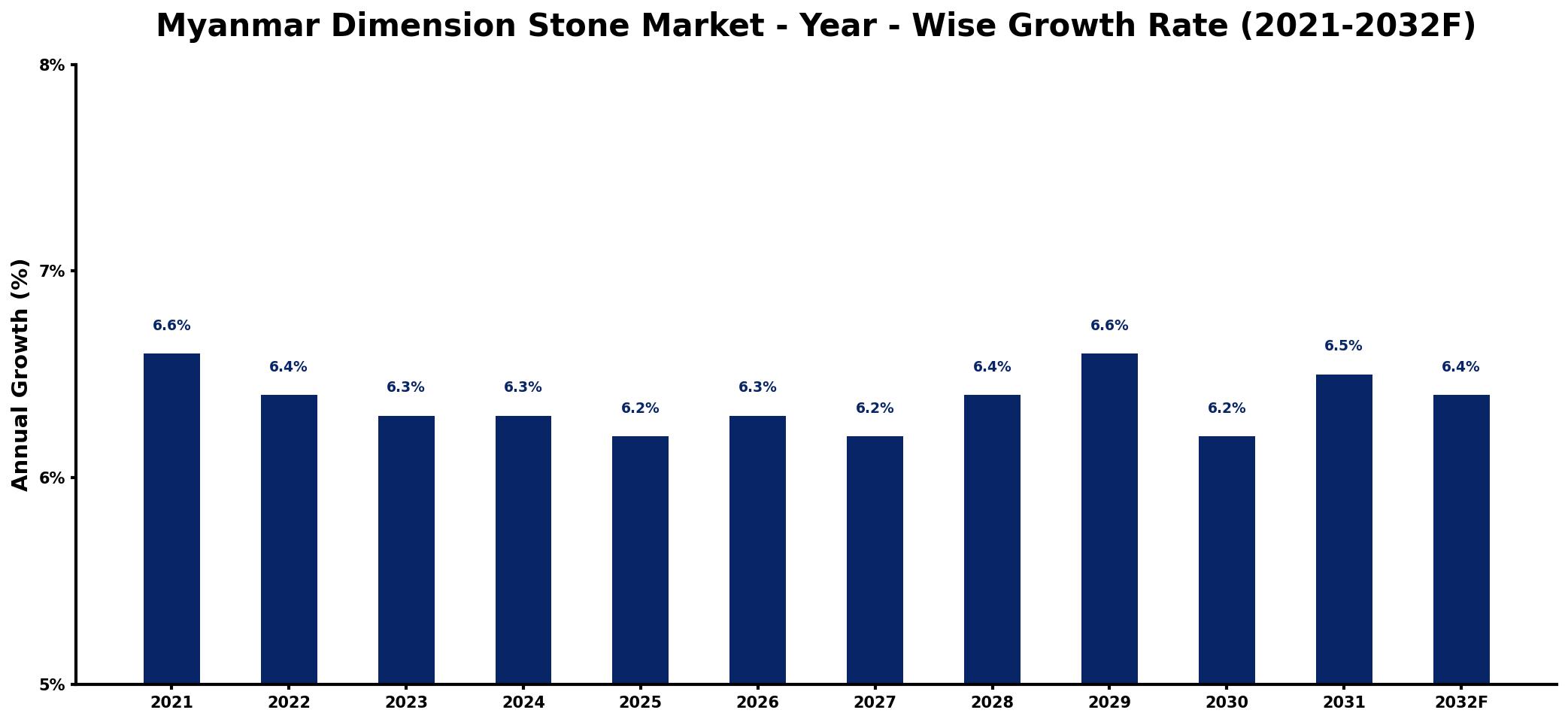
The table below presents the year‑wise growth rates along with the key drivers influencing the market
| Year | Growth Rate | Major Drivers |
| 2021 | 6.6% | Infrastructure projects drive demand |
| 2022 | 6.4% | Construction sector expands rapidly |
| 2023 | 6.3% | Rising urbanization increases needs |
| 2024 | 6.3% | Tourism development enhances requirements |
| 2025 | 6.2% | Government investments boost construction |
| 2026 | 6.3% | Real estate market shows growth |
| 2027 | 6.2% | Export opportunities attract investments |
| 2028 | 6.4% | Sustainable building practices gain traction |
| 2029 | 6.6% | Technological advancements improve efficiency |
| 2030 | 6.2% | Increased local production capabilities |
| 2031 | 6.5% | Rising consumer preferences for quality |
| 2032 | 6.4% | Collaborations enhance market access |
Note: Market size estimations and growth projections presented in this report are based on 6Wresearch's proprietary forecasting methodology, utilizing the latest available industry data, government publications, and primary research inputs.
Myanmar Dimension Stone Market Synopsis
In recent years, the Myanmar Dimension Stone Market has gained momentum, largely driven by an upsurge in construction activities across various sectors. Local quarries are increasingly focusing on improving their extraction and processing methods to elevate product quality and meet global standards.
The market showcases a diverse selection of dimension stones including marble, granite, limestone, and sandstone, with a noticeable preference for marble due to its superior aesthetic qualities. Furthermore, local producers are exploring unique colors and patterns to cater to the evolving tastes of consumers, indicating a burgeoning creativity in the market.
Myanmar Dimension Stone Market Key Takeaways
- Steady growth driven by infrastructure development and rising demand for quality construction materials.
- Marble remains the most in-demand dimension stone, prized for its aesthetic appeal and durability.
- Local producers are enhancing extraction techniques to align with international quality standards.
- Emerging trends emphasize sustainability and ethical sourcing, influencing consumer preferences.
- Government policies aim to create a conducive environment for sustainable growth in the sector.
Evaluation of Restraints in Myanmar Dimension Stone Market
Despite the promising outlook, the Myanmar Dimension Stone Market is restrained by several significant factors. The limited access to advanced technology and modern machinery hampers efficient extraction and processing, ultimately affecting product competitiveness. Regulatory inconsistencies further complicate the landscape, as operators face uncertainty in securing essential permits and compliance. Additionally, poor transportation infrastructure and energy supply limitations challenge the distribution and export of dimension stone products, creating bottlenecks for growth.
Myanmar Dimension Stone Market Trends
The market is witnessing several key trends that are shaping its future. Notably, the increasing preference for high-quality marble and granite in residential and commercial applications underscores a shift towards more refined interior designs. Moreover, there is a growing inclination towards sustainability, with consumers actively seeking ethically sourced and certified stone products. This is driving local producers to adopt sustainable practices while simultaneously expanding their product offerings to include distinctive colors and patterns that cater to market demand.
Myanmar Dimension Stone Market Opportunities
With Myanmars vast natural stone reserves, there exists an array of promising investment opportunities within the dimension stone sector. The rising demand for premium construction materials, both locally and internationally, offers a lucrative avenue for investors to engage in mining, quarrying, and processing operations. Additionally, establishing robust distribution channels and marketing strategies will be crucial for tapping into the expanding market. As urbanization and industrialization continue to unfold, the sector stands poised for substantial growth.
Government Initiatives in the Myanmar Dimension Stone Market
The Myanmar government is actively promoting sustainable development within the dimension stone market, ensuring environmental protection while encouraging responsible mining practices. Policies from the Ministry of Natural Resources and Environmental Conservation focus on licensing and regulation to enhance industry transparency. The government also offers incentives for technology upgrades and infrastructure improvements, aiming to bolster the competitive edge of domestic producers and attract foreign investments.
Future Insights of the Myanmar Dimension Stone Market
Looking ahead to 2026-2032, the Myanmar Dimension Stone Market is expected to maintain its growth momentum, driven by sustained construction activities and an increasing appetite for high-quality materials. Continued efforts from the government to attract investments and streamline regulations will play a critical role in shaping the landscape. Additionally, as local producers innovate and align their offerings with international standards, Myanmar is well-positioned to establish itself as a significant player in the global dimension stone market.
Myanmar Dimension Stone Market Latest Developments (2025 - 2026)
Recently, the Myanmar Dimension Stone Market has observed a surge in collaborations between local quarries and international firms, aiming to enhance extraction techniques and product quality. Additionally, various initiatives to improve transportation infrastructure are being undertaken to facilitate the smoother distribution of dimension stone products. Emerging technological advancements in processing are also gaining traction, further influencing market dynamics and positioning local players competitively within the region.
Myanmar Dimension Stone Market - Key Attractiveness of the Report
- 10 Years of Market Numbers
- Historical Data Starting from 2022 to 2025
- Base Year: 2025
- Forecast Data until 2032
- Key Performance Indicators Impacting the Market
- Major Upcoming Developments and Projects
Key Highlights of the Report:
- Myanmar Dimension Stone Market Outlook
- Market Size of Myanmar Dimension Stone Market, 2025
- Forecast of Myanmar Dimension Stone Market, 2032
- Historical Data and Forecast of Myanmar Dimension Stone Revenues & Volume for the Period 2022-2032F
- Myanmar Dimension Stone Market Trend Evolution
- Myanmar Dimension Stone Market Drivers and Challenges
- Myanmar Dimension Stone Price Trends
- Myanmar Dimension Stone Porter's Five Forces
- Myanmar Dimension Stone Industry Life Cycle
- Historical Data and Forecast of Myanmar Dimension Stone Market Revenues & Volume By Type for the Period 2022-2032F
- Historical Data and Forecast of Myanmar Dimension Stone Market Revenues & Volume By Granite for the Period 2022-2032F
- Historical Data and Forecast of Myanmar Dimension Stone Market Revenues & Volume By Limestone for the Period 2022-2032F
- Historical Data and Forecast of Myanmar Dimension Stone Market Revenues & Volume By Marble for the Period 2022-2032F
- Historical Data and Forecast of Myanmar Dimension Stone Market Revenues & Volume By Travertine for the Period 2022-2032F
- Historical Data and Forecast of Myanmar Dimension Stone Market Revenues & Volume By Other varieties for the Period 2022-2032F
- Historical Data and Forecast of Myanmar Dimension Stone Market Revenues & Volume By Application for the Period 2022-2032F
- Historical Data and Forecast of Myanmar Dimension Stone Market Revenues & Volume By Structural use for the Period 2022-2032F
- Historical Data and Forecast of Myanmar Dimension Stone Market Revenues & Volume By Decorative uses for the Period 2022-2032F
- Myanmar Dimension Stone Import Export Trade Statistics
- Market Opportunity Assessment By Type
- Market Opportunity Assessment By Application
- Myanmar Dimension Stone Top Companies Market Share
- Myanmar Dimension Stone Competitive Benchmarking By Technical and Operational Parameters
- Myanmar Dimension Stone Company Profiles
- Myanmar Dimension Stone Key Strategic Recommendations






































