Myanmar Disposable Razor Blades Market Size, Share & Growth Rate
The Myanmar Disposable Razor Blades Market was estimated at USD 376 Million in 2025 and is projected to reach USD 507 Million by 2032, growing at a CAGR of 4.4% from 2026 to 2032. This growth trajectory is primarily driven by increasing urbanization, which is spurring a shift towards modern personal grooming solutions, as well as rising disposable incomes among the population. With more consumers prioritizing convenience and hygiene, the demand for innovative disposable razor blades is anticipated to rise significantly.
Myanmar Disposable Razor Blades Market Year-wise Growth Rate and Key Drivers
This graph highlights how the Myanmar Disposable Razor Blades Market has steadily grown over the years, supported by major growth factors.
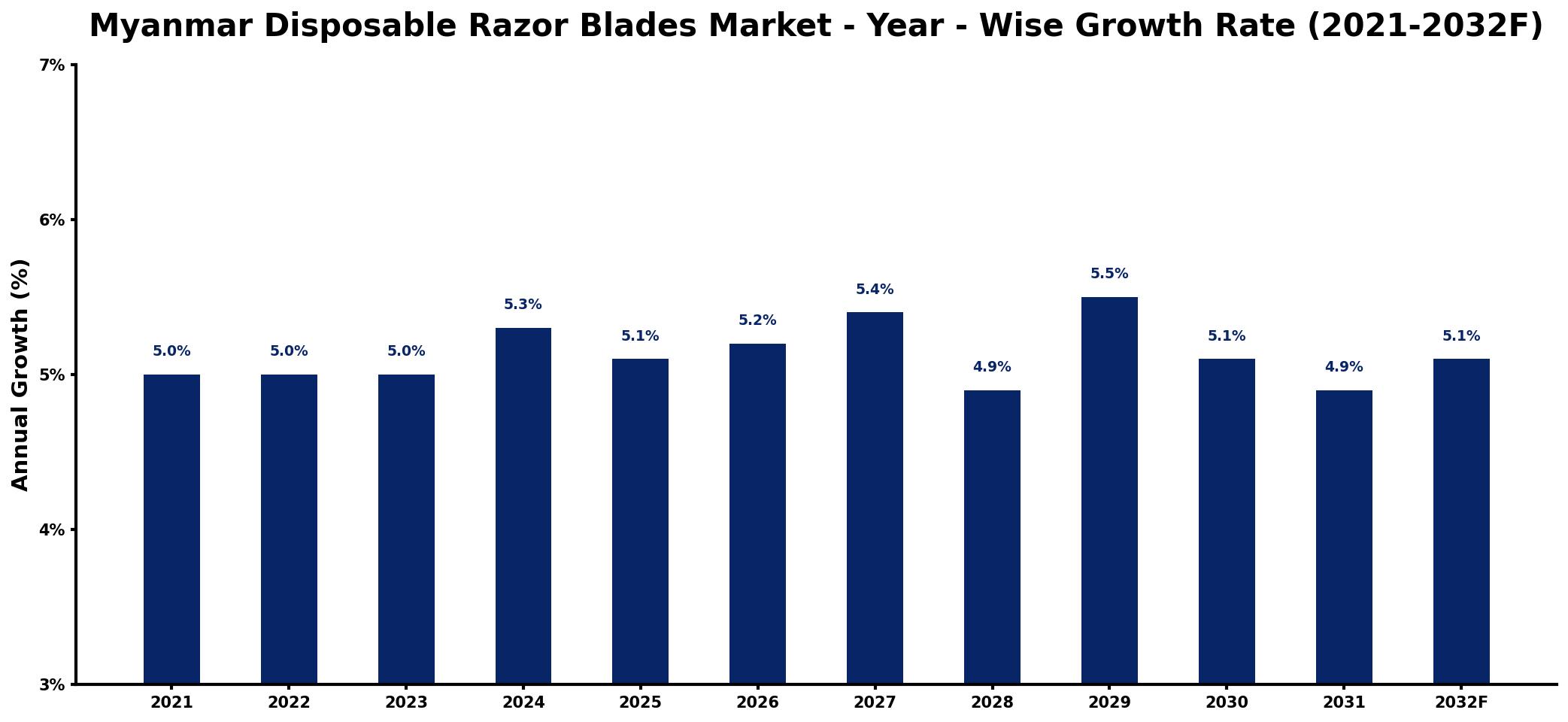
The table below presents the year‑wise growth rates along with the key drivers influencing the market
| Year | Growth Rate | Major Drivers |
| 2021 | 5.0% | Rising urban population growth |
| 2022 | 5.0% | Increased consumer spending power |
| 2023 | 5.0% | Expansion of retail outlets |
| 2024 | 5.3% | Growing awareness of hygiene |
| 2025 | 5.1% | Surge in online shopping preferences |
| 2026 | 5.2% | Investment in local manufacturing capacity |
| 2027 | 5.4% | Enhanced distribution network efficiency |
| 2028 | 4.9% | Shift towards personal grooming products |
| 2029 | 5.5% | Emerging trends in male grooming |
| 2030 | 5.1% | Growing demand for convenience products |
| 2031 | 4.9% | Increased focus on eco-friendly options |
| 2032 | 5.1% | increased capital investment inflows |
Note: Market size estimations and growth projections presented in this report are based on 6Wresearch's proprietary forecasting methodology, utilizing the latest available industry data, government publications, and primary research inputs.
Myanmar Disposable Razor Blades Market Synopsis
The Myanmar Disposable Razor Blades market has shown recent momentum, largely fueled by a cultural shift towards personal grooming and greater awareness of hygiene standards. As urbanization intensifies, consumers are increasingly adopting disposable razor options for their practicality and efficiency.
Looking ahead, the market is poised for transformative growth, particularly as local brands rise to challenge established international players. Innovations in product design, including multi-blade razors and eco-friendly materials, are expected to shape the competitive landscape, appealing to a young demographic keen on personal care.
Myanmar Disposable Razor Blades Market Key Takeaways
- Steady growth driven by urbanization and rising disposable incomes.
- Strong demand for innovative features like lubricating strips and ergonomic handles.
- Local brands are capturing market share with affordable, quality alternatives.
- Growing preference for eco-friendly razors reflects changing consumer attitudes.
- E-commerce is increasingly important for market reach and distribution efficiency.
Evaluation of Restraints in Myanmar Disposable Razor Blades Market
Despite the upward trajectory, the Myanmar Disposable Razor Blades market grapples with certain restraints. Traditional shaving methods, such as straight and safety razors, remain prevalent, leading to a slower adoption of disposable alternatives. Additionally, the market is highly competitive, resulting in price wars that can pressure margins for both local and international brands. Distribution channels often lack efficiency, further complicating access to consumers. External economic factors, including currency fluctuations and political instability, also pose risks to market growth, influencing consumer purchasing behavior.
Myanmar Disposable Razor Blades Market Trends
Current trends in the Myanmar Disposable Razor Blades market highlight a rising consumer demand for eco-friendly products. Shoppers are increasingly interested in razors made from biodegradable materials, reflecting a broader global trend towards sustainability. Additionally, the popularity of multi-blade razors continues to grow, as they are perceived to offer superior shaving experiences. Manufacturers are responding to this trend by integrating innovative features like precision trimmers and advanced lubricating strips, which enhance comfort and effectiveness.
Myanmar Disposable Razor Blades Market Opportunities
The Myanmar Disposable Razor Blades market presents ample investment opportunities driven by a youthful population eager for modern grooming products. As urbanization progresses, the demand for convenient and affordable shaving solutions is set to surge. Moreover, the market's relatively untapped nature provides a unique opening for new entrants looking to establish a foothold. Companies focusing on targeted marketing and product differentiation can effectively capitalize on the burgeoning consumer interest in grooming solutions.
Government Initiatives in the Myanmar Disposable Razor Blades Market
Government policies affecting the Myanmar Disposable Razor Blades market include regulations surrounding trade, quality standards, and taxation. The government actively regulates the import and export of razor blades, ensuring fair competition among both domestic and international manufacturers. Quality standards are set to protect consumer interests, reinforcing product safety and efficacy. Taxation policies also play a crucial role, impacting pricing and profitability, thereby influencing the overall dynamics of the market.
Future Insights of the Myanmar Disposable Razor Blades Market
Looking forward to the period from 2026 to 2032, the future of the Myanmar Disposable Razor Blades market appears bright. Factors such as increasing disposable incomes and heightened awareness of personal grooming are likely to continue propelling market demand. The entrance of international brands, coupled with aggressive marketing and product innovation, is expected to enhance competition and consumer choices. However, the market must navigate the complexities of traditional shaving methods and counterfeit products, which may hinder smoother expansion.
Myanmar Disposable Razor Blades Market Latest Developments (2025 - 2026)
Recent developments in the Myanmar Disposable Razor Blades market indicate a notable shift towards product innovation and sustainability. Industry players are increasingly investing in research and development to create eco-friendly razors, responding to growing consumer concerns about environmental impact. Additionally, strategic partnerships and collaborations are becoming more common as companies seek to enhance their market presence and distribution capabilities. This evolving landscape suggests a dynamic future for the market, with continued focus on consumer preferences and emerging trends.
Myanmar Disposable Razor Blades Market - Key Attractiveness of the Report
- 10 Years of Market Numbers
- Historical Data Starting from 2022 to 2025
- Base Year: 2025
- Forecast Data until 2032
- Key Performance Indicators Impacting the Market
- Major Upcoming Developments and Projects
Key Highlights of the Report:
- Myanmar Disposable Razor Blades Market Outlook
- Market Size of Myanmar Disposable Razor Blades Market, 2025
- Forecast of Myanmar Disposable Razor Blades Market, 2032
- Historical Data and Forecast of Myanmar Disposable Razor Blades Revenues & Volume for the Period 2022-2032F
- Myanmar Disposable Razor Blades Market Trend Evolution
- Myanmar Disposable Razor Blades Market Drivers and Challenges
- Myanmar Disposable Razor Blades Price Trends
- Myanmar Disposable Razor Blades Porter's Five Forces
- Myanmar Disposable Razor Blades Industry Life Cycle
- Historical Data and Forecast of Myanmar Disposable Razor Blades Market Revenues & Volume By Blade Count for the Period 2022-2032F
- Historical Data and Forecast of Myanmar Disposable Razor Blades Market Revenues & Volume By 1 & 2 Blades for the Period 2022-2032F
- Historical Data and Forecast of Myanmar Disposable Razor Blades Market Revenues & Volume By 3 & 4 Blades for the Period 2022-2032F
- Historical Data and Forecast of Myanmar Disposable Razor Blades Market Revenues & Volume By 5 & More Blades for the Period 2022-2032F
- Historical Data and Forecast of Myanmar Disposable Razor Blades Market Revenues & Volume By End-user for the Period 2022-2032F
- Historical Data and Forecast of Myanmar Disposable Razor Blades Market Revenues & Volume By Men for the Period 2022-2032F
- Historical Data and Forecast of Myanmar Disposable Razor Blades Market Revenues & Volume By Women for the Period 2022-2032F
- Historical Data and Forecast of Myanmar Disposable Razor Blades Market Revenues & Volume By Distribution Channel for the Period 2022-2032F
- Historical Data and Forecast of Myanmar Disposable Razor Blades Market Revenues & Volume By Hypermarkets/Supermarkets for the Period 2022-2032F
- Historical Data and Forecast of Myanmar Disposable Razor Blades Market Revenues & Volume By Pharmacies for the Period 2022-2032F
- Historical Data and Forecast of Myanmar Disposable Razor Blades Market Revenues & Volume By Online for the Period 2022-2032F
- Historical Data and Forecast of Myanmar Disposable Razor Blades Market Revenues & Volume By Others for the Period 2022-2032F
- Myanmar Disposable Razor Blades Import Export Trade Statistics
- Market Opportunity Assessment By Blade Count
- Market Opportunity Assessment By End-user
- Market Opportunity Assessment By Distribution Channel
- Myanmar Disposable Razor Blades Top Companies Market Share
- Myanmar Disposable Razor Blades Competitive Benchmarking By Technical and Operational Parameters
- Myanmar Disposable Razor Blades Company Profiles
- Myanmar Disposable Razor Blades Key Strategic Recommendations






































