Myanmar Dog and Cat Food Market Summary
The myanmar dog and cat food market was estimated at USD 263 Million in 2025 and is projected to reach USD 343 Million by 2032, growing at a CAGR of 4.8% from 2026 to 2032.
Myanmar Dog and Cat Food Market Year-wise Growth Rate and Key Drivers
This graph highlights how the Myanmar Dog and Cat Food Market has steadily grown over the past five years, supported by major growth factors.
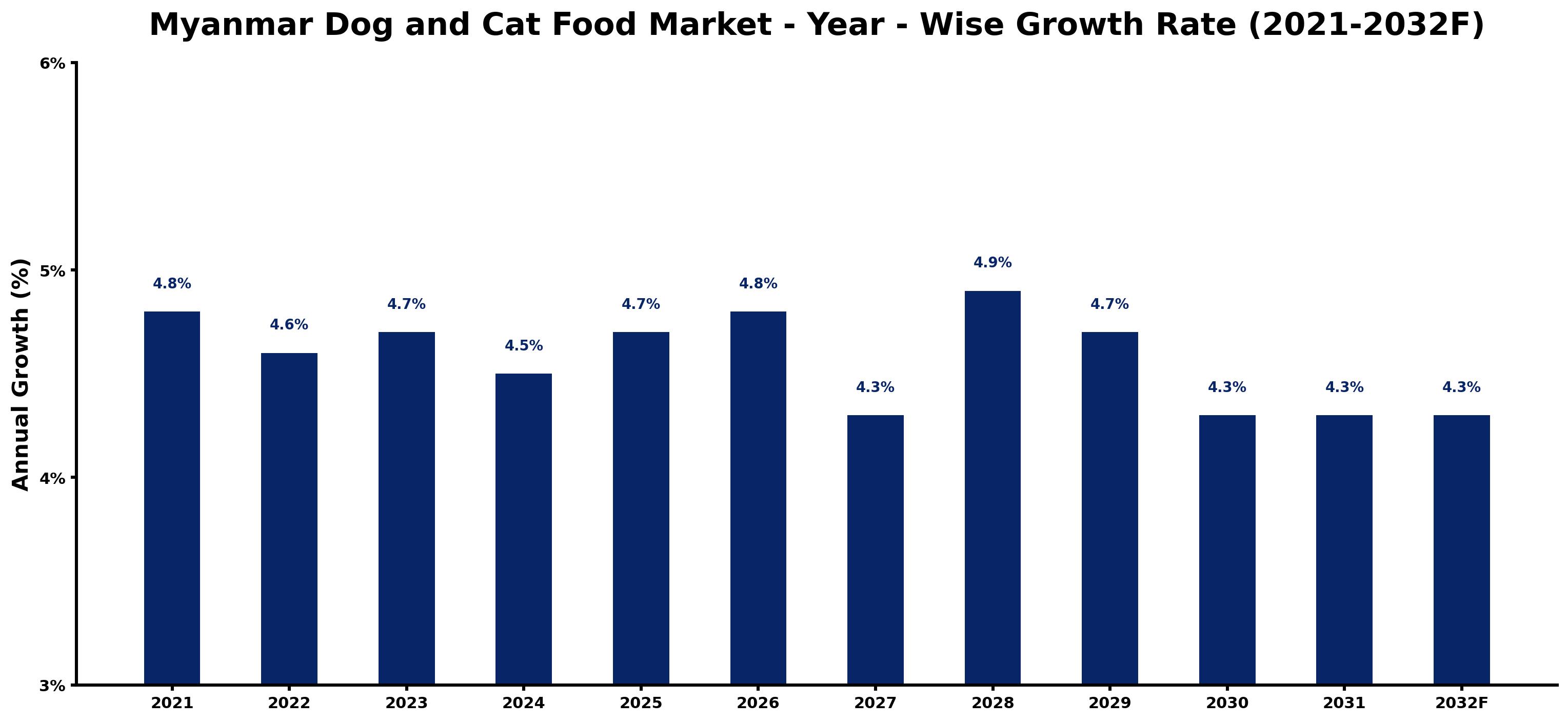
The table below presents the year wise growth rates along with the key drivers influencing the market
| Year | Growth Rate | Major Drivers |
| 2021 | 4.8% | Pandemic disruptions led to increased pet ownership and care across households. |
| 2022 | 4.6% | Emerging middle-class consumers prioritized premium pet food quality and nutrition. |
| 2023 | 4.7% | Urbanization trends prompted demand for convenient, packaged pet food solutions. |
| 2024 | 4.5% | Rising disposable incomes allowed families to invest in pet health and wellness. |
| 2025 | 4.7% | The proliferation of e-commerce facilitated easier access to diverse pet products. |
| 2026 | 4.8% | Local manufacturers began offering tailored food options for regional pet populations. |
| 2027 | 4.3% | Increased awareness around animal health drove demand for specialized pet diets. |
| 2028 | 4.9% | Pet humanization trends encouraged consumers to seek organic and natural ingredients. |
| 2029 | 4.7% | Young urban professionals increasingly focused on high-quality nutrition for pets. |
| 2030 | 4.3% | Social media influencers shifted consumer preferences toward premium pet brands. |
| 2031 | 4.3% | Investment in veterinary services created opportunities for advanced pet food formulations. |
| 2032 | 4.3% | Sustainable packaging initiatives became essential for environmentally-conscious pet owners. |
Note - Market size estimations and growth projections presented in this report are based on 6Wresearch's advanced forecasting approach, validated with industry datasets as of June 2026.
Myanmar Dog and Cat Food Market Synopsis
The Myanmar Dog and Cat Food Market is projected to reach 4.8% and witness significant growth during the forecast period (2026-2032). This market serves a crucial role in providing nutritional products specifically designed for dogs and cats, addressing the needs of pet owners who prioritize the health and well-being of their animals. The evolving landscape of pet ownership in Myanmar, along with increasing awareness regarding pet nutrition, forms the backbone of this market's expansion.
Myanmar Dog and Cat Food Market Growth Drivers
Driving factors behind the growth of the Myanmar Dog and Cat Food Market include a notable rise in pet ownership and an increasing focus on pet health and nutrition among consumers. Urbanization has played a pivotal role in this transformation, as more households move towards city living, leading to lifestyle changes that enhance the demand for pet care products.
- The surge in disposable incomes allows pet owners to invest in premium and specialized pet food formulations, tailored to meet specific dietary needs and preferences.
- With urban living, there is a growing acceptance of pets as family members, prompting owners to prioritize the nutritional quality of the food provided to their animals.
- Health trends among pet owners are catalyzing the adoption of veterinarian-recommended and scientifically formulated pet foods, further boosting market demand.
- Online retail channels are increasingly becoming popular, facilitating easier access to a wider range of pet food products, including organic and high-protein options.
- The influence of social media and pet-related communities is raising awareness about proper pet nutrition, encouraging responsible feeding practices among consumers.
Myanmar Dog and Cat Food Market Challenges and Restraints
Despite the promising growth trajectory, the Myanmar Dog and Cat Food Market faces several challenges that could hinder its development. Challenges primarily focus on product safety, market competition, and the education of consumers regarding pet nutrition.
- Maintaining stringent quality control and adhering to nutritional standards remain significant obstacles for manufacturers and distributors in the pet food sector.
- Competition from imported brands, which often offer diverse product lines, poses a threat to local manufacturers who may struggle to match the quality or variety of offerings.
- The presence of counterfeit products in the market raises concerns about product authenticity, leading to potential mistrust among consumers regarding the safety of pet food.
- Addressing price sensitivity is crucial, particularly in rural regions where access to quality pet food may be limited and affordability a significant concern for pet owners.
- Education campaigns are imperative to inform pet owners about proper feeding practices and the importance of nutrition for the health and longevity of their pets.
Myanmar Dog and Cat Food Market Regional Analysis
The growth of the Myanmar Dog and Cat Food Market is not uniform across the country. Urban areas are leading this market's expansion, benefiting from better access to pet food retailers and veterinary services. In contrast, rural regions may experience slower growth due to limited access to specialized pet care products and information.
- In metropolitan areas, a growing expatriate community and affluent locals are driving the demand for premium pet food products.
- Rural markets, while seeing a rise in pet ownership, often face logistical challenges in product distribution and limited availability of high-quality pet food.
- As infrastructure improves in rural locations, opportunities for market expansion will increase, highlighting the potential for future growth in these underserved areas.
- The diversity of regional preferences in pet care products necessitates tailored marketing strategies that resonate with local cultural attitudes towards pets.
- Emerging trends toward organic and natural pet food options are more pronounced in urban settings, prompting a shift in product offerings by local manufacturers seeking to capture this market segment.
Myanmar Dog and Cat Food Market Government Investment and Initiatives
The government of Myanmar has recognized the significance of the dog and cat food market and has initiated various policies to enhance the safety and nutritional quality of pet food products. These regulatory measures include stringent standards for ingredient sourcing and manufacturing practices, designed to protect both animal health and consumer interests.
- Government policies promote responsible pet ownership by ensuring that available products meet essential quality and safety benchmarks.
- There are initiatives aimed at improving the overall awareness of pet nutrition through public information campaigns and collaborations with veterinary professionals.
- Government spending on animal health research encourages innovation in the dog and cat food sector, driving the development of nutritionally superior products.
- Policies to foster local production of pet food are in place, aimed at reducing dependency on imported goods and enhancing local economic growth.
- Investment in regulatory frameworks for labeling requirements helps consumers make informed choices, supporting the growth of a responsible pet food market.
Myanmar Dog and Cat Food Market Latest Developments (May 2025 - June 2026)
Recent developments within the Myanmar Dog and Cat Food Market indicate a progressive shift towards healthier pet food options and an influx of innovative product offerings. The sector has witnessed an uptick in the introduction of premium and specialized formulations, responding to evolving consumer demands.
- Increased collaboration between local manufacturers and international suppliers has facilitated the introduction of high-quality ingredients, enhancing product formulations.
- Market players are enhancing their distribution networks to ensure that premium dog and cat food options penetrate rural markets more effectively.
- Online sales channels have expanded significantly, with e-commerce platforms becoming key avenues for pet food purchases, particularly among urban consumers.
- Awareness campaigns by NGOs and government bodies have started focusing on the importance of pet nutrition, contributing to a more informed consumer base.
- Innovative marketing strategies that leverage social media and influencer partnerships are becoming prevalent, helping brands connect more authentically with pet owners.
Myanmar Dog and Cat Food Market - Key Attractiveness of the Report
- 10 Years of Market Numbers
- Historical Data Starting from 2022 to 2025
- Base Year: 2025
- Forecast Data until 2032
- Key Performance Indicators Impacting the Market
- Major Upcoming Developments and Projects
Key Highlights of the Report:
- Myanmar Dog and Cat Food Market Outlook
- Market Size of Myanmar Dog and Cat Food Market, 2025
- Forecast of Myanmar Dog and Cat Food Market, 2032
- Historical Data and Forecast of Myanmar Dog and Cat Food Revenues & Volume for the Period 2022-2032F
- Myanmar Dog and Cat Food Market Trend Evolution
- Myanmar Dog and Cat Food Market Drivers and Challenges
- Myanmar Dog and Cat Food Price Trends
- Myanmar Dog and Cat Food Porter's Five Forces
- Myanmar Dog and Cat Food Industry Life Cycle
- Historical Data and Forecast of Myanmar Dog and Cat Food Market Revenues & Volume By Animal Type for the Period 2022-2032F
- Historical Data and Forecast of Myanmar Dog and Cat Food Market Revenues & Volume By Dog for the Period 2022-2032F
- Historical Data and Forecast of Myanmar Dog and Cat Food Market Revenues & Volume By Cat for the Period 2022-2032F
- Historical Data and Forecast of Myanmar Dog and Cat Food Market Revenues & Volume By Product Type for the Period 2022-2032F
- Historical Data and Forecast of Myanmar Dog and Cat Food Market Revenues & Volume By Dry Food for the Period 2022-2032F
- Historical Data and Forecast of Myanmar Dog and Cat Food Market Revenues & Volume By Wet/Canned Food for the Period 2022-2032F
- Historical Data and Forecast of Myanmar Dog and Cat Food Market Revenues & Volume By Nutritious Food for the Period 2022-2032F
- Historical Data and Forecast of Myanmar Dog and Cat Food Market Revenues & Volume By Snacks/Treats for the Period 2022-2032F
- Historical Data and Forecast of Myanmar Dog and Cat Food Market Revenues & Volume By Others for the Period 2022-2032F
- Historical Data and Forecast of Myanmar Dog and Cat Food Market Revenues & Volume By Distribution Channel for the Period 2022-2032F
- Historical Data and Forecast of Myanmar Dog and Cat Food Market Revenues & Volume By Specialized Pet Shops for the Period 2022-2032F
- Historical Data and Forecast of Myanmar Dog and Cat Food Market Revenues & Volume By Supermarkets/Hypermarkets for the Period 2022-2032F
- Historical Data and Forecast of Myanmar Dog and Cat Food Market Revenues & Volume By Online Channel for the Period 2022-2032F
- Historical Data and Forecast of Myanmar Dog and Cat Food Market Revenues & Volume By Other Channels for the Period 2022-2032F
- Myanmar Dog and Cat Food Import Export Trade Statistics
- Market Opportunity Assessment By Animal Type
- Market Opportunity Assessment By Product Type
- Market Opportunity Assessment By Distribution Channel
- Myanmar Dog and Cat Food Top Companies Market Share
- Myanmar Dog and Cat Food Competitive Benchmarking By Technical and Operational Parameters
- Myanmar Dog and Cat Food Company Profiles
- Myanmar Dog and Cat Food Key Strategic Recommendations






































