Myanmar Electric Hair Clipper & Trimmer Market Size, Share & Growth Rate
The Myanmar Electric Hair Clipper & Trimmer Market was estimated at USD 686 Million in 2025 and is projected to reach USD 1189 Million by 2032, growing at a CAGR of 8.2% from 2026 to 2032. This growth trajectory is driven by increasing disposable incomes, a shift towards personal grooming, and a rising interest in advanced grooming technology. Additionally, the growing trend of e-commerce is making these grooming tools more accessible to a broader audience.
Myanmar Electric Hair Clipper & Trimmer Market Year-wise Growth Rate and Key Drivers
This graph highlights how the Myanmar Electric Hair Clipper & Trimmer Market has steadily grown over the years, supported by major growth factors.
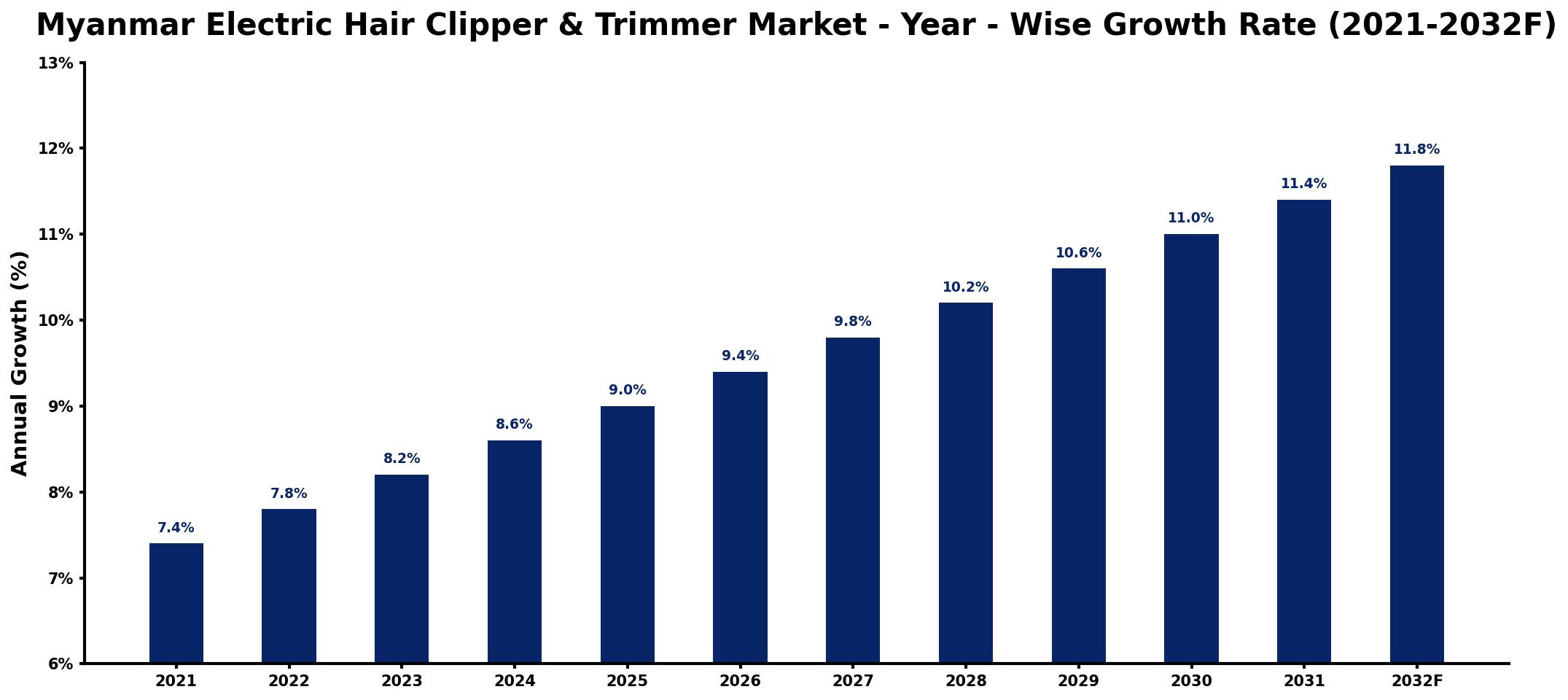
The table below presents the year‑wise growth rates along with the key drivers influencing the market
| Year | Growth Rate | Major Drivers |
| 2021 | 7.4% | Rising consumer grooming awareness |
| 2022 | 7.8% | Increased disposable income levels |
| 2023 | 8.2% | Expansion of retail distribution channels |
| 2024 | 8.6% | Growing popularity of personal care |
| 2025 | 9.0% | Surge in online shopping trends |
| 2026 | 9.4% | Investment in beauty industry innovations |
| 2027 | 9.8% | Increase in male grooming products |
| 2028 | 10.2% | Emergence of eco-friendly solutions |
| 2029 | 10.6% | Growth in home salon services |
| 2030 | 11.0% | Development of advanced technologies |
| 2031 | 11.4% | Rise in grooming subscription services |
| 2032 | 11.8% | Increased focus on personal hygiene |
Note: Market size estimations and growth projections presented in this report are based on 6Wresearch's proprietary forecasting methodology, utilizing the latest available industry data, government publications, and primary research inputs.
Myanmar Electric Hair Clipper & Trimmer Market Synopsis
The most influential factor currently shaping the Myanmar Electric Hair Clipper & Trimmer Market is the rising demand for personal grooming products. As more consumers embrace grooming trends, they are seeking high-quality, user-friendly devices that simplify their routines. This shift is particularly pronounced among the younger demographic, who prioritize convenience and technology in their grooming choices.
Moreover, established international brands dominate the market, yet local manufacturers are beginning to carve out their niche by offering affordable alternatives. This competitive landscape is fostering innovation, with an increasing focus on cordless and rechargeable models that appeal to consumers' desire for convenience and mobility.
- The market is characterized by a significant shift towards cordless and rechargeable grooming devices.
- Consumer education remains critical to overcoming traditional manual cutting methods and boosting market penetration.
- Product innovation, including advanced features and ergonomic designs, is essential for capturing consumer interest.
- The rise of e-commerce is transforming distribution channels, enhancing accessibility for consumers.
- Government policies are encouraging local manufacturing, creating a more favorable environment for market growth.
Despite the promising growth, the Myanmar Electric Hair Clipper & Trimmer Market faces several constraints that impede its advancement. A significant barrier is the general lack of consumer awareness surrounding electric grooming tools, which leads to slower adoption rates. Many potential customers remain tied to traditional manual methods, often due to cultural preferences. Additionally, the market contends with the proliferation of low-cost alternatives and counterfeit products, complicating the landscape for genuine brands. Lastly, unreliable distribution channels and insufficient after-sales service pose challenges in establishing trust with consumers and ensuring product satisfaction.
Several emerging trends are currently shaping the Myanmar Electric Hair Clipper & Trimmer Market. There is an increasing consumer preference for multi-functional grooming devices that combine various capabilities, enabling precise styling and cutting. Moreover, eco-conscious consumers are actively seeking sustainable and environmentally friendly products, aligning their grooming choices with broader global trends. As technology advances, manufacturers are introducing innovative features such as adjustable blade settings and longer battery life, which further enhance user experience and satisfaction.
The Myanmar Electric Hair Clipper & Trimmer Market presents significant opportunities for investment, particularly as the urban population continues to grow. With an expanding middle class increasingly interested in personal grooming, businesses can tap into this demand by offering innovative and affordable products tailored for local consumers. Collaborations with local distributors and retailers can further enhance market reach, while strategic marketing campaigns focused on education and awareness can effectively capture the interest of potential buyers. The ongoing transition towards e-commerce platforms also presents a lucrative avenue for investment, allowing brands to establish a stronger online presence.
The Myanmar government has introduced policies aimed at fostering the growth of the electric hair clipper and trimmer market. These initiatives include providing incentives for local manufacturing, reducing import tariffs on necessary components, and encouraging foreign investment in the sector. Furthermore, regulations have been established to ensure product safety and consumer protection, promoting a more competitive and sustainable market. Such government measures are designed to stimulate domestic production, create job opportunities, and enhance the availability of quality grooming products.
Looking ahead to 2026-2032, the Myanmar Electric Hair Clipper & Trimmer Market is poised for robust growth. Key drivers include the ongoing trends in personal grooming and self-care, as well as rising disposable incomes among consumers. The continued demand for innovative, user-friendly devices suggests a favorable environment for both established and new entrants in the market. However, vigilance will be required to navigate the competitive landscape shaped by traditional grooming methods and cost-sensitive consumer behavior. The integration of advanced technologies and features will be instrumental in capturing consumer interest and enhancing market position.
Recent developments in the Myanmar Electric Hair Clipper & Trimmer Market include an increased focus on the introduction of eco-friendly products and enhanced features that cater to the modern consumer's needs. Retailers are adapting to the shift towards e-commerce, investing in robust online platforms and marketing strategies. Additionally, partnerships between international brands and local distributors are becoming more common, aimed at improving accessibility and brand presence across diverse consumer segments. This collaborative approach is likely to strengthen market dynamics and facilitate growth over the coming years.
- 10 Years of Market Numbers
- Historical Data Starting from 2022 to 2025
- Base Year: 2025
- Forecast Data until 2032
- Key Performance Indicators Impacting the Market
- Major Upcoming Developments and Projects
Key Highlights of the Report:
- Myanmar Electric Hair Clipper & Trimmer Market Outlook
- Market Size of Myanmar Electric Hair Clipper & Trimmer Market, 2025
- Forecast of Myanmar Electric Hair Clipper & Trimmer Market, 2032
- Historical Data and Forecast of Myanmar Electric Hair Clipper & Trimmer Revenues & Volume for the Period 2022-2032F
- Myanmar Electric Hair Clipper & Trimmer Market Trend Evolution
- Myanmar Electric Hair Clipper & Trimmer Market Drivers and Challenges
- Myanmar Electric Hair Clipper & Trimmer Price Trends
- Myanmar Electric Hair Clipper & Trimmer Porter's Five Forces
- Myanmar Electric Hair Clipper & Trimmer Industry Life Cycle
- Historical Data and Forecast of Myanmar Electric Hair Clipper & Trimmer Market Revenues & Volume By Product for the Period 2022-2032F
- Historical Data and Forecast of Myanmar Electric Hair Clipper & Trimmer Market Revenues & Volume By Corded for the Period 2022-2032F
- Historical Data and Forecast of Myanmar Electric Hair Clipper & Trimmer Market Revenues & Volume By Cordless for the Period 2022-2032F
- Historical Data and Forecast of Myanmar Electric Hair Clipper & Trimmer Market Revenues & Volume By Distribution Channel for the Period 2022-2032F
- Historical Data and Forecast of Myanmar Electric Hair Clipper & Trimmer Market Revenues & Volume By Offline for the Period 2022-2032F
- Historical Data and Forecast of Myanmar Electric Hair Clipper & Trimmer Market Revenues & Volume By Online for the Period 2022-2032F
- Myanmar Electric Hair Clipper & Trimmer Import Export Trade Statistics
- Market Opportunity Assessment By Product
- Market Opportunity Assessment By Distribution Channel
- Myanmar Electric Hair Clipper & Trimmer Top Companies Market Share
- Myanmar Electric Hair Clipper & Trimmer Competitive Benchmarking By Technical and Operational Parameters
- Myanmar Electric Hair Clipper & Trimmer Company Profiles
- Myanmar Electric Hair Clipper & Trimmer Key Strategic Recommendations






































