Myanmar Electric shavers Market Size Growth Rate
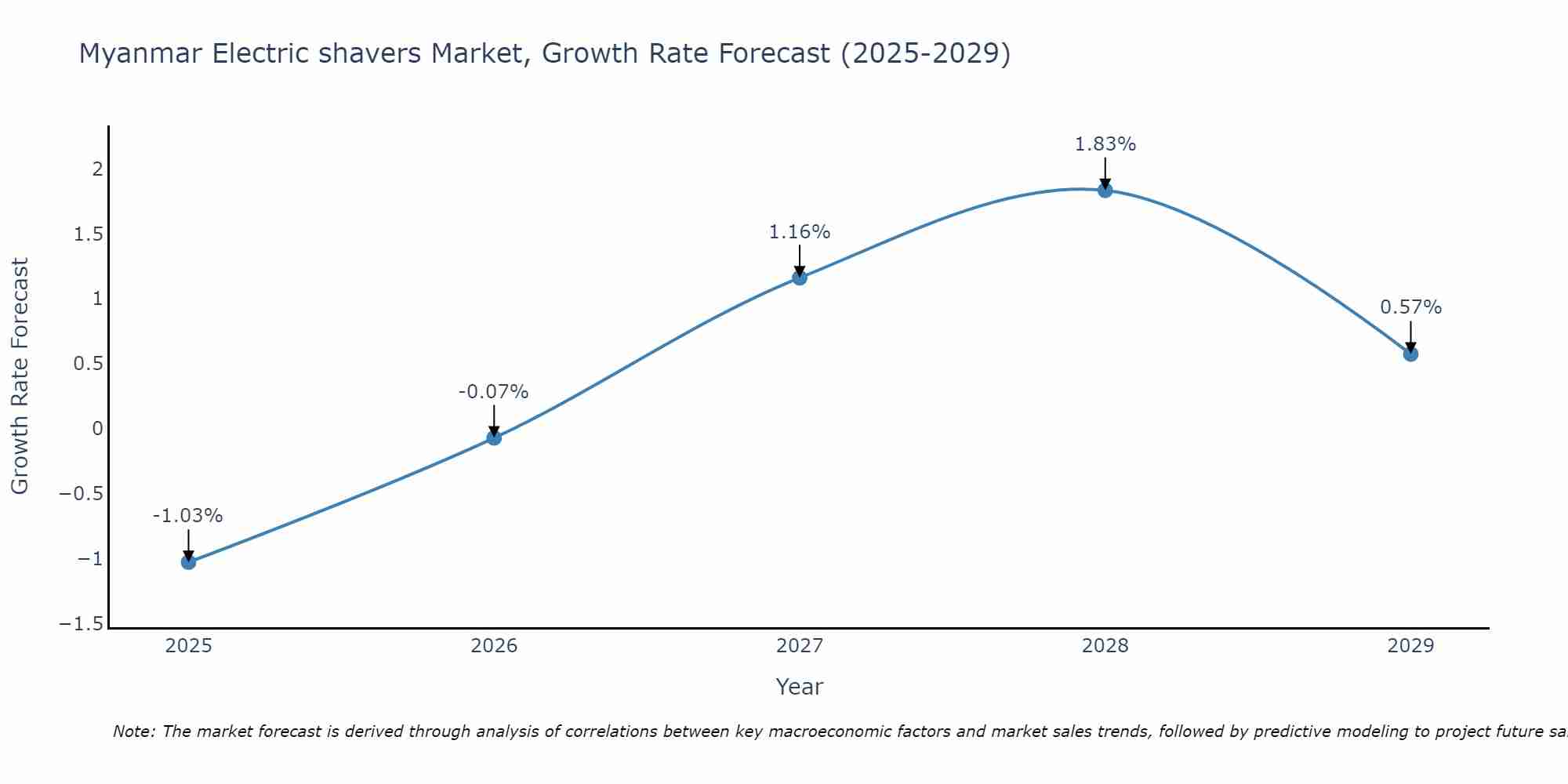
The Myanmar Electric shavers Market is projected to witness mixed growth rate patterns during 2025 to 2029. Growth accelerates to 1.83% in 2028, following an initial rate of -1.03%, before easing to 0.57% at the end of the period.
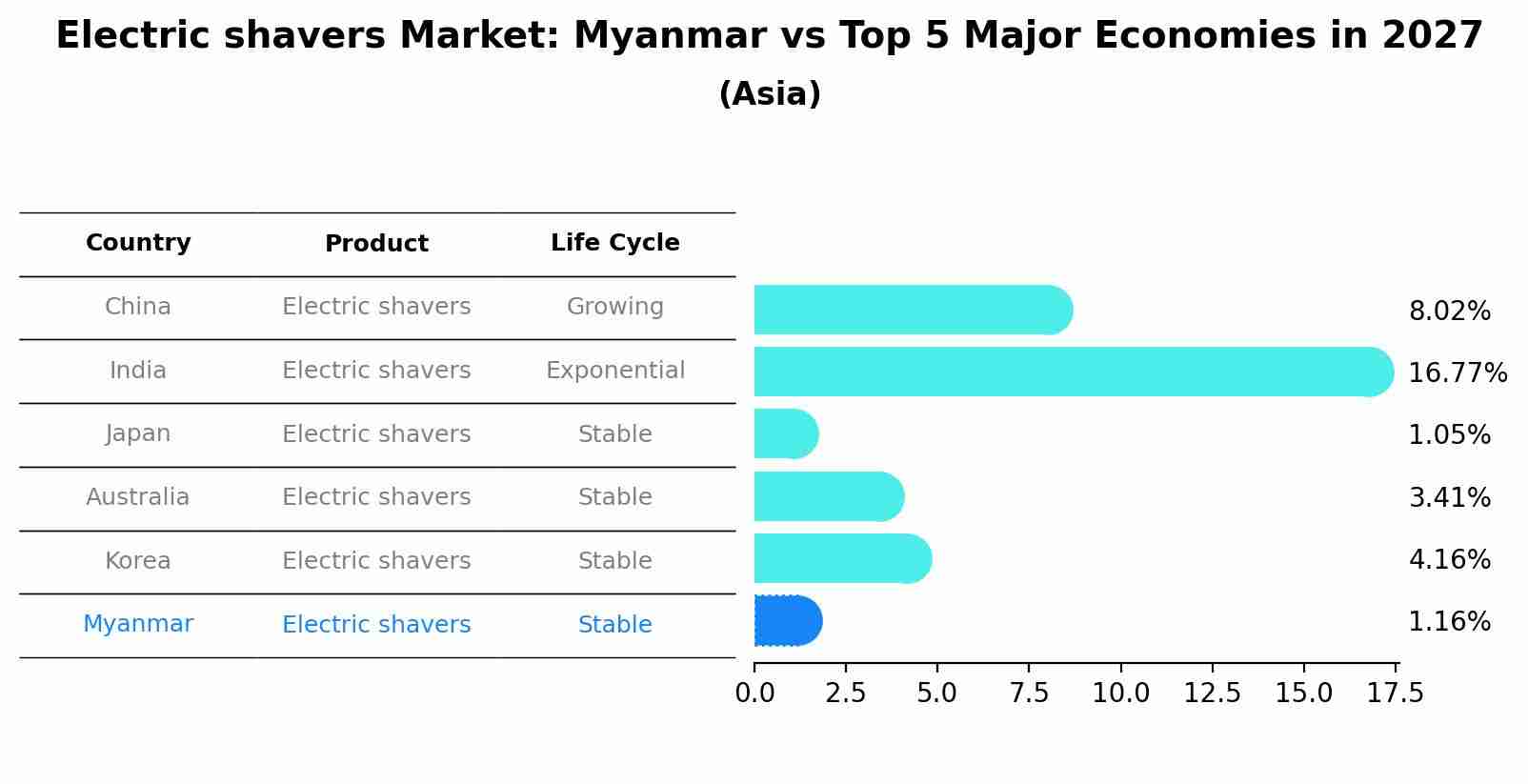
Electric shavers Market: Myanmar vs Top 5 Major Economies in 2027 (Asia)
By 2027, the Electric shavers market in Myanmar is anticipated to reach a growth rate of 1.16%, as part of an increasingly competitive Asia region, where China remains at the forefront, supported by India, Japan, Australia and South Korea, driving innovations and market adoption across sectors.
Myanmar Electric shavers Market Overview
The electric shavers market in Myanmar is experiencing steady growth driven by increasing awareness and adoption of grooming products among the urban population. Demand for electric shavers is rising due to their convenience, efficiency, and improved shaving experience compared to traditional razors. International brands like Philips, Panasonic, and Braun dominate the market with their advanced technologies and wide product range. Local players are also emerging, offering more affordable options to cater to a broader consumer base. The market is expected to further expand with the growing middle-class population, rising disposable income, and changing lifestyle preferences towards personal grooming products. Key factors influencing purchasing decisions include product features, price, brand reputation, and availability of after-sales services. E-commerce platforms are also playing a significant role in driving sales and providing consumers with easy access to a variety of electric shavers.
Myanmar Electric shavers Market Trends
The electric shavers market in Myanmar is currently witnessing a growing demand for advanced grooming products that offer convenience and efficiency. Consumers are increasingly seeking features such as cordless operation, quick charging, and precision trimming capabilities. There is a noticeable shift towards eco-friendly and sustainable options, with a preference for rechargeable shavers that reduce waste generated by disposable products. Moreover, the market is also seeing a rise in the popularity of multifunctional shavers that can cater to different grooming needs, such as beard trimming and body hair removal. Brands focusing on innovative technology, ergonomic designs, and affordability are likely to gain traction in the Myanmar electric shavers market as consumers prioritize quality and value for money.
Myanmar Electric shavers Market Challenges
In the Myanmar electric shavers market, there are several challenges that impact the industry`s growth. One major challenge is the relatively low level of consumer awareness and adoption of electric shavers compared to traditional manual razors. This lack of awareness means that companies need to invest significantly in marketing and education efforts to change consumer behavior and preferences. Additionally, the market may face infrastructure challenges, such as inconsistent electricity supply in certain regions, which could affect the usage of electric shavers. Furthermore, the presence of counterfeit products in the market poses a threat to legitimate brands, impacting consumer trust and brand reputation. Overall, overcoming these challenges will require strategic marketing initiatives, product innovation, and efforts to improve market regulations and enforcement to ensure fair competition and consumer protection.
Myanmar Electric shavers Market Investment Opportunities
The Myanmar electric shavers market presents promising investment opportunities due to the country`s increasing urbanization, rising disposable income, and growing awareness of personal grooming. As more consumers in Myanmar seek convenient and efficient grooming solutions, the demand for electric shavers is expected to rise. Investing in this market could be lucrative for companies looking to capitalize on the developing personal care sector in Myanmar. Opportunities exist not only in selling electric shavers but also in providing related accessories, maintenance services, and innovative product offerings tailored to the preferences of Myanmar consumers. By understanding the market trends, consumer preferences, and distribution channels in Myanmar, investors can strategically position themselves to benefit from the expanding electric shavers market in the country.
Myanmar Electric shavers Market Government Policy
The government of Myanmar has implemented policies to encourage the growth of the electric shavers market in the country. These policies include reducing import tariffs on electric shavers to make them more affordable for consumers and promote the adoption of personal grooming products. Additionally, the government has introduced regulations to ensure the safety and quality of electric shavers sold in the market, thereby protecting consumers from substandard products. Furthermore, initiatives to promote local manufacturing of electric shavers have been introduced to boost domestic production and create employment opportunities in the sector. Overall, these government policies aim to stimulate the growth of the electric shavers market in Myanmar through a combination of incentives, regulations, and support for domestic manufacturing.
Myanmar Electric shavers Market Future Outlook
The Myanmar electric shavers market is expected to see steady growth in the coming years due to increasing disposable income, urbanization, and changing consumer preferences towards grooming products. As the country continues to develop and modernize, there will be a growing demand for convenient and efficient grooming solutions, driving the adoption of electric shavers. Additionally, advancements in technology, such as the introduction of more innovative features and designs, are likely to further fuel market growth. However, challenges such as price sensitivity among consumers and competition from traditional manual razors may impact the market dynamics. Overall, with the rising awareness and emphasis on personal grooming, the Myanmar electric shavers market is poised for expansion in the foreseeable future.
Key Highlights of the Report:
- Myanmar Electric shavers Market Outlook
- Market Size of Myanmar Electric shavers Market, 2021
- Forecast of Myanmar Electric shavers Market, 2031
- Historical Data and Forecast of Myanmar Electric shavers Revenues & Volume for the Period 2021 - 2031
- Myanmar Electric shavers Market Trend Evolution
- Myanmar Electric shavers Market Drivers and Challenges
- Myanmar Electric shavers Price Trends
- Myanmar Electric shavers Porter's Five Forces
- Myanmar Electric shavers Industry Life Cycle
- Historical Data and Forecast of Myanmar Electric shavers Market Revenues & Volume By Product for the Period 2021 - 2031
- Historical Data and Forecast of Myanmar Electric shavers Market Revenues & Volume By Oil Shaver for the Period 2021 - 2031
- Historical Data and Forecast of Myanmar Electric shavers Market Revenues & Volume By Wet/Dry Shaver for the Period 2021 - 2031
- Historical Data and Forecast of Myanmar Electric shavers Market Revenues & Volume By Clippers for the Period 2021 - 2031
- Historical Data and Forecast of Myanmar Electric shavers Market Revenues & Volume By A Rotary Shaver for the Period 2021 - 2031
- Historical Data and Forecast of Myanmar Electric shavers Market Revenues & Volume By Accessories for the Period 2021 - 2031
- Historical Data and Forecast of Myanmar Electric shavers Market Revenues & Volume By End-user for the Period 2021 - 2031
- Historical Data and Forecast of Myanmar Electric shavers Market Revenues & Volume By Male for the Period 2021 - 2031
- Historical Data and Forecast of Myanmar Electric shavers Market Revenues & Volume By Female for the Period 2021 - 2031
- Historical Data and Forecast of Myanmar Electric shavers Market Revenues & Volume By Distribution Channel for the Period 2021 - 2031
- Historical Data and Forecast of Myanmar Electric shavers Market Revenues & Volume By Health & Beauty Stores for the Period 2021 - 2031
- Historical Data and Forecast of Myanmar Electric shavers Market Revenues & Volume By General Merchandising/Mass Stores for the Period 2021 - 2031
- Historical Data and Forecast of Myanmar Electric shavers Market Revenues & Volume By Supermarkets & Hypermarkets for the Period 2021 - 2031
- Historical Data and Forecast of Myanmar Electric shavers Market Revenues & Volume By Others for the Period 2021 - 2031
- Historical Data and Forecast of Myanmar Electric shavers Market Revenues & Volume By Type for the Period 2021 - 2031
- Historical Data and Forecast of Myanmar Electric shavers Market Revenues & Volume By Rechargeable Shaver for the Period 2021 - 2031
- Historical Data and Forecast of Myanmar Electric shavers Market Revenues & Volume By Battery Type Shaver for the Period 2021 - 2031
- Myanmar Electric shavers Import Export Trade Statistics
- Market Opportunity Assessment By Product
- Market Opportunity Assessment By End-user
- Market Opportunity Assessment By Distribution Channel
- Market Opportunity Assessment By Type
- Myanmar Electric shavers Top Companies Market Share
- Myanmar Electric shavers Competitive Benchmarking By Technical and Operational Parameters
- Myanmar Electric shavers Company Profiles
- Myanmar Electric shavers Key Strategic Recommendations






































