Myanmar Electrical Equipment Market Summary
The myanmar electrical equipment market was estimated at USD 388 Million in 2025 and is projected to reach USD 542 Million by 2032, growing at a CAGR of 6.0% from 2026 to 2032.
Myanmar Electrical Equipment Market Year-wise Growth Rate and Key Drivers
This graph highlights how the Myanmar Electrical Equipment Market has steadily grown over the past five years, supported by major growth factors.
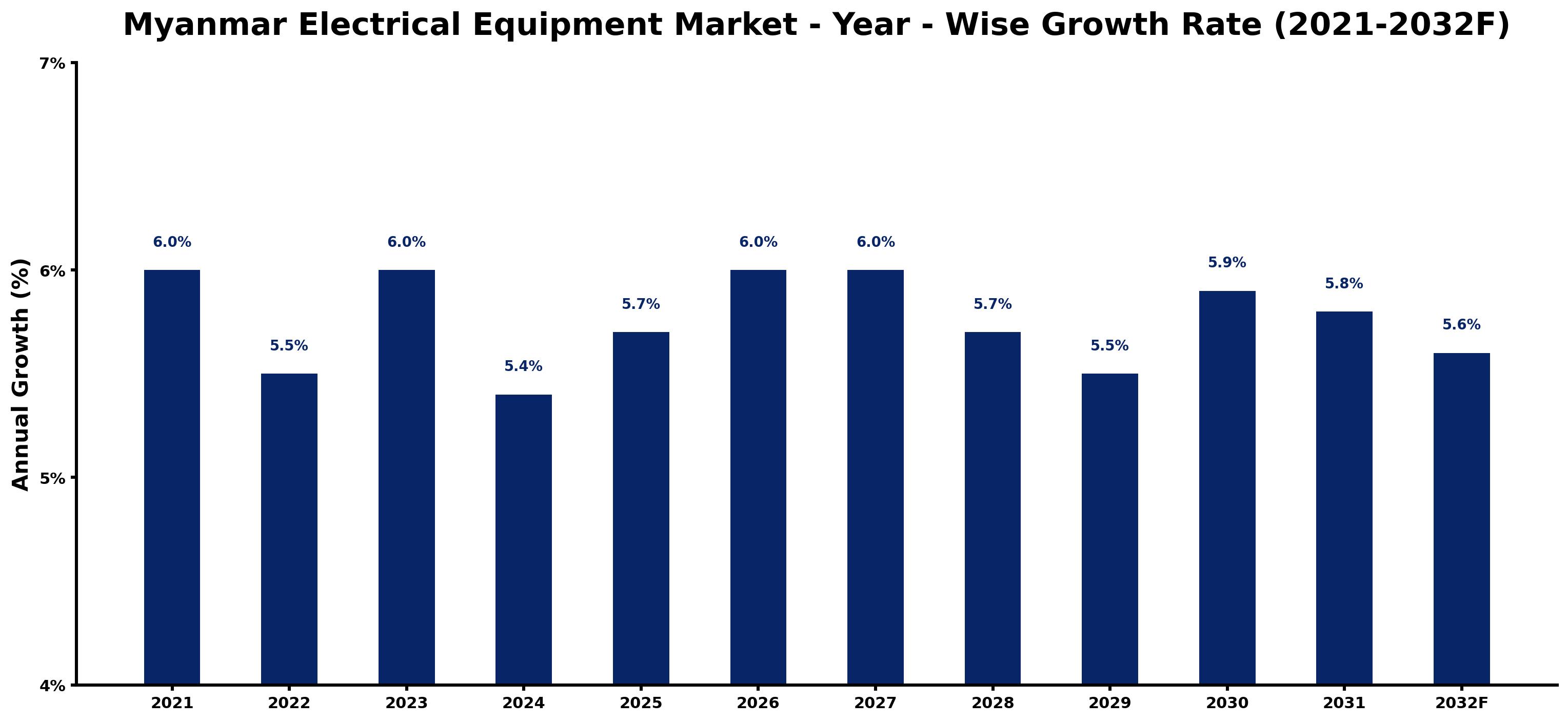
The table below presents the year wise growth rates along with the key drivers influencing the market
| Year | Growth Rate | Major Drivers |
| 2021 | 6.0% | Post-COVID recovery initiatives led to increased infrastructure investment across Myanmar. |
| 2022 | 5.5% | Urbanization trends highlighted the necessity for reliable electrical distribution networks. |
| 2023 | 6.0% | Private sector interest in renewable energy solutions began reshaping market dynamics significantly. |
| 2024 | 5.4% | Challenges in traditional electric supply prompted innovations in off-grid solar solutions. |
| 2025 | 5.7% | Demand for energy-efficient technologies aligned with global sustainability commitments in Myanmar. |
| 2026 | 6.0% | Local manufacturing efforts became crucial to meet burgeoning electrical equipment needs. |
| 2027 | 6.0% | Urban development projects necessitated the modernization of outdated electrical systems extensively. |
| 2028 | 5.7% | Investment in electric vehicle infrastructure catalyzed growth opportunities within the electrical sector. |
| 2029 | 5.5% | Partnerships with foreign tech firms enhanced the local capabilities for advanced electrical solutions. |
| 2030 | 5.9% | Growing consumer awareness about renewable options shifted preferences towards eco-friendly products. |
| 2031 | 5.8% | Market competition intensified, leading to innovations in smart grid technologies and automation. |
| 2032 | 5.6% | Consumer demand for reliable power sources culminated in robust year-on-year sector expansion. |
Note - Market size estimations and growth projections presented in this report are based on 6Wresearch's advanced forecasting approach, validated with industry datasets as of June 2026.
Myanmar Electrical Equipment Market Synopsis
The Myanmar Electrical Equipment Market is projected to reach 6.0% and witness significant growth during the forecast period (2026-2032). This growth is largely attributed to increasing urbanization and industrialization within the country. The demand for energy-efficient products, driven by various government initiatives and infrastructure projects, plays a pivotal role in shaping the market landscape. As Myanmar continues to evolve, the market for electrical equipment becomes more diverse, encompassing essential products such as power cables, transformers, switchgear, lighting fixtures, and generators.
Myanmar Electrical Equipment Market Growth Drivers
The steady expansion of the Myanmar Electrical Equipment Market is propelled by several key factors:
- Urbanization is a primary catalyst, with a significant portion of the population migrating to urban areas in search of better opportunities. This trend amplifies the need for reliable electrical infrastructure.
- Government initiatives aimed at promoting renewable energy sources are increasing demand for solar energy solutions, thereby boosting the electrical equipment market.
- Infrastructure development projects, including residential, commercial, and industrial constructions, require extensive electrical installations, driving demand for various equipment.
- A heightened awareness of energy efficiency among consumers encourages the adoption of advanced electrical products, such as LED lighting systems and energy management technologies.
- The expansion of the manufacturing sector in Myanmar necessitates improved electrical systems, fostering growth in the electrical equipment market.
Myanmar Electrical Equipment Market Trends and Opportunities
Trends in the Myanmar Electrical Equipment Market reflect a shift towards sustainability and technological innovation. An increasing focus on energy-efficient products is noticeable across various sectors. Key trends include:
- The adoption of renewable energy technologies, particularly solar power, is becoming more prevalent as the government promotes sustainability.
- There is a growing demand for smart home technologies that integrate electrical systems with automation, providing enhanced user experiences and energy savings.
- Increased investments in energy management systems are being observed as companies seek to optimize their energy consumption effectively.
- The ongoing electrification efforts by the government are catalyzing the demand for electrical equipment across diverse applications, contributing to overall market growth.
- Emerging trends in industrial automation are pushing companies to invest in advanced electrical solutions that support modern manufacturing processes.
Myanmar Electrical Equipment Market Challenges and Restraints
Despite the promising growth potential, the Myanmar Electrical Equipment Market faces several challenges that could impede its expansion:
- The infrastructure in Myanmar remains underdeveloped, with an inconsistent power supply that poses a significant barrier to the electrical equipment market.
- A scarcity of skilled labor and technical expertise limits the capability of companies in effectively implementing and maintaining electrical systems.
- Counterfeit electrical products present safety hazards and undermine confidence in genuine brands, impacting market growth.
- Regulatory challenges and bureaucratic inefficiencies create delays in the importation and distribution of electrical equipment.
- Competition from low-cost international players can pressure local manufacturers, complicating the pricing strategies in the market.
Myanmar Electrical Equipment Market Investment Opportunities
The prospects for investment in the Myanmar Electrical Equipment Market are substantial, fueled by the urgent need for infrastructure modernization and urban development. Areas of particular interest include:
- Manufacturing and distribution services for electrical equipment are increasingly attractive as the government supports enhanced access to electricity.
- Investments in renewable energy projects are expected to grow, especially in solar energy and energy storage solutions, leveraging the country's natural resources.
- The rising trend of smart technologies in various sectors presents opportunities for advanced electrical equipment and systems.
- The construction and industrial sectors remain key areas for investment, necessitating comprehensive electrical installations as development progresses.
- Government incentives aimed at improving the energy landscape create a conducive environment for local and foreign investments in the electrical equipment sector.
Myanmar Electrical Equipment Market Government Investment and Initiatives
The government of Myanmar has enacted various policies to stimulate the growth of the Electrical Equipment Market. These measures include:
- Tax incentives aimed at attracting investment in infrastructure development and electrical manufacturing.
- Subsidies for companies that invest in renewable energy projects, particularly those focusing on solar power and energy efficiency.
- Regulatory frameworks designed to ensure the safety and quality of electrical products sold in the market, fostering competitive practices.
- Public spending on electrification projects aimed at enhancing access to electricity within rural and urban populations.
- Initiatives to improve the technical training of the workforce to address the skills gap in the electrical sector.
Myanmar Electrical Equipment Market Latest Developments (May 2025 - June 2026)
Recent developments in the Myanmar Electrical Equipment Market indicate a sustained focus on modernization and sustainability. Industry movements during this period have included:
- A series of government announcements regarding new infrastructure projects that require extensive electrical installations, signaling increased demand for equipment.
- Increased collaborations between local authorities and private companies to enhance grid connectivity, particularly in rural regions.
- Launches of new energy-efficient products aimed at addressing the increasing consumer awareness surrounding sustainability.
- Expansions in renewable energy initiatives, specifically in solar energy, reflecting the ongoing commitment to improving energy access.
- Emerging partnerships between local firms and international companies, facilitating knowledge transfer and technology adoption in the electrical equipment sector.
Myanmar Electrical Equipment Market - Key Attractiveness of the Report
- 10 Years of Market Numbers
- Historical Data Starting from 2022 to 2025
- Base Year: 2025
- Forecast Data until 2032
- Key Performance Indicators Impacting the Market
- Major Upcoming Developments and Projects
Key Highlights of the Report:
- Myanmar Electrical Equipment Market Outlook
- Market Size of Myanmar Electrical Equipment Market, 2025
- Forecast of Myanmar Electrical Equipment Market, 2032F
- Historical Data and Forecast of Myanmar Electrical Equipment Revenues & Volume for the Period 2022-2032F
- Myanmar Electrical Equipment Market Trend Evolution
- Myanmar Electrical Equipment Market Drivers and Challenges
- Myanmar Electrical Equipment Price Trends
- Myanmar Electrical Equipment Porter's Five Forces
- Myanmar Electrical Equipment Industry Life Cycle
- Historical Data and Forecast of Myanmar Electrical Equipment Market Revenues & Volume By Types for the Period 2022-2032F
- Historical Data and Forecast of Myanmar Electrical Equipment Market Revenues & Volume By Electronic and electrical wires and cables for the Period 2022-2032F
- Historical Data and Forecast of Myanmar Electrical Equipment Market Revenues & Volume By Batteries and accumulators for the Period 2022-2032F
- Historical Data and Forecast of Myanmar Electrical Equipment Market Revenues & Volume By Wiring devices for the Period 2022-2032F
- Historical Data and Forecast of Myanmar Electrical Equipment Market Revenues & Volume By Electric lighting equipment for the Period 2022-2032F
- Historical Data and Forecast of Myanmar Electrical Equipment Market Revenues & Volume By Others for the Period 2022-2032F
- Historical Data and Forecast of Myanmar Electrical Equipment Market Revenues & Volume By Applications for the Period 2022-2032F
- Historical Data and Forecast of Myanmar Electrical Equipment Market Revenues & Volume By Residential end-users for the Period 2022-2032F
- Historical Data and Forecast of Myanmar Electrical Equipment Market Revenues & Volume By Non-residential end-users for the Period 2022-2032F
- Myanmar Electrical Equipment Import Export Trade Statistics
- Market Opportunity Assessment By Types
- Market Opportunity Assessment By Applications
- Myanmar Electrical Equipment Top Companies Market Share
- Myanmar Electrical Equipment Competitive Benchmarking By Technical and Operational Parameters
- Myanmar Electrical Equipment Company Profiles
- Myanmar Electrical Equipment Key Strategic Recommendations






































