Myanmar Electrical Steel Market Size, Share & Growth Rate
The Myanmar Electrical Steel Market was estimated at USD 1488 Million in 2025 and is projected to reach USD 2128 Million by 2032, growing at a CAGR of 5.2% from 2026 to 2032. This upward trend is primarily fueled by a surge in infrastructure development and a concerted move towards energy-efficient solutions across multiple sectors, particularly in automotive and power distribution. Increased investments in renewable energy sources also bolster the demand for advanced electrical steel products, setting the stage for sustainable growth in the years to come.
Myanmar Electrical Steel Market Year-wise Growth Rate and Key Drivers
This graph highlights how the Myanmar Electrical Steel Market has steadily grown over the years, supported by major growth factors.
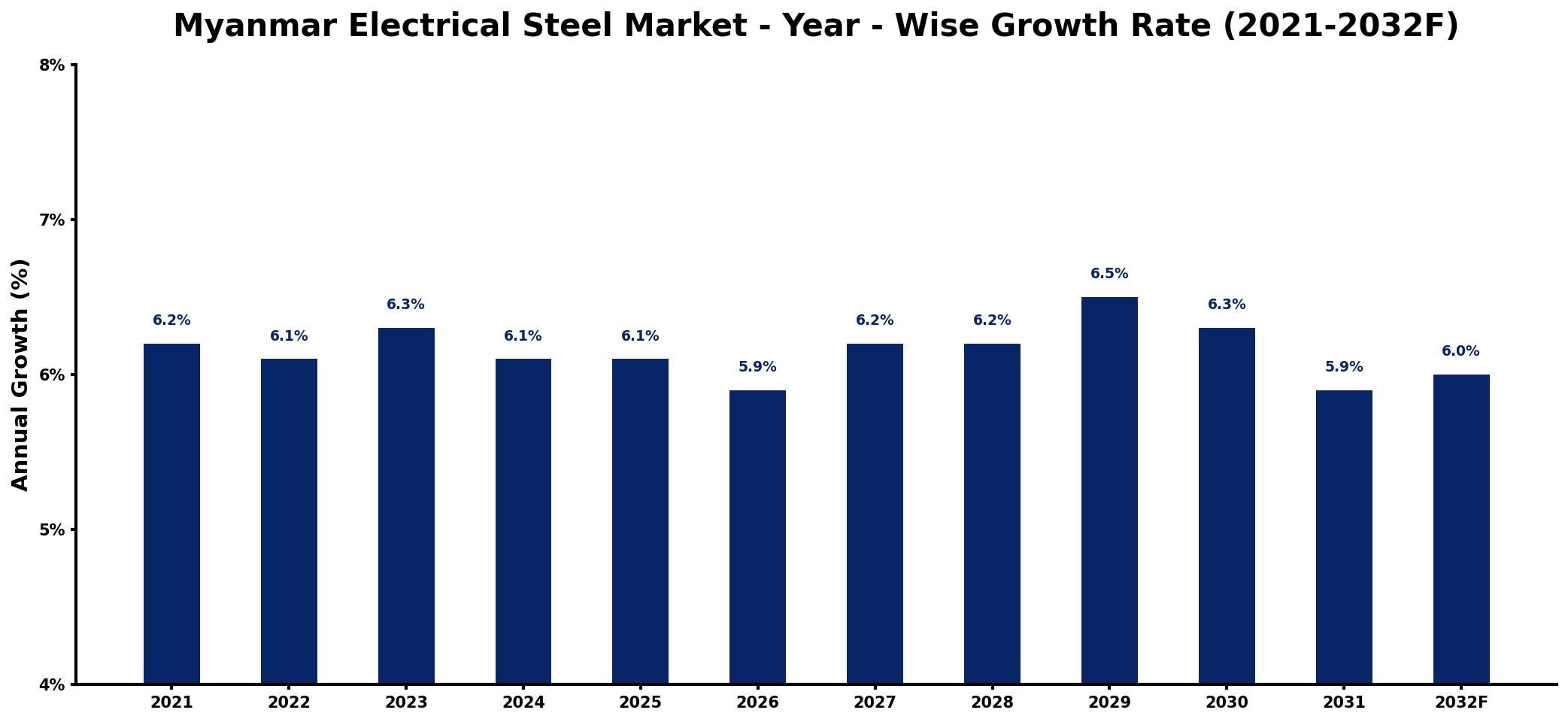
The table below presents the year‑wise growth rates along with the key drivers influencing the market
| Year | Growth Rate | Major Drivers |
| 2021 | 6.2% | Rising renewable energy investments |
| 2022 | 6.1% | Increased manufacturing sector demand |
| 2023 | 6.3% | Expansion of automotive production facilities |
| 2024 | 6.1% | Growing residential construction projects |
| 2025 | 6.1% | Surge in infrastructure development initiatives |
| 2026 | 5.9% | Boost in energy efficiency standards |
| 2027 | 6.2% | Enhanced industrial automation adoption |
| 2028 | 6.2% | Growth in electric vehicle market |
| 2029 | 6.5% | Increase in export opportunities |
| 2030 | 6.3% | Demand from telecommunications sector |
| 2031 | 5.9% | Rise in technological innovations |
| 2032 | 6.0% | growing automotive sector requirements |
Note: Market size estimations and growth projections presented in this report are based on 6Wresearch's proprietary forecasting methodology, utilizing the latest available industry data, government publications, and primary research inputs.
Myanmar Electrical Steel Market Synopsis
The Myanmar Electrical Steel Market is currently benefiting from positive momentum driven by heightened demand in key industries. As investments in energy and infrastructure accelerate, the market is evolving to address the need for more efficient electrical equipment. However, while short-term growth is promising, the long-term trajectory will depend on overcoming existing challenges such as technological limitations and production capacity.
Looking ahead, the market stands at a pivotal juncture, where government initiatives and growing urbanization create an environment ripe for expansion. The ongoing commitment to developing renewable energy and modernizing the power sector is expected to underpin robust demand for electrical steel products, thereby solidifying Myanmar's position in the global landscape.
Myanmar Electrical Steel Market Key Takeaways
- Steady market growth driven by infrastructure investments and energy efficiency demands.
- Significant opportunities in renewable energy projects requiring electrical steel components.
- Government policies are enhancing market attractiveness through incentives and support.
- Technological advancements in electrical steel products are focused on improving performance.
- Challenges remain in domestic production capacity and reliance on imports.
Evaluation of Restraints in Myanmar Electrical Steel Market
Despite its potential, the Myanmar Electrical Steel Market is held back by several significant restraints. A primary issue is the limited domestic production capacity, which forces reliance on imports and makes the market vulnerable to international price fluctuations. Moreover, the lack of modern technology in production processes impacts the efficiency and quality of the products available. Regulatory hurdles and bureaucratic complexities add further challenges, stifling competition and hindering the entry of innovative players into the market. Addressing these restraints will require concerted efforts from both the government and industry stakeholders.
Myanmar Electrical Steel Market Trends
The market is currently witnessing a trend towards adopting high-efficiency electrical steel products, driven by the need for energy-saving solutions and lower carbon emissions. There is also an increasing focus on research and development to enhance the magnetic properties of electrical steel, making products more competitive in terms of performance and energy efficiency. This trend aligns with the government's push for modernizing the power infrastructure and highlights a collective move toward sustainability in energy consumption.
Myanmar Electrical Steel Market Opportunities
Investment opportunities in the Myanmar Electrical Steel Market are emerging, particularly in manufacturing high-efficiency electrical steel products. As the country continues to develop its infrastructure, companies that produce components for renewable energy projects, such as solar and wind, stand to benefit significantly. The growing urbanization trend further expands the market, indicating a robust demand for electrical steel in construction and power distribution applications, thereby presenting avenues for both local and foreign investors.
Government Initiatives in the Myanmar Electrical Steel Market
The government of Myanmar has implemented a range of policies aimed at promoting the growth of the Electrical Steel Market. These include tax incentives and subsidies for foreign investments, encouraging research and development to improve product quality, and initiatives aimed at enhancing infrastructure and electricity access in rural areas. Regulations focusing on environmental sustainability also play a critical role in shaping the market landscape, ensuring that developments align with international standards.
Future Insights of the Myanmar Electrical Steel Market
Looking towards 2026-2032, the Myanmar Electrical Steel Market is poised for significant expansion. The combination of rising industrialization and increasing investments in energy infrastructure suggests a sustained demand for electrical steel products. Government initiatives focused on attracting foreign investment and enhancing power generation capabilities further bolster this optimistic outlook. Despite the challenges of limited domestic production and reliance on imports, favorable macroeconomic conditions and growing demand for high-quality electrical steel will likely lead to consistent growth opportunities in the sector.
Myanmar Electrical Steel Market Latest Developments (2025 - 2026)
Recent developments in the Myanmar Electrical Steel Market indicate a shift towards greater technological integration and product innovation. As companies increasingly focus on enhancing the performance characteristics of electrical steel, collaborations between domestic producers and international technology providers have gained traction. Furthermore, government-led initiatives to improve power distribution infrastructure are creating new avenues for market engagement and investment, reflecting a strong commitment to elevating the sectors capabilities.
Myanmar Electrical Steel Market - Key Attractiveness of the Report
- 10 Years of Market Numbers
- Historical Data Starting from 2022 to 2025
- Base Year: 2025
- Forecast Data until 2032
- Key Performance Indicators Impacting the Market
- Major Upcoming Developments and Projects
Key Highlights of the Report:
- Myanmar Electrical Steel Market Outlook
- Market Size of Myanmar Electrical Steel Market, 2025
- Forecast of Myanmar Electrical Steel Market, 2032
- Historical Data and Forecast of Myanmar Electrical Steel Revenues & Volume for the Period 2022-2032F
- Myanmar Electrical Steel Market Trend Evolution
- Myanmar Electrical Steel Market Drivers and Challenges
- Myanmar Electrical Steel Price Trends
- Myanmar Electrical Steel Porter's Five Forces
- Myanmar Electrical Steel Industry Life Cycle
- Historical Data and Forecast of Myanmar Electrical Steel Market Revenues & Volume By Type for the Period 2022-2032F
- Historical Data and Forecast of Myanmar Electrical Steel Market Revenues & Volume By Grain-oriented for the Period 2022-2032F
- Historical Data and Forecast of Myanmar Electrical Steel Market Revenues & Volume By Non-grain-oriented for the Period 2022-2032F
- Historical Data and Forecast of Myanmar Electrical Steel Market Revenues & Volume By End Use for the Period 2022-2032F
- Historical Data and Forecast of Myanmar Electrical Steel Market Revenues & Volume By Energy for the Period 2022-2032F
- Historical Data and Forecast of Myanmar Electrical Steel Market Revenues & Volume By Automotive for the Period 2022-2032F
- Historical Data and Forecast of Myanmar Electrical Steel Market Revenues & Volume By Household Appliances for the Period 2022-2032F
- Historical Data and Forecast of Myanmar Electrical Steel Market Revenues & Volume By Manufacturing for the Period 2022-2032F
- Historical Data and Forecast of Myanmar Electrical Steel Market Revenues & Volume By Others for the Period 2022-2032F
- Historical Data and Forecast of Myanmar Electrical Steel Market Revenues & Volume By Application for the Period 2022-2032F
- Historical Data and Forecast of Myanmar Electrical Steel Market Revenues & Volume By Transformers for the Period 2022-2032F
- Historical Data and Forecast of Myanmar Electrical Steel Market Revenues & Volume By Motors for the Period 2022-2032F
- Historical Data and Forecast of Myanmar Electrical Steel Market Revenues & Volume By Inductors for the Period 2022-2032F
- Historical Data and Forecast of Myanmar Electrical Steel Market Revenues & Volume By Others for the Period 2022-2032F
- Myanmar Electrical Steel Import Export Trade Statistics
- Market Opportunity Assessment By Type
- Market Opportunity Assessment By End Use
- Market Opportunity Assessment By Application
- Myanmar Electrical Steel Top Companies Market Share
- Myanmar Electrical Steel Competitive Benchmarking By Technical and Operational Parameters
- Myanmar Electrical Steel Company Profiles
- Myanmar Electrical Steel Key Strategic Recommendations






































