Myanmar Electrical Testing Equipment Market Size, Share & Growth Rate
The Myanmar Electrical Testing Equipment Market was estimated at USD 1036 Million in 2025 and is projected to reach USD 1502 Million by 2032, growing at a CAGR of 5.4% from 2026 to 2032. This growth trajectory is primarily fueled by the government's commitment to enhancing the nations power infrastructure, coupled with increased investments in industrial expansion and the need for reliable electrical supply across diverse sectors. As infrastructure projects ramp up, the demand for various testing equipment is expected to surge, highlighting significant opportunities for market players.
Myanmar Electrical Testing Equipment Market Year-wise Growth Rate and Key Drivers
This graph highlights how the Myanmar Electrical Testing Equipment Market has steadily grown over the years, supported by major growth factors.
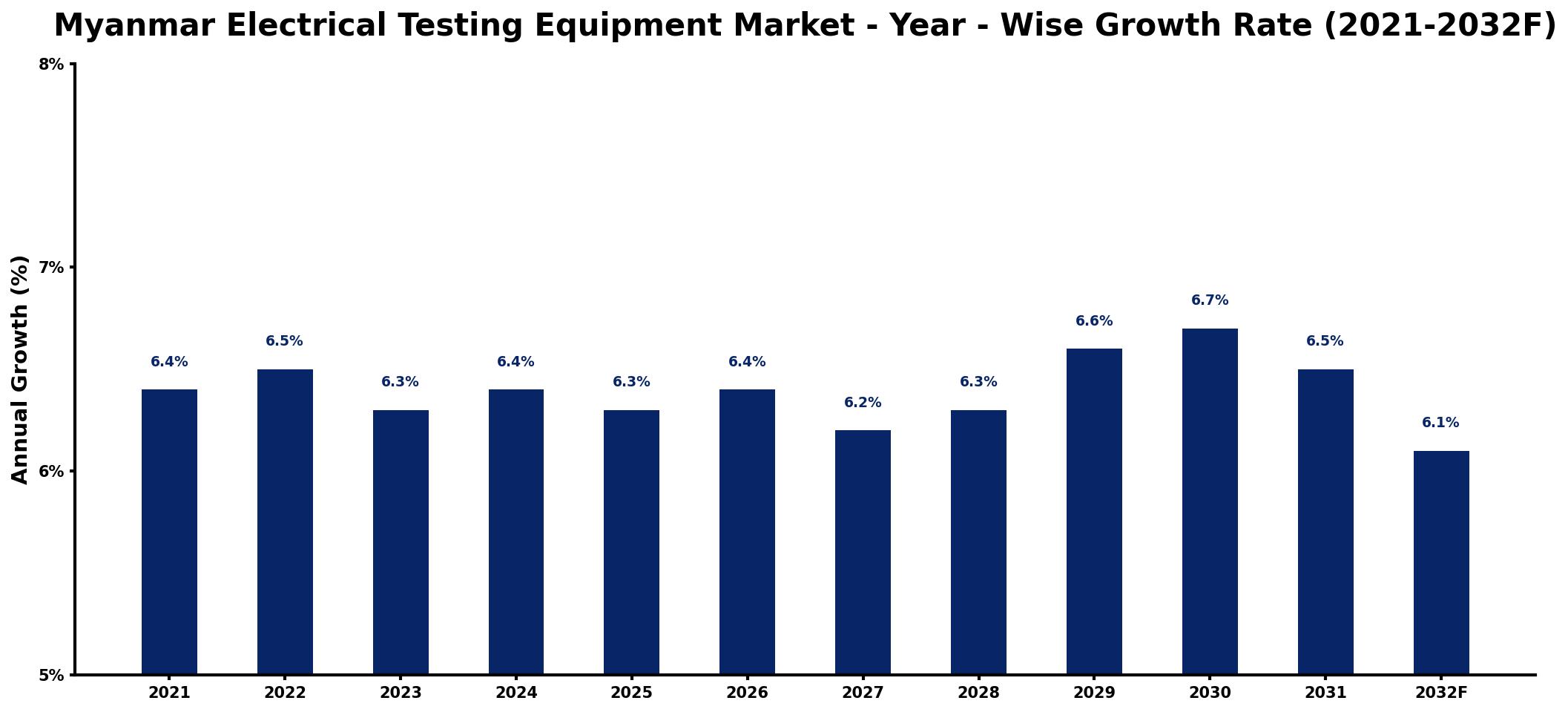
The table below presents the year‑wise growth rates along with the key drivers influencing the market
| Year | Growth Rate | Major Drivers |
| 2021 | 6.4% | Rising industrial infrastructure investments |
| 2022 | 6.5% | Increasing focus on safety standards |
| 2023 | 6.3% | Growth in renewable energy projects |
| 2024 | 6.4% | Expansion of manufacturing sectors |
| 2025 | 6.3% | Demand from construction industry |
| 2026 | 6.4% | Technological advancements in automation |
| 2027 | 6.2% | Government incentives for modernization |
| 2028 | 6.3% | rising infrastructure development spending |
| 2029 | 6.6% | Increased foreign direct investments |
| 2030 | 6.7% | Surge in energy efficiency initiatives |
| 2031 | 6.5% | Emerging markets driving demand |
| 2032 | 6.1% | rising export shipment volumes |
Note: Market size estimations and growth projections presented in this report are based on 6Wresearch's proprietary forecasting methodology, utilizing the latest available industry data, government publications, and primary research inputs.
Myanmar Electrical Testing Equipment Market Synopsis
In Myanmar, there is a growing recognition of the essential role that electrical testing equipment plays in maintaining safety and operational efficiency within electrical systems. The demand for devices such as multimeters and power quality analyzers is particularly pronounced, as industries seek to ensure reliable performance in increasingly complex electrical networks.
The market landscape is marked by a blend of domestic manufacturers and international brands, each contributing to a diverse portfolio of offerings. Recent technological advancements are reshaping product capabilities, focusing on improved accuracy, efficiency, and user safety, thus aligning with the evolving needs of industries that rely heavily on robust electrical systems.
Myanmar Electrical Testing Equipment Market Key Takeaways
- Strong growth prospects driven by governmental infrastructure initiatives.
- Increasing demand for advanced testing instruments across various sectors.
- Technological innovations are enhancing the functionality of testing equipment.
- Market expansion opportunities in calibration and maintenance services.
- A competitive landscape featuring both local and international players.
Evaluation of Restraints in Myanmar Electrical Testing Equipment Market
Despite the optimistic growth trajectory, the Myanmar Electrical Testing Equipment Market faces significant restraints. A substantial challenge is the outdated infrastructure and testing facilities, which often hinder the adoption of cutting-edge equipment. Additionally, the shortage of skilled technicians capable of operating advanced testing devices poses a serious barrier to market growth. The complexity of the regulatory environment further complicates matters, as companies must navigate compliance and standardization issues, which can slow down innovation and market entry for new technologies.
Myanmar Electrical Testing Equipment Market Trends
The market is currently witnessing a pronounced shift towards the adoption of digital testing technologies that offer real-time data monitoring and advanced analysis capabilities. This trend is driven by an increasing focus on maintaining electrical systems for efficiency and safety, particularly as Myanmar invests in renewable energy sources. Moreover, industries are gravitating towards equipment that supports predictive maintenance, ensuring longevity and reliability in their electrical networks.
Myanmar Electrical Testing Equipment Market Opportunities
Given the ongoing modernization of Myanmar's power grid and industrial landscape, substantial investment opportunities are emerging in the electrical testing equipment sector. Suppliers of advanced testing instruments, such as oscilloscopes and insulation testers, stand to benefit significantly. Additionally, offering calibration and maintenance services presents a lucrative avenue for business development, as ensuring operational efficacy in electrical installations becomes paramount amidst rising demand.
Government Initiatives in the Myanmar Electrical Testing Equipment Market
The Myanmar government has enacted several policies aimed at enhancing the quality and safety of electrical testing equipment. These regulations focus on establishing manufacturing and import standards to protect public health and mitigate risks associated with electrical installations. Furthermore, government initiatives are designed to promote the local production of testing equipment, fostering a self-sufficient market that reduces dependency on imports and encourages innovation within the domestic industry.
Future Insights of the Myanmar Electrical Testing Equipment Market
Looking ahead, the Myanmar Electrical Testing Equipment Market is poised for significant growth driven by urbanization, industrialization, and ongoing infrastructural projects. The emphasis on improving energy efficiency and reliability will only intensify the demand for sophisticated testing equipment. As industries across manufacturing, energy, and construction sectors ramp up their operations, the integration of advanced testing technologies will play a crucial role in meeting regulatory standards and enhancing operational performance. Ultimately, the market is set to thrive amid favorable government policies and a commitment to developing the nations energy infrastructure.
Myanmar Electrical Testing Equipment Market Latest Developments (2025 - 2026)
Recent developments within the Myanmar Electrical Testing Equipment Market highlight a push toward modernizing infrastructure and increasing the adoption of advanced testing technologies. Industry players are actively pursuing partnerships aimed at product innovation, while local manufacturers are beginning to invest in higher quality standards to compete more effectively against international brands. Additionally, the market has seen a notable increase in public-private collaborations aimed at improving training programs for technicians, ensuring that the workforce is equipped to handle sophisticated testing equipment.
Myanmar Electrical Testing Equipment Market - Key Attractiveness of the Report
- 10 Years of Market Numbers
- Historical Data Starting from 2022 to 2025
- Base Year: 2025
- Forecast Data until 2032
- Key Performance Indicators Impacting the Market
- Major Upcoming Developments and Projects
Key Highlights of the Report:
- Myanmar Electrical Testing Equipment Market Outlook
- Market Size of Myanmar Electrical Testing Equipment Market, 2025
- Forecast of Myanmar Electrical Testing Equipment Market, 2032
- Historical Data and Forecast of Myanmar Electrical Testing Equipment Revenues & Volume for the Period 2022-2032F
- Myanmar Electrical Testing Equipment Market Trend Evolution
- Myanmar Electrical Testing Equipment Market Drivers and Challenges
- Myanmar Electrical Testing Equipment Price Trends
- Myanmar Electrical Testing Equipment Porter's Five Forces
- Myanmar Electrical Testing Equipment Industry Life Cycle
- Historical Data and Forecast of Myanmar Electrical Testing Equipment Market Revenues & Volume By Service Type for the Period 2022-2032F
- Historical Data and Forecast of Myanmar Electrical Testing Equipment Market Revenues & Volume By Electrical Testing Equipment Calibration Services for the Period 2022-2032F
- Historical Data and Forecast of Myanmar Electrical Testing Equipment Market Revenues & Volume By Electrical Testing Equipment Repair Services or After Sales Services for the Period 2022-2032F
- Historical Data and Forecast of Myanmar Electrical Testing Equipment Market Revenues & Volume By Product Type for the Period 2022-2032F
- Historical Data and Forecast of Myanmar Electrical Testing Equipment Market Revenues & Volume By General Purpose Electrical Testing Equipment for the Period 2022-2032F
- Historical Data and Forecast of Myanmar Electrical Testing Equipment Market Revenues & Volume By Mechanical Electrical Test Equipment for the Period 2022-2032F
- Historical Data and Forecast of Myanmar Electrical Testing Equipment Market Revenues & Volume By End User for the Period 2022-2032F
- Historical Data and Forecast of Myanmar Electrical Testing Equipment Market Revenues & Volume By Aerospace and Defense for the Period 2022-2032F
- Historical Data and Forecast of Myanmar Electrical Testing Equipment Market Revenues & Volume By Telecommunications for the Period 2022-2032F
- Historical Data and Forecast of Myanmar Electrical Testing Equipment Market Revenues & Volume By Semiconductor and Electronics for the Period 2022-2032F
- Myanmar Electrical Testing Equipment Import Export Trade Statistics
- Market Opportunity Assessment By Service Type
- Market Opportunity Assessment By Product Type
- Market Opportunity Assessment By End User
- Myanmar Electrical Testing Equipment Top Companies Market Share
- Myanmar Electrical Testing Equipment Competitive Benchmarking By Technical and Operational Parameters
- Myanmar Electrical Testing Equipment Company Profiles
- Myanmar Electrical Testing Equipment Key Strategic Recommendations






































