Myanmar Enterprise Application Integration Market Size & Growth Rate (2026-2032)
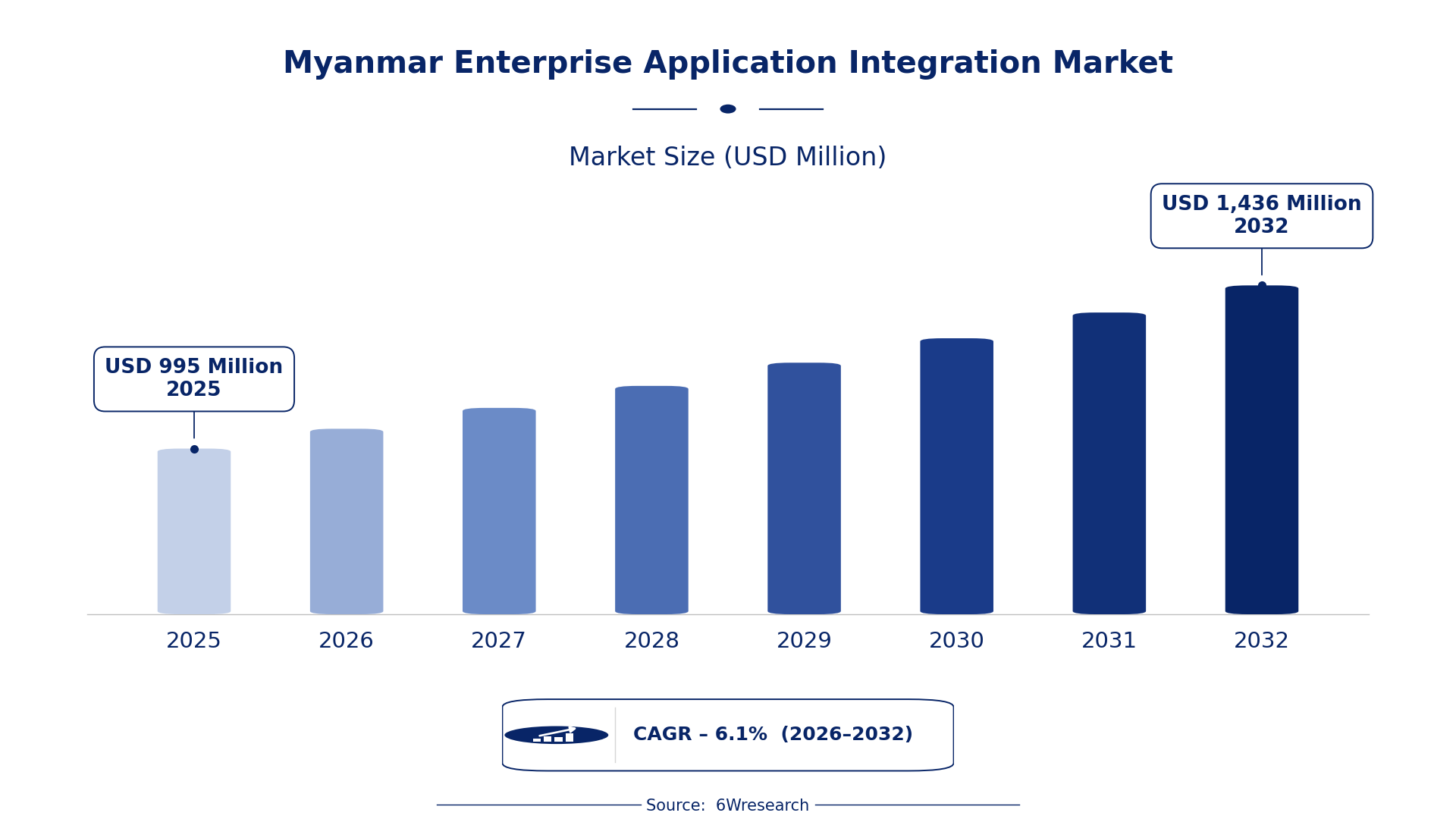
The Myanmar Enterprise Application Integration Market was estimated at USD 995 Million in 2025 and is projected to reach USD 1436 Million by 2032, growing at a CAGR of 6.1% from 2026 to 2032.
Myanmar Enterprise Application Integration Market Synopsis
The Myanmar Enterprise Application Integration market is on an upward trajectory as local businesses increasingly prioritize digital transformation. As companies across various sectors recognize the value of integrating disparate applications, there is a rising demand for EAI solutions tailored to their unique operational needs.
With a focus on enhancing operational efficiency and agility, organizations are adopting advanced integration technologies. This shift is further supported by the government’s commitment to fostering a modern digital ecosystem, which is critical for driving innovation and competitiveness in the market.
Myanmar Enterprise Application Integration Market Year-wise Growth Rate and Key Drivers
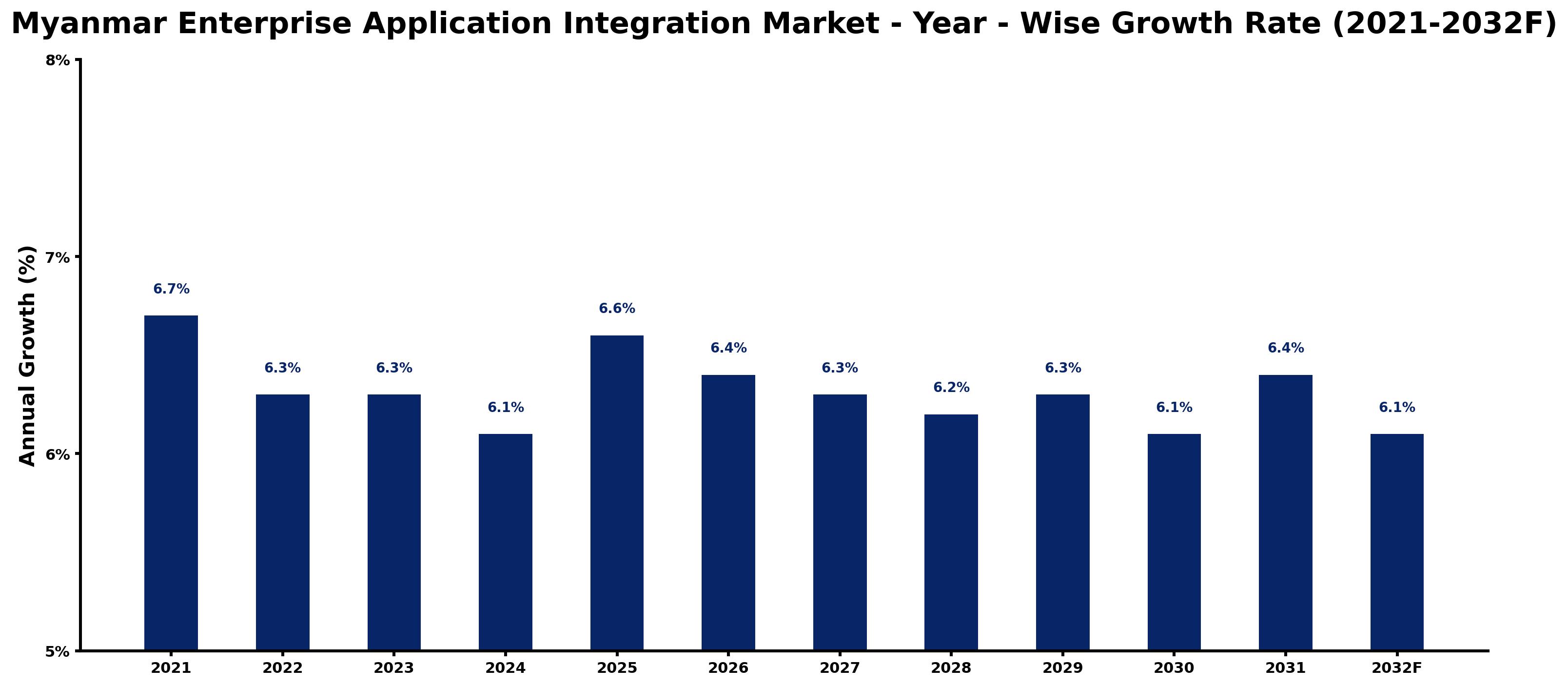
This graph illustrates the annual growth rates of the Myanmar Enterprise Application Integration Market from 2021 to 2032, highlighting a steady upward trajectory and projected expansion over the forecast period.
The table below presents the year‑wise growth rates along with the key drivers influencing the market
| Year | Growth Rate | Major Drivers |
| 2021 | 6.7% | Increased mobile penetration boosting cloud application usage. |
| 2022 | 6.3% | Growing fintech sector requiring seamless application connectivity. |
| 2023 | 6.3% | Surge in local startups driving integration solutions demand. |
| 2024 | 6.1% | Adoption of e-Government services enhancing data interoperability. |
| 2025 | 6.6% | Local businesses seeking operational efficiency through integration tools. |
| 2026 | 6.4% | Investment in telecom infrastructure accelerating application deployment. |
| 2027 | 6.3% | Rising cybersecurity concerns necessitating integrated solutions. |
| 2028 | 6.2% | Educational institutions adopting integrated systems for management. |
| 2029 | 6.3% | Expanding e-commerce sector needing integrated payment platforms. |
| 2030 | 6.1% | Regulatory compliance requirements driving enterprise application integration. |
| 2031 | 6.4% | Increased foreign investments fostering technology integration demand. |
| 2032 | 6.1% | Local manufacturing sector modernizing through digital integrations. |
Note: Market size estimations and growth projections presented in this report are based on 6Wresearch's proprietary forecasting methodology, utilizing the latest available industry data, government publications, and primary research inputs.
Myanmar Enterprise Application Integration Market Key Takeaways
Below are some of the specific key takeaways from the market, including:
- Steady growth fueled by increasing digital initiatives across industries.
- Emerging focus on cloud-based EAI solutions to enhance operational processes.
- Adoption of advanced technologies such as API management and microservices architecture.
- Rising demand for mobile integration capabilities to support remote work.
- Government policies driving the modernization of IT infrastructure.
Evaluation of Restraints in Myanmar Enterprise Application Integration Market
The Myanmar Enterprise Application Integration market encounters significant hurdles that impede its progress. A prevalent challenge is the limited understanding among businesses regarding the advantages of EAI solutions, which often leads to underinvestment in necessary technologies. on top of that, the scarcity of skilled professionals proficient in integration technologies exacerbates this issue, leaving many organizations unable to implement robust EAI systems.
Additionally, many companies still rely on outdated legacy systems, which complicate efforts to achieve effective data exchange. The current political landscape adds another layer of uncertainty, making it challenging for enterprises to commit to integration initiatives in a stable manner. Addressing these restraints will require collaborative efforts between technology providers and businesses to enhance awareness and drive skill development.
Myanmar Enterprise Application Integration Market Trends
The trend towards cloud-based integration solutions is gaining traction as organizations seek to optimize workflows and improve data accessibility. By enabling real-time information sharing, these solutions enhance decision-making capabilities. on top of that, the increasing adoption of advanced technologies such as artificial intelligence and microservices is transforming the way businesses approach integration.
There's a notable shift toward mobile integration as enterprises adapt to remote work conditions. This trend highlights the need for agile integration strategies that can support dynamic business environments while enhancing customer engagement. Companies are prioritizing scalable and flexible solutions to remain competitive in a rapidly changing digital landscape.
Myanmar Enterprise Application Integration Market Opportunities
The Myanmar Enterprise Application Integration market offers a wealth of investment opportunities as organizations increasingly recognize the importance of digital solutions. The growing appetite for EAI systems presents avenues for technology providers to deliver tailored solutions across multiple sectors. Collaborations with local businesses can yield customized services that meet specific integration requirements, further driving market growth.
Investors should also focus on addressing the skills gap in the workforce by supporting training initiatives. This will not only enhance the capabilities of local professionals but also build trust in the adoption of EAI technologies, ensuring long-term growth in the sector.
Government Initiatives in the Myanmar Enterprise Application Integration Market
The government of Myanmar is actively fostering the growth of the Enterprise Application Integration market through strategic initiatives. By prioritizing digital transformation and the adoption of technology solutions, the government aims to create a supportive regulatory environment that encourages innovation and investment in the sector.
- A recent national digital infrastructure upgrade programme was launched to enhance connectivity across urban and rural areas.
- Current efforts focus on promoting e-government services to streamline public sector operations and improve service delivery.
- Ongoing initiatives aim to simplify regulations for technology companies, making it easier for them to operate within the EAI landscape.
- A planned public-private partnership is set to be established, aimed at expanding access to digital tools and resources for local businesses by 2026.
- The government has introduced a policy framework to incentivize investments in integration technologies and infrastructure development.
Future Insights of the Myanmar Enterprise Application Integration Market
Looking ahead to 2026-2032, the Myanmar Enterprise Application Integration market is expected to experience considerable expansion. As businesses increasingly adopt digital technologies, the need for efficient integration of diverse systems will grow. The integration of cloud computing and big data analytics will further drive demand for advanced EAI solutions.
With government backing and ongoing infrastructure improvements, the conditions for growth are favorable. Companies that invest in modern integration technologies will position themselves competitively in the evolving marketplace, opening doors to new business opportunities and enhanced operational efficiency.
Myanmar Enterprise Application Integration Market Latest Developments
In the past year, the Myanmar Enterprise Application Integration market has seen significant developments as businesses increasingly focus on digital transformation. The trend of adopting cloud-based solutions has accelerated, with many organizations implementing new integration strategies to enhance their operations.
- A leading technology vendor launched a cloud-based EAI platform in Q1 2025, enabling businesses to integrate multiple systems efficiently.
- An initiative that began in late 2024 focused on upgrading legacy systems across various sectors, improving data interoperability.
- By mid-2025, a major regional operator announced plans for a partnership aimed at enhancing EAI services for healthcare providers.
- Upcoming in early 2026, a new government-backed program is set to facilitate training for IT professionals in integration technologies.
- A product upgrade expected in Q3 2025 will introduce advanced AI capabilities to existing EAI solutions, further enhancing functionality.
Myanmar Enterprise Application Integration Market - Key Attractiveness of the Report
- 10 Years of Market Numbers
- Historical Data Starting from 2022 to 2025
- Base Year: 2025
- Forecast Data until 2032
- Key Performance Indicators Impacting the Market
- Major Upcoming Developments and Projects
Key Highlights of the Report:
- Myanmar Enterprise Application Integration Market Outlook
- Market Size of Myanmar Enterprise Application Integration Market, 2025
- Forecast of Myanmar Enterprise Application Integration Market, 2032
- Historical Data and Forecast of Myanmar Enterprise Application Integration Revenues & Volume for the Period 2022-2032F
- Myanmar Enterprise Application Integration Market Trend Evolution
- Myanmar Enterprise Application Integration Market Drivers and Challenges
- Myanmar Enterprise Application Integration Price Trends
- Myanmar Enterprise Application Integration Porter's Five Forces
- Myanmar Enterprise Application Integration Industry Life Cycle
- Historical Data and Forecast of Myanmar Enterprise Application Integration Market Revenues & Volume By Deployment type for the Period 2022-2032F
- Historical Data and Forecast of Myanmar Enterprise Application Integration Market Revenues & Volume By Hosted for the Period 2022-2032F
- Historical Data and Forecast of Myanmar Enterprise Application Integration Market Revenues & Volume By On-Premise for the Period 2022-2032F
- Historical Data and Forecast of Myanmar Enterprise Application Integration Market Revenues & Volume By Hybrid for the Period 2022-2032F
- Historical Data and Forecast of Myanmar Enterprise Application Integration Market Revenues & Volume By Organization size for the Period 2022-2032F
- Historical Data and Forecast of Myanmar Enterprise Application Integration Market Revenues & Volume By Small for the Period 2022-2032F
- Historical Data and Forecast of Myanmar Enterprise Application Integration Market Revenues & Volume By Medium for the Period 2022-2032F
- Historical Data and Forecast of Myanmar Enterprise Application Integration Market Revenues & Volume By Enterprises for the Period 2022-2032F
- Historical Data and Forecast of Myanmar Enterprise Application Integration Market Revenues & Volume By Large Enterprises for the Period 2022-2032F
- Historical Data and Forecast of Myanmar Enterprise Application Integration Market Revenues & Volume By Industry Vertical for the Period 2022-2032F
- Historical Data and Forecast of Myanmar Enterprise Application Integration Market Revenues & Volume By Banking, financial services and insurance(BFSI) for the Period 2022-2032F
- Historical Data and Forecast of Myanmar Enterprise Application Integration Market Revenues & Volume By Business services for the Period 2022-2032F
- Historical Data and Forecast of Myanmar Enterprise Application Integration Market Revenues & Volume By IT and telecom for the Period 2022-2032F
- Historical Data and Forecast of Myanmar Enterprise Application Integration Market Revenues & Volume By Manufacturing for the Period 2022-2032F
- Historical Data and Forecast of Myanmar Enterprise Application Integration Market Revenues & Volume By Retail and wholesale for the Period 2022-2032F
- Historical Data and Forecast of Myanmar Enterprise Application Integration Market Revenues & Volume By Healthcare for the Period 2022-2032F
- Historical Data and Forecast of Myanmar Enterprise Application Integration Market Revenues & Volume By Government for the Period 2022-2032F
- Historical Data and Forecast of Myanmar Enterprise Application Integration Market Revenues & Volume By Other verticals( education, entertainment and media, power and utilities) for the Period 2022-2032F
- Myanmar Enterprise Application Integration Import Export Trade Statistics
- Market Opportunity Assessment By Deployment type
- Market Opportunity Assessment By Organization size
- Market Opportunity Assessment By Industry Vertical
- Myanmar Enterprise Application Integration Top Companies Market Share
- Myanmar Enterprise Application Integration Competitive Benchmarking By Technical and Operational Parameters
- Myanmar Enterprise Application Integration Company Profiles
- Myanmar Enterprise Application Integration Key Strategic Recommendations






































