Myanmar Ethylene And Propylene Market Size, Share & Growth Rate
The Myanmar Ethylene And Propylene Market was estimated at USD 1359 Million in 2025 and is projected to reach USD 1957 Million by 2032, growing at a CAGR of 5.3% from 2026 to 2032. This anticipated growth is driven by the expanding petrochemical and polymer industries within Myanmar, where the demand for raw materials in the production of plastics, packaging, and synthetic fibers continues to soar. As more industries recognize the benefits of using ethylene and propylene as feedstocks, we can expect further market penetration and adoption across various sectors.
Myanmar Ethylene And Propylene Market Year-wise Growth Rate and Key Drivers
This graph highlights how the Myanmar Ethylene And Propylene Market has steadily grown over the years, supported by major growth factors.
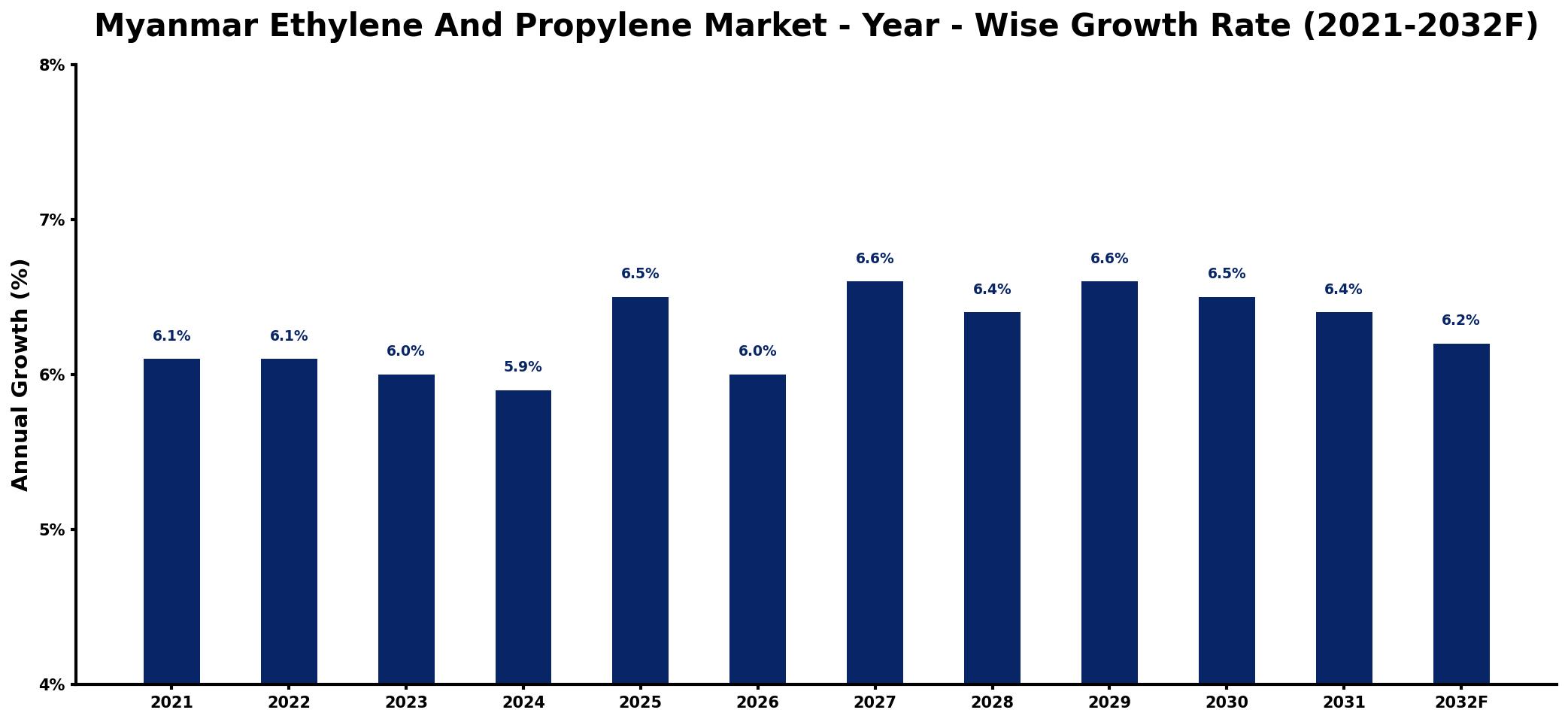
The table below presents the year‑wise growth rates along with the key drivers influencing the market
| Year | Growth Rate | Major Drivers |
| 2021 | 6.1% | Rising demand from automotive sector |
| 2022 | 6.1% | Increased construction activity nationwide |
| 2023 | 6.0% | Expansion of packaging industry demand |
| 2024 | 5.9% | Growth in consumer goods production |
| 2025 | 6.5% | Investment in renewable energy projects |
| 2026 | 6.0% | Surge in agricultural applications usage |
| 2027 | 6.6% | Development of infrastructure projects |
| 2028 | 6.4% | Boost in electronics manufacturing sector |
| 2029 | 6.6% | Enhancement of healthcare product supply |
| 2030 | 6.5% | Strengthening of textile industry needs |
| 2031 | 6.4% | Rise in domestic manufacturing capabilities |
| 2032 | 6.2% | Diversification of export markets opportunities |
Note: Market size estimations and growth projections presented in this report are based on 6Wresearch's proprietary forecasting methodology, utilizing the latest available industry data, government publications, and primary research inputs.
Myanmar Ethylene And Propylene Market Synopsis
In Myanmar, ethylene and propylene serve as pivotal components in the manufacture of essential materials like plastics, which are integral to the countrys growing industrial landscape. The increasing reliance on these petrochemicals is reflective of a broader trend towards modernization and enhanced manufacturing capabilities.
As the country navigates its path towards industrialization, importation plays a crucial role in fulfilling the domestic demand for these chemicals. This reliance, however, exposes the market to vulnerabilities associated with global supply chain dynamics, highlighting the need for stronger local production and supply strategies.
Myanmar Ethylene And Propylene Market Key Takeaways
- The market is expected to grow significantly due to the rising demand for plastics and other materials.
- Challenges related to import dependencies and regulatory compliance impact market stability.
- Investment in domestic production is crucial for mitigating supply chain vulnerabilities.
- Government incentives are aimed at bolstering the petrochemical sector and enhancing industrial competitiveness.
- Current trends indicate a shift towards more sustainable and efficient production processes.
Evaluation of Restraints in Myanmar Ethylene And Propylene Market
Despite its growth potential, the Myanmar Ethylene and Propylene Market faces significant restraints that could hinder its development. The heavy reliance on imports exposes the market to global supply chain fluctuations, which can lead to price volatility and availability challenges. Furthermore, strict adherence to international quality standards and regulatory requirements creates additional complexities for importers and manufacturers alike. As competition intensifies from alternative feedstocks, the need for investments in local production facilities becomes increasingly vital to enhance market resilience and competitiveness.
Myanmar Ethylene And Propylene Market Trends
Current trends in the Myanmar Ethylene and Propylene Market are largely centered around sustainability and technological advancements. The push for eco-friendly production methods is influencing manufacturers to adopt innovative processes that minimize environmental impact while maximizing output efficiency. Additionally, as demand patterns evolve, there is a noticeable shift towards the utilization of these petrochemicals in developing high-value applications, including advanced materials and biodegradable plastics.
Myanmar Ethylene And Propylene Market Opportunities
The potential for growth in the Myanmar Ethylene and Propylene Market is significant, particularly in light of the government's supportive policies aimed at enhancing the petrochemical sector. Opportunities lie in increasing domestic production capabilities, which could alleviate dependence on imports. Additionally, investments in infrastructure and technology can open new avenues for product diversification and innovation, catering to the rising demand for specialized and high-performance materials.
Government Initiatives in the Myanmar Ethylene And Propylene Market
The Myanmar government has recognized the importance of the petrochemical industry and is actively implementing policies to stimulate growth. These initiatives include offering investment incentives to attract both domestic and foreign players into the ethylene and propylene sector. Regulatory frameworks are being developed to streamline feedstock supply and pricing, ensuring a more stable market environment. Infrastructure development programs are also underway, aiming to bolster the entire petrochemical value chain and enhance the country's industrial competitiveness.
Future Insights of the Myanmar Ethylene And Propylene Market
Looking ahead to 2026-2032, the Myanmar Ethylene and Propylene Market is poised for transformative growth. Continued investments in domestic production, supported by favorable government policies, will likely reduce import dependency and stabilize the market. As industries pivot towards advanced materials and sustainable practices, the demand for ethylene and propylene will remain robust, establishing a strong foundation for long-term growth and innovation in this essential sector.
Myanmar Ethylene And Propylene Market Latest Developments (2025 - 2026)
Recent developments in the Myanmar Ethylene and Propylene Market have focused on bolstering local production capabilities and reducing reliance on imports. Industry stakeholders are increasingly investing in modernization efforts aimed at enhancing production efficiency and meeting international quality standards. Additionally, collaborative initiatives between government and private sector entities are gaining traction, aimed at fostering a more resilient supply chain and encouraging innovation in product development.
Myanmar Ethylene And Propylene Market - Key Attractiveness of the Report
- 10 Years of Market Numbers
- Historical Data Starting from 2022 to 2025
- Base Year: 2025
- Forecast Data until 2032
- Key Performance Indicators Impacting the Market
- Major Upcoming Developments and Projects
Key Highlights of the Report:
- Myanmar Ethylene And Propylene Market Outlook
- Market Size of Myanmar Ethylene And Propylene Market, 2025
- Forecast of Myanmar Ethylene And Propylene Market, 2032
- Historical Data and Forecast of Myanmar Ethylene And Propylene Revenues & Volume for the Period 2022-2032F
- Myanmar Ethylene And Propylene Market Trend Evolution
- Myanmar Ethylene And Propylene Market Drivers and Challenges
- Myanmar Ethylene And Propylene Price Trends
- Myanmar Ethylene And Propylene Porter's Five Forces
- Myanmar Ethylene And Propylene Industry Life Cycle
- Historical Data and Forecast of Myanmar Ethylene And Propylene Market Revenues & Volume By Type for the Period 2022-2032F
- Historical Data and Forecast of Myanmar Ethylene And Propylene Market Revenues & Volume By Ethylene for the Period 2022-2032F
- Historical Data and Forecast of Myanmar Ethylene And Propylene Market Revenues & Volume By Polyethylene for the Period 2022-2032F
- Historical Data and Forecast of Myanmar Ethylene And Propylene Market Revenues & Volume By Ethylene oxide for the Period 2022-2032F
- Historical Data and Forecast of Myanmar Ethylene And Propylene Market Revenues & Volume By Propylene for the Period 2022-2032F
- Historical Data and Forecast of Myanmar Ethylene And Propylene Market Revenues & Volume By Polypropylene for the Period 2022-2032F
- Historical Data and Forecast of Myanmar Ethylene And Propylene Market Revenues & Volume By Propylene Oxide for the Period 2022-2032F
- Historical Data and Forecast of Myanmar Ethylene And Propylene Market Revenues & Volume By Others for the Period 2022-2032F
- Historical Data and Forecast of Myanmar Ethylene And Propylene Market Revenues & Volume By Application for the Period 2022-2032F
- Historical Data and Forecast of Myanmar Ethylene And Propylene Market Revenues & Volume By Chemical & Petrochemicals for the Period 2022-2032F
- Historical Data and Forecast of Myanmar Ethylene And Propylene Market Revenues & Volume By Pharmaceuticals for the Period 2022-2032F
- Historical Data and Forecast of Myanmar Ethylene And Propylene Market Revenues & Volume By Paints & Coatings for the Period 2022-2032F
- Historical Data and Forecast of Myanmar Ethylene And Propylene Market Revenues & Volume By Others for the Period 2022-2032F
- Myanmar Ethylene And Propylene Import Export Trade Statistics
- Market Opportunity Assessment By Type
- Market Opportunity Assessment By Application
- Myanmar Ethylene And Propylene Top Companies Market Share
- Myanmar Ethylene And Propylene Competitive Benchmarking By Technical and Operational Parameters
- Myanmar Ethylene And Propylene Company Profiles
- Myanmar Ethylene And Propylene Key Strategic Recommendations






































