Myanmar Fencing Market Size, Share & Growth Rate
The Myanmar Fencing Market was estimated at USD 460 Million in 2025 and is projected to reach USD 647 Million by 2032, growing at a CAGR of 5.0% from 2026 to 2032. This growth is primarily driven by the rapid urbanization and infrastructure development across the country, as well as heightened security concerns among residents and businesses alike. As construction activities gain momentum, the demand for a variety of fencing solutions is set to increase, reflecting the dynamic nature of the Myanmar market.
Myanmar Fencing Market Year-wise Growth Rate and Key Drivers
This graph highlights how the Myanmar Fencing Market has steadily grown over the years, supported by major growth factors.
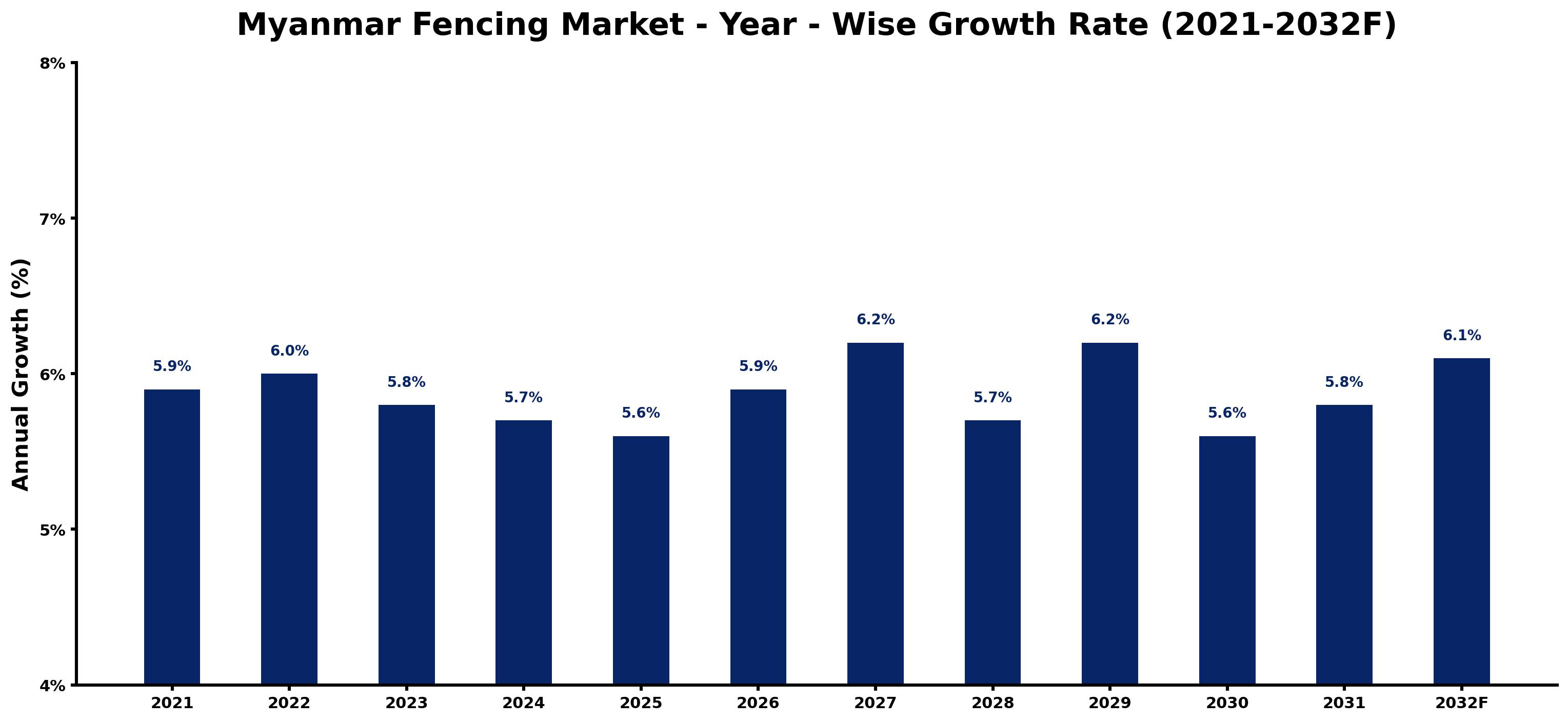
The table below presents the year‑wise growth rates along with the key drivers influencing the market
| Year | Growth Rate | Major Drivers |
| 2021 | 5.9% | Growing urbanization and commercial development |
| 2022 | 6.0% | Rapid growth in telecom and data center sectors |
| 2023 | 5.8% | Rising electricity demand across industries |
| 2024 | 5.7% | Increasing smart city development projects |
| 2025 | 5.6% | Increasing industrial automation investments |
| 2026 | 5.9% | Government infrastructure modernization initiatives |
| 2027 | 6.2% | Expansion of transportation and logistics networks |
| 2028 | 5.7% | Expansion of commercial construction activities |
| 2029 | 6.2% | Expansion of manufacturing activities |
| 2030 | 5.6% | Expansion of transportation and logistics networks |
| 2031 | 5.8% | Increasing industrial infrastructure investments |
| 2032 | 6.1% | Increasing industrial automation investments |
Note - Market size estimations and growth projections presented in this report are based on 6Wresearch’s advanced forecasting approach, validated with industry datasets as of June 2026.
Myanmar Fencing Market Synopsis
The strongest force shaping the Myanmar Fencing Market is the increasing emphasis on security and privacy in residential, commercial, and industrial sectors. As urban areas expand and new developments arise, the demand for robust and aesthetically appealing fencing solutions is on the rise.
Moreover, government initiatives aimed at enhancing border security and facilitating infrastructure projects are bolstering the need for effective fencing solutions. These factors collectively create a vibrant landscape for growth in the fencing sector.
Myanmar Fencing Market Key Takeaways
- Rising urbanization and construction activities are key drivers of market growth.
- Demand for durable and eco-friendly fencing materials is increasing.
- Customization options are becoming essential to meet diverse consumer preferences.
- Government policies support quality standards and local manufacturing initiatives.
- The market is characterized by competition between local and international suppliers.
Evaluation of Restraints in Myanmar Fencing Market
Despite its growth potential, the Myanmar Fencing Market faces several constraints that hinder its development. A lack of consumer awareness regarding the advantages of high-quality fencing solutions can lead to diminished demand. Furthermore, difficulties in accessing premium materials and advanced technology limit innovation and production quality. Regulatory inconsistencies and competition from informal suppliers add layers of complexity, complicating the business environment for formal fencing companies.
Myanmar Fencing Market Trends
The market is currently witnessing a trend towards more durable and visually appealing materials, particularly aluminum and composite options, which address security and privacy concerns effectively. Consumers increasingly prefer fencing solutions that require low maintenance and offer cost-effectiveness over the long term. Additionally, eco-conscious consumers are driving demand for sustainable fencing materials, aligning with a broader global trend towards environmental responsibility.
Myanmar Fencing Market Opportunities
Investment opportunities abound in the Myanmar fencing market, particularly given the ongoing boom in construction and infrastructure development. Suppliers can leverage this growth by providing a diverse range of fencing materials and installation services. Moreover, focusing on innovative eco-friendly solutions presents a unique avenue for businesses to differentiate themselves in a competitive market, catering to an increasingly environmentally aware consumer base.
Government Initiatives in the Myanmar Fencing Market
Government policies in Myanmar regarding the fencing market focus primarily on establishing quality and safety standards, alongside promoting environmental sustainability. Initiatives to regulate fencing production and installation enhance consumer protection while encouraging local manufacturing, thereby bolstering the domestic industry. These efforts underscore the government's commitment to creating a competitive and responsible fencing landscape in Myanmar.
Future Insights of the Myanmar Fencing Market
Looking ahead to 2026-2032, the Myanmar Fencing Market is poised for sustained growth, driven by continued urbanization, infrastructure projects, and rising security demands. As modernization efforts gather pace and foreign investments flow in, the need for high-quality, efficient fencing solutions is expected to surge. Additionally, the market will likely embrace advanced materials and smart technologies, further enhancing security capabilities while appealing to design aesthetics.
Myanmar Fencing Market Latest Developments (May 2025 - June 2026)
In recent months, the Myanmar fencing market has seen a notable shift toward innovative products and enhanced customer engagement strategies. Manufacturers are increasingly exploring the integration of smart technologies into fencing solutions to offer enhanced security features. Moreover, there is a growing collaboration between local suppliers and international companies to improve access to high-quality materials and cutting-edge technology.
Myanmar Fencing Market - Key Attractiveness of the Report
- 10 Years of Market Numbers
- Historical Data Starting from 2022 to 2025
- Base Year: 2025
- Forecast Data until 2032
- Key Performance Indicators Impacting the Market
- Major Upcoming Developments and Projects
Key Highlights of the Report:
- Myanmar Fencing Market Outlook
- Market Size of Myanmar Fencing Market, 2025
- Forecast of Myanmar Fencing Market, 2032
- Historical Data and Forecast of Myanmar Fencing Revenues & Volume for the Period 2022-2032F
- Myanmar Fencing Market Trend Evolution
- Myanmar Fencing Market Drivers and Challenges
- Myanmar Fencing Price Trends
- Myanmar Fencing Porter's Five Forces
- Myanmar Fencing Industry Life Cycle
- Historical Data and Forecast of Myanmar Fencing Market Revenues & Volume By Material for the Period 2022-2032F
- Historical Data and Forecast of Myanmar Fencing Market Revenues & Volume By Metal for the Period 2022-2032F
- Historical Data and Forecast of Myanmar Fencing Market Revenues & Volume By Wood for the Period 2022-2032F
- Historical Data and Forecast of Myanmar Fencing Market Revenues & Volume By Plastic & Composite for the Period 2022-2032F
- Historical Data and Forecast of Myanmar Fencing Market Revenues & Volume By Concrete for the Period 2022-2032F
- Historical Data and Forecast of Myanmar Fencing Market Revenues & Volume By Distribution Channel for the Period 2022-2032F
- Historical Data and Forecast of Myanmar Fencing Market Revenues & Volume By Online for the Period 2022-2032F
- Historical Data and Forecast of Myanmar Fencing Market Revenues & Volume By Retail for the Period 2022-2032F
- Historical Data and Forecast of Myanmar Fencing Market Revenues & Volume By Installation for the Period 2022-2032F
- Historical Data and Forecast of Myanmar Fencing Market Revenues & Volume By Do-It-Yourself for the Period 2022-2032F
- Historical Data and Forecast of Myanmar Fencing Market Revenues & Volume By Contractor for the Period 2022-2032F
- Historical Data and Forecast of Myanmar Fencing Market Revenues & Volume By Application for the Period 2022-2032F
- Historical Data and Forecast of Myanmar Fencing Market Revenues & Volume By Residential for the Period 2022-2032F
- Historical Data and Forecast of Myanmar Fencing Market Revenues & Volume By Agricultural for the Period 2022-2032F
- Historical Data and Forecast of Myanmar Fencing Market Revenues & Volume By Industrial for the Period 2022-2032F
- Historical Data and Forecast of Myanmar Fencing Market Revenues & Volume By End-users for the Period 2022-2032F
- Historical Data and Forecast of Myanmar Fencing Market Revenues & Volume By Government for the Period 2022-2032F
- Historical Data and Forecast of Myanmar Fencing Market Revenues & Volume By Petroleum & Chemicals for the Period 2022-2032F
- Historical Data and Forecast of Myanmar Fencing Market Revenues & Volume By Military & Defense for the Period 2022-2032F
- Historical Data and Forecast of Myanmar Fencing Market Revenues & Volume By Mining for the Period 2022-2032F
- Historical Data and Forecast of Myanmar Fencing Market Revenues & Volume By Energy & Power for the Period 2022-2032F
- Historical Data and Forecast of Myanmar Fencing Market Revenues & Volume By Transport for the Period 2022-2032F
- Historical Data and Forecast of Myanmar Fencing Market Revenues & Volume By Others for the Period 2022-2032F
- Myanmar Fencing Import Export Trade Statistics
- Market Opportunity Assessment By Material
- Market Opportunity Assessment By Distribution Channel
- Market Opportunity Assessment By Installation
- Market Opportunity Assessment By Application
- Market Opportunity Assessment By End-users
- Myanmar Fencing Top Companies Market Share
- Myanmar Fencing Competitive Benchmarking By Technical and Operational Parameters
- Myanmar Fencing Company Profiles
- Myanmar Fencing Key Strategic Recommendations






































