Myanmar Fishing Equipment Market Size Growth Rate
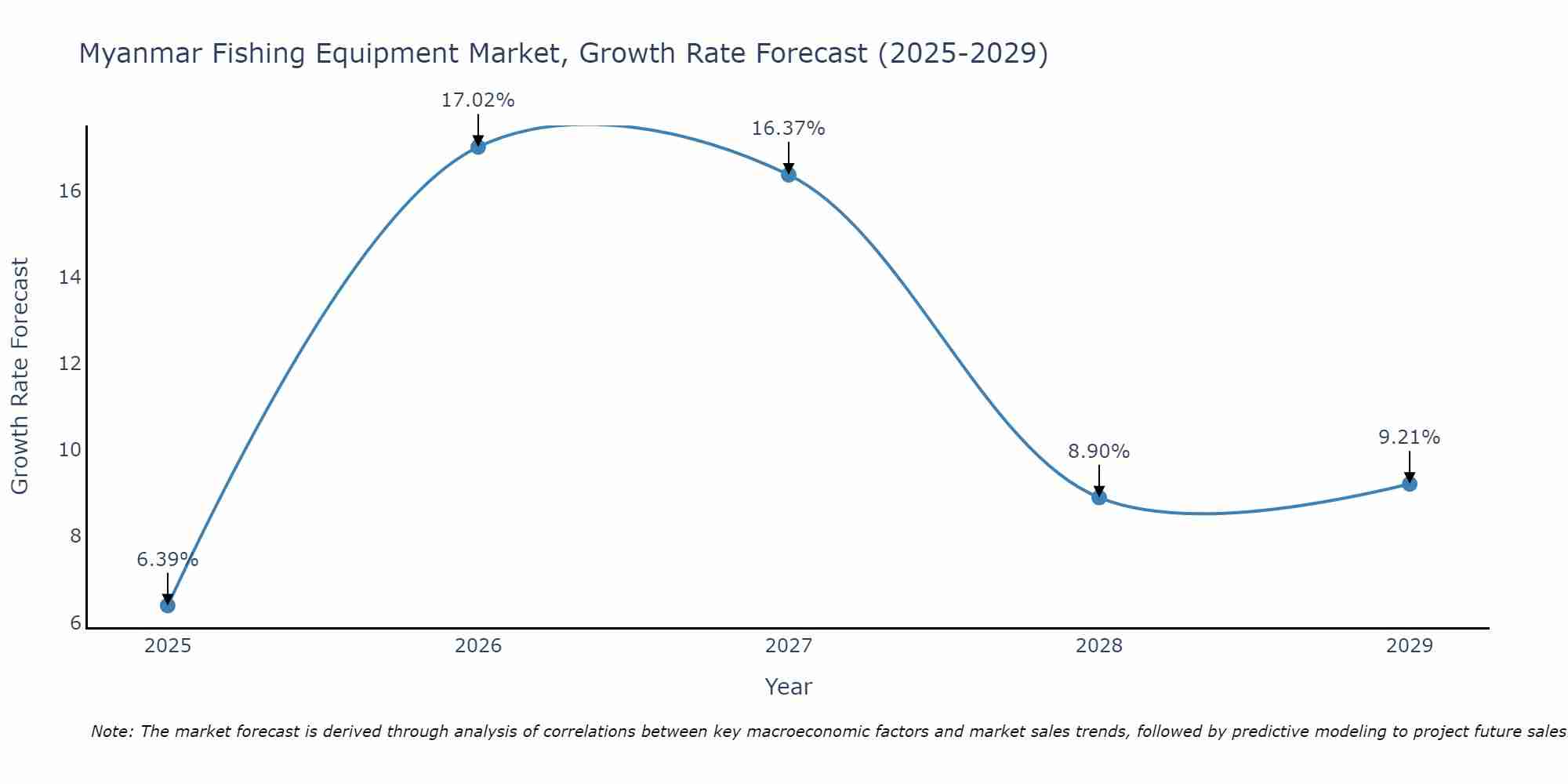
The Myanmar Fishing Equipment Market is projected to witness mixed growth rate patterns during 2025 to 2029. Starting at 6.39% in 2025, the market peaks at 17.02% in 2026, and settles at 9.21% by 2029.
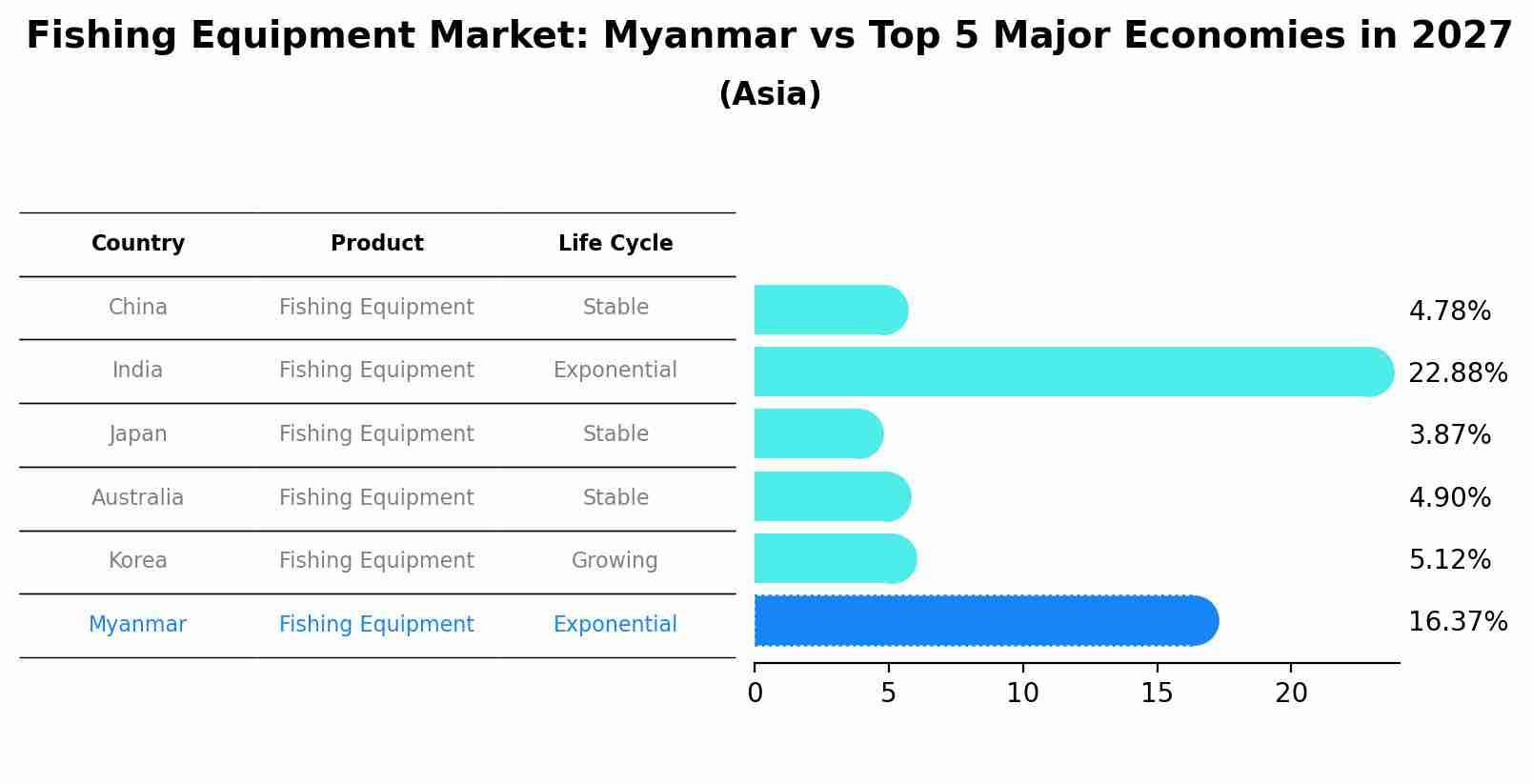
Fishing Equipment Market: Myanmar vs Top 5 Major Economies in 2027 (Asia)
By 2027, Myanmar's Fishing Equipment market is forecasted to achieve a exponential growth rate of 16.37%, with China leading the Asia region, followed by India, Japan, Australia and South Korea.
Myanmar Fishing Equipment Market Overview
The Myanmar Fishing Equipment Market is characterized by a growing demand for modern and efficient fishing tools and accessories driven by the country`s extensive coastline and abundant freshwater resources. The market offers a wide range of products including fishing rods, reels, lines, hooks, lures, nets, and other accessories catering to both commercial and recreational fishermen. The market is predominantly fragmented with a mix of local manufacturers and international brands competing for market share. Key trends in the market include a shift towards eco-friendly and sustainable fishing practices, leading to an increased demand for environmentally conscious fishing equipment. Additionally, the market is witnessing a rising interest in advanced technology such as GPS-enabled fishing gear and electronic fish finders, indicating a growing inclination towards modernization among Myanmar`s fishing community.
Myanmar Fishing Equipment Market Trends
The Myanmar fishing equipment market is experiencing a shift towards more advanced and sustainable technologies, driven by increasing awareness of environmental conservation and the need for more efficient fishing practices. There is a growing demand for eco-friendly fishing gear such as biodegradable fishing lines and non-toxic fishing lures. Additionally, there is a rising interest in smart fishing equipment that utilizes GPS technology and sensors to improve catch rates and reduce bycatch. Local manufacturers are also focusing on producing high-quality yet affordable fishing equipment to cater to the needs of both professional and recreational fishermen in Myanmar. Overall, the market is witnessing a trend towards innovation and sustainability in fishing equipment offerings.
Myanmar Fishing Equipment Market Challenges
One major challenge faced in the Myanmar Fishing Equipment Market is the prevalence of counterfeit and low-quality products. This undermines consumer trust and satisfaction, leading to potential safety concerns and reduced overall market demand. Additionally, the lack of regulations and enforcement mechanisms in the market allows for the proliferation of substandard products, making it difficult for legitimate and reputable manufacturers to compete effectively. Another challenge is the limited access to modern and advanced fishing equipment due to import restrictions and affordability issues, hindering the ability of local fishermen to improve their efficiency and productivity. Addressing these challenges through stricter regulations, quality control measures, and industry collaborations will be crucial in developing a more sustainable and competitive fishing equipment market in Myanmar.
Myanmar Fishing Equipment Market Investment Opportunities
The Myanmar Fishing Equipment Market presents promising investment opportunities due to the country`s abundant natural resources and growing fishing industry. With a coastline spanning over 2,000 kilometers and rich inland water bodies, there is a high demand for modern and efficient fishing equipment such as nets, boats, rods, and accessories. Investing in the Myanmar fishing equipment market can be lucrative as the government is focusing on promoting the fisheries sector through policy reforms and infrastructure development. Additionally, there is a growing trend towards sustainable and responsible fishing practices, creating opportunities for innovative and environmentally friendly fishing equipment. Investors can capitalize on this market by providing high-quality and cost-effective fishing equipment to meet the needs of local fishermen and contribute to the growth of the fishing industry in Myanmar.
Myanmar Fishing Equipment Market Government Policy
The government of Myanmar has implemented policies to regulate and manage the fishing equipment market in the country. These policies include licensing requirements for fishing equipment manufacturers and distributors to ensure compliance with quality and safety standards. Additionally, there are restrictions on the types of fishing gear that can be used to protect marine resources and prevent overfishing. The government also imposes export controls on certain types of fishing equipment to safeguard domestic fisheries and promote sustainable practices. Overall, these policies aim to promote responsible fishing practices, protect the environment, and support the long-term sustainability of the fishing industry in Myanmar.
Myanmar Fishing Equipment Market Future Outlook
The future outlook for the Myanmar Fishing Equipment Market appears promising, driven by factors such as the country`s abundant water resources, increasing demand for fish as a staple food source, and the growing popularity of recreational fishing among locals and tourists. With a rising middle-class population and economic development, there is a growing interest in fishing as a leisure activity, leading to a surge in demand for high-quality fishing equipment. Additionally, the government`s efforts to promote sustainable fishing practices and aquaculture activities are expected to further boost the market. International partnerships and investments in the fishing industry are also likely to drive innovation and technology adoption in the sector, creating opportunities for both domestic and foreign fishing equipment manufacturers and suppliers in Myanmar.
Key Highlights of the Report:
- Myanmar Fishing Equipment Market Outlook
- Market Size of Myanmar Fishing Equipment Market, 2021
- Forecast of Myanmar Fishing Equipment Market, 2031
- Historical Data and Forecast of Myanmar Fishing Equipment Revenues & Volume for the Period 2018 - 2031
- Myanmar Fishing Equipment Market Trend Evolution
- Myanmar Fishing Equipment Market Drivers and Challenges
- Myanmar Fishing Equipment Price Trends
- Myanmar Fishing Equipment Porter's Five Forces
- Myanmar Fishing Equipment Industry Life Cycle
- Historical Data and Forecast of Myanmar Fishing Equipment Market Revenues & Volume By Type for the Period 2018 - 2031
- Historical Data and Forecast of Myanmar Fishing Equipment Market Revenues & Volume By Hooks for the Period 2018 - 2031
- Historical Data and Forecast of Myanmar Fishing Equipment Market Revenues & Volume By Lines for the Period 2018 - 2031
- Historical Data and Forecast of Myanmar Fishing Equipment Market Revenues & Volume By Sinkers & Floats for the Period 2018 - 2031
- Historical Data and Forecast of Myanmar Fishing Equipment Market Revenues & Volume By Rods for the Period 2018 - 2031
- Historical Data and Forecast of Myanmar Fishing Equipment Market Revenues & Volume By Reels for the Period 2018 - 2031
- Historical Data and Forecast of Myanmar Fishing Equipment Market Revenues & Volume By Nets & Traps for the Period 2018 - 2031
- Historical Data and Forecast of Myanmar Fishing Equipment Market Revenues & Volume By Spear & Gaffs for the Period 2018 - 2031
- Historical Data and Forecast of Myanmar Hooks Fishing Equipment Market Revenues & Volume By Others for the Period 2018 - 2031
- Historical Data and Forecast of Myanmar Fishing Equipment Market Revenues & Volume By Nature for the Period 2018 - 2031
- Historical Data and Forecast of Myanmar Fishing Equipment Market Revenues & Volume By Fresh Water for the Period 2018 - 2031
- Historical Data and Forecast of Myanmar Fishing Equipment Market Revenues & Volume By Salt Water for the Period 2018 - 2031
- Historical Data and Forecast of Myanmar Fishing Equipment Market Revenues & Volume By Fly Fishing for the Period 2018 - 2031
- Historical Data and Forecast of Myanmar Fishing Equipment Market Revenues & Volume By Distribution Channel for the Period 2018 - 2031
- Historical Data and Forecast of Myanmar Fishing Equipment Market Revenues & Volume By Online for the Period 2018 - 2031
- Historical Data and Forecast of Myanmar Fishing Equipment Market Revenues & Volume By Offline for the Period 2018 - 2031
- Myanmar Fishing Equipment Import Export Trade Statistics
- Market Opportunity Assessment By Type
- Market Opportunity Assessment By Nature
- Market Opportunity Assessment By Distribution Channel
- Myanmar Fishing Equipment Top Companies Market Share
- Myanmar Fishing Equipment Competitive Benchmarking By Technical and Operational Parameters
- Myanmar Fishing Equipment Company Profiles
- Myanmar Fishing Equipment Key Strategic Recommendations






































