Myanmar Food Processing & Handling Equipment Market Summary
The myanmar food processing & handling equipment market was estimated at USD 371 Million in 2025 and is projected to reach USD 526 Million by 2032, growing at a CAGR of 5.9% from 2026 to 2032.
Myanmar Food Processing & Handling Equipment Market Year-wise Growth Rate and Key Drivers
This graph highlights how the Myanmar Food Processing & Handling Equipment Market has steadily grown over the past five years, supported by major growth factors.
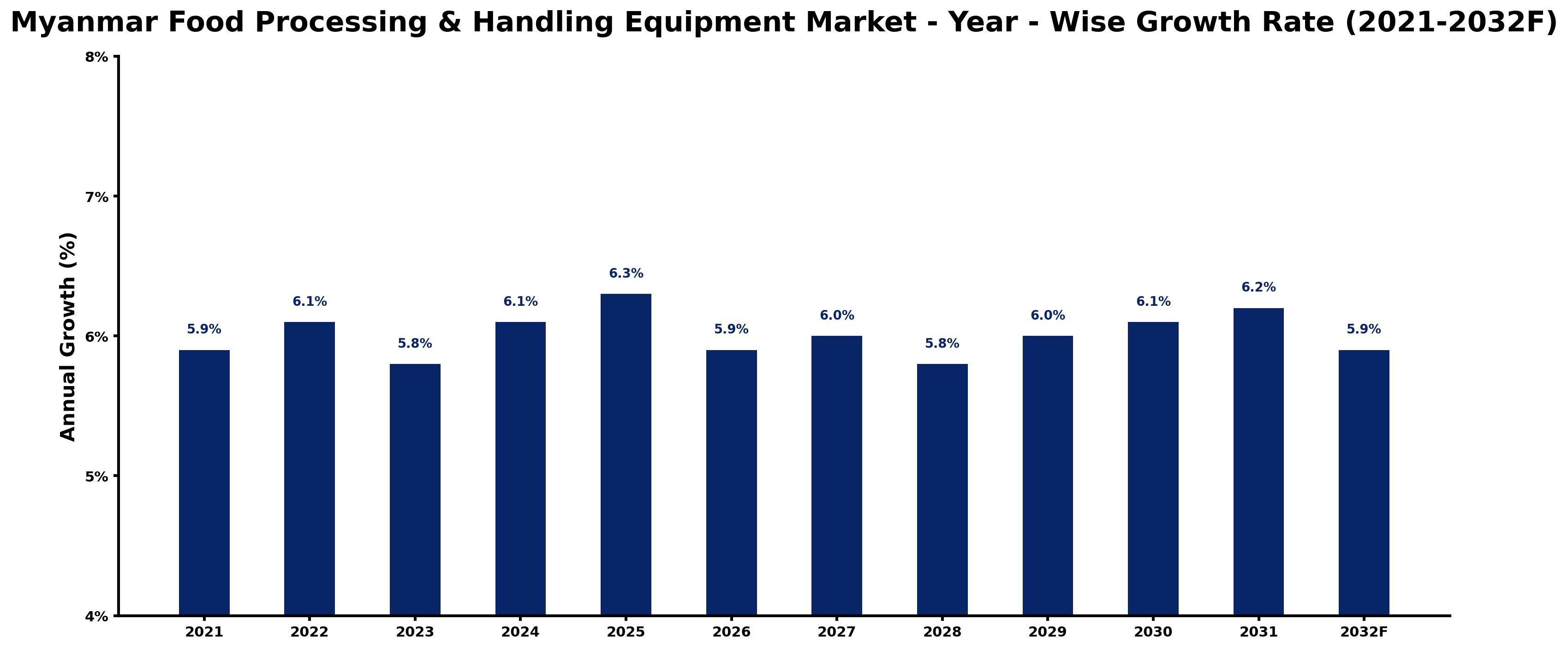
The table below presents the year wise growth rates along with the key drivers influencing the market
| Year | Growth Rate | Major Drivers |
| 2021 | 5.9% | Post-coup economic challenges create a demand for efficient food processing solutions. |
| 2022 | 6.1% | Increased urbanization leads to higher consumer expectations for quality and safety. |
| 2023 | 5.8% | Rural electrification projects enhance food storage and processing capabilities nationwide. |
| 2024 | 6.1% | Foreign investment in agriculture encourages modernization of processing equipment and techniques. |
| 2025 | 6.3% | Smallholder farms increasingly adopt mechanized solutions to boost productivity and sustainability. |
| 2026 | 5.9% | Technological training programs elevate local expertise in food processing machinery handling. |
| 2027 | 6.0% | E-commerce platforms expand distribution channels, increasing demand for advanced packaging equipment. |
| 2028 | 5.8% | Health trends prompt food businesses to invest in quality assurance and safety technologies. |
| 2029 | 6.0% | Climate change concerns drive innovations in energy-efficient food processing systems. |
| 2030 | 6.1% | Local enterprises focus on value addition, stimulating interest in processing technology upgrades. |
| 2031 | 6.2% | Consumer preferences shift towards convenience, prompting growth in ready-to-eat food processing. |
| 2032 | 5.9% | Regional trade agreements enhance market access for advanced food processing technologies. |
Note - Market size estimations and growth projections presented in this report are based on 6Wresearch's advanced forecasting approach, validated with industry datasets as of June 2026.
Myanmar Food Processing & Handling Equipment Market Synopsis
The Myanmar Food Processing Handling Equipment Market is projected to reach 5.9% and witness significant growth during the forecast period (2026-2032). This expansion is primarily fueled by factors such as increasing urbanization, growing disposable incomes, and shifting consumer preferences towards processed and convenience food products. As a result, the market presents robust opportunities across various categories of equipment, including cutting and peeling machines, mixing and blending machinery, and advanced packaging solutions, essential for meeting the rising demand.
Myanmar Food Processing & Handling Equipment Market Growth Drivers
The Myanmar Food Processing & Handling Equipment Market is experiencing a surge in growth due to several key drivers. Urbanization continues to reshape the food landscape, prompting an increased consumption of processed foods. With more individuals relocating to urban areas, there is a discernible shift in dietary preferences, emphasizing convenience. This trend is accompanied by a rise in disposable income, allowing consumers to purchase a wider range of food options.
- Technological advancements in food processing equipment are driving efficiency and innovation. Manufacturers are increasingly adopting automated solutions that enhance productivity while ensuring food safety and quality.
- Government initiatives aimed at supporting the food processing sector have bolstered investment in infrastructure and modern equipment, further propelling market growth.
- There is a growing demand for sustainable processing and packaging solutions in the market. Equipment that minimizes environmental impact is becoming increasingly popular among consumers and businesses alike.
- The rise of the middle class in Myanmar is influencing consumption patterns, leading to an increased demand for quality and variety in food products, thereby enhancing the market for food processing equipment.
- Challenges in the supply chain have necessitated the need for more sophisticated handling equipment to ensure that food products maintain optimal freshness during transportation and storage.
Myanmar Food Processing & Handling Equipment Market Trends and Opportunities
Current trends within the Myanmar Food Processing & Handling Equipment Market reflect a definitive shift towards modernization and sustainability. The industry is witnessing an increasing adoption of automation and digital technology aimed at not only enhancing productivity but also ensuring food safety and compliance with international standards.
- The integration of smart technology, including Internet of Things (IoT) solutions, is increasingly prevalent, allowing for real-time monitoring and control of food processing operations. This enhances overall efficiency and product quality.
- Innovative equipment designs that cater to both traditional local foods and modern convenience products are gaining traction, reflecting a dual focus on heritage and modern consumer needs.
- Breadth of equipment types is expanding to include thermal processing machinery that meets diverse requirements for food preservation and safety.
- Sustainable practices in equipment production are becoming essential, as environmental concerns shape consumer preferences and corporate responsibilities.
- The overall growth trajectory in the food processing sector is poised to enhance opportunities for suppliers of modern equipment tailored to evolving consumer demands.
Myanmar Food Processing & Handling Equipment Market Challenges and Restraints
Despite promising growth, the Myanmar Food Processing & Handling Equipment Market faces several significant challenges. Chief among them is the inadequacy of technological resources and machinery access. Many local businesses struggle with outdated equipment, resulting in inefficiencies.
- Limited infrastructure hampers the operational capacity of companies within the food processing sector, affecting both production and distribution logistics.
- A shortage of skilled labor presents a barrier to adopting advanced processing technologies, impacting overall productivity and quality.
- High import duties on machinery and equipment create financial obstacles for businesses looking to modernize their operations.
- Regulatory challenges surrounding food safety standards necessitate significant investments in compliance-related equipment and processes.
- Competition from cheaper imported products poses continual pressure on local manufacturers to improve quality and cost-efficiency.
Myanmar Food Processing & Handling Equipment Market Investment Opportunities
Investment prospects in the Myanmar Food Processing & Handling Equipment Market are increasingly appealing due to the surge in demand for processed and packaged food products. As urbanization accelerates and disposable incomes rise, there are numerous avenues for strategic investment.
- Investors should target the supply of advanced food processing machinery, particularly in categories like packaging equipment, refrigeration systems, and sorting and grading machines.
- Modernizing existing food processing facilities presents significant opportunities, especially for investors aiming to align local operations with international quality standards.
- The growing trend towards convenience foods creates a demand for specialized equipment that supports high-efficiency processing and packaging.
- Establishing partnerships with local businesses and government entities can yield fruitful collaborations for equipment upgrades and technological advancements.
- Investors are encouraged to support environmental sustainability initiatives within the sector, enhancing appeal among eco-conscious consumers.
Myanmar Food Processing & Handling Equipment Market Government Investment and Initiatives
Government policies in Myanmar are designed to foster growth within the Food Processing & Handling Equipment Market. The focus is on enhancing productivity, ensuring food safety, and facilitating the development of the agricultural sector. Initiatives have been established to encourage businesses to invest in modern processing technologies and equipment.
- Regulatory frameworks are being strengthened to ensure that food safety standards are met, which incentivizes the adoption of advanced machinery.
- Financial support and incentives for food processing industries are integral to encourage investment in equipment upgrades, thereby enhancing productivity and quality.
- Infrastructure improvements are a government priority, aimed at facilitating the distribution of processed goods and ensuring efficient supply chain operations.
- Policies targeted towards enhancing competitiveness in the agricultural sector are expected to correlate positively with the growth of food processing industries.
- Overall, government initiatives seek to cultivate an environment conducive to the flourishing of the food processing sector, thus supporting broader economic development goals.
Myanmar Food Processing & Handling Equipment Market Latest Developments (May 2025 - June 2026)
Between May 2025 and June 2026, the Myanmar Food Processing & Handling Equipment Market has shown signs of robust advancement. The emphasis on food safety has intensified, prompting a surge in demand for equipment that ensures high-quality standards in processing. Digital transformation in food processing operations continues to gain momentum, with an increasing number of businesses adopting automation and smart technologies to streamline their production processes. The government has launched new initiatives aimed at enhancing infrastructure, which is expected to facilitate smoother distribution of processed foods. Additionally, the global shift towards sustainable practices has inspired local manufacturers to adopt environmentally friendly equipment, aligning operations with international best practices and market expectations.
Myanmar Food Processing & Handling Equipment Market - Key Attractiveness of the Report
- 10 Years of Market Numbers
- Historical Data Starting from 2022 to 2025
- Base Year: 2025
- Forecast Data until 2032
- Key Performance Indicators Impacting the Market
- Major Upcoming Developments and Projects
Key Highlights of the Report:
- Myanmar Food Processing & Handling Equipment Market Outlook
- Market Size of Myanmar Food Processing & Handling Equipment Market, 2025
- Forecast of Myanmar Food Processing & Handling Equipment Market, 2032F
- Historical Data and Forecast of Myanmar Food Processing & Handling Equipment Revenues & Volume for the Period 2022-2032F
- Myanmar Food Processing & Handling Equipment Market Trend Evolution
- Myanmar Food Processing & Handling Equipment Market Drivers and Challenges
- Myanmar Food Processing & Handling Equipment Price Trends
- Myanmar Food Processing & Handling Equipment Porter's Five Forces
- Myanmar Food Processing & Handling Equipment Industry Life Cycle
- Historical Data and Forecast of Myanmar Food Processing & Handling Equipment Market Revenues & Volume By Equipment Type for the Period 2022-2032F
- Historical Data and Forecast of Myanmar Food Processing & Handling Equipment Market Revenues & Volume By Food Processing equipment for the Period 2022-2032F
- Historical Data and Forecast of Myanmar Food Processing & Handling Equipment Market Revenues & Volume By Foodservice equipment for the Period 2022-2032F
- Historical Data and Forecast of Myanmar Food Processing & Handling Equipment Market Revenues & Volume By Food Packaging equipment for the Period 2022-2032F
- Historical Data and Forecast of Myanmar Food Processing & Handling Equipment Market Revenues & Volume By Application for the Period 2022-2032F
- Historical Data and Forecast of Myanmar Food Processing & Handling Equipment Market Revenues & Volume By Bakery & confectionery products for the Period 2022-2032F
- Historical Data and Forecast of Myanmar Food Processing & Handling Equipment Market Revenues & Volume By Meat & poultry products for the Period 2022-2032F
- Historical Data and Forecast of Myanmar Food Processing & Handling Equipment Market Revenues & Volume By Dairy products for the Period 2022-2032F
- Historical Data and Forecast of Myanmar Food Processing & Handling Equipment Market Revenues & Volume By Alcoholic beverages for the Period 2022-2032F
- Historical Data and Forecast of Myanmar Food Processing & Handling Equipment Market Revenues & Volume By Non-alcoholic beverages for the Period 2022-2032F
- Historical Data and Forecast of Myanmar Food Processing & Handling Equipment Market Revenues & Volume By Fish & seafood products for the Period 2022-2032F
- Historical Data and Forecast of Myanmar Food Processing & Handling Equipment Market Revenues & Volume By Others? for the Period 2022-2032F
- Historical Data and Forecast of Myanmar Food Processing & Handling Equipment Market Revenues & Volume By Form for the Period 2022-2032F
- Historical Data and Forecast of Myanmar Food Processing & Handling Equipment Market Revenues & Volume By Solid for the Period 2022-2032F
- Historical Data and Forecast of Myanmar Food Processing & Handling Equipment Market Revenues & Volume By Liquid for the Period 2022-2032F
- Historical Data and Forecast of Myanmar Food Processing & Handling Equipment Market Revenues & Volume By Semi-solid for the Period 2022-2032F
- Myanmar Food Processing & Handling Equipment Import Export Trade Statistics
- Market Opportunity Assessment By Equipment Type
- Market Opportunity Assessment By Application
- Market Opportunity Assessment By Form
- Myanmar Food Processing & Handling Equipment Top Companies Market Share
- Myanmar Food Processing & Handling Equipment Competitive Benchmarking By Technical and Operational Parameters
- Myanmar Food Processing & Handling Equipment Company Profiles
- Myanmar Food Processing & Handling Equipment Key Strategic Recommendations






































