Myanmar Gas Chromatography Systems Market Size, Share & Growth Rate
The Myanmar Gas Chromatography Systems Market was estimated at USD 1053 Million in 2025 and is projected to reach USD 1509 Million by 2032, growing at a CAGR of 5.3% from 2026 to 2032. This growth trajectory is bolstered by an increasing demand across vital sectors such as pharmaceuticals, food and beverage, and environmental testing. As industries prioritize quality control and regulatory compliance, the need for advanced gas chromatography systems is expected to surge.
Myanmar Gas Chromatography Systems Market Year-wise Growth Rate and Key Drivers
This graph highlights how the Myanmar Gas Chromatography Systems Market has steadily grown over the years, supported by major growth factors.
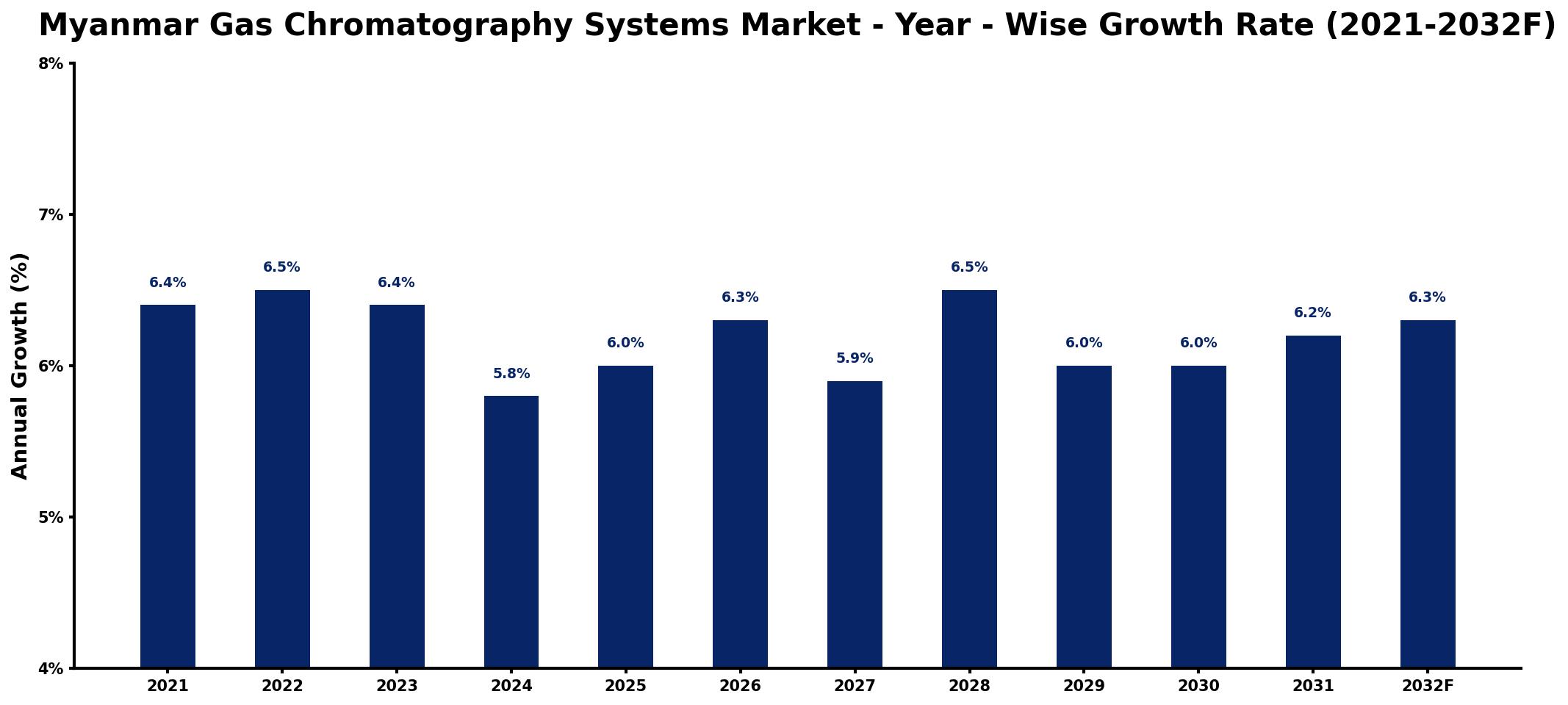
The table below presents the year‑wise growth rates along with the key drivers influencing the market
| Year | Growth Rate | Major Drivers |
| 2021 | 6.4% | Rising demand in environmental testing |
| 2022 | 6.5% | Increased investments in pharmaceuticals |
| 2023 | 6.4% | Growth in food safety regulations |
| 2024 | 5.8% | Expansion of research laboratories |
| 2025 | 6.0% | Surge in petrochemical applications |
| 2026 | 6.3% | Growing interest in academic research |
| 2027 | 5.9% | Development of renewable energy sectors |
| 2028 | 6.5% | Increased focus on quality control |
| 2029 | 6.0% | growing commercial sector adoption |
| 2030 | 6.0% | Growing adoption in agriculture |
| 2031 | 6.2% | Rise in industrial manufacturing standards |
| 2032 | 6.3% | Increased utilization in forensics |
Note: Market size estimations and growth projections presented in this report are based on 6Wresearch's proprietary forecasting methodology, utilizing the latest available industry data, government publications, and primary research inputs.
Myanmar Gas Chromatography Systems Market Synopsis
The Myanmar Gas Chromatography Systems Market is currently on an upward trajectory, driven by heightened awareness of the importance of accurate chemical analysis and environmental monitoring. Industries are increasingly adopting these systems for their ability to detect impurities and monitor pollutants effectively, reflecting a broader commitment to quality assurance.
Recent government initiatives aimed at improving regulatory standards have further catalyzed market growth. This creates a favorable environment for stakeholders who are seeking to enhance analytical capabilities while ensuring compliance with national and international benchmarks.
Myanmar Gas Chromatography Systems Market Key Takeaways
- The market is propelled by rising demand from industries such as pharmaceuticals and environmental testing.
- Investment opportunities abound due to the government's focus on quality control and regulatory compliance.
- Technological advancements are leading to the introduction of user-friendly and portable systems.
- Partnerships with local distributors can facilitate market entry for innovative solutions.
- Compliance with international quality standards is becoming increasingly vital for market participants.
Evaluation of Restraints in Myanmar Gas Chromatography Systems Market
Despite its potential, the Myanmar Gas Chromatography Systems Market faces significant constraints. Limited awareness about the technology among potential users hinders widespread adoption, as many are not fully cognizant of the benefits that GC systems offer. Additionally, the lack of skilled professionals to operate and maintain these advanced systems poses a barrier to optimal utilization. Outdated infrastructure and regulatory frameworks further complicate matters, impeding the pace of market advancement and the entry of smaller firms in a competitive landscape.
Myanmar Gas Chromatography Systems Market Trends
A noticeable trend in the Myanmar Gas Chromatography Systems Market is the growing preference for portable and user-friendly systems. These devices are favored for their high sensitivity and accuracy, particularly in applications related to environmental analysis and food safety. Furthermore, the shift towards gas chromatography-mass spectrometry (GC-MS) is becoming more pronounced, as it offers enhanced analytical capabilities that meet evolving industrial needs. Automation features are also gaining traction, contributing to faster analysis and improved detection limits.
Myanmar Gas Chromatography Systems Market Opportunities
Significant investment opportunities exist in the Myanmar Gas Chromatography Systems Market, primarily due to the burgeoning industrial and environmental monitoring sectors. The increasing need for precise analytical instruments presents an opening for investors to introduce innovative and reliable gas chromatography solutions tailored to local market demands. Collaborating with local distributors and service providers can bolster market presence, while focusing on quality control and regulatory compliance can further enhance investor confidence in this growing landscape.
Government Initiatives in the Myanmar Gas Chromatography Systems Market
Government policies surrounding the Myanmar Gas Chromatography Systems Market emphasize environmental sustainability and the assurance of product quality and safety. The Ministry of Natural Resources and Environmental Conservation is instrumental in regulating the use of gas chromatography systems to minimize environmental impacts, while the Ministry of Health and Sports oversees product safety standards. The government also promotes research and development in gas chromatography through various incentives, creating a conducive regulatory environment that encourages technological advancement and competitiveness.
Future Insights of the Myanmar Gas Chromatography Systems Market
Looking ahead to 2026-2032, the Myanmar Gas Chromatography Systems Market is set to experience consistent growth, fueled by rising demand for analytical instruments across various sectors. As industrial infrastructure continues to expand and quality control becomes a paramount focus, the market is likely to evolve with advancements in technology. Government initiatives aimed at fostering investment and industrial development are expected to bolster this upward trend, providing a robust foundation for future growth and innovation.
Myanmar Gas Chromatography Systems Market Latest Developments (2025 - 2026)
Recent industry developments reflect a growing emphasis on innovation and compliance within the Myanmar Gas Chromatography Systems Market. Increased collaborations between technology providers and local industries are resulting in tailored solutions that enhance analytical capabilities. Additionally, there is a heightened focus on upgrading infrastructure to better support the deployment of advanced GC systems, ensuring adherence to evolving regulatory standards.
Myanmar Gas Chromatography Systems Market - Key Attractiveness of the Report
- 10 Years of Market Numbers
- Historical Data Starting from 2022 to 2025
- Base Year: 2025
- Forecast Data until 2032
- Key Performance Indicators Impacting the Market
- Major Upcoming Developments and Projects
Key Highlights of the Report:
- Myanmar Gas Chromatography Systems Market Outlook
- Market Size of Myanmar Gas Chromatography Systems Market, 2025
- Forecast of Myanmar Gas Chromatography Systems Market, 2032
- Historical Data and Forecast of Myanmar Gas Chromatography Systems Revenues & Volume for the Period 2022-2032F
- Myanmar Gas Chromatography Systems Market Trend Evolution
- Myanmar Gas Chromatography Systems Market Drivers and Challenges
- Myanmar Gas Chromatography Systems Price Trends
- Myanmar Gas Chromatography Systems Porter's Five Forces
- Myanmar Gas Chromatography Systems Industry Life Cycle
- Historical Data and Forecast of Myanmar Gas Chromatography Systems Market Revenues & Volume By Product for the Period 2022-2032F
- Historical Data and Forecast of Myanmar Gas Chromatography Systems Market Revenues & Volume By Systems for the Period 2022-2032F
- Historical Data and Forecast of Myanmar Gas Chromatography Systems Market Revenues & Volume By Detectors for the Period 2022-2032F
- Historical Data and Forecast of Myanmar Gas Chromatography Systems Market Revenues & Volume By Auto-samplers for the Period 2022-2032F
- Historical Data and Forecast of Myanmar Gas Chromatography Systems Market Revenues & Volume By Fraction Collectors for the Period 2022-2032F
- Historical Data and Forecast of Myanmar Gas Chromatography Systems Market Revenues & Volume By Other Products for the Period 2022-2032F
- Historical Data and Forecast of Myanmar Gas Chromatography Systems Market Revenues & Volume By End User for the Period 2022-2032F
- Historical Data and Forecast of Myanmar Gas Chromatography Systems Market Revenues & Volume By Pharmaceutical and Bioindustries for the Period 2022-2032F
- Historical Data and Forecast of Myanmar Gas Chromatography Systems Market Revenues & Volume By Academic Research Institutes for the Period 2022-2032F
- Historical Data and Forecast of Myanmar Gas Chromatography Systems Market Revenues & Volume By Other End Users for the Period 2022-2032F
- Myanmar Gas Chromatography Systems Import Export Trade Statistics
- Market Opportunity Assessment By Product
- Market Opportunity Assessment By End User
- Myanmar Gas Chromatography Systems Top Companies Market Share
- Myanmar Gas Chromatography Systems Competitive Benchmarking By Technical and Operational Parameters
- Myanmar Gas Chromatography Systems Company Profiles
- Myanmar Gas Chromatography Systems Key Strategic Recommendations






































