Myanmar Gas Compressor Market Size Growth Rate
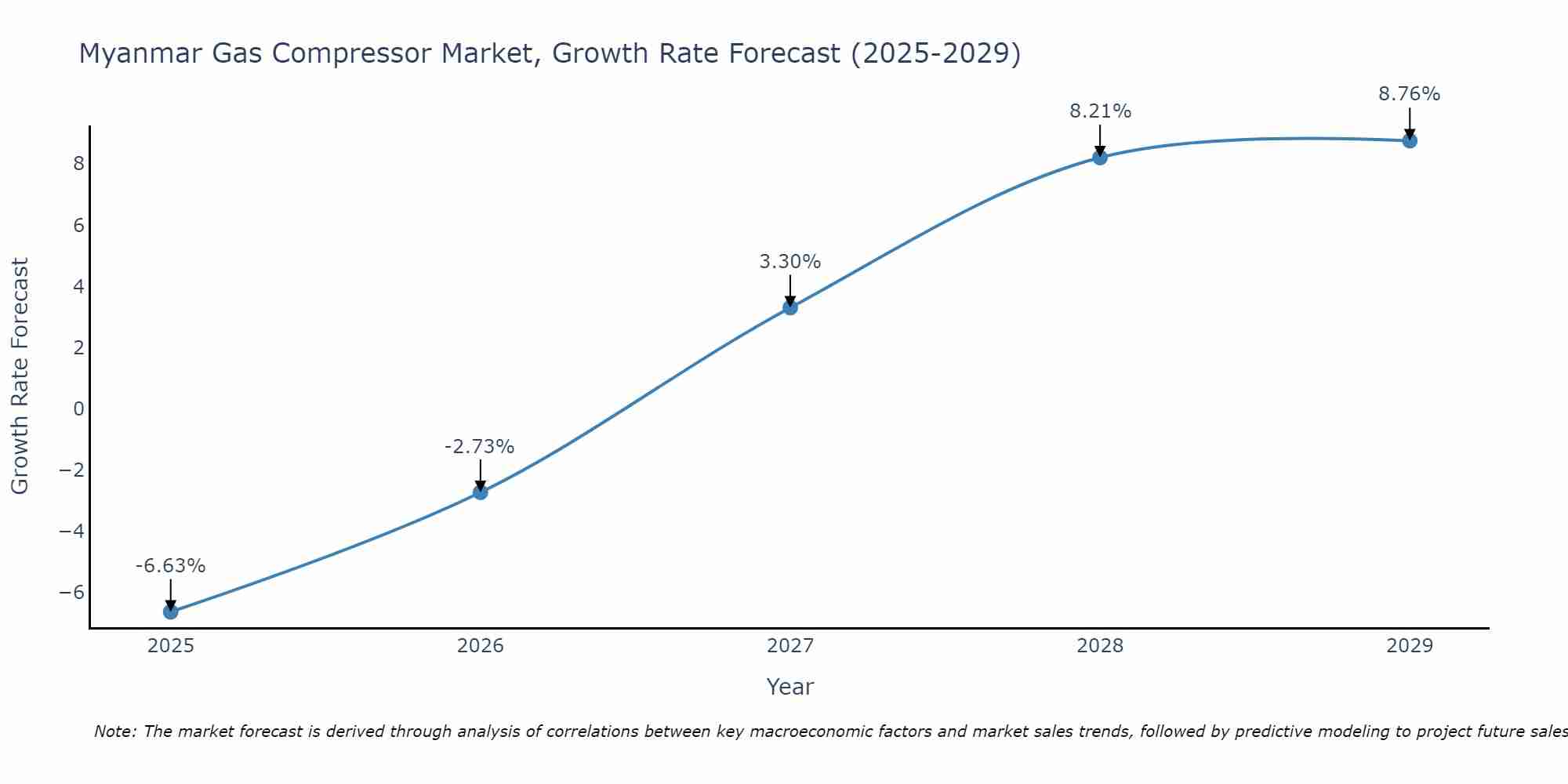
The Myanmar Gas Compressor Market is poised for steady growth rate improvements from 2025 to 2029. From -6.63% in 2025, the growth rate steadily ascends to 8.76% in 2029.
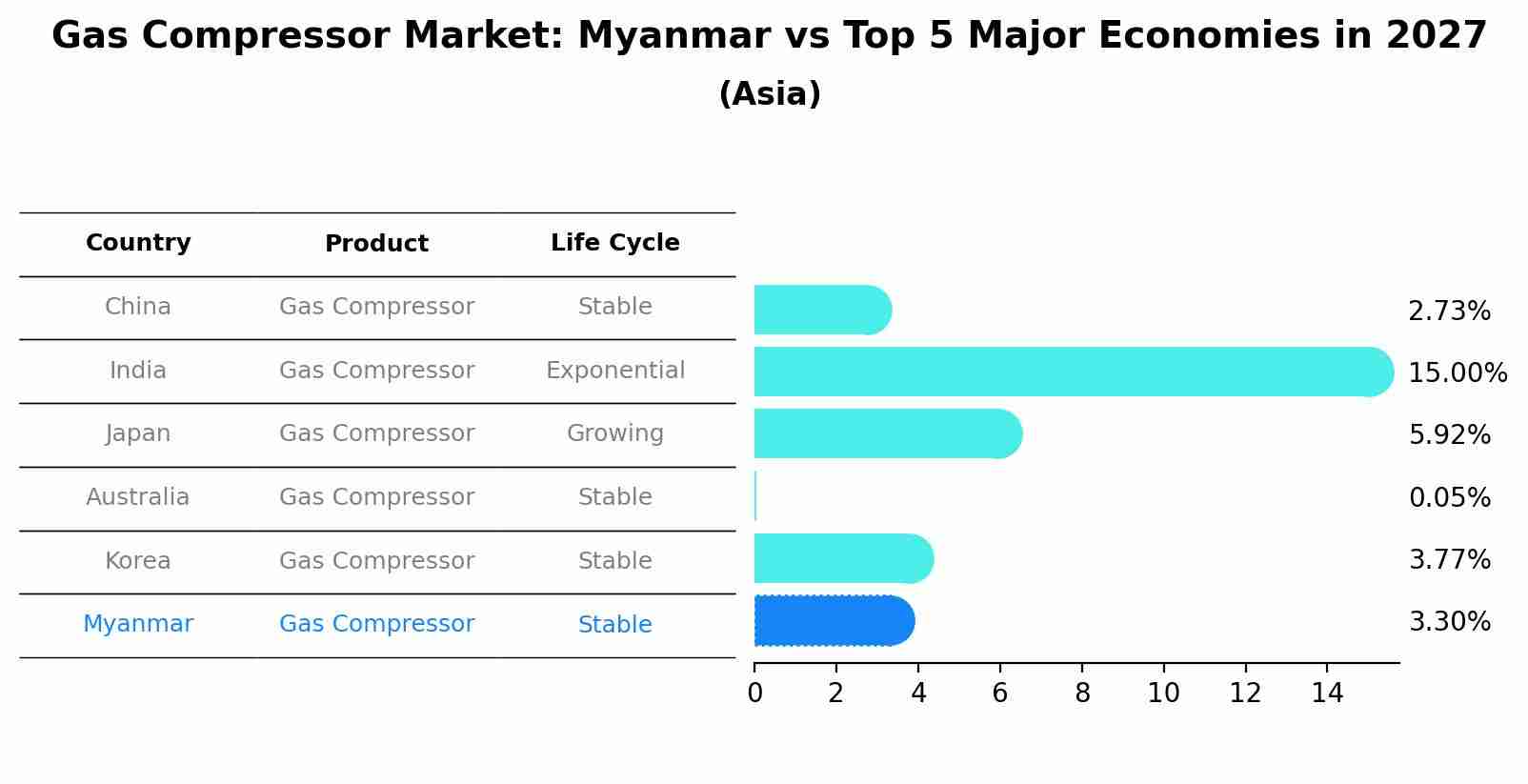
Gas Compressor Market: Myanmar vs Top 5 Major Economies in 2027 (Asia)
In the Asia region, the Gas Compressor market in Myanmar is projected to expand at a stable growth rate of 3.30% by 2027. The largest economy is China, followed by India, Japan, Australia and South Korea.
Myanmar Gas Compressor Market Overview
The Myanmar Gas Compressor Market is experiencing steady growth driven by increasing investments in the country`s oil and gas sector. The market is primarily dominated by international players offering a wide range of compressors for various applications including upstream, midstream, and downstream operations. Key trends in the market include a shift towards more efficient and environmentally friendly compressors, as well as a growing emphasis on digitalization and automation technologies. The demand for gas compressors in Myanmar is expected to continue rising as the country aims to expand its natural gas production and infrastructure. Market players are focusing on innovation and strategic partnerships to capitalize on the opportunities presented by the growing demand for gas compressors in Myanmar.
Myanmar Gas Compressor Market Trends
The Myanmar Gas Compressor Market is witnessing a growing demand for efficient and environmentally friendly compressor technologies. There is a notable shift towards the adoption of natural gas as a cleaner energy source, driving the need for advanced gas compressor solutions that can enhance operational efficiency and reduce emissions. Additionally, the exploration and production activities in Myanmar`s oil and gas sector are expected to drive the demand for gas compressors for various applications, such as gas gathering, transmission, and processing. Market players are focusing on developing innovative compressor technologies with improved performance and reliability to cater to the evolving needs of the industry. Overall, the market is poised for growth opportunities driven by increasing investments in the oil and gas sector and the emphasis on sustainable energy solutions.
Myanmar Gas Compressor Market Challenges
The Myanmar Gas Compressor Market faces several challenges, including limited infrastructure development, political instability, and inconsistent regulatory frameworks. The lack of adequate infrastructure, such as pipelines and storage facilities, hinders the efficient transportation and distribution of natural gas. Political instability and regulatory uncertainties create a challenging business environment, leading to delays in project approvals and implementation. Additionally, the market is also impacted by fluctuations in global gas prices and competition from other energy sources. These challenges pose obstacles to the growth and development of the gas compressor market in Myanmar, requiring industry players to navigate complex hurdles to establish a stable and sustainable presence in the country.
Myanmar Gas Compressor Market Investment Opportunities
The Myanmar Gas Compressor Market offers promising investment opportunities due to the country`s growing energy sector and increasing demand for natural gas. With Myanmar being a key player in the region`s energy industry, there is a need for advanced gas compressor technology to enhance production and distribution efficiency. Investing in gas compressor manufacturing, distribution, or technology companies could be lucrative as the government continues to focus on expanding the country`s energy infrastructure. Additionally, with Myanmar`s strategic location between major energy markets in Asia, there is potential for partnerships and collaborations with international companies looking to establish a presence in the region. Overall, the Myanmar Gas Compressor Market presents opportunities for investors to capitalize on the country`s energy sector growth and contribute to its development.
Myanmar Gas Compressor Market Government Policy
The government of Myanmar has implemented policies to encourage investment and development in the gas compressor market. These policies include offering tax incentives and providing subsidies to attract foreign investors and promote local manufacturing of gas compressors. Additionally, the government has introduced regulations to ensure environmental sustainability and safety standards in the industry. The Myanmar government is also focusing on enhancing infrastructure and promoting research and development in the gas compressor sector to boost production capacity and meet the growing demand for energy in the country. Overall, these policies aim to create a conducive environment for growth and competitiveness in the Myanmar gas compressor market.
Myanmar Gas Compressor Market Future Outlook
The Myanmar gas compressor market is expected to witness steady growth in the coming years due to increasing investments in the country`s oil and gas sector. The expansion of natural gas exploration and production activities, coupled with the rising demand for natural gas in Myanmar and neighboring countries, will drive the demand for gas compressors. Additionally, the government`s efforts to attract foreign investments in the energy sector and the development of new gas fields are likely to further boost the market. Technological advancements in compressor systems, such as the adoption of more energy-efficient and environmentally friendly solutions, are also expected to play a key role in shaping the future of the Myanmar gas compressor market.
Key Highlights of the Report:
- Myanmar Gas Compressor Market Outlook
- Market Size of Myanmar Gas Compressor Market, 2021
- Forecast of Myanmar Gas Compressor Market, 2031
- Historical Data and Forecast of Myanmar Gas Compressor Revenues & Volume for the Period 2018 - 2031
- Myanmar Gas Compressor Market Trend Evolution
- Myanmar Gas Compressor Market Drivers and Challenges
- Myanmar Gas Compressor Price Trends
- Myanmar Gas Compressor Porter's Five Forces
- Myanmar Gas Compressor Industry Life Cycle
- Historical Data and Forecast of Myanmar Gas Compressor Market Revenues & Volume By Type for the Period 2018 - 2031
- Historical Data and Forecast of Myanmar Gas Compressor Market Revenues & Volume By Oil Injected for the Period 2018 - 2031
- Historical Data and Forecast of Myanmar Gas Compressor Market Revenues & Volume By Oil Free for the Period 2018 - 2031
- Historical Data and Forecast of Myanmar Gas Compressor Market Revenues & Volume By Compressor for the Period 2018 - 2031
- Historical Data and Forecast of Myanmar Gas Compressor Market Revenues & Volume By Dynamic Compressor for the Period 2018 - 2031
- Historical Data and Forecast of Myanmar Gas Compressor Market Revenues & Volume By Positive Displacement Compressor for the Period 2018 - 2031
- Historical Data and Forecast of Myanmar Gas Compressor Market Revenues & Volume By End User for the Period 2018 - 2031
- Historical Data and Forecast of Myanmar Gas Compressor Market Revenues & Volume By Construction for the Period 2018 - 2031
- Historical Data and Forecast of Myanmar Gas Compressor Market Revenues & Volume By Oil & Gas for the Period 2018 - 2031
- Historical Data and Forecast of Myanmar Gas Compressor Market Revenues & Volume By Mining for the Period 2018 - 2031
- Historical Data and Forecast of Myanmar Gas Compressor Market Revenues & Volume By Chemicals for the Period 2018 - 2031
- Historical Data and Forecast of Myanmar Gas Compressor Market Revenues & Volume By Power Generation for the Period 2018 - 2031
- Historical Data and Forecast of Myanmar Gas Compressor Market Revenues & Volume By Others for the Period 2018 - 2031
- Myanmar Gas Compressor Import Export Trade Statistics
- Market Opportunity Assessment By Type
- Market Opportunity Assessment By Compressor
- Market Opportunity Assessment By End User
- Myanmar Gas Compressor Top Companies Market Share
- Myanmar Gas Compressor Competitive Benchmarking By Technical and Operational Parameters
- Myanmar Gas Compressor Company Profiles
- Myanmar Gas Compressor Key Strategic Recommendations






































