Myanmar Gas Equipment Market Size, Share & Growth Rate
The Myanmar Gas Equipment Market was estimated at USD 286 Million in 2025 and is projected to reach USD 398 Million by 2032, growing at a CAGR of 4.8% from 2026 to 2032. This growth is driven by the country's increasing focus on clean energy solutions and the expansion of its industrial sector. As Myanmar advances its natural gas infrastructure and improves energy access in rural and urban areas, the demand for gas equipment is expected to see robust growth.
Myanmar Gas Equipment Market Year-wise Growth Rate and Key Drivers
This graph highlights how the Myanmar Gas Equipment Market has steadily grown over the years, supported by major growth factors.
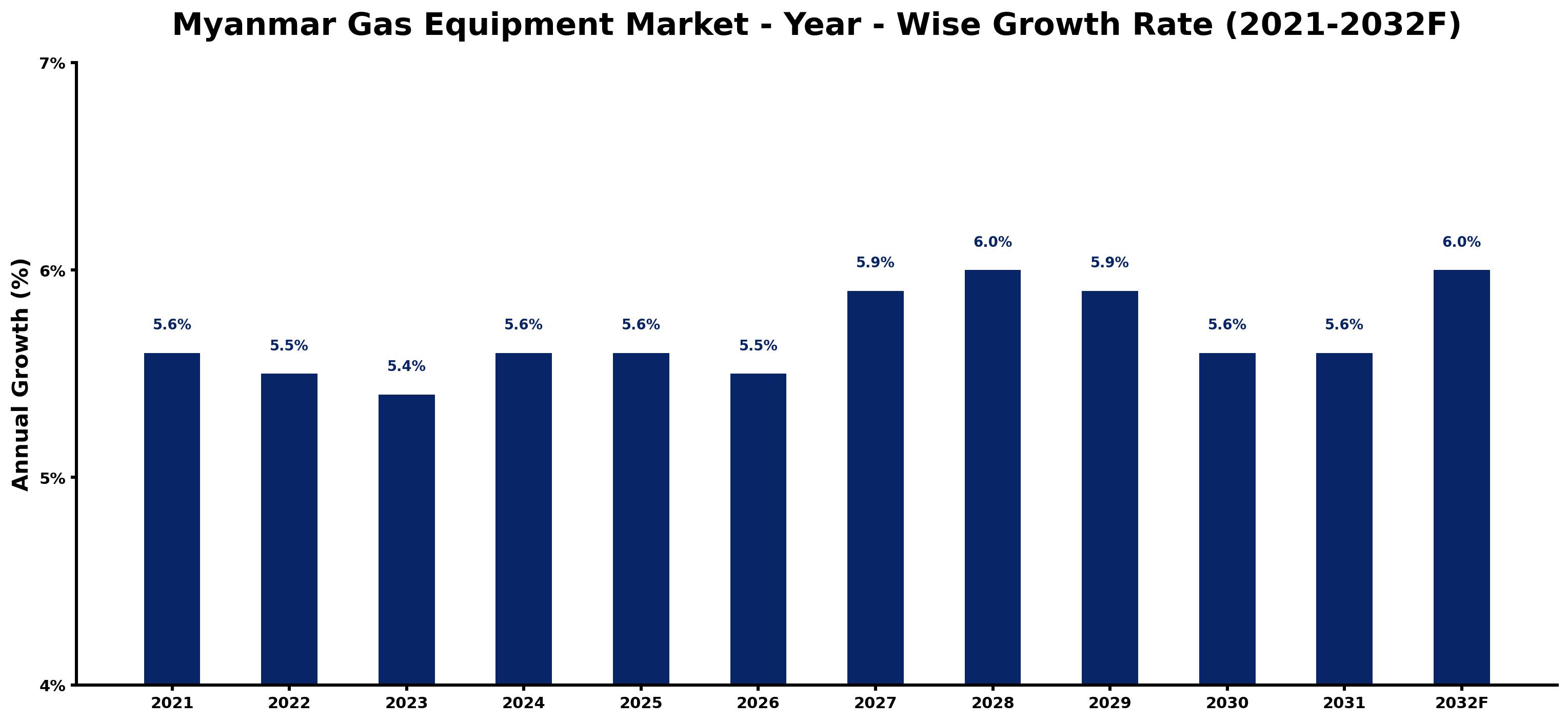
The table below presents the year‑wise growth rates along with the key drivers influencing the market
| Year | Growth Rate | Major Drivers |
| 2021 | 5.6% | Increasing adoption of advanced technologies |
| 2022 | 5.5% | Government infrastructure modernization initiatives |
| 2023 | 5.4% | Increasing adoption of advanced technologies |
| 2024 | 5.6% | Increasing smart city development projects |
| 2025 | 5.6% | Expansion of manufacturing activities |
| 2026 | 5.5% | Expansion of commercial construction activities |
| 2027 | 5.9% | Rapid growth in telecom and data center sectors |
| 2028 | 6.0% | Rapid growth in telecom and data center sectors |
| 2029 | 5.9% | Growing renewable energy integration projects |
| 2030 | 5.6% | Rising electricity demand across industries |
| 2031 | 5.6% | Growing renewable energy integration projects |
| 2032 | 6.0% | Increasing industrial automation investments |
Note - Market size estimations and growth projections presented in this report are based on 6Wresearch’s advanced forecasting approach, validated with industry datasets as of June 2026.
Myanmar Gas Equipment Market Synopsis
In recent years, the Myanmar Gas Equipment Market has been characterized by steady momentum, largely fueled by governmental support for natural gas as a cleaner energy source. As the nation invests in its gas distribution network and infrastructure, a significant opportunity for growth in this sector emerges.
Looking ahead, the market is poised for further expansion driven by increasing urbanization, rising disposable incomes, and a growing preference for modern energy solutions among consumers. This creates a fertile environment for both local suppliers and international entrants to thrive.
Myanmar Gas Equipment Market Key Takeaways
- The market is experiencing a steady CAGR of 4.8% from 2026 to 2032, reflecting robust demand.
- Local suppliers dominate the market, but international companies are increasingly entering the landscape.
- There is a notable shift towards eco-friendly gas equipment driven by consumer preferences.
- Investments in infrastructure and energy access initiatives are critical for market growth.
- Challenges such as infrastructure limitations and counterfeit products need addressing for sustained progress.
Evaluation of Restraints in Myanmar Gas Equipment Market
While the Myanmar Gas Equipment Market is on an upward trajectory, it faces several notable constraints. Limited infrastructure development, particularly in rural areas, restricts access and distribution of gas equipment. This, combined with inconsistent regulatory frameworks and a lack of quality control, poses significant risks for both consumers and manufacturers. Furthermore, the presence of counterfeit products undermines consumer confidence, potentially jeopardizing the reputation of legitimate brands and increasing safety risks.
Myanmar Gas Equipment Market Trends
Current trends indicate a growing emphasis on efficient and environmentally friendly gas equipment, such as advanced gas stoves, heaters, and water heaters. This aligns with the broader consumer shift towards sustainability and innovative technology in household applications. Additionally, the rise in urban populations coupled with increasing disposable incomes is enhancing the demand for modern gas equipment across residential and commercial sectors.
Myanmar Gas Equipment Market Opportunities
The Myanmar Gas Equipment Market holds substantial investment potential, particularly as the country emerges as a key player in natural gas production. Investors have the opportunity to supply cutting-edge technology and equipment for gas exploration, production, and transportation. Collaborations with local firms for domestic manufacturing can also capitalize on the rising demand, ensuring equipment is tailored to meet local needs while fostering economic development.
Government Initiatives in the Myanmar Gas Equipment Market
The Myanmar government is actively promoting policies aimed at enhancing the use of clean energy sources while ensuring safety standards in the gas equipment sector. Initiatives are in place to incentivize the adoption of efficient and environmentally friendly products, thereby reducing dependence on traditional fuels. Regulatory frameworks are being established to improve safety measures surrounding gas equipment, safeguarding consumer welfare while promoting responsible industrial practices.
Future Insights of the Myanmar Gas Equipment Market
The outlook for the Myanmar Gas Equipment Market is optimistic, with sustained growth anticipated through 2026-2032. Factors such as ongoing industrialization, urbanization, and government commitment to natural gas as a cleaner energy source will drive demand for gas equipment across various sectors. Nonetheless, companies must navigate potential regulatory challenges and competition from alternative energy sources to realize the full potential of the market.
Myanmar Gas Equipment Market Latest Developments (May 2025 - June 2026)
Recent developments in the Myanmar Gas Equipment Market highlight significant progress toward infrastructure enhancement and modernization. There is a growing focus on sustainable practices and technological innovation, with several manufacturers investing in research and development to cater to evolving market needs. Additionally, various public-private partnerships are emerging, aimed at boosting the local manufacturing landscape to ensure the availability of quality gas equipment.
Myanmar Gas Equipment Market - Key Attractiveness of the Report
- 10 Years of Market Numbers
- Historical Data Starting from 2022 to 2025
- Base Year: 2025
- Forecast Data until 2032
- Key Performance Indicators Impacting the Market
- Major Upcoming Developments and Projects
Key Highlights of the Report:
- Myanmar Gas Equipment Market Outlook
- Market Size of Myanmar Gas Equipment Market, 2025
- Forecast of Myanmar Gas Equipment Market, 2032F
- Historical Data and Forecast of Myanmar Gas Equipment Revenues & Volume for the Period 2022-2032F
- Myanmar Gas Equipment Market Trend Evolution
- Myanmar Gas Equipment Market Drivers and Challenges
- Myanmar Gas Equipment Price Trends
- Myanmar Gas Equipment Porter's Five Forces
- Myanmar Gas Equipment Industry Life Cycle
- Historical Data and Forecast of Myanmar Gas Equipment Market Revenues & Volume By Equipment Type for the Period 2022-2032F
- Historical Data and Forecast of Myanmar Gas Equipment Market Revenues & Volume By Gas Delivery Systems for the Period 2022-2032F
- Historical Data and Forecast of Myanmar Gas Equipment Market Revenues & Volume By Gas Regulators for the Period 2022-2032F
- Historical Data and Forecast of Myanmar Gas Equipment Market Revenues & Volume By Flow Devices for the Period 2022-2032F
- Historical Data and Forecast of Myanmar Gas Equipment Market Revenues & Volume By Purifiers & Filters for the Period 2022-2032F
- Historical Data and Forecast of Myanmar Gas Equipment Market Revenues & Volume By Gas Generating Systems for the Period 2022-2032F
- Historical Data and Forecast of Myanmar Gas Equipment Market Revenues & Volume By Gas Detection Systems for the Period 2022-2032F
- Historical Data and Forecast of Myanmar Gas Equipment Market Revenues & Volume By Cryogenic Products for the Period 2022-2032F
- Historical Data and Forecast of Myanmar Gas Delivery Systems Gas Equipment Market Revenues & Volume By Accessories for the Period 2022-2032F
- Historical Data and Forecast of Myanmar Gas Equipment Market Revenues & Volume By Process for the Period 2022-2032F
- Historical Data and Forecast of Myanmar Gas Equipment Market Revenues & Volume By Gas Generation for the Period 2022-2032F
- Historical Data and Forecast of Myanmar Gas Equipment Market Revenues & Volume By Gas Storage for the Period 2022-2032F
- Historical Data and Forecast of Myanmar Gas Equipment Market Revenues & Volume By Gas Detection for the Period 2022-2032F
- Historical Data and Forecast of Myanmar Gas Equipment Market Revenues & Volume By Gas Transportation for the Period 2022-2032F
- Historical Data and Forecast of Myanmar Gas Equipment Market Revenues & Volume By End-Gas for the Period 2022-2032F
- Historical Data and Forecast of Myanmar Gas Equipment Market Revenues & Volume By Nitrogen for the Period 2022-2032F
- Historical Data and Forecast of Myanmar Gas Equipment Market Revenues & Volume By Hydrogen for the Period 2022-2032F
- Historical Data and Forecast of Myanmar Gas Equipment Market Revenues & Volume By Helium for the Period 2022-2032F
- Historical Data and Forecast of Myanmar Gas Equipment Market Revenues & Volume By Oxygen for the Period 2022-2032F
- Historical Data and Forecast of Myanmar Gas Equipment Market Revenues & Volume By Carbon Dioxide for the Period 2022-2032F
- Historical Data and Forecast of Myanmar Gas Equipment Market Revenues & Volume By Others for the Period 2022-2032F
- Historical Data and Forecast of Myanmar Gas Equipment Market Revenues & Volume By End-Users for the Period 2022-2032F
- Historical Data and Forecast of Myanmar Gas Equipment Market Revenues & Volume By Metal Fabrication for the Period 2022-2032F
- Historical Data and Forecast of Myanmar Gas Equipment Market Revenues & Volume By Chemicals for the Period 2022-2032F
- Historical Data and Forecast of Myanmar Gas Equipment Market Revenues & Volume By Healthcare for the Period 2022-2032F
- Historical Data and Forecast of Myanmar Gas Equipment Market Revenues & Volume By Oil and Gas for the Period 2022-2032F
- Historical Data and Forecast of Myanmar Gas Equipment Market Revenues & Volume By Food and Beverage for the Period 2022-2032F
- Historical Data and Forecast of Myanmar Gas Equipment Market Revenues & Volume By Others for the Period 2022-2032F
- Myanmar Gas Equipment Import Export Trade Statistics
- Market Opportunity Assessment By Equipment Type
- Market Opportunity Assessment By Process
- Market Opportunity Assessment By End-Gas
- Market Opportunity Assessment By End-Users
- Myanmar Gas Equipment Top Companies Market Share
- Myanmar Gas Equipment Competitive Benchmarking By Technical and Operational Parameters
- Myanmar Gas Equipment Company Profiles
- Myanmar Gas Equipment Key Strategic Recommendations






































