Myanmar High Strength Steel Market Size, Share & Growth Rate
The Myanmar High Strength Steel Market was estimated at USD 398 Million in 2025 and is projected to reach USD 538 Million by 2032, growing at a CAGR of 4.4% from 2026 to 2032. This growth trajectory is primarily driven by the surge in infrastructure projects and the expansion of the automotive manufacturing sector. With an increasing focus on lightweight materials to enhance structural integrity and performance, high-strength steel is becoming a key component in various applications across multiple industries in Myanmar.
Myanmar High Strength Steel Market Year-wise Growth Rate and Key Drivers
This graph highlights how the Myanmar High Strength Steel Market has steadily grown over the years, supported by major growth factors.
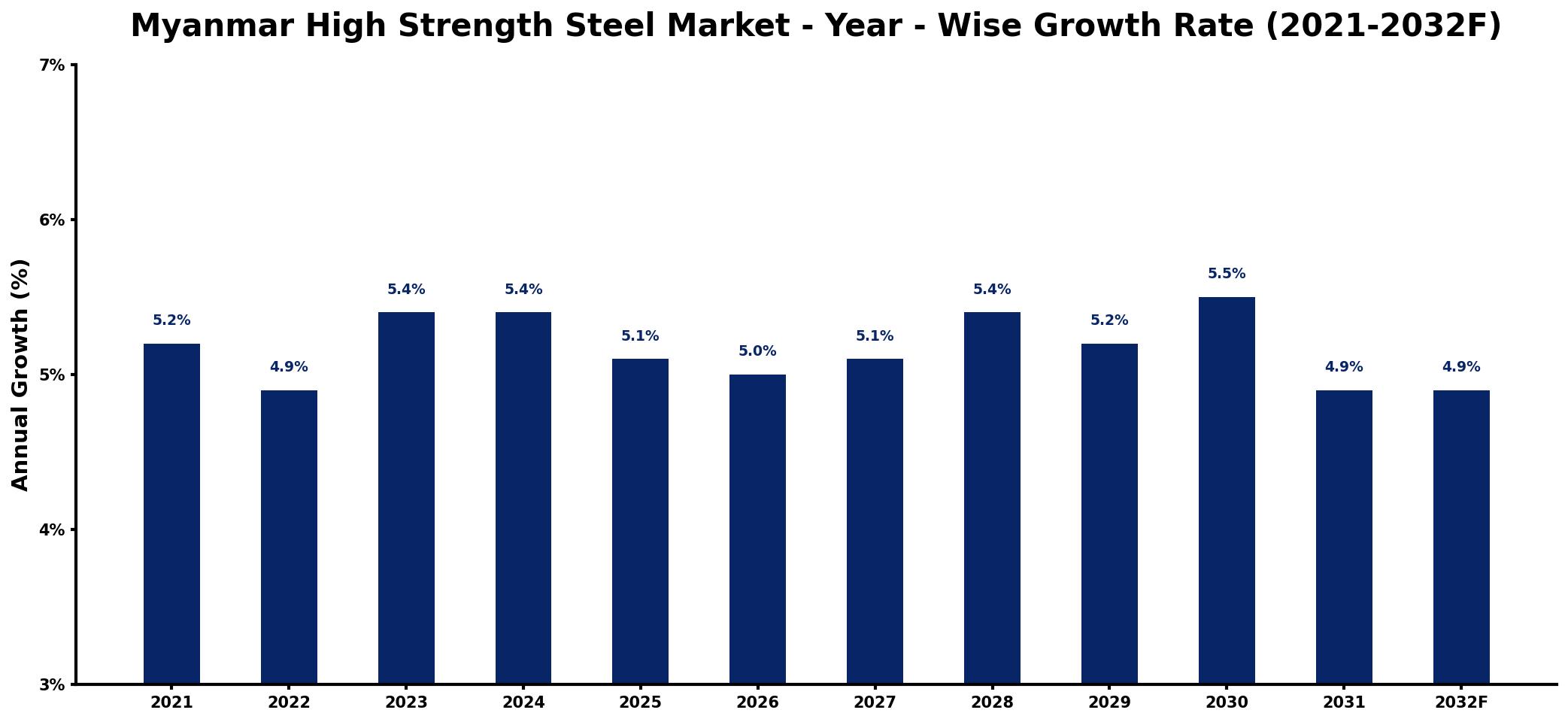
The table below presents the year‑wise growth rates along with the key drivers influencing the market
| Year | Growth Rate | Major Drivers |
| 2021 | 5.2% | Renewable energy sector expansion |
| 2022 | 4.9% | Infrastructure projects gaining momentum |
| 2023 | 5.4% | Automotive manufacturing increasing output |
| 2024 | 5.4% | Construction industry experiencing revival |
| 2025 | 5.1% | Government investment in infrastructure |
| 2026 | 5.0% | Technological advancements in applications |
| 2027 | 5.1% | Export opportunities in regional markets |
| 2028 | 5.4% | Urbanization driving construction demand |
| 2029 | 5.2% | Rising demand for durable materials |
| 2030 | 5.5% | Sustainability initiatives boosting investments |
| 2031 | 4.9% | Emerging markets increasing consumption |
| 2032 | 4.9% | Innovation in manufacturing processes |
Note: Market size estimations and growth projections presented in this report are based on 6Wresearch's proprietary forecasting methodology, utilizing the latest available industry data, government publications, and primary research inputs.
Myanmar High Strength Steel Market Synopsis
Recent momentum in the Myanmar high-strength steel market is characterized by robust demand stemming from both construction and automotive industries. However, as these sectors evolve, the market is anticipated to transition towards more specialized applications that leverage advanced steel grades with enhanced mechanical properties.
Looking forward, the market is poised for growth as infrastructure development accelerates and automotive production increases. The ongoing shift towards sustainable construction practices and vehicle designs will further bolster the demand for high-strength steel, positioning the market for significant advancement in the coming years.
Myanmar High Strength Steel Market Key Takeaways
- The market is experiencing a notable increase in demand, particularly driven by infrastructure and automotive sectors.
- High-strength steel's mechanical properties are critical for lightweight and durable design solutions.
- Technological advancements are essential for manufacturers to meet evolving customer requirements.
- Government initiatives are likely to support the growth of high-strength steel utilization in construction projects.
- Competition from alternative materials and imported steel presents challenges for market players.
Evaluation of Restraints in Myanmar High Strength Steel Market
The Myanmar high-strength steel market faces several restraints that hinder its full potential. One significant limitation arises from the technological advancements required to produce high-quality steel that meets the diverse specifications demanded by customers. Manufacturers must navigate complex challenges to ensure material quality, particularly in terms of strength, ductility, and corrosion resistance. Additionally, competition from alternative materials, including composites and advanced alloys, along with the presence of imported steel, further complicates market dynamics, pushing local producers to innovate continually and differentiate their offerings.
Myanmar High Strength Steel Market Trends
Several trends are currently shaping the Myanmar high-strength steel market. The growing emphasis on sustainability is prompting industries to adopt lighter and more efficient materials, making high-strength steel an attractive option. Furthermore, advancements in manufacturing processes and techniques are enhancing the versatility of high-strength steel, allowing for more tailored applications across various sectors. As a result, manufacturers are increasingly focused on innovation and developing new steel grades to meet specific industry requirements.
Myanmar High Strength Steel Market Opportunities
Genuine growth opportunities in the Myanmar high-strength steel market lie in the acceleration of infrastructure investments and the increasing vehicle production rates. With the government prioritizing large-scale infrastructure projects, there is a substantial demand for high-strength steel in structural applications. Additionally, the automotive sector's shift towards lighter vehicles for improved fuel efficiency presents an ideal opportunity for manufacturers to expand their product lines and innovate further, catering to the evolving market needs.
Government Initiatives in the Myanmar High Strength Steel Market
The Myanmar government is actively supporting the high-strength steel market through various initiatives that align with its infrastructure development plans. Policies promoting the use of advanced steel alloys in construction are anticipated, including incentives for contractors who utilize high-strength steel in building projects. Moreover, investments in enhancing domestic steel production capacity are likely to be emphasized, ensuring that the local industry can adequately meet the increasing demand while maintaining quality and safety standards.
Future Insights of the Myanmar High Strength Steel Market
From 2026 to 2032, the Myanmar high-strength steel market is expected to thrive as new infrastructure projects emerge and automotive manufacturing evolves. The focus on energy-efficient designs and sustainable practices will drive the demand for high-strength steel with superior properties. Additionally, as manufacturers embrace technological advancements, the market is likely to see enhanced quality and performance standards, establishing high-strength steel as a critical component in various applications within the country.
Myanmar High Strength Steel Market Latest Developments (2025 - 2026)
Recent developments in the Myanmar high-strength steel market indicate a concerted effort among manufacturers to enhance production capabilities and invest in research and development. Furthermore, collaborations with governmental bodies are being established to ensure alignment with national infrastructure goals. The focus remains on addressing quality standards and increasing competitiveness against imported steel, driving local production initiatives.
Myanmar High Strength Steel Market - Key Attractiveness of the Report
- 10 Years of Market Numbers
- Historical Data Starting from 2022 to 2025
- Base Year: 2025
- Forecast Data until 2032
- Key Performance Indicators Impacting the Market
- Major Upcoming Developments and Projects
Key Highlights of the Report:
- Myanmar High Strength Steel Market Outlook
- Market Size of Myanmar High Strength Steel Market, 2025
- Forecast of Myanmar High Strength Steel Market, 2032
- Historical Data and Forecast of Myanmar High Strength Steel Revenues & Volume for the Period 2022-2032F
- Myanmar High Strength Steel Market Trend Evolution
- Myanmar High Strength Steel Market Drivers and Challenges
- Myanmar High Strength Steel Price Trends
- Myanmar High Strength Steel Porter's Five Forces
- Myanmar High Strength Steel Industry Life Cycle
- Historical Data and Forecast of Myanmar High Strength Steel Market Revenues & Volume By Product Type for the Period 2022-2032F
- Historical Data and Forecast of Myanmar High Strength Steel Market Revenues & Volume By Dual Phase Steel for the Period 2022-2032F
- Historical Data and Forecast of Myanmar High Strength Steel Market Revenues & Volume By Bake Hardenable Steel for the Period 2022-2032F
- Historical Data and Forecast of Myanmar High Strength Steel Market Revenues & Volume By Carbon Manganese Steel for the Period 2022-2032F
- Historical Data and Forecast of Myanmar High Strength Steel Market Revenues & Volume By Other Product Types for the Period 2022-2032F
- Historical Data and Forecast of Myanmar High Strength Steel Market Revenues & Volume By Application for the Period 2022-2032F
- Historical Data and Forecast of Myanmar High Strength Steel Market Revenues & Volume By Automotive for the Period 2022-2032F
- Historical Data and Forecast of Myanmar High Strength Steel Market Revenues & Volume By Construction for the Period 2022-2032F
- Historical Data and Forecast of Myanmar High Strength Steel Market Revenues & Volume By Yellow Goods and Mining Equipment for the Period 2022-2032F
- Historical Data and Forecast of Myanmar High Strength Steel Market Revenues & Volume By Aviation and Marine for the Period 2022-2032F
- Historical Data and Forecast of Myanmar High Strength Steel Market Revenues & Volume By Other Applications for the Period 2022-2032F
- Myanmar High Strength Steel Import Export Trade Statistics
- Market Opportunity Assessment By Product Type
- Market Opportunity Assessment By Application
- Myanmar High Strength Steel Top Companies Market Share
- Myanmar High Strength Steel Competitive Benchmarking By Technical and Operational Parameters
- Myanmar High Strength Steel Company Profiles
- Myanmar High Strength Steel Key Strategic Recommendations






































